Optics for South Carolina Swamp and Farmland
Hunting in South Carolina is an incredible experience, but the diverse landscapes, from the dense, humid lowcountry swamps to the expansive, sun-drenched farmlands, can make choosing the right optics feel like a real puzzle. You need gear that can handle the low light of a deep cypress stand one morning and then let you glass a distant field edge under a blazing sun that afternoon. This guide is all about cutting through the confusion, helping you understand what optical features truly matter for South Carolina's unique hunting challenges, and how to select binoculars, rangefinders, and rifle scopes that will perform when it counts.
Understanding South Carolina's Diverse Hunting Environments
Before we even talk about specific gear, let's really dig into the places we hunt here in South Carolina. Our state isn't just one type of terrain, and what works beautifully on a western deer hunt might be completely useless when you're wading through a Lowcountry swamp or tucked into a Pee Dee river bottom. The challenges presented by these distinct environments directly influence the kind of optics that will give you an edge.
The Lowcountry Swamp Challenge
Imagine yourself in a South Carolina swamp, perhaps in the Francis Marion National Forest, where the cypress knees rise from tannin-stained water and the palmetto thickets create an almost impenetrable wall of green. Here, the light struggles to penetrate the dense canopy, even on a sunny day. Early morning and late evening hunts become incredibly challenging because your eyes are constantly fighting the gloom. The air is thick with humidity, and a sudden downpour can drench everything in minutes. You're rarely looking beyond 50 or 75 yards, and often much closer. The frustration of trying to identify a deer in that shadowy, cluttered environment with sub-par optics is a feeling many of us know all too well. It’s not just about seeing; it’s about discerning movement, antler tine length, or a tell-tale ear flick amidst a tangle of branches and vines when the light is barely there.
Furthermore, the ground is often uneven, soft, and wet, making it difficult to keep steady, especially if you're trying to use binoculars or a scope with high magnification that amplifies every little wobble. You need optics that are robust enough to handle bumps and scrapes, and absolutely must be waterproof and fog-proof to contend with the constant moisture. Trying to glass through fogged-up lenses when a buck steps out into a small opening is a truly disheartening experience, one that can cost you a shot at a lifetime memory.
The Farmland Edge Opportunity
Now, picture yourself perched on the edge of a sprawling soybean field near Aiken or a vast cornfield in the Pee Dee region. The sun is just starting to dip below the horizon, casting long shadows across the golden stalks. Here, your needs are almost completely opposite to the swamp. You might be glassing deer hundreds of yards away, trying to pick out a mature buck from a group of does as they filter out into the open to feed. Clarity and light-gathering capability over long distances become paramount. The light might be fading, but you need to see detail at significant ranges, not just fuzzy shapes.
Longer shots are definitely a possibility in these open environments, so a precise rangefinder is absolutely critical. You won't be guessing distances when a trophy buck steps into the field at 250 yards. The stakes are higher for accuracy. While humidity isn't as much of an immediate lens-fogging threat as in a swamp, clear glass that resists glare from a setting sun or hazy conditions is still crucial. The ability to distinguish antler points or body size against a busy background of crop stubble or distant trees means you need optics that deliver crisp, true-to-life images.
Mixed Pine and Hardwood Forests
Then there are the vast tracts of mixed pine and hardwood forests, like those found in the Sumter National Forest or many of the Wildlife Management Areas (WMAs) across the state. These areas present a hybrid challenge, often serving as transition zones between dense cover and more open areas. You might be still-hunting along a ridge line, peering through dense saplings, but then suddenly find yourself with a 100-yard shot across a logging road or into a small clear-cut. The distances are moderate, typically ranging from 50 to 150 yards, but the cover can still be surprisingly thick.
In these environments, versatility is key. You need binoculars that offer a good balance of field of view for scanning dense woods and enough magnification to pick apart distant details. Your rifle scope needs a variable power range that can handle both the tight woods and the occasional longer shot across an opening. Good light transmission is still vital, as deer often move during the dim hours of dawn and dusk, when the forest floor can be quite dark even if the sky above is clear. This middle-ground terrain demands optics that are adaptable and reliable, without being overly specialized for either extreme.
Essential Binoculars for South Carolina Hunting
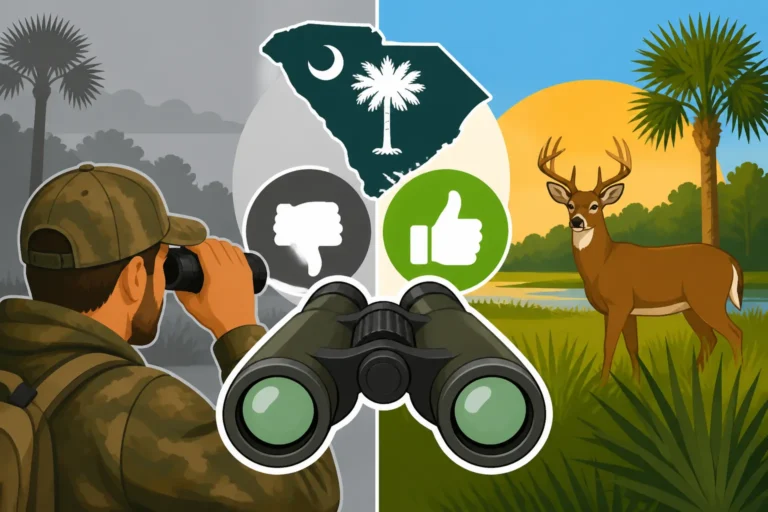
When you're out in the South Carolina woods, whether it's a steamy August archery opener or a crisp January rifle hunt, your binoculars are often your most used piece of gear. They're your eyes in the timber, helping you pick apart cover, scout distant fields, and identify game without raising your rifle. Choosing the right pair can make or break a hunt, so let's dive into what really matters.
Magnification and Objective Lens Size
This is often the first thing people look at, and for good reason. Binoculars are typically labeled with two numbers, like 8×42 or 10×50. The first number, '8x' or '10x', refers to the magnification – how many times closer an object appears. The second number, '42' or '50', is the diameter of the objective lens (the front lens) in millimeters. A larger objective lens gathers more light, which is incredibly important in the low-light conditions prevalent in South Carolina's swamps and deep woods. An 8x magnification offers a wider field of view, making it easier to scan dense cover and locate movement quickly, which is a huge advantage when Hunting a Funnel Between Two Swamps. It's less prone to hand shake, too, so your image stays steadier.
On the other hand, 10x binoculars bring distant objects closer, which can be beneficial when glassing open fields or clear-cuts where deer might be hundreds of yards away. The trade-off is a narrower field of view and a more exaggerated image shake. For most South Carolina hunting, particularly in the thick stuff, an 8×42 or 10×42 is often a sweet spot. The 42mm objective lens gathers plenty of light for dawn and dusk, while the magnification allows for effective scanning. If you find yourself consistently needing to identify antler points at extreme distances on open land, then a 10×50 might be worth the extra bulk and cost for that added light gathering and reach. We've talked before about 8×42 Versus 10×42 in the Woods, and for good reason – it's a crucial decision based on your primary hunting style and terrain.
Optical Quality and Coatings
Magnification and objective lens size tell you part of the story, but the true performance of a binocular comes down to its optical quality and the coatings applied to the lenses. This is where the rubber meets the road, especially when trying to pierce through the murky light of a swamp or pick out a camouflaged deer against a busy backdrop. High-quality binoculars use what's called Extra-low Dispersion (ED) glass, which significantly reduces chromatic aberration (color fringing) and delivers a sharper, clearer image with better color fidelity. This means you're seeing truer colors and finer details, which is crucial for identifying game in challenging light.
Lens coatings are equally important. Most decent binoculars will be "fully multi-coated," meaning all air-to-glass surfaces have multiple layers of anti-reflective coatings. These coatings maximize light transmission, preventing light from being reflected away and ensuring more light reaches your eye. In South Carolina's perpetually green and humid environments, this translates to brighter, higher-contrast images, making it easier to spot a deer's brown hide against the foliage. Without good coatings, even a binocular with a large objective lens can appear dim and washed out, leading to frustration and missed opportunities, especially during those critical low-light periods when deer are most active.
Durability and Weather Resistance
Let's be honest, hunting in South Carolina isn't a clean, dry affair. You're going to encounter heat, humidity, sudden downpours, and plenty of opportunities for your gear to take a tumble. That's why durability and weather resistance aren't just nice-to-haves; they're absolute necessities for any optics you carry into the field here. Binoculars need to be built like tanks, with robust housing and rubber armor that can withstand impacts and protect the delicate optics inside. The rubber armor also provides a secure grip, even when your hands are sweaty or wet.
More importantly, your binoculars must be waterproof and fog-proof. Most quality binoculars are sealed with O-rings and then purged and filled with an inert gas like nitrogen or argon. This process prevents moisture from entering the housing and causing internal fogging when you move from a warm, humid environment (like your truck cab) to the cooler, damp air of the swamp, or when the air temperature drops at dusk. Without this, your lenses will fog internally, rendering them useless exactly when you need them most. Don't skimp on this feature; trying to hunt with fogged lenses is a recipe for frustration and missed opportunities. You'll be glad for this protection when you're Recovering a Deer From a Lowcountry Swamp and your binoculars take an accidental dunk.
Rangefinders: Pinpointing Distances in Varied Terrain
Accuracy is everything in hunting, and guessing distances is a sure way to make a bad shot. That's where a good rangefinder comes in. In South Carolina's diverse terrain, from tight swamp bottoms to wide-open agriculture fields, a reliable rangefinder is just as crucial as your binoculars for making ethical and effective shots.
Line-of-Sight vs. Angle Compensation
Many entry-level rangefinders provide a simple line-of-sight (LOS) distance, which is fine on perfectly flat ground. However, South Carolina's terrain, while not mountainous, certainly isn't always flat. You might be shooting from a slight rise overlooking a creek bottom, or perhaps from a tree stand down into a gully. In these situations, the true ballistic distance to the target is shorter than the straight line-of-sight distance because gravity acts on the bullet over the horizontal distance, not the angled one. This is where angle compensation becomes absolutely vital.
A rangefinder with angle compensation will calculate the "shoots-like" distance, accounting for the incline or decline. This gives you a more accurate number to base your hold-over or scope adjustment on. If you're hunting in the Upstate, especially along the foothills or near creek banks, or even in the slightly rolling terrain of the Midlands, a rangefinder that can calculate angle compensation is a non-negotiable feature. For example, if you're 20 feet up in a stand and ranging a deer at 50 yards straight out, the line-of-sight might be 50 yards, but the "shoots-like" distance could be closer to 48 yards. That small difference, especially at longer ranges or with archery equipment, can mean the difference between a clean kill and a missed shot.
Ranging Capabilities and Reflectivity
The stated maximum range on a rangefinder's box can sometimes be a bit optimistic, especially when it comes to ranging game animals in real-world conditions. Most manufacturers list their maximum range based on a highly reflective target, like a building or a road sign. Ranging a deer in dense cover, however, is a very different beast. You need a rangefinder that can consistently and quickly pick up an animal at your maximum expected shooting distance, even if it's partially obscured by brush or standing in tall grass.
In South Carolina, where cover can be thick and humid air can sometimes affect laser performance, look for rangefinders known for their accuracy and consistent performance on non-reflective targets like deer and trees. Many high-quality rangefinders employ sophisticated algorithms to filter out interference and return a precise reading. When you're trying to get a quick read on a buck that just stepped out of a Reading South Carolina Mud for Fresh Deer Movement and is feeding along a powerline cut, you don't have time to re-range multiple times because the unit can't get a clear return. Fast acquisition time and reliable readings, even in less-than-ideal conditions, are paramount.
Integrated Systems and User Interface
While a standalone rangefinder is a perfectly viable option, some hunters opt for integrated systems, like rangefinding binoculars. These combine the functionality of binoculars and a rangefinder into one unit, streamlining your gear and reducing the amount of equipment you need to carry and manage. For hunters who value efficiency and want to quickly range an animal after spotting it, these can be a great investment. There's no fumbling between two different devices; you spot, you range, you're ready.
The user interface of your chosen rangefinder also plays a significant role in its effectiveness in the field. Is the display clear and easy to read in varying light conditions? Can you easily switch between modes (LOS vs. angle compensation) with gloved hands? A cluttered or complicated interface can be a real hindrance when a deer appears suddenly, and you need to get a fast, accurate reading. Simple, intuitive controls and a bright, uncluttered display are often preferred, especially when dealing with the adrenaline of a hunting situation. We often discuss Rangefinding Binoculars Worth the Cost, and for many, the convenience and speed of an integrated unit are indeed worth the investment.
Rifle Scopes for South Carolina's Ranges
Your rifle scope is the bridge between you and your target, and in South Carolina, that bridge needs to be versatile enough to span everything from thick swamp timber to wide-open agricultural fields. Selecting the right scope involves more than just picking a brand; it’s about matching the scope’s features to the specific hunting scenarios you’ll face.
Magnification Ranges for Swamp and Farmland
The range of magnification your rifle scope offers is perhaps the most critical factor for hunting diverse South Carolina landscapes. In the dense lowcountry swamps or heavy pine thickets, shots are almost always close – often under 75 yards, sometimes as close as 10 or 20. A scope with a low minimum magnification, like a 1-4x, 1-6x, or 2-7x, is ideal here. It gives you a wide field of view, making it easy to acquire a fast-moving target in tight cover and avoid the "magnification tunnel vision" that higher powers can induce. You're trying to get a clear, quick picture of the deer and its surroundings, not zoom in on a single hair.
Conversely, when you're hunting those sprawling Pee Dee farmlands or long powerline cuts, you might face shots out to 200 or 300 yards. For these situations, a scope with a higher maximum magnification, like a 3-9x, 3-12x, or even a 4-16x, becomes much more useful. This allows you to precisely place your shot on a deer that looks like a tiny speck in your field of view at a low power. The key is balance: a variable power scope that can go low enough for close-quarters engagement and high enough for those longer shots. A 3-9×40 is a classic choice for a reason, offering a great balance for most of South Carolina's mixed terrain. We've certainly gone deep into Rifle Scope Magnification for South Carolina Deer in the past, and it remains a key consideration for every hunter.
Reticle Choices and Illumination
The reticle is what you use to aim, and the design of that crosshair can significantly impact your effectiveness. A simple duplex reticle is classic and reliable for many situations, offering a clear aiming point. However, in South Carolina, where light conditions vary wildly and shots can range from brush-snapping close to across a field, more advanced reticles can offer distinct advantages. A Bullet Drop Compensating (BDC) reticle, for example, has hash marks or dots below the main crosshair, allowing you to hold over for longer shots without having to dial your turrets. This can be a real time-saver when a buck steps out quickly at an unexpected distance in a clearing after you've been working a Scrape Lines Along a Logging Road.
For low-light conditions, particularly those dawn and dusk hunts in the deep woods or during an overcast day in the swamp, an illuminated reticle can be a game-changer. Imagine trying to place a black crosshair on a dark-bodied deer against a shadowy background – it's incredibly difficult. An illuminated dot or center section of the reticle provides a clear, bright aiming point without obscuring your target. It allows you to make an ethical shot even when ambient light is extremely dim. Many hunters find these invaluable for extending their effective hunting time during those critical low-light periods. The discussion around Illuminated Reticles for Dark Timber is a testament to how crucial this feature can be in our South Carolina woods.
Exit Pupil and Light Transmission
Beyond magnification and reticle, a scope's ability to gather and transmit light is paramount, especially in South Carolina's dim environments. The "exit pupil" is the diameter of the light beam that leaves the eyepiece and enters your eye. You calculate it by dividing the objective lens diameter by the magnification (e.g., a 3-9×40 scope at 5x magnification has an exit pupil of 40/5 = 8mm). A larger exit pupil makes it easier to get behind the scope quickly and see a bright image, particularly in low light. This is why a 40mm or 50mm objective lens is so popular; it provides a good balance of light gathering without making the scope overly bulky.
However, the raw size of the objective lens only tells part of the story. The quality of the glass and the anti-reflective coatings applied to all internal lenses determine the scope's overall light transmission. High-quality, fully multi-coated optics can transmit 90% or more of the available light, resulting in a brighter, clearer, and higher-contrast image even when light is scarce. This is what truly separates a high-performance scope from a mediocre one when you're trying to make out details in the shadows of a Hunting a Funnel Between Two Swamps. Don't underestimate the importance of good glass and coatings, especially if you plan to hunt during those prime dawn and dusk hours. The conversation about Low-Light Performance in a Scope is always relevant when we talk about hunting conditions in South Carolina.
Specialty Optics for Specific South Carolina Scenarios
While binoculars, rangefinders, and rifle scopes cover the core needs for most South Carolina deer and turkey hunting, there are specialized optics that become incredibly valuable for other game species or unique situations. These tools can expand your hunting opportunities and significantly increase your success in specific scenarios.
Thermal and Night Vision for Hogs
Feral hogs are a year-round problem in South Carolina, causing immense damage to agricultural crops and wildlife habitat. For hunters looking to control hog populations, especially on private land, thermal and night vision optics are a game-changer. Unlike deer and turkey, hogs are often most active after dark, making traditional daylight hunting methods less effective. Thermal optics detect heat signatures, allowing you to see hogs clearly even in complete darkness, dense brush, or through fog. Imagine being able to pick out a group of hogs rooting in a cornfield from hundreds of yards away, even on a moonless night. This technology provides an unfair advantage against these destructive animals.
Night vision, on the other hand, amplifies ambient light (starlight, moonlight) to create a visible image. While not as effective in absolute darkness as thermal, modern digital night vision can be incredibly clear and useful. Both types of optics are perfectly legal for hunting hogs at night on private land in South Carolina, and they've revolutionized hog control efforts. The investment can be significant, but for serious hog hunters or landowners facing severe depredation, they pay for themselves quickly in meat harvested and crop damage prevented. We've dedicated entire discussions to Thermal Scopes Legal for South Carolina Hogs and Night Hunting Hogs With Lights on Private Land because of their effectiveness.
Red Dot Sights for Shotguns and Fast Action
While typically associated with tactical firearms, red dot sights have a significant place in South Carolina hunting, particularly for turkey hunting with shotguns or for quick-reaction hog hunting in thick cover. A red dot sight provides a simple, illuminated aiming point (a red dot or reticle) that is projected onto a lens. The beauty of a red dot is that it offers unlimited eye relief and a completely unobstructed field of view. You simply put the red dot on your target and pull the trigger. There's no front sight to align with a rear sight, no complex reticle to deal with.
For turkey hunting, especially with modern, dense turkey loads that demand precise head and neck shots, a red dot sight vastly improves accuracy compared to traditional bead sights. It allows for faster target acquisition and more precise aiming, which is critical when a gobbler is strutting at 40 yards. Similarly, for hog hunting in dense woods where shots are often up close and fast-paced, a red dot on a rifle or shotgun can be incredibly effective. It's about speed and simplicity, ensuring you can get on target and make an accurate shot quickly. If you're pondering Red Dots on a Turkey Shotgun, you're already thinking smart about maximizing your chances.
Protecting Your Optics in South Carolina's Climate
South Carolina's climate is notoriously hard on gear. The combination of high humidity, heat, sudden rain, and abrasive sand or mud means your valuable optics need constant protection and careful maintenance. Neglecting these aspects can lead to compromised performance, damage, or even outright failure when you need your optics most.
Humidity and Fogging Prevention
Humidity is the silent killer of optics, constantly threatening to fog lenses, both externally and internally. While quality optics are nitrogen-purged and O-ring sealed to prevent internal fogging, external fogging is still a persistent issue. Moving from a cool truck to the humid morning air, or even just your own body heat condensing on lenses, can cause them to fog over. This is incredibly frustrating when that trophy buck steps out. Carrying a lens cloth isn't enough; you need proactive strategies.
Keeping your optics clean helps, as dirt and oil can attract moisture. Using anti-fog wipes or treatments on external lens surfaces can provide temporary relief, but the best defense is often a good offense: keep your optics protected when not in immediate use. Lens caps should always be on when you're moving. Some hunters even keep their binoculars inside a small, sealed dry bag with a desiccant pack when not actively glassing, especially if leaving them in a vehicle overnight. Understanding Fogging Optics in South Carolina Humidity is key to preventing those frustrating moments in the field.
Cleaning and Maintenance in the Field
It's inevitable: your optics will get dirty. Whether it's mud flung from your ATV, sand from a coastal walk, or sweat and fingerprints, cleaning is a regular chore. However, improper cleaning can cause more harm than good, scratching delicate lens coatings. Always start by gently blowing off any loose dirt or dust. A small, soft lens brush or a can of compressed air works well. Never wipe a dirty lens with a shirt or anything abrasive; you'll embed those tiny particles and scratch the coatings.
Once loose debris is removed, use a specialized lens cleaning pen or a few drops of lens cleaning solution on a clean, soft microfiber cloth. Gently wipe the lenses in a circular motion from the center outwards. Avoid harsh chemicals. After a particularly wet or muddy hunt, it’s a good idea to wipe down the entire optic with a damp cloth to remove grit, then dry it thoroughly before storing. This regular, gentle maintenance will extend the life of your optics and ensure they perform at their best.
Carrying and Storage Solutions
How you carry and store your optics directly impacts their longevity and readiness for use. Slings, straps, and especially binocular harnesses are crucial for comfort and protection in the field. A good binocular harness keeps your binoculars secure against your chest, preventing them from swinging and banging against trees or your rifle, while also distributing their weight comfortably. This also means they're always ready for quick access without fumbling. When you're constantly scanning the horizon or picking apart dense cover, that quick, easy access without wear and tear is invaluable. We often share advice on Binocular Harnesses Worth Wearing because they are truly a game-changer.
When not in use, proper storage is just as important. Never leave your optics exposed to extreme temperatures in a vehicle for extended periods; heat can damage internal components and seals. Store them in a clean, dry, climate-controlled environment, ideally in a padded case or bag. Make sure they are completely dry before putting them away to prevent mildew or corrosion. A small, breathable storage bag will protect them from dust while allowing any residual moisture to evaporate. Investing in good carrying and storage solutions is a small price to pay to protect your significant investment in quality optics.
Making Your Optics Investment Count with GoHunt
Choosing the right optics for South Carolina hunting is a significant decision and often a substantial investment. It’s not just about buying the most expensive gear; it’s about making informed choices that align with your specific hunting style and the unique environments you'll encounter. Utilizing resources and a thoughtful approach can ensure your investment pays off in the field.
Researching and Comparing Options
With so many brands and models on the market, it's easy to feel overwhelmed. This is where dedicated research and comparison become invaluable. Start by identifying your primary hunting scenarios in South Carolina: are you mostly in thick coastal swamps, wide-open farmlands, or mixed timber? This will help narrow down the crucial features you need. For example, if you're primarily in swamps, prioritize superior low-light performance and rugged waterproofing. If you're glassing distant fields, focus on clarity at high magnification and ranging capability.
Online resources, hunting forums, and detailed reviews are excellent starting points. Pay close attention to what other hunters are saying about how optics perform in similar conditions to what you'll find in South Carolina. Websites like GoHunt, for instance, often provide detailed specifications and user reviews that can help you compare different models side-by-side, evaluating everything from optical quality to ergonomics and durability. Don't be afraid to read both positive and negative feedback to get a balanced view of a product's real-world performance.
Understanding Warranty and Customer Service
High-quality optics are built to last, but accidents happen, and sometimes, manufacturing defects occur. A robust warranty and excellent customer service can provide immense peace of mind. Before making a purchase, thoroughly research the manufacturer's warranty policy. Do they offer a lifetime warranty? Does it cover accidental damage, or just manufacturing defects? What is their reputation for handling repairs or replacements? This due diligence is critical, especially for premium optics.
A company that stands behind its products with a comprehensive warranty and a responsive customer service team demonstrates confidence in its quality. Imagine dropping your expensive binoculars while traversing a muddy creek bed; knowing that the manufacturer will repair or replace them without excessive hassle makes the initial investment much less daunting. It's not just about what you buy; it's about the support you can expect if something goes wrong down the line.
Field Testing Before the Season
Once you've made your selection and acquired your new optics, don't wait until opening day to use them. The absolute best way to make your investment count is to spend time field testing them in conditions similar to what you'll experience during hunting season. Take your new binoculars on scouting trips to your Scouting South Carolina Public Land Before Season spots, practice ranging various distances in different light conditions, and zero your rifle scope thoroughly at the range. Don't just zero at 100 yards; practice shooting at 50, 150, and 200 yards if those are realistic hunting distances for you.
Practice using your rangefinder quickly and efficiently, noting how fast it acquires targets and how it performs in different types of cover. Familiarize yourself with all the features of your rifle scope, from adjusting magnification to using any illuminated reticles or BDC hash marks. The more comfortable and proficient you are with your optics before the season starts, the more confident you'll be when that moment of truth arrives. Websites like GoHunt often have maps and planning tools that can help you identify realistic scenarios for practicing your ranging and glassing, turning theoretical knowledge into practical skills for the South Carolina woods.
Binocular Comparison for South Carolina Hunters
Choosing between an 8×42 and a 10×42 binocular is a common dilemma for South Carolina hunters. Here's a quick comparison to help you decide based on our typical hunting environments:
| Feature | 8×42 Binocular | 10×42 Binocular |
|---|---|---|
| Magnification | 8 times | 10 times |
| Field of View | Wider, easier to scan dense cover and locate game. | Narrower, can make scanning thick woods challenging. |
| Light Gathering | Excellent for low light (larger exit pupil). | Very good for low light, slightly less than 8×42. |
| Image Stability | More stable image, less susceptible to hand shake. | Less stable, hand shake more noticeable. |
| Eye Relief | Often more generous, comfortable for eyeglass wearers. | Can be slightly less, may require more precise positioning. |
| Close Focus | Often allows for closer minimum focus distance. | Typically a slightly longer minimum focus distance. |
| Best For | Thick cover, swamps, early archery, fast-moving game. | Open fields, powerline cuts, longer distance glassing. |
| Typical SC Use | General purpose, excellent in most scenarios, especially close-quarters. | Better for extended glassing over open land, less effective in dense timber. |
Disclaimer
This article is for general informational purposes only and does not constitute professional advice. Laws, prices and regulations vary by location and change over time. Consult a qualified professional for guidance on your specific situation.