Illuminated Reticles for Dark Timber
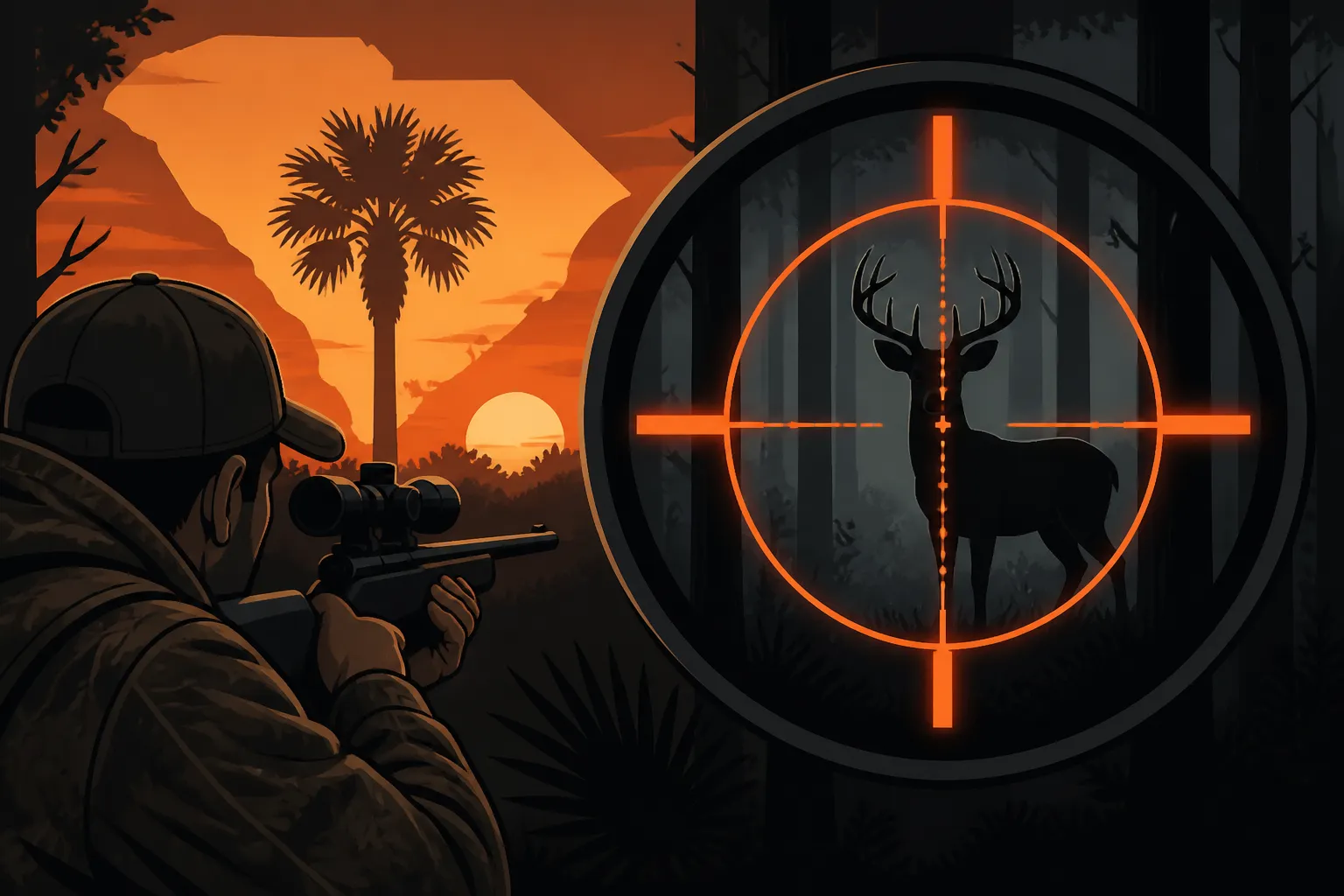
There’s nothing quite as frustrating as being in a stand during those prime low-light hours – dawn or dusk – in a dense South Carolina timber stand, spotting a deer, and then losing your reticle against the dark background. That shadowy moment where your crosshairs just vanish into a deer's shoulder or a thick pine trunk can cost you a shot and leave you wondering if your gear is truly up to the task. This guide will walk you through the world of illuminated reticles and how they can be a game-changer for hunting in the dark, dense timber and swamp bottoms that are so common across our beautiful state.
The Challenge of Dark Timber in South Carolina
Hunting in South Carolina often means dealing with seriously dense, dark timber, whether you're deep in the Francis Marion National Forest or tucked into a creek bottom in the Upstate. These areas, while prime spots for deer, can be incredibly challenging for optical visibility, especially during the critical periods of first light and last light.
Low-Light Conditions and Visibility Issues
Think about those mornings when you're settling into your stand before the sun even hints at rising. The world is a canvas of grays and blacks. The deer move through the shadows, often camouflaged by the deep woods. Your unilluminated black reticle, which works perfectly fine in bright daylight, suddenly disappears. It might blend into a dark tree trunk, a shadowed patch of brush, or even the dark hide of a deer itself. This isn't just an inconvenience; it can lead to missed opportunities, poor shot placement, or even a complete inability to make an ethical shot. You might be staring at a beautiful buck, but if you can't clearly see your aiming point, you can't take the shot. Hunters often experience this frustration when hunting a funnel between two swamps or trying to pick out a deer moving along the edge of a deep Hunting Pee Dee River Bottoms. The natural canopy, especially in older growth timber, creates a perpetual twilight effect, even midday.
South Carolina's Diverse and Dense Hunting Environments
South Carolina offers a vast array of hunting environments, many of which inherently create low-light challenges. From the thick, almost impenetrable coastal swamp timbers and pine plantations of the Lowcountry to the dense hardwood ridges and deep hollers of the Upstate, darkness is a constant companion during legal hunting hours. Imagine trying to thread a bullet through a tight opening in a thick patch of river cane on the edge of a tidal creek, or picking out a hog rooting in the deep shadows of a Francis Marion National Forest Hunting bottomland at dusk. These aren't open fields where a simple black crosshair stands out. These are environments where every advantage in visibility counts. Even a slight increase in clarity can make the difference between a successful hunt and going home empty-handed. Optics for South Carolina Swamp and Farmland need to be carefully chosen to handle these conditions.
How Illuminated Reticles Solve Low-Light Problems
Illuminated reticles aren't just a fancy feature; they're a practical solution to a very real problem faced by hunters in challenging light conditions. They essentially make your aiming point stand out, regardless of how dark your target or background may be.
Enhanced Reticle Visibility Against Dark Backgrounds
The primary benefit of an illuminated reticle is its ability to provide a bright, clear aiming point that contrasts sharply with any background, no matter how dark. Instead of a black crosshair getting lost in the shadows, you get a glowing dot or crosshair that you can quickly acquire and precisely place. This is especially crucial when a deer presents itself in dense cover just as legal shooting light is fading. You might have enough light to see the deer, but not enough to distinguish your reticle. With illumination, that problem vanishes. You can focus on the target, place the dot, and make an accurate shot. This capability directly impacts your confidence in taking an ethical shot, ensuring you're only pulling the trigger when you have a clear, precise aiming point. For example, when hunting Low-Light Performance in a Scope is paramount.
Faster Target Acquisition and Shot Placement
In hunting, sometimes a matter of seconds can determine success or failure. A deer might step out of cover for a fleeting moment, or angle into a small shooting lane. Fumbling to find your reticle wastes precious time. An illuminated reticle dramatically speeds up target acquisition. Your eye is naturally drawn to the glowing dot or crosshair, allowing you to get on target faster and make quicker, more decisive shots. This is invaluable when a deer is on the move or when you're hunting in thick spots where shot windows are narrow and brief. The ability to instantly identify your aiming point and confirm its placement means less hesitation and a more confident trigger squeeze. Many hunters find this feature indispensable for those quick, close-range shots that often occur in the dense, tangled undergrowth common in South Carolina's river bottoms or Hunting the ACE Basin for Deer where quick reactions are often needed. GoHunt's optics reviews often highlight scopes with excellent illumination for these very reasons.
Improved Accuracy in Challenging Conditions
Beyond just seeing your reticle, an illuminated reticle can actually improve your accuracy in challenging light. When you can clearly see your reticle, you reduce eye strain and the subconscious effort your brain makes to "find" the crosshairs. This allows you to focus more intently on the target and your breathing, leading to a steadier aim. This is particularly beneficial for longer shots, even within dense timber, where precise reticle placement is non-negotiable. Furthermore, many illuminated reticles offer multiple brightness settings, allowing you to fine-tune the intensity to match the ambient light perfectly, preventing washout in brighter moments or being too dim in the deepest shadows. This adaptability ensures optimal visibility no matter the exact lighting conditions you encounter throughout your hunt.
Types of Illuminated Reticles and Their Features
Not all illuminated reticles are created equal. They come with different illumination styles, color options, and power sources, each with its own set of advantages and considerations for the South Carolina hunter.
Reticle Illumination Styles
Illuminated reticles typically come in a few main styles:
- Dot Illumination: This is perhaps the most common, where only a small central dot within the crosshairs illuminates. It's incredibly fast for target acquisition and doesn't obscure much of the target. It's excellent for close to medium range shots in dark timber.
- Partial Reticle Illumination: In this style, a portion of the crosshairs, such as the central intersection and a short section of each post, illuminates. This gives you a more substantial aiming point than just a dot, which some hunters prefer for a clearer sight picture.
- Full Reticle Illumination: Here, the entire reticle, including all crosshairs and sometimes even ballistic holdovers, glows. While this provides the maximum amount of visible aiming structure, some hunters find it can be too "busy" or distracting, especially if the brightness isn't perfectly dialed in.
Each style has its proponents, and the best choice often comes down to personal preference and the typical range of your shots. For example, in the often-tight quarters of South Carolina's thick woods, a simple illuminated dot or partial reticle can be extremely effective for quick acquisition.
Color Options and Brightness Settings
Most illuminated reticles offer either red or green illumination, and sometimes both.
- Red Illumination: This is the traditional choice and is generally less harsh on your night vision, making it ideal for very low-light situations without causing your pupils to constrict too much.
- Green Illumination: Some hunters find green to be more visible in certain conditions, especially against dark foliage or brown animal hides. It can also appear brighter to the human eye in some instances.
Many modern scopes provide a wide range of brightness settings, often with 10 or more steps, allowing you to precisely adjust the illumination to match the ambient light. The ability to dial down to a very subtle glow for true dark conditions, or crank it up for a gloomy, overcast day, is a critical feature. Having too bright an illumination can create glare and eye fatigue, while too dim an illumination defeats the purpose. A good scope will have an "off" position between each brightness setting, preventing you from having to cycle through all settings to turn it off or on again. Many hunting optics available through GoHunt feature these detailed brightness controls.
Power Sources and Battery Life
The vast majority of illuminated reticles are powered by small lithium coin-cell batteries (like CR2032 or CR2030). Battery life can vary significantly depending on the scope, the brightness setting used, and how frequently the illumination is engaged. Some scopes boast hundreds of hours of battery life, while others may be less.
Here are some considerations regarding power:
- Automatic Shut-Off: Many high-quality scopes include an automatic shut-off feature, which powers down the illumination after a period of inactivity (e.g., 2 hours) to conserve battery life. This is a fantastic feature for forgetful hunters.
- Battery Indicators: Some advanced optics will even have a low-battery indicator, giving you a heads-up before it dies.
- Spare Batteries: Regardless of features, always carry spare batteries! Nothing ruins a hunt faster than a dead battery when you need it most. Store them in a waterproof container in your pack.
- Daylight Brightness: Some reticles are designed to be "daylight bright," meaning they are visible and useful even in direct sunlight. While primarily beneficial for tactical applications, it can be useful on bright, sunny days when hunting shadowed areas.
Understanding these features will help you pick an illuminated reticle that truly serves your needs in the diverse South Carolina hunting landscape.
Choosing and Using Your Illuminated Reticle Effectively
Selecting the right illuminated reticle and knowing how to use it properly can significantly enhance your hunting success, particularly when pursuing deer in South Carolina's challenging dark timber. It's not just about having the feature, but mastering its application.
Matching Reticle to Hunting Style and Environment
When choosing a scope with an illuminated reticle, consider your primary hunting style and the specific environments you frequent.
- Dense Lowcountry Swamps: If you're often Hunting a Funnel Between Two Swamps or deep in the cypress knees, a simple illuminated dot or a partial reticle with minimal clutter might be best. Shots tend to be closer, and quick target acquisition through thick cover is paramount. You'll want a reticle that doesn't obscure too much of your target.
- Upstate Hardwoods and Ridges: For hunting Grunt Calls in Mature South Carolina Timber or picking out deer along shaded ridge lines, a slightly more complex illuminated reticle with subtensions for holdovers might be beneficial if longer shots are possible. However, the core principle of clarity in low light remains.
- Field Edges and Clear-Cuts: While less "dark timber," even a Hunting a Clear-Cut Regrowth Edge can have shaded transition zones where deer appear at dawn or dusk. Here, a reticle that offers good low-light performance but also doesn't wash out in brighter field conditions is ideal. This is where multiple brightness settings truly shine.
Think about how you typically aim. Do you prefer a fine crosshair for precision, or a bolder one for speed? Your illuminated reticle should complement that preference. GoHunt offers extensive comparison tools for different scope models, which can be invaluable for making this decision.
Practical Tips for Field Use
Having an illuminated reticle is one thing; using it effectively is another. Here are some tips to maximize its benefits:
- Pre-Set Brightness: Before you head out, especially if you anticipate hunting at dawn or dusk, set your reticle to a brightness level that you know works well for those conditions. You don't want to be fumbling with controls when a deer steps out.
- Test in Varying Light: Practice with your scope in different low-light scenarios, not just on the range. Walk into a shadowed wood line an hour before dark and see how your reticle performs. Adjust the brightness to find the sweet spot where it's visible without being overly distracting or causing glare.
- Battery Management: Always carry spare batteries. Make it a habit to check your battery before a hunt, especially for longer trips. Some hunters cycle batteries out every season, regardless of use, just for peace of mind.
- Clean Optics: An illuminated reticle can't compensate for dirty or foggy lenses. Keep your scope lenses clean with appropriate cleaning tools, especially in South Carolina's often humid environment. Rifle Scopes for Low-Light Swamp Edges are particularly susceptible to fogging.
- Don't Over-Rely: While beneficial, don't become solely dependent on the illumination. Always strive for good shot placement fundamentals. The illumination is an aid, not a crutch. If your battery dies, you should still be able to make an ethical shot with the unilluminated reticle if light permits.
Considerations for South Carolina Specifics
South Carolina's climate and terrain present some unique challenges that an illuminated reticle can help address, but it also brings specific considerations.
- Humidity and Fogging: The high humidity, especially in the Lowcountry, can lead to lens fogging. While an illuminated reticle helps with visibility of the reticle, it won't clear a foggy lens. Invest in quality optics with good anti-fog coatings, and consider anti-fog wipes.
- Warm Weather Battery Drain: Batteries can sometimes be affected by extreme heat or cold, though modern lithium batteries are quite resilient. Be aware of leaving your rifle exposed to direct, scorching sun for extended periods.
- Targeting Hogs at Night (where legal): While primarily for deer in legal light, illuminated reticles are also immensely useful for night hunting feral hogs on private land where legal with lights or thermal devices. The bright reticle ensures you can aim precisely even on pitch-black nights.
- Matching with Caliber: While an illuminated reticle doesn't change your caliber choice, knowing you can acquire a target quickly and clearly in dark timber might influence your confidence in your chosen cartridge, whether it's a versatile .308 or a classic .30-30. Choosing a Rifle Caliber for South Carolina Deer is still paramount. Sometimes, having that confidence in a shot at a critical moment is key, especially if deer patterns change due to something like Hunting After a Poor Acorn Year, forcing them into denser, darker areas for alternative food sources.
Illuminated reticles truly are a fantastic tool for the South Carolina hunter, giving you an undeniable edge in those challenging low-light conditions. They help turn potential missed opportunities into successful harvests by keeping your aiming point clear and visible when it matters most.
| Reticle Illumination Type | Advantages | Disadvantages | Best For |
|---|---|---|---|
| Central Dot Illumination | Fast acquisition, minimal target obscuring | Can be too small for some eyes, less structure | Quick shots in thick cover, close-to-medium range |
| Partial Reticle Illumination | Good balance of speed and precision | Can still feel a bit "busy" to some | Versatile hunting in mixed cover, medium range |
| Full Reticle Illumination | Maximum visibility, clear holdovers | Can be distracting, potential for washout | Long-range precision, open country (with careful use) |
| Red Illumination | Less harsh on night vision, traditional | Can be less visible against red/brown targets | Very low-light conditions, maintaining night adaptation |
| Green Illumination | Often perceived as brighter, stands out | Can be harsher on night vision, less common | Daytime low-light, against green foliage, some find it clearer |
Disclaimer
This article is for general informational purposes only and does not constitute professional advice. Laws, prices and regulations vary by location and change over time. Consult a qualified professional for guidance on your specific situation.