Thermal Scopes Legal for South Carolina Hogs
The relentless challenge of feral hogs in South Carolina is something every landowner and hunter here knows all too well. These intelligent, destructive animals cause millions of dollars in agricultural damage annually, tearing up fields, polluting waterways, and competing with native wildlife for food. It's a battle that often feels uphill, especially when they go entirely nocturnal, making them incredibly difficult to locate and manage with traditional methods. That's why many hunters are turning to advanced tools, and this guide is going to walk you through the exciting world of thermal scopes for hog hunting in the Palmetto State, covering what's legal and how to make the most of this game-changing technology.
Understanding South Carolina's Hog Hunting Regulations
Before we dive into the specifics of thermal optics, it’s crucial to grasp the unique regulatory landscape surrounding feral hogs in South Carolina. Unlike deer, turkey, or even squirrels, hogs are not considered a game animal in the traditional sense. They are an invasive species, and the state's approach reflects a strong desire for control and eradication rather than population management through regulated harvests. This distinction is vital when considering what tools and tactics you can legally employ.
Why Hogs Are Different in South Carolina
Feral hogs are a true ecological and economic menace here. They reproduce at an alarming rate, often having multiple litters a year with large numbers of piglets, and they have no natural predators that can keep their populations in check. From rooting up valuable crops in the Lowcountry to destroying sensitive forest ecosystems in the Upstate, their impact is widespread and severe. This understanding is why the South Carolina Department of Natural Resources (SCDNR) has implemented very liberal regulations for hunting them.
Because of their status as an invasive pest, there are no closed seasons, no bag limits, and generally no weapon restrictions for feral hogs on private land in South Carolina. You can hunt them year-round, any time of day or night, and with pretty much any legal firearm you choose. This stands in stark contrast to the strict seasons, limits, and daylight-only rules for species like deer or turkey. It's a testament to the urgency of managing these destructive animals. For a deeper dive into these regulations, check out South Carolina Feral Hog Regulations.
General Rules for Night Hunting
One of the biggest frustrations for hunters dealing with feral hogs is their tendency to become almost exclusively nocturnal, especially in areas with significant human pressure. They learn to avoid daylight activity, emerging from dense cover only under the cloak of darkness to feed in fields or travel along secluded creek bottoms. Trying to intercept them with traditional methods during legal daylight hours can feel like a losing battle.
Thankfully, South Carolina's regulations are quite accommodating for night hunting feral hogs on private land. This is where advanced optics really shine. You are generally permitted to hunt hogs at night on property you own or have permission to hunt. This often includes using artificial lights, which is a tactic many hunters employ successfully to spot and shoot hogs after dark. However, it's absolutely critical to understand that these liberal rules primarily apply to private land. Public lands, such as Wildlife Management Areas (WMAs) or National Forests, usually have much stricter rules, often prohibiting night hunting entirely, or at least requiring specific permits and limited methods. Always verify the rules for the specific tract of land you intend to hunt. For more on night hunting with lights, see Night Hunting Hogs With Lights on Private Land.
The Legality of Thermal and Night Vision for Hogs
Now for the exciting part for many hunters: the use of thermal and night vision equipment. Given the hogs' nocturnal habits and the state's aggressive management stance, South Carolina has embraced technology as a legitimate tool in the fight against these pests.
South Carolina's Stance on Advanced Optics
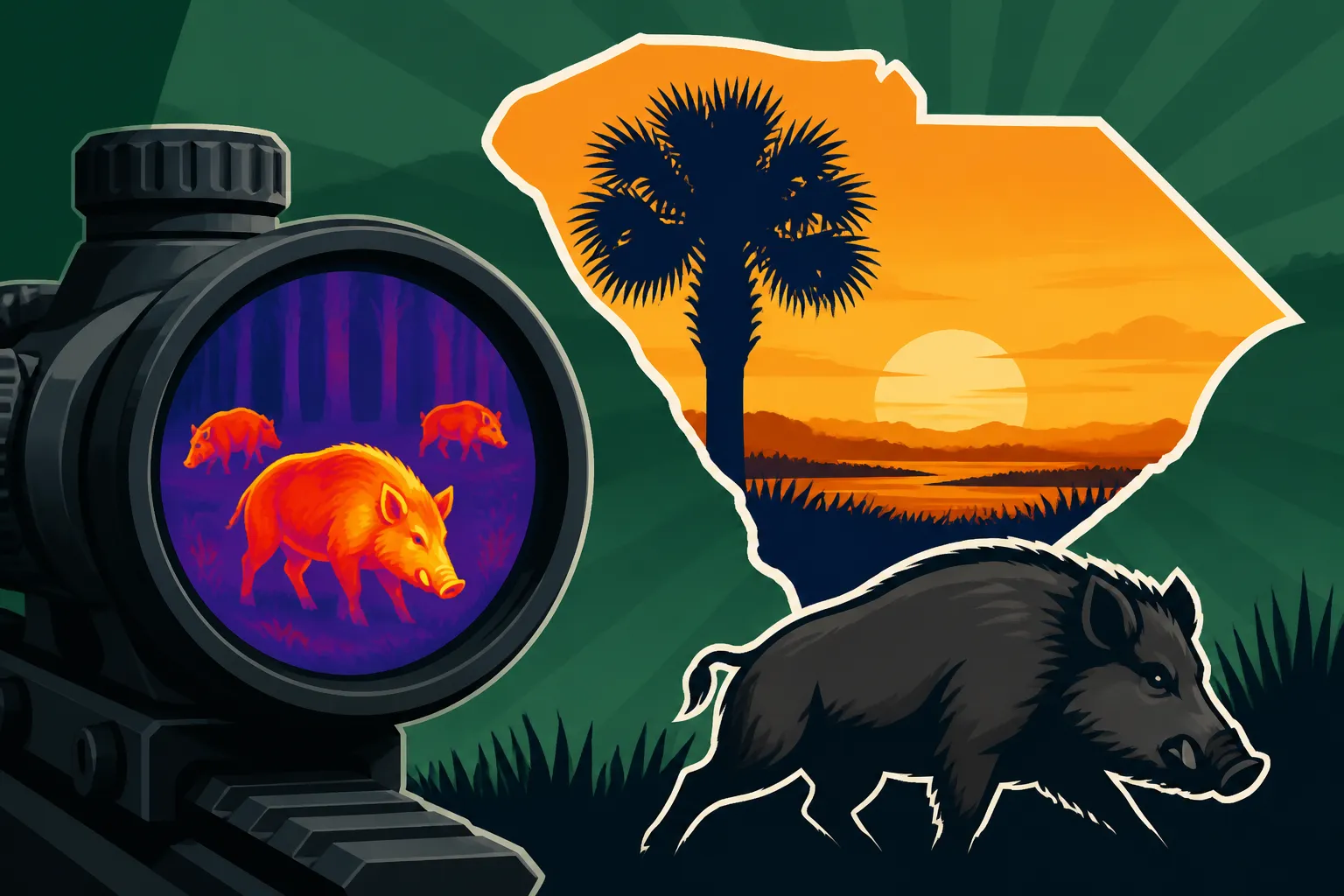
Yes, you read that right. In South Carolina, you can legally use thermal imaging and night vision devices for hunting feral hogs on private property. This is a huge advantage for hunters and landowners alike, allowing you to effectively target these elusive animals during the hours they are most active. Thermal scopes detect heat signatures, meaning a hog hiding in dense brush, or moving silently across a field in pitch black, will stand out like a beacon. Night vision, on the other hand, amplifies ambient light, giving you visibility in low-light conditions. Both technologies offer a significant edge.
The reasoning behind this permissiveness is simple: it’s about control. The state views feral hogs as a severe problem, and any legal, effective means to reduce their numbers is encouraged. This flexibility with advanced optics for hogs is a stark contrast to how these devices are typically treated for other game animals, where they are almost universally prohibited due to fair chase considerations and the advantage they provide over the animal. With hogs, the playing field is deliberately tilted in the hunter’s favor to facilitate their removal. So, if you've been hesitant to invest in thermal or night vision gear because you weren't sure it was legal, rest assured, for private land hog hunting in South Carolina, it is.
Public Land Nuances and Exceptions
While private land offers broad allowances for thermal and night vision hog hunting, the rules change dramatically when you step onto public ground. Wildlife Management Areas (WMAs), National Forests (like Francis Marion or Sumter), and other public hunting areas typically operate under a different set of regulations that are much more restrictive. Generally, night hunting, and by extension, the use of thermal or night vision optics, are prohibited on most public lands in South Carolina.
The logic here often revolves around safety, preventing conflict with other users, and maintaining specific hunting traditions for regulated game species. A hunter using thermal at night on a WMA could pose a safety risk to other hunters or hikers who might be present, even if unknowingly. Furthermore, public land regulations are often designed to simplify enforcement and prevent the accidental or intentional taking of non-target species using methods that are typically illegal. Therefore, if your plan involves hunting hogs on public land, you absolutely must consult the specific regulations for that WMA or National Forest. These details are usually available through the SCDNR website, or can be looked up conveniently using tools like the Go Outdoors SC app. Never assume that the private land rules extend to public land; it’s a recipe for a citation. For more on specific public land opportunities, check out South Carolina Wildlife Management Areas.
Practical Application of Thermal Scopes for Hog Control
Now that we know thermal scopes are a legal and powerful tool for private land hog hunting in South Carolina, let’s talk about how to effectively put them to use. This isn't just about pointing and shooting in the dark; it's about strategic hunting that leverages the unique capabilities of thermal technology.
Advantages of Thermal for Hog Hunting
The benefits of thermal imaging in the pursuit of feral hogs are truly transformative. First and foremost, thermal scopes allow for detection of hogs in conditions where traditional optics or even night vision would be useless. Think about a dense pine thicket or a kudzu-choked creek bottom – places where hogs love to bed down. With thermal, you can often pick out the heat signature of an animal in cover that’s impenetrable to the naked eye, even during the day. This is a game-changer for locating those elusive sounders.
At night, the advantage is even more pronounced. Hogs moving silently through a harvested cornfield or along a dark wood line become obvious thermal targets. This capability not only helps you find them, but it also aids in positive identification, reducing the chance of mistakenly targeting another animal. Furthermore, if you make a shot and a hog runs, a thermal optic can greatly assist in tracking. A wounded animal's heat signature will often remain visible in the brush or tall grass, making recovery much more efficient and ethical. It’s also incredibly helpful for ensuring clean shots by clearly outlining the animal's form, even in low light. For more on year-round hog hunting, read Hunting South Carolina's Year-Round Feral Hogs.
Setting Up for a Successful Thermal Hog Hunt
Effective thermal hog hunting isn't just about the gear; it's about strategy and preparation. Start with diligent scouting, just as you would for deer. Look for fresh rooting, tracks, scat, and rubbed trees. Hogs are creatures of habit, often using the same travel corridors between bedding areas and food sources. Areas bordering agricultural fields – corn, soybeans, peanuts – are prime spots, as are creek bottoms and swamp edges where cover is dense and water is plentiful. Platforms like GoHunt can be invaluable for analyzing aerial photos and identifying potential travel routes and bedding areas before you even step foot on the property.
Once you’ve identified a promising area, consider your setup. A stable shooting platform is crucial for accuracy at night. This could be a sturdy tripod, a blind positioned to overlook a known feeding area, or even a vehicle if hunting from within a designated area on private land. Many hunters also choose to use suppressors with their firearms for hog hunting. Not only do suppressors reduce the report, making the hunt more comfortable for you and less disruptive to neighbors, but they can also prevent other hogs in a sounder from scattering immediately, sometimes allowing for multiple shots. Always ensure your firearm and suppressor are legally owned and registered. For more insights into setting up on specific terrain, consider Reading a Tidal Creek for Deer Movement which can also apply to hog travel patterns.
Choosing and Using Your Thermal Scope
Investing in a thermal scope is a significant decision, and understanding the features and best practices will ensure you get the most out of your purchase for South Carolina hog hunting.
Key Features to Look For
When you're looking at thermal scopes, there are a few key specifications that will directly impact your experience in the field. Resolution is paramount; a higher resolution (e.g., 640×480 vs. 320×240) means a clearer, more detailed image, which is crucial for positive identification and precise shot placement. The refresh rate (measured in Hz) dictates how smooth the image appears; 60Hz is ideal for tracking moving animals without lag. Detection range is also important, but don't confuse it with identification range. You might detect a heat signature at a long distance, but you need to be able to clearly identify it as a hog before taking a shot.
Battery life is another practical consideration, as you'll be relying on this device during extended night hunts. Look for units with good battery endurance or options for external power packs. Other useful features include built-in recording capabilities (to review your shots or share your experiences) and various reticle options to suit your preference. Durability and waterproofing are also non-negotiable for the humid, often wet conditions we face in South Carolina. Think about what will truly make a difference when you're glassing a dark field or a thick patch of woods. Platforms like GoHunt often have detailed reviews and comparison tools for different thermal optics, which can be helpful in narrowing down your choices.
Ethical Considerations and Best Practices
While thermal scopes provide an incredible advantage, they don't negate the need for ethical hunting practices. The ability to see in the dark doesn't mean you should take reckless shots. Always strive for positive identification of your target. Hogs can sometimes be confused with other animals, especially at longer ranges or lower resolutions. Take your time, get a clear view, and confirm it's a hog before you put your finger on the trigger.
Responsible shot placement remains crucial. Just because you can see the animal doesn't mean you should take a low-percentage shot. Aim for vital areas to ensure a quick, humane kill. This is particularly important for feral hogs, which are notoriously tough animals. After the shot, be diligent in recovery. Even with thermal, a hog can run a surprising distance. Use your scope to scan the area where the animal ran, looking for heat trails or the animal itself. Remember that respecting property boundaries is still absolutely vital, especially at night. Ensure you know where your shots are going and where the property lines lie. Tools like GoHunt can help you verify property lines on your phone, providing an extra layer of confidence. Finally, proper disposal of the carcass is an important step in preventing disease spread and maintaining a good reputation for hunters.
| Feature / Optic Type | Thermal Scope (for Hogs) | Traditional Rifle Scope | Night Vision Scope (for Hogs) |
|---|---|---|---|
| Detection Method | Heat signature (emitted) | Visible light (reflected) | Ambient light (amplified) |
| Use at Night | Excellent, even in total dark | Poor, requires external light | Good, needs some ambient light |
| Through Fog/Smoke | Excellent | Poor | Poor |
| Through Light Cover | Good | Poor | Poor |
| Identification | Good at range, better up close | Excellent in daylight | Good at range, better up close |
| Battery Dependency | High | None (for basic scope) | High |
| Cost | High | Moderate | High |
| Legal for Hogs (SC Private Land) | Yes | Yes | Yes |
| Legal for Hogs (SC Public Land) | Generally No | Yes (daylight) | Generally No |
Disclaimer
This article is for general informational purposes only and does not constitute professional advice. Laws, prices and regulations vary by location and change over time. Consult a qualified professional for guidance on your specific situation.