Rifle Scope Magnification for South Carolina Deer
Choosing the right rifle scope magnification for deer hunting in South Carolina can feel like a real puzzle. You're trying to balance the need to see clearly at distance with the reality of thick cover and quick, close-range shots. Many hunters struggle with whether to go for more power "just in case" or stick with lower magnification for faster target acquisition, and it's a valid concern given our state's incredibly varied hunting landscapes. This guide will walk you through the nuances of scope magnification, helping you understand what numbers truly mean and how to select the ideal setup for your specific South Carolina hunting adventures.
Understanding Rifle Scope Magnification for South Carolina Deer Hunting
When you look at a rifle scope, you'll see numbers like 3-9×40 or 4-12×50. These numbers tell you a lot about what that scope is designed to do, but understanding their real-world application in the diverse hunting conditions of South Carolina is key. It’s not just about how big you can make the deer appear; it's about speed, light gathering, and overall practicality in the field.
What Magnification Numbers Really Mean
Let's break down those numbers. A scope labeled "3-9×40" means it's a variable power scope, allowing you to adjust the magnification from 3 times (3x) to 9 times (9x) your naked eye view. The "40" refers to the diameter of the objective lens in millimeters. This objective lens is the big lens at the front of the scope, facing your target. The larger the objective lens, generally the more light it can gather, which is crucial during those low-light periods at dawn and dusk when deer are most active.
So, if you set your scope to 3x, the deer will appear three times closer than it would with your naked eye. At 9x, it appears nine times closer. Fixed power scopes, like a 4x or 6x, offer only one magnification setting. While simpler and often more rugged, they lack the versatility that many South Carolina hunters appreciate, especially when moving between different types of cover. For example, a crisp 4x scope might be fantastic for tight timber shots, but you might find yourself wishing for a bit more reach if a buck steps out into a small food plot 150 yards away.
The Trade-Offs of Power in the Palmetto State
It's tempting to think that more magnification is always better, but that's simply not true in most South Carolina hunting scenarios. Higher magnification comes with several trade-offs that can significantly impact your hunt. For starters, as you crank up the power, your field of view — how much area you can see through the scope — shrinks dramatically. In thick woods or a fast-breaking situation, a narrow field of view means it’s harder to find your target, especially if that deer is on the move. Imagine a big buck slipping through a palmetto thicket; at 9x, you might only see a patch of brown, while at 3x, you could track its movement and pick out a clear shot lane.
Another consideration is stability. The higher the magnification, the more exaggerated any slight movement or wobble becomes. If you're shooting off-hand or from an improvised rest, a 12x or 14x setting can make your reticle dance around like crazy, making precise shot placement incredibly difficult. Lower magnifications are much more forgiving, allowing for a steadier sight picture and quicker shots in situations where a deer might only offer you a brief window. You might feel like you're missing out on spotting antler points at long range with a lower power, but ultimately, hitting what you aim at is paramount. This balance is something many seasoned hunters dial in over years, often realizing that less can indeed be more when it comes to practical field performance.
Choosing the Right Magnification for South Carolina's Diverse Terrain
South Carolina's hunting landscapes are incredibly varied, ranging from dense coastal swamps to rolling upstate ridges. What works perfectly for one area might be a hindrance in another. Understanding these differences and matching your scope magnification to the typical conditions you hunt in is a crucial step towards consistent success.
Swamp Bottoms and Thick Coastal Plain Cover
If you spend your deer season slogging through the thick, mosquito-ridden swamp bottoms of the Lowcountry or navigating the dense pine and hardwood stands of the Coastal Plain, high magnification is often your enemy. Shots in these areas are typically up close and personal, often within 50 to 75 yards, and sometimes as close as 10-20 yards. The vegetation is so thick that you're rarely going to have a clear line of sight beyond that.
For these environments, a scope with a low bottom end is invaluable. Think a 1-4x, 1.5-5x, or even a 2-7x. The 1x or 1.5x setting gives you an almost true-to-life view, allowing for incredibly fast target acquisition, much like a red dot sight but with just enough magnification to confidently identify your target and place a shot. This wide field of view is a game-changer when a deer explodes from cover directly in front of you. When hunting in these dense areas, the ability to quickly get on target and make an ethical shot often outweighs the desire for intricate detail on antler tines at distance. You're less about spotting a trophy and more about cleanly taking the deer that presents itself within the tight windows of opportunity that the cover provides. Hunting Lowcountry Swamp Deer is a prime example of where this strategy truly shines.
Open Fields and Powerline Cuts
Move away from the dense swamps, and you'll find plenty of opportunities to hunt more open terrain in South Carolina. This includes agricultural fields, timber clear-cuts that have a bit of regrowth, and the expansive powerline cuts that crisscross much of the state. In these scenarios, shot distances can easily stretch from 100 yards out to 200 or even 300 yards. Here, a little more magnification can certainly be beneficial.
A classic 3-9×40 or 3-9×50 scope is often considered the gold standard for these mixed conditions. At 3x, you still have a decent field of view for closer shots if a deer steps out of the woods edge unexpectedly. But when that mature buck finally walks out into the center of a cut soybean field at last light, you can crank it up to 9x to get a much clearer sight picture, identify antler points, and ensure precise shot placement. The extra magnification also helps immensely with target identification, ensuring you're shooting at a legal deer and not just a brown blob. For hunters who might be sitting a particular field, having that flexibility to dial up the power is a huge advantage. Many hunters find that scopes in the 4-12x or 4.5-14x range also perform well here, giving an even finer view for longer shots, as long as you're conscious of the reduced field of view at the highest settings. When you're Glassing a Powerline Cut at Last Light, the ability to zoom in and out to verify your target is critical.
Upstate Ridges and Mountain Foothills
The rolling hills and steeper terrain of the Upstate, particularly around the Sumter National Forest and the Blue Ridge Escarpment, offer yet another set of challenges and opportunities for deer hunters. While there are open areas, much of the hunting involves navigating mature timber, saddles, and drainages. Shot distances can vary wildly—from 40-yard close encounters in thick laurel patches to 200-yard shots across a hollow or down a long ridge.
For this type of hunting, versatility is key. Scopes like a 2-10x, 3-12x, or even a 4-16x can be excellent choices. The lower power settings (2x-4x) are perfect for still-hunting through dense oak ridges or maneuvering in thick understory. When you reach a vantage point, or if a deer appears across a ravine, you can dial up to the higher end (10x-16x) to get a more detailed view. This balance allows you to adapt to the changing landscape without being over-magnified when you don't need to be, or under-magnified when you do. For those who frequently hunt open clearings interspersed with heavy timber in the Upstate, the ability to switch between wide field of view and precision magnification is invaluable. Understanding Wind and Thermals on an Upstate Ridge also helps, as it informs where deer will likely be moving, thus influencing your shot setup.
Here's a quick comparison of magnification ranges for typical South Carolina terrain:
| Magnification Range | Best For | Typical Shot Distance | Key Advantages | Potential Disadvantages |
|---|---|---|---|---|
| 1-4x, 1.5-5x | Dense Swamps, Thick Timber | 10-75 yards | Wide field of view, fast target acquisition | Limited long-range detail |
| 2-7x, 2-10x | Mixed Woods, Moderate Cover | 20-150 yards | Good versatility, balanced performance | May lack high-end for very long shots |
| 3-9x, 3-12x | Open Fields, Powerlines, Mixed Terrain | 50-250 yards | Excellent all-rounder, solid detail | Can be too much in very thick brush |
| 4-16x, 4.5-14x | Long-Range Fields, Upstate Ridges | 100-300+ yards | Precise long-range aiming, detailed viewing | Narrow field of view at high power, sensitive to movement |
Practical Considerations for South Carolina Hunters
Beyond just the numbers, there are several other practical aspects of rifle scope magnification that South Carolina hunters should seriously consider. These often get overlooked but can make a real difference between a successful hunt and a missed opportunity, especially given our unique climate and hunting styles.
Eye Relief and Field of View in a Quick Shot Scenario
Eye relief is the distance your eye needs to be from the scope's eyepiece to see a full, clear image. It's incredibly important for safety, preventing the scope from "biting" you under recoil. Most modern scopes have ample eye relief, but it can vary. When hunting in South Carolina, especially in dense cover where deer can appear quickly and close, a generous and consistent eye relief is a huge benefit. You might not always have time to get into a perfect, textbook shooting position. A forgiving eye relief allows you to get on the scope faster, even if your head position isn't perfect.
Equally important in these quick-shot scenarios is the field of view, which, as we discussed, is directly tied to magnification. At lower magnifications, your field of view is wide, allowing you to quickly acquire a deer, track its movement, and get a shot off before it vanishes into the pines or palmettos. If you're using a scope with high minimum magnification (e.g., a 4-16x set at 4x) in thick woods, you might find yourself struggling to even find the deer in the scope if it's close and moving fast. Many South Carolina hunters swear by scopes that offer a true 1x or 1.5x on the low end for exactly this reason, providing a critical edge in fast-paced encounters common in our varied habitat. Consider how rapidly you need to react when a deer busts out of a Working a Fencerow for Late-Season Deer.
Low Light Performance and Exit Pupil
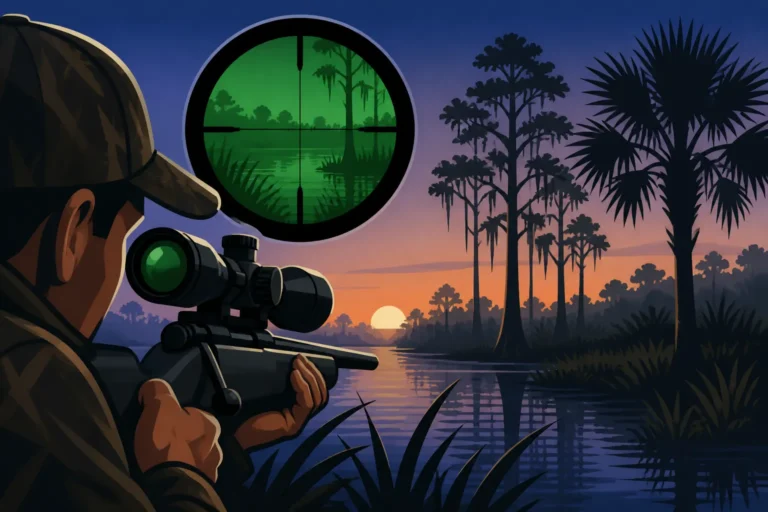
South Carolina deer are most active during the low light periods of dawn and dusk. This is when a scope's ability to gather and transmit light becomes paramount. While objective lens size plays a role (a 50mm objective generally gathers more light than a 40mm), the "exit pupil" is arguably more critical for low light performance. The exit pupil is the diameter of the column of light that leaves the eyepiece and enters your eye. You can calculate it by dividing the objective lens diameter by the magnification setting. For example, a 3-9×40 scope set at 4x has an exit pupil of 10mm (40mm / 4x = 10mm). At 9x, it's about 4.4mm (40mm / 9x = 4.4mm).
In very low light, the pupil of the human eye dilates to about 5-7mm, sometimes up to 7mm in younger individuals. For optimal low-light viewing, you want your scope's exit pupil to match or exceed your eye's dilated pupil. This means that a scope set at a higher magnification will have a smaller exit pupil, making the image appear darker. Even with a large objective, if you're cranked up to 14x at last light, the image will be dimmer than if you drop it down to 6x. This is why many experienced South Carolina hunters will lower their scope's magnification as the light fades, maximizing the exit pupil and effectively extending their shooting window. It’s a crucial technique to make the most of those prime hunting minutes. Your favorite mapping tool, perhaps even an advanced one like a GoHunt app, might tell you legal shooting hours, but your scope's performance will dictate what you can actually see during those precious moments.
Weight and Bulk for Long Walks
South Carolina public lands, whether you're navigating the Sumter National Forest Hunting or hiking into a remote corner of a WMA, often require significant walking. Every ounce counts when you're carrying your rifle, pack, and all your gear for miles. Larger objective lenses and higher magnification ranges often mean heavier, bulkier scopes. A massive scope might provide incredible optical performance, but if it makes your rifle unwieldy or tires you out before you even get to your stand, it's a net negative.
Consider your hunting style. Are you still-hunting, carrying your rifle at the ready for hours? Are you trekking deep into the woods to a remote treestand, like a Treestand Setups in Francis Marion National Forest? Or are you primarily hunting from a blind with minimal walking? For active hunting, a lighter, more compact scope in the 3-9x or 2-7x range often makes more sense. It keeps the rifle balanced, reduces fatigue, and is less likely to snag on brush. While a 56mm objective might look impressive, its added weight and bulk might not be worth the marginal gain in light transmission compared to a high-quality 40mm or 44mm objective, especially if you're mindful of managing your magnification in low light. A hunter relying on GoHunt for scouting might factor in terrain difficulty, which should then influence the weight and size of the gear they carry.
Remember, the best scope magnification for South Carolina deer hunting isn't about having the most power; it's about having the right power for the conditions you face most often. It's about versatility, quick target acquisition, and clear visibility when it matters most, without adding unnecessary bulk or complexity to your hunt.
Disclaimer
This article is for general informational purposes only and does not constitute professional advice. Laws, prices and regulations vary by location and change over time. Consult a qualified professional for guidance on your specific situation.