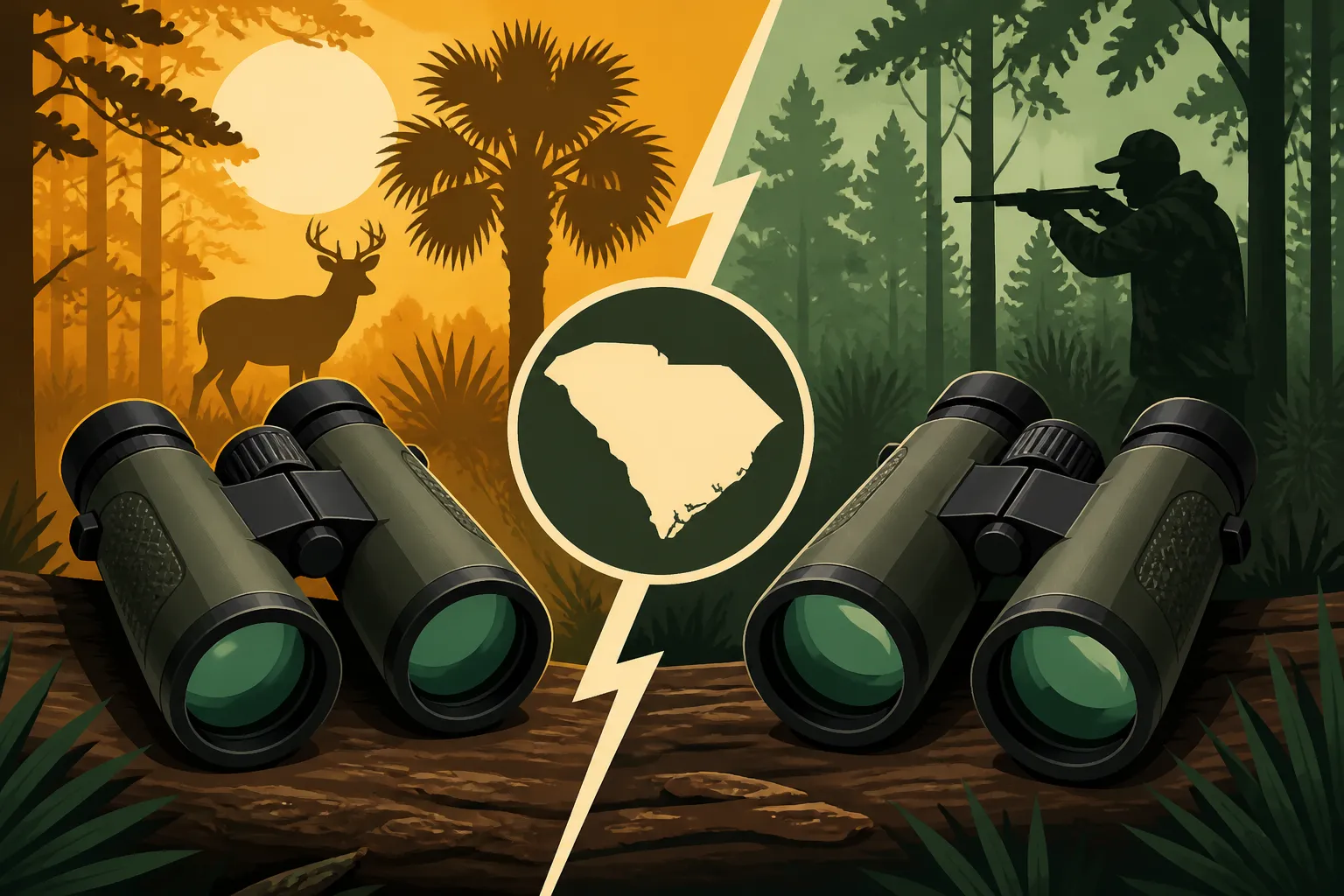
8×42 Versus 10×42 in the Woods
It's a common dilemma for hunters in South Carolina: you're standing in the sporting goods aisle, two pairs of binoculars in hand, both sporting those familiar "x42" numbers, but one says "8x" and the other "10x." You know optics are crucial for spotting that elusive whitetail or a strutting gobbler, but trying to figure out which magnification is genuinely better for the diverse terrain we hunt here can feel like trying to track a deer in a fresh downpour. This guide will help you understand the real-world differences between 8×42 and 10×42 binoculars and equip you to make the right choice for your specific South Carolina hunting adventures.
Understanding Binocular Magnification and Objective Lens Size
Before we dive into the pros and cons, let's quickly demystify what those numbers, like 8×42 or 10×42, actually mean on a pair of binoculars. It's not just marketing jargon; these figures tell you a lot about how the optics will perform in the field. Understanding them is the first step to making an informed decision, especially when you're glassing dense Lowcountry swamps or wide-open Upstate fields.
The "8×42" and "10×42" Breakdown
The first number, like the "8" in 8×42 or the "10" in 10×42, represents the magnification power. Simple enough, right? An 8x binocular makes an object appear eight times closer than it does to the naked eye, while a 10x binocular makes it appear ten times closer. So, if you're looking at a deer 100 yards away with an 8x binocular, it'll look like it's 12.5 yards away. With a 10x, that same deer will look like it's just 10 yards away. That extra "zoom" can seem appealing, but it comes with certain trade-offs that are important to consider.
The second number, "42" in both cases, refers to the diameter of the objective lens (the front lens) in millimeters. This number is crucial because it dictates how much light the binoculars can gather. A larger objective lens generally means more light can enter, which can result in a brighter image, especially in low-light conditions. Since both our contenders are 42mm, they're starting on equal footing regarding light-gathering potential. However, how that light is then processed and presented to your eye is where magnification plays a role.
Light Gathering and Exit Pupil
This is where things get a little more technical but are absolutely vital for hunting in the dim light of dawn and dusk, which are often prime hunting times in South Carolina. The "exit pupil" is the diameter of the light beam that exits the eyepiece and enters your eye. You can calculate it by dividing the objective lens diameter by the magnification.
For an 8×42 binocular, the exit pupil is 42mm / 8 = 5.25mm.
For a 10×42 binocular, the exit pupil is 42mm / 10 = 4.2mm.
Why does this matter? In low light, your eye's pupil dilates to let in more light, typically expanding to about 5-7mm in adults. If the binocular's exit pupil is smaller than your eye's dilated pupil, you're essentially losing some of the light your eye could use, resulting in a dimmer image. The 8×42, with its larger 5.25mm exit pupil, delivers a slightly wider and often perceived brighter beam of light to your eye, which can be a significant advantage during those crucial first and last minutes of legal shooting light when you're trying to pick out a deer silhouette in the deep shadows of a swamp or pinpoint a turkey on a dark roost limb.
The Case for 8×42 Binoculars in South Carolina's Diverse Terrain
When you're talking about hunting in a state like South Carolina, with its mix of thick woods, dense underbrush, and swampy bottoms, the 8×42 binocular often shines. Many hunters, myself included, have found that the practical advantages of an 8x magnification often outweigh the desire for more "reach." It's about how the optics perform in the real-world scenarios we face day in and day out.
Wider Field of View
One of the most immediate benefits of an 8x magnification is a significantly wider field of view (FOV). Imagine you're still-hunting through the pine plantations in the Sandhills or slowly picking your way through a hardwood bottom on a cold morning. A wider FOV means you see more of the landscape through your binoculars, horizontally and vertically. This is invaluable when game might appear suddenly or move quickly. If a buck suddenly busts out of a palmetto thicket, an 8×42 will give you a better chance of keeping it in your sight picture and tracking its movement.
This wider perspective also helps when you're trying to locate a gobbler moving through patchy cover, or when you're just generally scouting a new area on public land. You can cover more ground visually without having to constantly sweep the binoculars, reducing eye strain and increasing your chances of picking up subtle movements. For example, when you're trying to pinpoint a specific tree line where you heard a gobble, an 8x will let you scan a broader area more efficiently. You can use platforms like GoHunt to scout aerial photos, but nothing beats boots on the ground with a wide field of view.
Stability and Ease of Use
Try holding a pair of 10x binoculars perfectly still for an extended period, especially after a long walk to your stand or when your hands are cold from a January sit. It's tough! The higher the magnification, the more exaggerated any slight hand tremor becomes. This "hand shake" can make it difficult to resolve fine details, negating some of the benefit of the increased magnification.
An 8×42 binocular is inherently more stable and easier to hold steady. This means you get a clearer, more consistent image, which is crucial for quick target acquisition. If a deer steps out into a shooting lane for just a moment, you want to be able to raise your binoculars, get a steady sight picture, and identify it immediately. That extra stability means less fatigue during long glassing sessions, which can be common whether you're scanning a powerline cut or working a fencerow for late-season deer. This ease of use also translates to faster target acquisition, which can make all the difference when hunting the earliest coastal zone opener where deer might move quickly through dense cover.
Brighter Image in Low Light
As we touched on with the exit pupil discussion, the 8×42 generally delivers a brighter image, particularly in those critical low-light conditions common to hunting South Carolina. Think about hunting during South Carolina's Long Archery Season, which often means sitting from pre-dawn to mid-morning and then again in the late afternoon. You're trying to identify antler points or distinguish a deer from shadows when the light is barely filtering through the canopy.
That extra brightness can literally make the difference between seeing a legal buck and letting it walk past as a blur. In the deep shadows of Hunting Lowcountry Swamp Deer, where the sun might not penetrate until well after legal light, or in the thick timber of Still-Hunting Sumter Forest Ridges, the ability to gather and deliver more light to your eye is a tangible advantage. It helps you resolve details and colors more effectively, making positive identification easier and more confident, enhancing your overall hunting experience.
The Argument for 10×42 Binoculars: Reaching Out Further
While the 8×42 offers compelling advantages for much of South Carolina's hunting terrain, there are certainly scenarios where the added magnification of a 10×42 truly shines. Hunters who regularly find themselves in more open country or need to make detailed observations at greater distances will often lean towards the 10x. It's all about matching your gear to the specific challenges of your hunt.
Increased Magnification for Detail
The primary benefit of a 10×42 binocular is, naturally, the increased magnification. When you need to pick apart fine details at a distance, that extra "zoom" can be invaluable. Imagine you're perched on an Upstate ridge, Reading a Ridge for Upstate Deer, and you spot movement across a clear-cut 300 yards away. With a 10x, you might be able to count points on an antlered buck or determine if a distant turkey has a beard, details that could be indistinguishable with an 8x.
This level of detail is critical for making ethical harvest decisions, especially when specific antler restrictions are in play or when you need to confirm the sex of a bird. For hunters who spend time glassing large agricultural fields, powerline cuts, or open areas like those found near river bottoms, the ability to resolve these distant features without having to physically move closer can be a huge time-saver and a distinct advantage. This precision can also be beneficial when you're scouting new areas, allowing you to examine potential bedding areas or food sources from a discreet distance.
Longer Effective Range
If your typical hunting setups involve longer sightlines, the 10×42 can effectively extend your "reach." Consider hunting a large bean field in the Midlands, or a vast cutover in the Lowcountry. A deer might appear at 250-300 yards, and while an 8x could tell you it's a deer, a 10x would give you a much better chance of assessing its size, antler configuration, and even its direction of travel before it gets closer. This allows you to plan your stalk or adjust your setup more strategically.
For gobblers, especially when you're Setting Up on a Lowcountry Field Edge, being able to see if that distant speck is a jake or a mature gobbler, or if it has hens with it, can influence your calling strategy dramatically. The extra magnification can help you confirm if a distant bird is actually roosted or simply moving through timber, which is crucial information for Calling a South Carolina Gobbler Off the Roost. While a rangefinder will give you the exact distance, the 10x binocular gives you the visual information to make those initial crucial decisions.
Trade-offs to Consider
Of course, that increased magnification comes with a few trade-offs. As mentioned earlier, the narrower field of view means you see less of the overall scene. This can be frustrating in dense cover where you're trying to locate a moving animal. You might have to pan and scan more frequently, increasing the likelihood of missing something just outside your view. It's like trying to find a needle in a haystack with a magnifying glass versus a wide-angle lens – both have their uses, but one is better for initial searching.
The other significant trade-off is the increased sensitivity to hand shake. Even subtle movements are magnified, making it harder to hold the image steady. This can lead to eye fatigue and make detailed observation difficult without some form of support, like leaning against a tree or using a tripod. While dedicated Rifle Scopes for Low-Light Swamp Edges might have image stabilization, binoculars generally do not. If you're constantly on the move, walking long distances, or often shoot off-hand, the steadiness of an 8x might be a more practical choice.
Making Your Choice: Matching Optics to Your South Carolina Hunt
Ultimately, the "best" binocular for you isn't about one being inherently superior to the other, but rather which one is the best fit for your personal hunting style and the specific environments you frequent in South Carolina. It's like choosing between a recurve and a compound bow – both are effective, but they excel in different situations. Consider the unique challenges and opportunities that our state's diverse landscapes present.
Hunting the Lowcountry Swamps and Thick Pines
If you spend most of your time hunting the dense, often dimly lit, and notoriously thick cover of South Carolina's Lowcountry, such as the Francis Marion National Forest, the ACE Basin, or other coastal plain areas, an 8×42 binocular is often the superior choice. In these environments, shots are typically close-to-medium range, and the ability to quickly acquire a target, track it through heavy brush, and confidently identify it in low light is paramount.
The wider field of view of an 8×42 is a game-changer when a deer might materialize out of dense palmettos only 40 yards away. The brighter image helps you cut through the gloom of a cypress swamp at legal light, letting you discern antlers from branches. And the greater stability means you can raise your binoculars and make a quick, steady assessment even if your heart is pounding after a surprise encounter. Consider the typical distances you'll be shooting, and how quickly you need to react. Rangefinders in Thick Coastal Plain Cover are still useful, but the initial spotting comes down to your glass.
Upstate Mountains and Open Fields
Conversely, if your hunting grounds lean more towards the rolling hills and more open timber of the Upstate, like the Sumter National Forest's Andrew Pickens District, or if you frequently hunt agricultural fields in the Midlands or Pee Dee regions, a 10×42 might be more beneficial. Here, you often have longer sightlines, and the ability to pick out a detail on a distant animal can be a significant advantage.
Imagine Glassing a Powerline Cut at Last Light or scanning a vast, harvested cornfield where deer might be feeding hundreds of yards away. That extra magnification allows you to really "reach out" and assess a buck from a distance, perhaps spotting that kicker point or assessing its body size without having to close the gap. While you'll need to be more conscious of holding the binoculars steady, perhaps resting them on a backpack or a shooting stick, the increased detail can lead to more informed decisions on longer-range stalks or setups. Using a hunting app like GoHunt to analyze topography and identify open areas before you go can also help you determine if a 10x might be a better fit for those specific properties.
Personal Preference and Physicality
Beyond the terrain, your own personal preferences and physical capabilities play a huge role. If you have particularly steady hands or typically hunt from a stationary position where you can rest your elbows, the stability issue with 10x might not be as pronounced for you. If you find even 8x hard to hold steady, then 10x will only exacerbate the problem.
It's also worth considering how much time you spend behind your glass. For quick glances, either might suffice, but for prolonged glassing sessions, especially when Scouting South Carolina Public Land Before Season, eye fatigue can set in faster with higher magnification if the image isn't stable or bright enough. The best advice is to try both out, if possible. Head to a local sporting goods store, step outside, and look at objects at varying distances, mimicking your typical hunting conditions. See what feels comfortable, what you can hold steady, and what allows you to resolve the details you need.
Ultimately, there's no single perfect binocular for every South Carolina hunter, but by understanding the strengths and weaknesses of both 8×42 and 10×42, you can make a choice that truly enhances your time afield. For many, an 8×42 strikes a fantastic balance, especially in our dense woods. For others, the reach of a 10×42 is indispensable. Your Binocular Choice for South Carolina Whitetails is a personal one.
| Feature / Consideration | 8×42 Binoculars | 10×42 Binoculars |
|---|---|---|
| Magnification | 8 times closer | 10 times closer |
| Objective Lens | 42mm | 42mm |
| Exit Pupil | 5.25mm (Generally brighter image in low light) | 4.2mm (Slightly dimmer image in low light) |
| Field of View | Wider (Easier to scan and track moving targets in dense cover) | Narrower (Requires more scanning, harder to track fast-moving game) |
| Stability | More stable, less hand shake (Easier to hold steady for quick target acquisition and prolonged viewing) | Less stable, more hand shake (Requires steady hands or support for clear image, can cause eye fatigue) |
| Detail Resolution | Excellent for medium range, good detail | Superior for long-range detail, counting antler points, identifying distant features |
| Best For | Thick woods, swamps, dense cover, quick target acquisition, low-light conditions, still-hunting, Hunting the Rut in the Coastal Zones | Open fields, powerline cuts, Upstate mountains, long-range glassing, Reading a Ridge for Upstate Deer, Hunting the Rut in the Upstate Zone |
| User Comfort | Less eye strain, easier to use for extended periods | Can lead to more eye strain without steady support |
Disclaimer
This article is for general informational purposes only and does not constitute professional advice. Laws, prices and regulations vary by location and change over time. Consult a qualified professional for guidance on your specific situation.