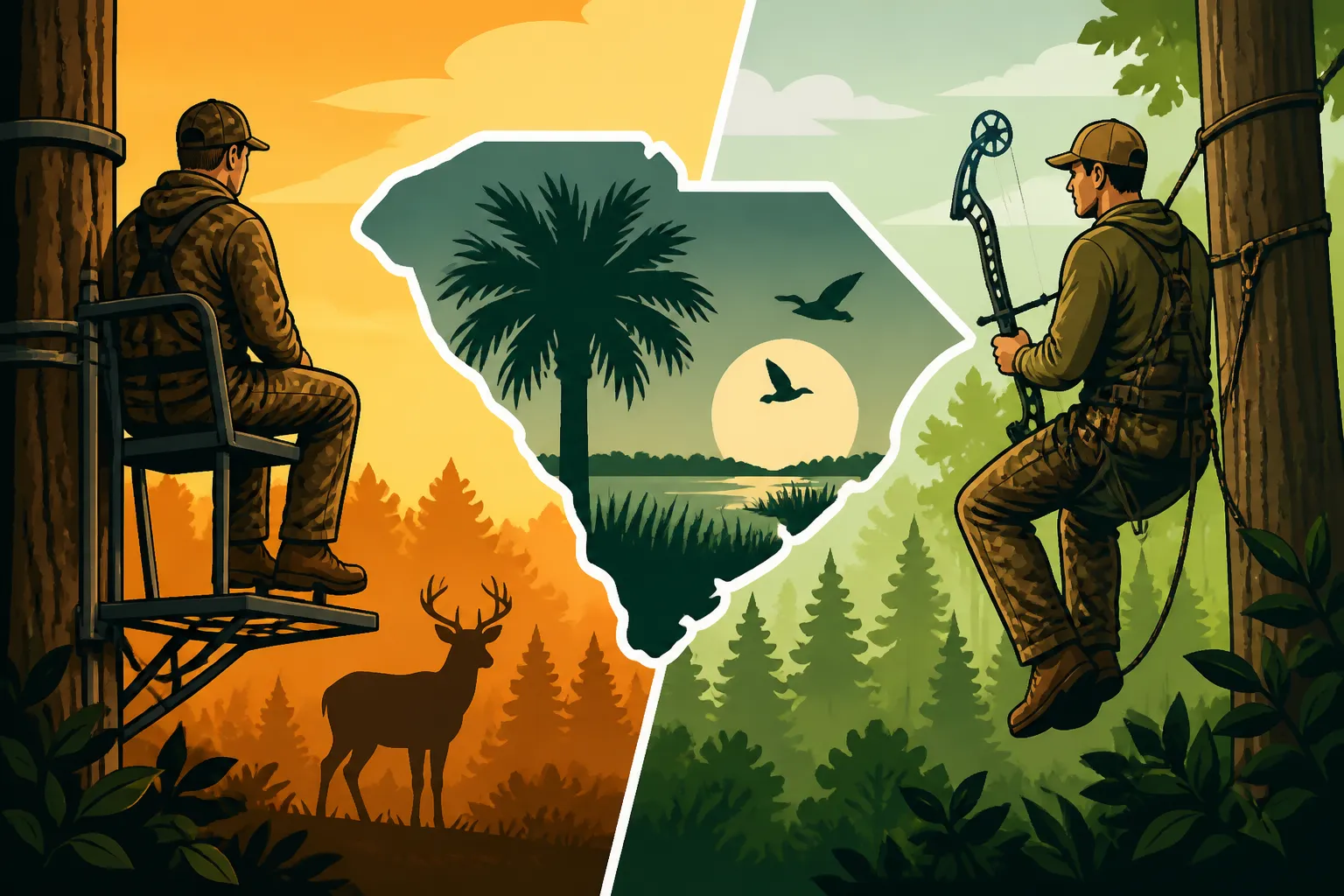
Treestands and Saddles on Public Land
Hunting South Carolina's public lands can be an incredible experience, but finding the right elevated setup that's legal, safe, and effective for those often pressured areas is a challenge many hunters grapple with. Between lugging heavy gear deep into a WMA or debating the merits of a lightweight saddle system, the choices can feel overwhelming. This guide is going to dive deep into both treestands and saddle hunting, focusing specifically on how to make the most of them on South Carolina's public land, ensuring you're compliant with regulations and maximizing your chances of success.
The Unique Demands of Public Land for Elevated Setups
Hunting on public land in South Carolina isn't like hunting a private lease where you might have semi-permanent setups. The very nature of public access introduces a host of considerations that demand specific strategies for elevated hunting. From navigating regulations to dealing with increased pressure, your choice of treestand or saddle, and how you deploy it, becomes critical for consistent success and ethical practice.
Portability and Mobility are King
When you're slogging through the thick undergrowth of Francis Marion National Forest or making a long haul into a remote section of the Sumter National Forest, every ounce matters. Heavy, cumbersome stands that are perfectly fine for a short walk on private land become a genuine burden on public ground. This is where the concept of "mobile hunting" truly shines. You need gear that allows you to get deep, set up quickly and quietly, and move again if conditions or deer movement dictate. Being tied to a single, heavy setup limits your adaptability, which is a hunter's greatest asset on public land.
Imagine you've scouted a promising ridge deep in the Enoree Ranger District, a spot that's a good mile or more from the nearest accessible road. Hauling a 30-pound stand and sticks through that terrain, especially in South Carolina's often humid conditions, is a Herculean task. If you get there and the wind has shifted unexpectedly, or the sign isn't as fresh as you hoped, the thought of moving that heavy setup again is enough to make many hunters throw in the towel. This is precisely why lightweight solutions are so revered by public land veterans who often chase deer that travel long distances and respond poorly to predictable pressure.
A mobile setup empowers you to react to fresh sign, shifting wind, or changing food sources. Instead of being committed to one spot, you can pack up and relocate to a completely different area within the same hunt or the next day, capitalizing on current deer activity. This flexibility allows you to constantly put yourself in the best possible position to encounter game, which is invaluable when Hunting Pressure on South Carolina Public Land is a factor.
Navigating South Carolina's Public Land Regulations
One of the biggest headaches for public land hunters is staying compliant with the often-complex rules governing Wildlife Management Areas (WMAs) and National Forests. These aren't always uniform; what's allowed in one area might be forbidden in another. Specifically, when it comes to treestands, regulations about leaving stands overnight, types of attachment, and even the use of screw-in steps can vary wildly. Ignorance of the rules isn't an excuse, and a violation can lead to hefty fines or even loss of hunting privileges.
For instance, some WMAs might explicitly state that treestands cannot be left unattended for more than 24 hours, or that only "portable" stands are allowed, implying they must be removed daily. Other areas might permit stands to be left for longer periods, but require them to be clearly labeled with your hunting license information. Before you even think about hanging a stand, a deep dive into the specific WMA rules on the South Carolina Department of Natural Resources (SCDNR) website or the National Forest Service regulations is non-negotiable. Don't just assume; confirm the rules for your chosen hunting spot. You can often use resources like the Go Outdoors SC app to check these details on the fly, ensuring you're compliant.
It’s not just about what kind of stand you can use, but also how you attach it and how long it can stay. Some regulations might prohibit any device that damages the tree, which can rule out screw-in steps. Others might dictate the type of material allowed for straps, often favoring nylon or polyester webbing over chain or wire that could girdle the tree. Always refer to the specific WMA or National Forest regulations document for your hunting area. If you're unsure, a quick call to the local DNR office can save you a lot of headache and potential legal trouble.
Dealing with Hunting Pressure and Changing Conditions
Public lands, by their very nature, see more hunting pressure than most private tracts. This means deer are often warier, more nocturnal, and their patterns can change rapidly as the season progresses and other hunters move through their territory. A static treestand setup that works early in the season might become useless once deer shift their bedding or feeding patterns due to increased human activity. This unpredictability demands a flexible approach to your elevated hunting.
Consider the early coastal zone opener. You might find a great spot along a Coastal Maritime Forest Edges near the water. But after opening weekend, if other hunters move into the area, those deer might retreat deeper into thicker cover, rendering your carefully placed stand less effective. A mobile setup, whether it's a lightweight hang-on or a saddle system, allows you to adapt. You can quickly pull up stakes and relocate to a new pinch point, thicket, or travel corridor that deer are now using. This nimbleness is paramount to sustained success on public land where deer behavior can be dynamic and influenced by a variety of factors, including other hunters, weather, and food availability.
Deer in pressured areas become extremely sensitive to movement and foreign objects. A stand that's been left up for weeks can become a known hazard to wary bucks. The ability to move your stand frequently, even just a few hundred yards, can make a huge difference. This constant adaptation helps you stay ahead of the game and react to how deer are using the landscape at that very moment, rather than relying on stale information or predictable patterns that have been disrupted by other hunters.
Treestands for South Carolina Public Land
For many, the treestand is the quintessential elevated hunting platform. And while they come in various forms, the key for public land hunting is always leaning towards lightweight and efficient. You’re not setting up a permanent blind; you’re setting up a temporary vantage point that you might need to move in a day or two, or even on the same hunt.
Climbing Stands: The Self-Contained Solution
Climbing stands are a popular choice for public land hunters who value simplicity and the ability to move through vast tracts of timber. These stands consist of two main sections – a seat section and a platform section – that you "climb" up the tree with. The beauty of a climbing stand is its self-contained nature; you don't need separate climbing sticks, which reduces your overall gear count and simplifies transport to and from your hunting location.
The ideal scenario for a climbing stand is in stands of straight, limbless trees, common in many of South Carolina's pine plantations or mature hardwood bottoms. If you're Hunting Longleaf Pine Savanna for Deer, you might find ample straight trunks perfect for a climber. However, they are less versatile than hang-on stands, as they require a tree with a straight trunk and no lower limbs to climb past. The noise generated during the climb can also be a factor, requiring careful, slow movements, especially at dawn or dusk when deer are most active. You’ll want to practice at home to get quiet and proficient before heading into the woods.
While modern climbing stands have become lighter and more packable, they still typically weigh more than a minimal hang-on or saddle setup. The bulk can be an issue when navigating dense cover or carrying other essentials. The limitations on tree selection also mean that a prime pinch point or funnels might be unhuntable if the surrounding trees don't meet the climber's specific requirements. However, for hunters who prefer a seated position and value the quick, all-in-one setup, a quality climbing stand can still be an excellent tool, provided they scout for suitable trees.
Hang-on Stands and Climbing Sticks: Versatility and Adaptability
Hang-on stands, used in conjunction with climbing sticks, offer unparalleled versatility for public land hunters. This system allows you to climb almost any huntable tree, regardless of its limb structure, as long as it's safe and sturdy. The components – the hang-on stand and the climbing sticks – are typically lighter than a full climbing stand when considered individually, though the total system weight can add up. The ability to break down the system into manageable pieces also helps with packing into difficult terrain.
The ability to place climbing sticks around limbs or to find a truly hidden "pocket" tree deep in the woods is a massive advantage. Imagine scouting a thick swamp edge where a perfect rub line leads to a bedding area, but the only suitable tree has a significant limb at 8 feet. A hang-on with sticks allows you to bypass that limb and set up where the deer actually are, rather than being limited by the tree itself. Brands like Lone Wolf, Summit, and XOP are well-regarded for their lightweight and robust hang-on stands and climbing sticks, often seen carried by public land hunters. When researching, check out reviews on sites like GoHunt for specific models suitable for your style and the conditions you expect to encounter.
The modular nature of hang-on stands and sticks also makes them highly adaptable. You can choose to carry only a few sticks if you plan a low setup, or more if you want to get higher. The key is to find a system that packs efficiently and quietly. Many hunters wrap their climbing sticks in Stealth Strips or similar silencing material to prevent metal-on-metal clanking during transport and setup. This attention to detail can be the difference between spooking a deer on your way in and getting an undetected setup.
Ladder Stands and Tripods: Niche Applications (Mostly Private Land)
While ladder stands and tripod stands offer stability and comfort, they are rarely practical or even permissible for public land hunting in South Carolina. Ladder stands are bulky, heavy, and typically designed for semi-permanent placement, making them ill-suited for the mobile nature of public land hunting. They are incredibly difficult to transport any significant distance and even harder to conceal, which can be an issue in high-pressure areas.
Tripod stands, while offering an elevated position in open areas without suitable trees, share similar portability issues. Additionally, many WMAs have explicit rules against leaving structures like these unattended, and the sheer visibility of a ladder or tripod stand on public land makes it a beacon for other hunters, disrupting your spot and potentially drawing unwanted attention or even theft. These options are almost exclusively reserved for private land where long-term placement and minimal transport are factors, making them unsuitable for the public land hunter's toolkit.
The primary reason these stands are impractical for public land is the sheer effort required to move them. Public land hunting often involves walking miles into remote areas, and a 50-plus pound ladder stand or tripod is simply too much to carry. Even if allowed, leaving such a prominent setup unattended on public land almost guarantees it will be discovered, tampered with, or stolen. For the vast majority of South Carolina public land hunting scenarios, stick to truly portable elevated options.
Saddle Hunting: The Mobile Game Changer
Saddle hunting has exploded in popularity among public land hunters, and for good reason. It offers an unprecedented level of mobility, concealment, and adaptability that traditional treestands often struggle to match. If you're looking to minimize your footprint, get deep into cover, and hunt from virtually any tree, the saddle might be your new best friend.
The Saddle System: Lightweight and Agile
A saddle hunting system essentially replaces the traditional treestand platform with a minimalist fabric harness that you wear. You ascend the tree using climbing sticks or an equivalent method, then attach yourself to the tree via a tether and a lineman's belt. Instead of sitting on a platform, you lean into the saddle, using the tree for support. This allows for 360-degree shooting lanes and an incredibly small profile, both on your back and up the tree.
The core components include the saddle itself, a set of lightweight climbing sticks (often a smaller number than with a hang-on stand, as you don't need to reach a specific stand height), a lineman's belt for safety during ascent/descent, and a tree tether for your hunting position. Sometimes, a small "platform" or a set of modular steps (like a ring of screw-in steps, if allowed) is used to provide a spot for your feet and additional stability, though many hunters use just the sticks. The entire setup, including sticks, can often weigh less than 10-15 pounds, making it ideal for those long treks into the remote parts of Sumter National Forest.
Because you are leaning into the tree, the saddle system allows you to use even relatively small or crooked trees that would be impossible for a treestand. This opens up a wider range of potential setups, allowing you to position yourself in denser cover or closer to deer trails that might lack the "perfect" treestand tree. The minimalist nature also means less bulk on your pack, making entry and exit through thick brush much easier and quieter.
Benefits for Public Land Hunters
The advantages of saddle hunting for public land are numerous and compelling. First and foremost is the extreme portability. A saddle and a few sticks can be packed down into a small backpack, allowing you to slip through thick brush and cover with ease. This means you can access those hard-to-reach areas that other hunters avoid, giving you an edge where mature bucks often take refuge away from easily accessible spots.
Secondly, concealment is vastly improved. Instead of a bulky stand protruding from the tree, you are hugging the trunk, using it as natural cover. This profile blends in much better, making it harder for wary deer to spot you, especially in a sparse South Carolina hardwood bottom or a pine plantation. Furthermore, the 360-degree shooting capability means you can shift around the tree to get a shot, even if a deer approaches from an unexpected angle, which is a common occurrence with Hunting the Rut in the Coastal Zones. This flexibility drastically increases your shot opportunities, especially when Hunting a Ridge-Top Saddle for Rutting Bucks where movement can be unpredictable.
The silence of a saddle setup is another huge benefit. With fewer metallic parts to clank together and a more controlled, deliberate ascent, you can get into position with minimal disturbance. This is critical when deer are already on high alert due to hunting pressure. Plus, the ability to pivot around the tree means you can keep the tree between you and an approaching animal, maximizing your chances of remaining undetected until the shot presents itself.
Learning Curve and Safety
While saddle hunting offers incredible benefits, it does come with a learning curve. It's not as intuitive as stepping onto a treestand platform. You need to become proficient with your climbing method, comfortable leaning into the saddle, and practiced in safely maneuvering around the tree. This isn't something you want to figure out for the first time in the dark on opening morning when every second counts.
Extensive practice at home, in your backyard or a local park, is absolutely essential. Get used to climbing, setting your tether height, and drawing your bow or shouldering your rifle from various positions around the tree. Safety, as with any elevated hunting, is paramount. Always use your lineman's belt during ascent and descent, and always be attached to the tree via your tether or belt. Ensure all carabiners are properly locked and straps are secure. Brands like Tethrd, Trophyline, and Latitude Outdoors specialize in saddle systems, and their websites, along with resources like GoHunt, offer valuable tutorials and safety information.
The learning curve also extends to shot execution. Shooting from a saddle requires different muscle memory than shooting from a traditional stand. Practice shooting from various angles around the tree, including strong-side, weak-side, and even behind the tree. Understand how your bow or rifle clears the tree, and how to comfortably maneuver into a shooting position. This practice will build confidence and ensure that when the moment of truth arrives, you're ready and safe.
Regulations and Ethical Considerations for Elevated Hunting
Hunting on public land demands not only skill and preparation but also a deep understanding of the rules and an unwavering commitment to ethical practices. This is especially true when using treestands or saddles, as improper use can lead to legal trouble, damage to natural resources, or conflicts with other hunters.
Understanding WMA and National Forest Rules for Stands
South Carolina's public lands, including Wildlife Management Areas (WMAs) managed by the SCDNR and National Forests (Francis Marion and Sumter), have specific guidelines regarding treestand use. It’s not a one-size-fits-all situation. For example, many WMAs prohibit "damaging" trees, which often means screw-in steps are a no-go, as they puncture the bark. Straps that don't girdle the tree are typically required, meaning methods that could cut off a tree's circulation are forbidden. Always consult the most current WMA regulations booklet or the National Forest Service website for the specific area you plan to hunt.
A common regulation across many WMAs is the restriction on leaving stands overnight or for extended periods. Some may allow a stand to be left for a period, perhaps seven days, but it must be clearly marked with your customer ID number or hunting license number. Other WMAs might require stands to be removed daily, which significantly impacts your choice of gear towards highly portable options. Failure to adhere to these rules can result in your stand being confiscated and you receiving a citation. Always check for specific rules on Treestand Rules on South Carolina Public Land before heading out to avoid any issues.
It's also crucial to remember that regulations can change from year to year. What was allowed last season might be prohibited this season, especially concerning public land management. It's your responsibility to stay informed. A quick check of the SCDNR website before each season, or even before heading to a new WMA, is a small effort that can prevent a lot of grief. Some areas might have specific rules about minimum height requirements for stands or restrictions on how close you can set up to a public road or boundary line.
Respecting Other Hunters and the Land
Public land is a shared resource, and ethical conduct is crucial for everyone's enjoyment and for maintaining positive perceptions of hunters. This means never encroaching on another hunter's established spot. If you find a treestand, ground blind, or even significant sign indicating another hunter is actively working an area, give them a wide berth. There's plenty of public land in South Carolina to go around. A general rule of thumb is to give at least a few hundred yards of space, and preferably more, to avoid interfering with someone else's hunt.
Beyond respecting fellow hunters, respecting the land itself is paramount. This includes leaving no trace. Remove all your gear, including climbing sticks, ropes, and trash, at the end of your hunt or at the end of the legal period for leaving a stand. Do not leave food wrappers, plastic bottles, or spent cartridges. Avoid excessive limb cutting; while some minimal trimming for shooting lanes might be necessary, clear-cutting a sight line is detrimental to the habitat and often prohibited. The goal is to make it appear as if you were never there, preserving the natural beauty and integrity of the hunting grounds for others.
Leaving your trash behind or damaging trees beyond what's necessary for a safe setup reflects poorly on all hunters. These actions can lead to stricter regulations, loss of public access, and a negative public image for our sport. Being a responsible steward of the land is part of the hunting tradition, ensuring these wild places remain healthy and accessible for future generations.
The Debate on Screw-in Steps and Tree Damage
The use of screw-in steps is a contentious issue, particularly on public land. While they offer a quick and quiet way to ascend a tree, they inherently cause damage by puncturing the bark and cambium layer. This can create entry points for diseases, pests, and can weaken the tree over time. Because of this, many public land management agencies, including the SCDNR for WMAs and the National Forest Service, explicitly ban screw-in steps or any device that "damages" the tree.
Alternative climbing methods, such as strap-on climbing sticks, climbing aids that use friction (like Stealth Strips), or specialized ropes, are generally preferred and often mandated. These methods are designed to be non-damaging, leaving no permanent mark on the tree. Before you even pack screw-in steps, verify they are legal in your specific hunting unit. When in doubt, always err on the side of caution and choose a non-damaging climbing method to ensure you're compliant and doing your part to protect the resource.
Even if screw-in steps are technically permitted in a specific area, many ethical hunters choose to avoid them to minimize their impact on the environment. The cumulative effect of thousands of hunters using screw-in steps year after year can be significant. By choosing tree-friendly alternatives, you're contributing to the long-term health of the forest and demonstrating respect for the resource that provides us with these incredible hunting opportunities.
Strategic Setup and Safety for Elevated Hunting
Getting into a tree safely and strategically is just as important as the gear you choose. A poorly chosen tree or a rushed setup can not only compromise your hunt but, more importantly, put your life at risk. On South Carolina's public lands, where help might be a long way off, meticulous planning and adherence to safety protocols are critical.
Choosing the Right Tree: Cover, Concealment, and Sturdiness
Selecting the perfect tree for your stand or saddle setup is an art form. First and foremost, safety is key: choose a living, healthy tree that is free of rot, dead limbs, or heavy moss/vines that might compromise its structural integrity. Avoid leaning trees or those exposed to high winds, especially during the often unpredictable afternoon thunderstorms common in South Carolina. For climbing stands, a straight, limbless trunk is essential. For hang-ons or saddles, limb structure matters less for climbing, but consider how limbs might block your shot or offer additional concealment.
Beyond safety, think concealment and shot angles. Look for trees that offer natural breaks in your silhouette, or those with ample foliage to help you blend in. A lone tree on a field edge might offer a great view, but it can make you stick out like a sore thumb. Instead, find a tree within a small cluster, or one with thicker branches that create a natural blind. When Setting Up on a Lowcountry Field Edge, consider a tree just inside the timber line that still gives you a clear shot into the field but keeps you hidden from view. Use resources like GoHunt to analyze topo maps and aerial photos to pinpoint potential setups before you even step foot in the woods.
The type of tree also plays a role. Hardwoods like oaks or maples often offer better climbing surfaces and more sturdy anchoring points than softer pines, especially older, larger pines. Always ensure the bark is stable and not shedding excessively, which could compromise your climbing sticks' grip. Scouting beforehand, using binoculars to inspect trees from a distance, can save you precious time and effort when you're trying to set up in the dark.
Secure Attachment and Lifeline Use
Regardless of whether you're using a treestand or a saddle, being securely attached to the tree at all times when off the ground is non-negotiable. This means using a full-body safety harness. When climbing up with sticks or a climber, a lineman's belt is your best friend, keeping you tethered to the tree even as you move. Once you reach your desired height and step onto your stand platform or settle into your saddle, immediately connect your safety harness tether to the tree.
For treestand hunters, a crucial piece of gear is a "tree strap" or "lifeline" that runs from the base of the tree to above your stand. You attach your safety harness to this line before leaving the ground and remain attached all the way up, while hunting, and all the way back down. This ensures continuous fall protection. For saddle hunters, the tether and lineman's belt serve similar functions, providing secure attachment points. Never, ever climb without being attached. The vast majority of treestand accidents happen during ascent or descent, or when adjusting position, and all are preventable with proper fall protection. This is the absolute core of Treestand Safety Gear for Wet Ground.
It's not enough to simply own a safety harness; you must wear it correctly and use it consistently. Read the manufacturer's instructions for your specific harness and practice donning it until it becomes second nature. Ensure all straps are snug and buckles are securely fastened. Having an emergency ascent/descent plan, especially if you hunt alone, is also wise. Consider carrying a small, accessible knife in case of entanglement and a whistle or personal locator beacon for emergencies.
Entry and Exit Routes: Minimizing Disturbance
On public land, where deer are often pressured and highly sensitive to human presence, your entry and exit routes to and from your stand or saddle location can make or break your hunt. The goal is to approach and leave your spot without being detected by deer. This means choosing routes that utilize natural cover, such as ditches, creek bottoms, or dense timber. Avoid walking through open fields or along prominent ridge lines if possible, as these expose you to easy detection.
Consider the wind direction not just for your hunt, but for your walk in and out. If you're hunting an evening stand, approach with the wind in your face or crosswind, so your scent isn't blowing into the bedding area you hope to intercept deer moving from. For a morning hunt, reverse the strategy, often walking in with the wind to your back to clear your scent from the active feeding areas. Plan your route using apps like GoHunt that show property lines and topography. A common mistake is to walk right through a bedding area on the way to your stand, blowing deer out before you even get settled. Sometimes, a longer, more circuitous route that keeps you hidden and scent-free is far more effective than a direct path. This strategic movement is key to Hunting a Funnel Between Two Swamps or other natural travel corridors.
Remember that deer, especially mature bucks on public land, are highly patternable based on human intrusion. If they detect you coming or going from a particular direction consistently, they will quickly learn to avoid that area during those times. Varying your entry and exit points, even slightly, can help keep them guessing. Use natural sounds to mask your footsteps, and move slowly and deliberately. The less disturbance you create, the more likely deer are to move naturally through your hunting area.
Maintenance and Off-Season Care for Longevity
Your elevated hunting gear is an investment in both your hunting success and your safety. Neglecting maintenance and proper off-season storage, especially in South Carolina's humid climate, can lead to premature wear, equipment failure, and potentially dangerous situations. A little care goes a long way in ensuring your treestands and saddles are ready for seasons to come.
Inspecting Gear for Wear and Tear
Before and after every season, and ideally before every hunt, give all your treestand and saddle components a thorough inspection. Look for signs of stress, fatigue, or damage. Check all welds on metal treestands for cracks or corrosion. Examine climbing sticks for bent sections or loose attachments. Pay close attention to all straps, ropes, and webbing on your safety harness, saddle, and climbing sticks. Look for frayed edges, cuts, sun damage (UV degradation), or excessive wear.
Plastic or rubber components, like cable coatings or platform grips, can also degrade over time. If you notice any significant wear, rust, or damage, replace the affected component immediately. Never try to "make do" with compromised gear, especially when your life literally depends on it. This rigorous inspection is a fundamental part of Treestand Safety Gear for Wet Ground. Even a tiny tear in a strap or a hairline crack in a weld can lead to catastrophic failure when under load.
It's also a good idea to set up your stand or saddle in your backyard once a year, just to ensure all components fit together properly and function as intended. This also serves as a refresher for your climbing and setup technique. This pre-season ritual allows you to identify any issues in a safe, controlled environment, rather than discovering them in the pre-dawn darkness of a South Carolina swamp.
Dealing with South Carolina's Humid Environment
South Carolina's climate presents unique challenges for hunting gear. High humidity, frequent rain, and extreme temperature fluctuations can accelerate the degradation of materials. Metal components are prone to rust, and fabric items (straps, ropes, saddles) can develop mildew or lose strength due to moisture exposure. This means you can't just throw your stand in the back of the truck and forget about it after a hunt.
After a hunt, especially if your gear has gotten wet, make sure to dry it thoroughly before storing it. Hang treestands and saddles in a well-ventilated area, out of direct sunlight. If you hunt in particularly wet areas like the Lowcountry swamps, consider products that offer enhanced rust resistance or moisture-wicking properties. A light coating of silicone spray on metal parts can help deter rust. For fabric components, proper drying prevents mildew which can significantly weaken the material over time, making it brittle and less reliable.
Never store wet gear in an enclosed space like a sealed tote or duffel bag, as this creates a perfect breeding ground for mold and mildew. If you encounter mildew, a diluted bleach solution (check manufacturer recommendations first!) can sometimes be used to clean fabric, followed by thorough rinsing and drying. However, any significant mold growth might indicate irreversible damage to the fabric's integrity, and the component should be replaced. Being diligent about drying your gear will significantly extend its lifespan in the notoriously humid South Carolina environment.
Post-Season Cleaning and Storage
Once the hunting season wraps up, a comprehensive cleaning and proper storage routine will extend the life of your treestands and saddles significantly. Start by removing any dirt, mud, or debris from all components. Use a stiff brush and water, or a mild soap solution if necessary, ensuring everything is rinsed thoroughly. Allow all items to air dry completely. For treestands, inspect all moving parts and consider lubricating hinges or pivot points with a silicone-based lubricant to prevent seizing.
Once clean and dry, store your gear in a cool, dry place, away from direct sunlight, extreme temperatures, and rodents. Garages, sheds, or spare closets are often suitable. Consider storing components in protective bags or containers to prevent dust and pest damage. For stands with cables, ensure they are stored in a way that doesn't put undue stress on the cables. Disassembling some larger components for storage can also be beneficial, allowing for more compact and protected placement. A small amount of attention now will save you from having to buy new gear sooner than expected and ensures your equipment is reliable when you need it most.
Proper storage also means keeping your gear away from chemicals, fuels, or any solvents that could degrade plastics, rubbers, or fabrics. UV exposure, even indirect, can cause materials to become brittle over time, so storing them indoors or in opaque containers is best. Taking the time for this post-season care is an investment in your safety and your future hunting seasons.
Comparative Table: Treestands vs. Saddle Hunting on Public Land
| Feature | Treestands (Hang-on/Climber) | Saddle Hunting (Saddle + Sticks) |
|---|---|---|
| Portability | Moderate to Good (can be bulky, heavier for long hauls) | Excellent (compact, lightweight, very packable) |
| Concealment | Moderate (larger profile, can cast shadows, visible platform) | Excellent (small profile, blends with tree, no platform to spot) |
| Versatility (Trees) | Good (climber needs straight, hang-on more versatile but needs flat back) | Excellent (can hunt virtually any safe tree, even crooked ones) |
| Comfort | Generally good (seated, often padded platform) | Moderate (leaning position, takes getting used to, requires slight movement) |
| Shooting Angles | Limited (typically 180 degrees forward from platform) | 360 degrees (can shoot around the tree, highly flexible) |
| Learning Curve | Low to Moderate (familiar for many, basic safety) | Moderate to High (requires practice for comfort, safety, and shooting) |
| Noise Factor (Setup) | Can be noisy during setup (metal-on-metal components) | Generally quieter (less metal, fabric components, controlled movements) |
| Footprint on Tree | Minimal with proper straps (no damage) | Minimal with proper straps (no damage) |
| Total System Weight | 15-30 lbs+ (stand + sticks) | 8-20 lbs (saddle + sticks/platform) |
| Typical Cost Range | Moderate to High | Moderate to High |
| Ideal Terrain | Open hardwoods, pine plantations (climbers); varied timber (hang-ons) | Any timber type, dense cover, small trees |
| Post-Season Storage | Larger, often requires more space | Compact, easily storable |
Disclaimer
This article is for general informational purposes only and does not constitute professional advice. Laws, prices and regulations vary by location and change over time. Consult a qualified professional for guidance on your specific situation.