Scouting South Carolina Public Land Before Season
There's nothing quite like the excitement of a new hunting season on the horizon, but let's be honest, showing up to your chosen spot on South Carolina public land without doing your homework can feel like walking into a maze blindfolded. You've probably been there: the alarm goes off before dawn, you hike in, hopeful, only to find the "perfect" ridge crawling with other hunters, or the creek bottom you scouted last year is now a flooded mess. It’s frustrating, disheartening, and a surefire way to dampen the spirit of the hunt. This comprehensive guide is designed to help you avoid those common pitfalls by meticulously preparing for your hunts, transforming you from a hopeful wanderer into a strategic, informed public land hunter. We’re going to dive deep into how to scout South Carolina's public lands before the season opens, ensuring you’re putting in smart work that translates into real success.
Why Pre-Season Scouting is Non-Negotiable
For many of us, the time we get to spend in the woods is precious, often hard-won amidst work and family commitments. Wasting those invaluable hours on unproductive ground is a real kick in the pants. That's why pre-season scouting isn't just a suggestion; it's a vital component of successful hunting, especially on public land.
Avoiding the "Opening Day Surprise"
Imagine dedicating a weekend of your life to hunting, only to find that your carefully selected spot is already occupied by another hunter who set up camp before you did. Or worse, the ideal pinch point you saw on a map is now completely overgrown, or a timber operation has altered the landscape entirely since your last visit. These "opening day surprises" are soul-crushing and incredibly common on South Carolina’s public lands, which see significant pressure.
Without pre-season scouting, you're essentially gambling your precious hunting time. You're relying on outdated information or pure luck, which often leads to disappointment. By putting in the legwork beforehand, you eliminate many of these variables. You can confirm access points, assess current habitat conditions, and identify potential high-pressure areas that you might want to avoid or approach differently. It's about taking control of your hunting experience and minimizing the chances of having your plans derailed by unforeseen circumstances. Scouting allows you to confirm that the deer sign you saw last year is still active, or if the rutting activity has shifted due to changes in the herd or environment. You can identify if the persimmon trees are loaded this year, or if a late frost killed the soft mast, drastically changing deer movement.
Understanding Habitat and Game Movement
Deer, turkeys, and other game animals are creatures of habit, but those habits are deeply tied to their environment. Food sources, water, bedding cover, and travel corridors are the cornerstones of their daily lives. On public land, these elements can change dramatically from year to year, or even within a single season, due to weather, timbering, or increased pressure.
Pre-season scouting gives you a crucial snapshot of what the habitat looks like before the hunting pressure begins. You can identify the freshest and most abundant food sources, whether it's an oak flat loaded with acorns in the Upstate or a patch of wild grapes in a Lowcountry swamp. You'll see where deer are naturally bedding and feeding, and how they’re traveling between those areas without the influence of hunters pushing them around. This baseline understanding is invaluable. When the season opens and pressure mounts, you'll have a better grasp of how game might adjust their patterns, allowing you to anticipate their moves rather than react to their disappearance. Knowing where the natural funnels are, like a dry creek crossing or a narrow strip of hardwoods between two clear-cuts, can make all the difference when game starts to feel the heat.
Essential Tools for Your Scouting Arsenal
Gone are the days when a paper map and a compass were your only scouting tools. Today, technology has put an incredible amount of information at our fingertips, but it's still crucial to balance digital insights with good old-fashioned boots-on-the-ground investigation. Combining both approaches gives you the most comprehensive understanding of your hunting area.
Digital Mapping and Aerial Reconnaissance
Before you even tie your boots, you should be spending time on your computer or tablet, pouring over maps. This digital reconnaissance is often the most efficient way to eliminate unproductive ground and pinpoint areas worth exploring in person. There are fantastic tools available that combine satellite imagery with property boundaries, topographical maps, and public land designations.
One highly recommended tool for this is GoHunt. Services like GoHunt, along with onX Hunt and even free options like Google Earth, allow you to study the terrain, identify potential bedding areas, food sources, and travel corridors from above. Look for changes in vegetation that might indicate clear-cuts or recent burns, which can drastically alter game movement. Identify bottlenecks, saddles, and drainages that funnel deer movement. Pay close attention to how public land borders private land, as deer often use the safety of private sanctuaries during the day and move onto public food sources at night. Use these digital maps to mark potential stand locations, historical sign, and strategic entry/exit routes. This pre-work saves you countless hours of walking in the wrong direction once you're on the ground. For more on this, check out our guide on Reading Aerial Photos for Upstate Deer. Remember to download offline maps to your device, as cell service can be spotty in many remote parts of South Carolina's public lands.
Physical Gear for Boots-on-the-Ground
Once you've done your digital homework, it's time to hit the woods. Don't go in unprepared; the right gear makes your physical scouting efforts more effective and comfortable. A good pair of comfortable, broken-in hiking boots is paramount, especially if you're tackling the steep terrain of the Andrew Pickens Ranger District or navigating the boggy bottoms of the Francis Marion National Forest. Snake boots are a wise investment for much of South Carolina, particularly in the Lowcountry where cottonmouths and rattlesnakes are common.
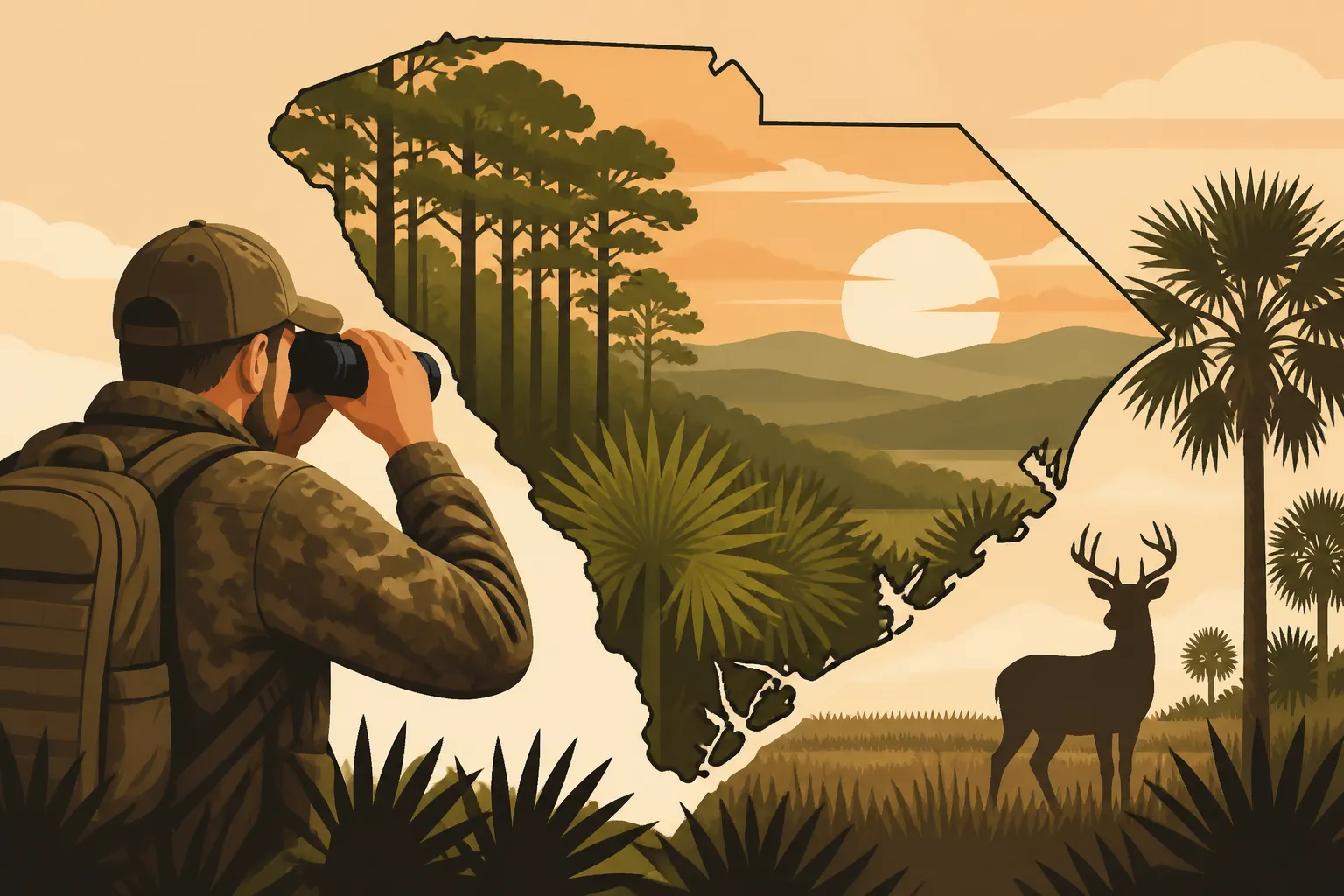
Beyond footwear, a reliable backpack should carry essentials like water, snacks, a first-aid kit, and bug spray (South Carolina bugs are no joke, especially during early scouting trips). A pair of binoculars is incredibly useful for spotting distant features or even game from a vantage point. A rangefinder can help you verify distances to potential shooting lanes or landmarks. Don't forget a small pair of clippers for trimming shooting lanes around potential stand sites. And while your phone's GPS is great, a traditional compass or a dedicated handheld GPS unit with extra batteries can be a lifesaver if your phone dies or loses signal. A measuring tape can help you record rub heights or track sizes, adding to your overall data collection. Having a small notebook and pencil to jot down observations is also incredibly helpful, especially when you’re covering multiple areas.
Decoding the Public Land Puzzle Remotely
Before your boots even touch the South Carolina dirt, a significant portion of your scouting can be done from the comfort of your home. This remote work is critical for understanding the big picture and narrowing down the vast expanses of public land into manageable, promising sections.
Identifying Key Features and Access Points
The most effective remote scouting begins with meticulously poring over topo maps and high-resolution satellite imagery. Look for the "terrain features" that naturally funnel game. In the Upstate, these might be saddles between two ridge tops, steep draws leading down to creek bottoms, or benches along a hillside. In the Lowcountry, you'll be looking for pinch points created by swamps, dry creek crossings, and subtle elevation changes that concentrate movement. Pay close attention to where different types of timber meet – for example, where a mature hardwood bottom transitions into a pine plantation often creates an edge that deer will follow.
Also, critically assess access points. Public land, by its nature, is accessible, but how accessible can tell you a lot about hunting pressure. Look for overgrown logging roads, old clear-cuts, or areas that seem difficult to reach. These remote spots often hold less pressured game simply because fewer hunters are willing to put in the effort to get there. Mark these potential entry and exit routes on your digital map. Consider how the wind might affect these routes – will you be broadcasting your scent to every deer in the vicinity as you walk in? Think about alternative, stealthier approaches. An often-overlooked area could be the key to success. For coastal areas, understanding features like those discussed in Reading a Tidal Creek for Deer Movement can be vital.
Researching Regulations and Pressure Points
Every Wildlife Management Area (WMA) and National Forest in South Carolina has its own set of rules and regulations. Trust me, you do not want to find out you've unknowingly violated a rule on opening day. Before you even set foot on public land, dive into the SCDNR website and study the regulations for the specific area you plan to hunt. Are there special primitive weapons seasons? Are crossbows allowed during archery season? What are the bag limits, and are there any specific quota hunts or sign-in requirements? Our guide on Using the Go Outdoors SC Map Tool is a great resource for navigating these specifics.
Beyond the formal rules, research recent hunting pressure. Forums, local Facebook groups, and even conversations with folks at your local sporting goods store can give you insights into which areas are heavily hunted. Is there a big deer drive planned for a specific WMA on opening weekend? Knowing this can help you strategically avoid those areas or position yourself to intercept deer being pushed. Public land can get crowded, especially on weekends and holidays. Understanding Hunting Pressure on South Carolina Public Land will inform your decision-making. Don't be afraid to hunt areas that others overlook, even if they require a bit more effort to access. Sometimes the "hard to get to" spots are precisely where the unpressured game resides.
Boots-on-the-Ground: What to Look For
Once you've completed your digital reconnaissance and armed yourself with the necessary gear, it's time for the real work: getting your boots dirty. This is where you confirm or deny your digital predictions and collect invaluable, up-to-the-minute intelligence.
Fresh Sign and Movement Patterns
When you're walking public land before the season, you're a detective looking for clues. The most important clue is fresh sign. Old rubs, tracks from last winter, or faded droppings are interesting, but they don't tell you where the deer are now. You're looking for shiny rubs, fresh scrapes with turned-up dirt and a strong smell, and tracks that are crisp and clearly defined, indicating recent activity. Pay attention to the direction of travel these tracks suggest. Are they moving from a bedding thicket towards a known food source? Are they crossing a particular ridge?
Look for distinct travel corridors, often subtly worn paths through the underbrush or worn-down edges of clear-cuts. Deer are creatures of efficiency; they'll take the path of least resistance. These travel routes are often more pronounced near bedding areas and heavily used food sources. If you find a series of fresh rubs or an active scrape line, like those detailed in Scrape Lines Along a Logging Road, you've likely identified a key buck's cruising path. During the rut, these areas can be absolutely electric. Remember, you're not just looking for a sign, but a pattern of fresh sign that indicates consistent use. Don't forget that Reading South Carolina Mud for Fresh Deer Movement can tell you a lot about recent activity and travel patterns, especially around water sources.
Food Sources and Water
Food and water are the lifeblood of all wildlife, and knowing what's available and where is paramount. Pre-season scouting allows you to assess the current year's mast crop. Are the white oaks dropping acorns early? Are the persimmons ripe and falling? Have the muscadine grapes been picked clean by other animals? What about planted food plots on adjacent private lands that might draw deer to the border of public ground?
Deer will prioritize food. If the acorns are abundant in one area, that’s where they’ll be. If there's been a poor acorn year, as discussed in Hunting After a Poor Acorn Year, they'll shift to other food sources like honeysuckle, greenbriar, or agricultural fields bordering public land. Water is also critical, especially during the warmer early seasons in South Carolina. Identify reliable water sources like creeks, ponds, or even low-lying areas that hold rainwater. Deer will always need to drink, and these spots can be natural congregation points. Take notes on the abundance and freshness of various food sources, as this intelligence will directly influence where you decide to set up your stand. Remember to look for browse lines on trees and shrubs, which indicate heavy feeding pressure.
Strategic Stand Placement and Entry/Exit Routes
Finding game sign is only half the battle. The other, equally crucial half is figuring out how to get to your hunting spot, set up, and get out, all without alerting every deer within a half-mile radius. This requires thoughtful planning based on your scouting observations.
Picking Your Perch
Once you've identified an area with consistent, fresh sign, the next step is to choose your exact stand location. This is where all your scouting data comes together. You're looking for a spot that offers a clear shot at expected travel corridors, dominant scrapes, or preferred food sources. Consider the prevailing winds for your chosen spot. A perfect location with the wrong wind will guarantee you get busted every time. Look for a tree that offers good cover and concealment, breaking up your outline. Remember, deer are constantly looking up, so good back cover is vital.
Think about shot angles and shooting lanes. Can you see enough to make an ethical shot? Will you need to do a little trimming? If you're planning a treestand setup in areas like the Francis Marion National Forest, keep in mind tree type and size for secure placement. For those considering ground blinds, evaluate the natural cover available for brushing in. A well-placed ground blind can be incredibly effective, especially in thick cover or along field edges. Our article on Using a Ground Blind on South Carolina Public Land offers some great tips. Don't be afraid to mark a few alternative spots; having a Plan B and even a Plan C based on different wind directions or unexpected pressure is a smart move.
Stealthy Ingress and Egress
This is arguably one of the most overlooked aspects of hunting public land, but it can make or break your hunt. Getting to and from your stand without spooking game is paramount. Your entry and exit routes should be planned with the wind in mind, always trying to keep it in your face or quartering away from where you expect deer to be. Avoid walking through bedding areas or known feeding locations on your way in or out. Can you use a creek bottom, a logging road, or a thick pine strip to conceal your movement and muffle your sound?
Consider the time of day you'll be entering and exiting. If you’re hunting an evening sit, you might be walking in during daylight, but exiting after dark. A quiet headlamp with a red-light option is crucial for not disturbing nocturnal animals. The goal is to be a ghost – seen by nothing, heard by nothing, smelled by nothing. This might mean adding a few extra minutes to your walk, or even taking a slightly longer route, but the payoff of undisturbed game is well worth the effort. By understanding Wind and Thermals on an Upstate Ridge, you can tailor your routes to the specific conditions, ensuring your scent isn't blowing directly into the deer's nose. Sometimes, finding success on public land is simply about Finding Ground Others Walk Past because they're not willing to put in the effort for a truly stealthy approach.
Adapting Your Scouting to Different Zones
South Carolina is a diverse state, offering a variety of landscapes that present unique challenges and opportunities for hunters. What works for scouting in the mountains of the Upstate might not apply to the coastal swamps. Understanding these regional nuances is key to effective pre-season preparation.
Upstate Mountain Considerations
The Upstate of South Carolina, with its foothills and mountains, presents a distinct scouting environment. Here, elevation changes and thermals play a massive role in deer movement. When scouting, pay close attention to ridge tops, saddles, and steep draws. Deer often use these features as travel corridors, especially during the rut. As the sun rises and heats the slopes, thermals will rise, carrying your scent uphill. In the evenings, as the air cools, thermals fall, pulling your scent downhill. Understanding and anticipating these shifts is vital for stand placement and entry/exit routes. Our guide on Reading a Ridge for Upstate Deer delves deeper into these specific tactics.
Food sources in the Upstate are heavily reliant on hard mast, primarily acorns from various oak species. Identify the dominant oak species in the area – white oaks, red oaks, chestnut oaks – and scout for the most abundant mast crops. Water sources are typically plentiful due to numerous creeks and streams, but deer will still gravitate to consistent, unpressured spots. Look for benches and smaller, less obvious draws where deer might bed and feed away from the main ridge lines, escaping pressure from hunters who stick to the obvious paths. Exploring the specific hunting strategies for Hunting Blue Ridge Escarpment Ridgelines can provide additional insights into successful Upstate scouting.
Lowcountry Swamp and Coastal Plain Nuances
Down in the Lowcountry and Coastal Plain, scouting is an entirely different beast. Here, water is the dominant feature. Swamps, rivers, and tidal creeks dictate game movement more than elevation. You'll be looking for subtle rises in elevation, "islands" of high ground within a swamp, or narrow strips of dry land that act as highways for deer. Understanding water levels is crucial; what's dry and traversable one week could be under a foot of water the next, completely changing game patterns. Hunting Lowcountry Swamp Deer requires an intimate knowledge of these hydrological dynamics.
Food sources in the Lowcountry are more diverse, including a mix of soft mast like persimmons, muscadine grapes, and various browse species, alongside acorns. Identify areas with a good mix of these, as deer often shift their preferences. Access can be a major challenge due to thick underbrush and water. Look for old logging roads, dike banks, or natural high points that offer easier, quieter access. Be mindful of tidal influences near the coast; a low tide might expose new feeding areas or travel routes, while high tide could flood them. Scouting these areas often involves pushing through dense palmetto thickets or wading through shallow water, so robust, waterproof gear is essential. Additionally, understanding the dynamics of Hunting Coastal Maritime Forest Edges can provide valuable insights for those targeting deer near the ocean.
| Scouting Phase | Key Actions | Tools & Considerations |
|---|---|---|
| Remote Recon | Map review, identifying access, potential hotspots, terrain features. | GoHunt, onX Hunt, Google Earth, SCDNR regulations, weather history, public forums. |
| Boots-on-Ground (Phase 1) | Confirming digital findings, identifying fresh sign (tracks, rubs, scrapes), observing habitat conditions, finding food/water. | Binoculars, rangefinder, compass/GPS, clippers, notebook, bug spray, snake boots. |
| Boots-on-Ground (Phase 2) | Pinpointing stand locations, planning entry/exit routes, assessing wind/thermals, trimming shooting lanes. | Treestand/blind (if placing early), safety harness, saw, measuring tape, scent-free clothing. |
| Post-Scouting | Documenting findings, creating detailed maps, developing a hunt plan with contingencies. | Digital mapping app (GoHunt), journal, calendar for season dates, weather forecast. |
Disclaimer
Hunting is an inherently dangerous activity. Always prioritize safety, including wearing appropriate blaze orange/pink, using a safety harness when hunting from elevated stands, and always following all local, state, and federal hunting regulations. This guide is for informational purposes only and does not supersede official SCDNR guidelines or landowner requirements. Be sure to check the latest regulations before heading afield.