Reading a Ridge for Upstate Deer
Hunting the rolling hills and rugged terrain of the South Carolina Upstate can be a completely different ballgame than the flat, swampy lowcountry. Many hunters struggle to consistently locate and intercept deer in this environment, often feeling like they're just wandering aimlessly through the timber. This comprehensive guide will peel back the layers of these unique landscapes, showing you how to read the subtle cues of an Upstate ridge system to pinpoint deer movement and increase your chances of success.
Understanding Upstate Topography and Deer Behavior
The Upstate of South Carolina isn't just about pretty mountain views; it's a dynamic landscape that dictates how deer live and move. Ignoring these topographical nuances is like trying to read a map with half the labels missing – you just won't get where you need to go. Deer in these areas have adapted their behavior to maximize safety, minimize effort, and access crucial resources.
The Lay of the Land: Appalachian Foothills Influence
Unlike the vast, flat expanses and thick river bottoms of the coastal plain, the Upstate is defined by its dramatic elevation changes. You'll find everything from gently sloping ridges to steep, unforgiving bluffs carved out by countless creeks and rivers. These features, part of the larger Appalachian foothills, create distinct microclimates and vegetation patterns that directly influence deer. For instance, a north-facing slope might hold thicker, cooler timber with different forage than a sun-drenched, south-facing slope. Deer will gravitate to areas that offer the best cover and food, often seeking the cooler, denser timber on north slopes during warmer early season hunts or the sunnier, more open south slopes for warmth in late season. Understanding this fundamental difference is the first step in unlocking the secrets of Upstate deer hunting. The higher elevations and varied terrain also mean different considerations for travel and approach compared to flat land.
How Deer Use Ridges: Travel Corridors and Thermal Hubs
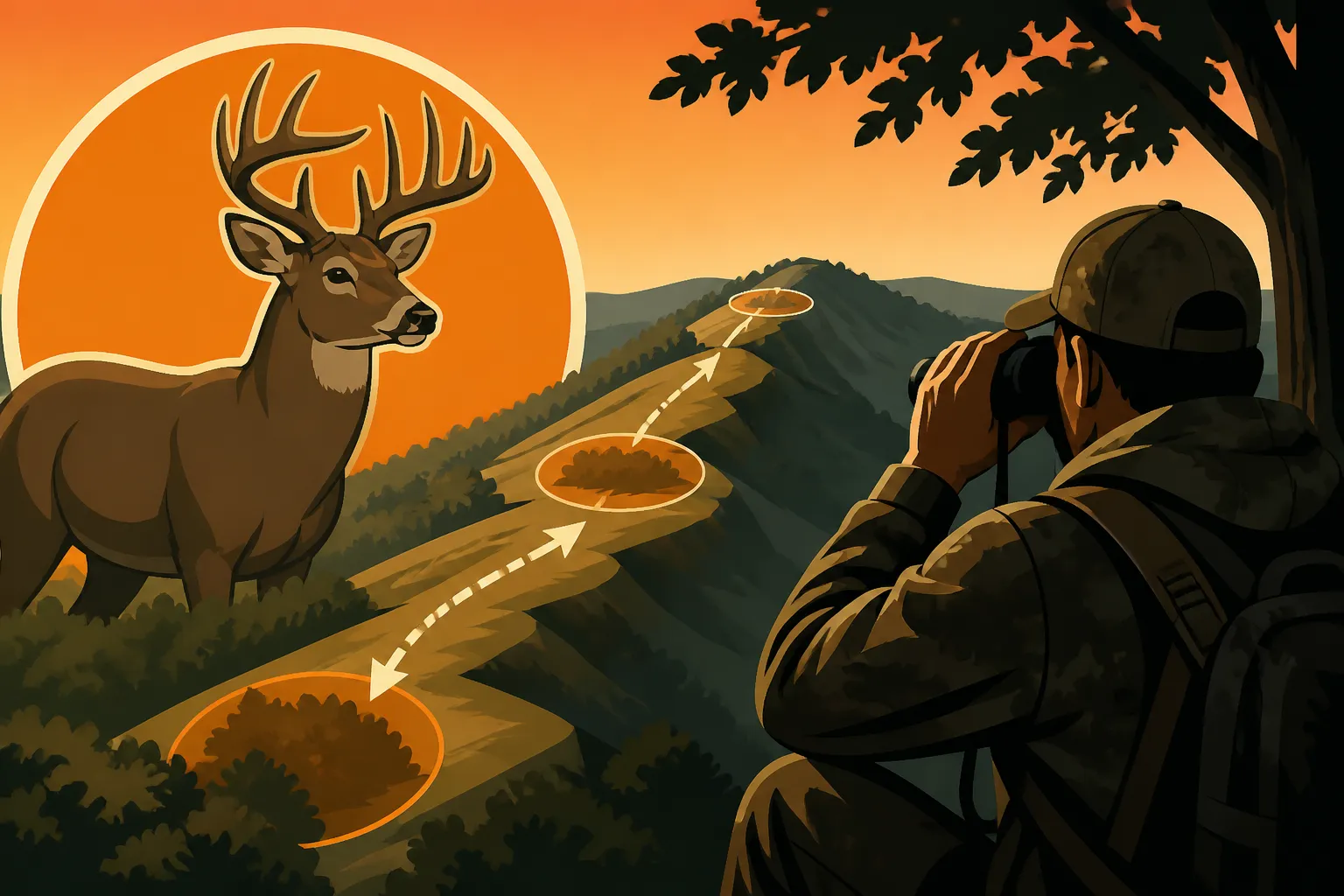
Deer view ridges not just as obstacles, but as highways and havens. They naturally use ridge lines as primary travel corridors, connecting different feeding areas to bedding locations. Think of a ridge as a natural path of least resistance, especially when traversing steep country. Instead of fighting through thick, steep ravines or scrambling down slick banks, deer will often stick to the more gradual slopes or the spine of a ridge to get where they need to go. But it's not just about easy travel. Ridges are also critical thermal hubs. As the sun rises and sets, the air temperature changes, creating predictable thermal drafts that rise and fall along these slopes. Deer are incredibly sensitive to these thermals, using them to their advantage to smell danger long before it becomes a threat. For a deeper dive into how these invisible forces shape deer movement, check out our guide on Wind and Thermals on an Upstate Ridge. Being able to anticipate these thermal movements and position yourself accordingly is paramount.
Key Features to Scout on a Ridge
Successfully hunting a ridge requires more than just walking it; it demands a keen eye for detail and the ability to interpret what the terrain is telling you. It's about finding those subtle breaks and transitions that concentrate deer activity, turning a vast expanse of woods into a manageable hunting puzzle.
Identifying Saddles and Benches
Saddles and benches are the absolute bread and butter of ridge hunting. A saddle is a low spot or dip in a ridge line, essentially a natural funnel that deer will almost invariably use to cross from one side of the ridge to the other. Imagine a highway cutting through a mountain range; the saddle is the easiest pass. They offer less strenuous travel and often provide a quick escape route. Benches, on the other hand, are flatter, shelf-like areas that break up an otherwise steep slope. These are prime spots for deer to pause, browse, or even bed down, offering them a secure platform with good visibility or cover. They're like natural rest stops or staging areas. Identifying these subtle features on a topographical map or using a mapping application like GoHunt is incredibly valuable, as they immediately highlight potential ambush points. These areas serve as natural convergence zones for deer activity.
Locating Food Sources and Water
Even the most perfect saddle or bench is useless if there's no reason for deer to be there. Food and water are the ultimate deer magnets. On Upstate ridges, this often means focusing on mast crops. Oak ridges, particularly those with a variety of red and white oaks, can be goldmines when acorns are dropping. Persimmons, wild grapes, and various browse plants also draw deer. Keep an eye out for clear-cuts or areas of young, regenerating timber on the slopes; these can provide dense cover and succulent new growth that deer relish. Don't forget about water, either. Small springs, seepages, or even intermittent creeks running off the ridge can be crucial, especially during dry spells. Sometimes, finding these elusive food and water sources means adapting your strategy, especially Hunting After a Poor Acorn Year when traditional food sources might be scarce. Understanding the annual mast cycle and how it affects deer distribution will give you a significant advantage.
Reading Terrain with Mapping Tools
Gone are the days of relying solely on paper maps and compasses. Modern mapping applications have revolutionized how we scout and plan our hunts, particularly in complex Upstate terrain. Tools like GoHunt or the Go Outdoors SC app allow you to virtually scout a potential area from the comfort of your home. You can examine detailed topographical lines, identify elevation changes, mark potential saddles, benches, and historical bedding areas, and even overlay satellite imagery to spot clear-cuts or timber changes. Before I ever set foot on a new piece of public land, I'm poring over aerial photos on GoHunt, tracing out potential travel corridors and plotting my entry and exit routes. This allows you to quickly eliminate unproductive areas and focus your on-the-ground scouting efforts on the most promising spots. For more in-depth preparation, our guide on Reading Aerial Photos for Upstate Deer offers excellent strategies for leveraging these digital tools. Similarly, Scouting With the Go Outdoors SC App can provide valuable insights specific to public lands.
| Ridge Feature | Description | Typical Deer Activity | Best Hunting Strategy |
|---|---|---|---|
| Saddle | Low point or dip in a ridge line. | Primary travel corridor between slopes, crossing point. | Stand on downwind side, overlooking travel paths during transition. |
| Bench | Flat, shelf-like area along a steep slope. | Resting, browsing, bedding, staging area. Often with good cover. | Hunt edges of benches, especially where they narrow or meet thicker cover. |
| Ridge Point | Protrusion or finger extending off the main ridge. | Security bedding, vantage point, observation area. Bucks often bed on points. | Approach carefully, hunt thick cover on the downwind side. |
| Creek Bottom/Drainage | Low-lying area at the base of a ridge, often with water. | Water source, denser cover, feeding in specific vegetation. | Hunt travel routes connecting to ridge from water/cover. |
| Steep Slope | Inaccessible or difficult-to-traverse incline. | Seldom traveled directly, but may contain hidden benches or browse if not too thick. | Focus on edges of slopes where they transition to more walkable terrain. |
Interpreting Sign and Deer Movement
Finding a ridge with the right topography is only half the battle; the real art lies in understanding the story the deer themselves are writing on the landscape. Every rub, every track, every droppings pile contributes to a narrative of how deer are using that particular ridge.
Distinguishing Fresh from Old Sign
When scouting a ridge, it's easy to get excited about finding a big rub or a well-worn trail. However, not all sign is created equal. The most crucial skill is learning to differentiate fresh sign from old. Fresh tracks will have crisp edges and no debris in them; old tracks will be weathered and potentially filled with leaves. Rubs that are still sappy or have fresh wood shavings indicate recent activity, whereas gray, dried-out rubs are from previous seasons. Droppings that are dark, moist, and clumped are very recent, while dry, scattered pellets could be days or weeks old. In the Upstate, with its variable weather, sign can fade quickly. Focus your efforts on areas with an abundance of fresh sign. Old sign might tell you deer were there, but fresh sign tells you they are still there, or will be soon. Remember, you're hunting deer now, not deer from last year. Our guide to Finding Sign in Big Sumter Forest Timber offers more great tips for discerning recent activity.
Funnels and Pinch Points
The topography of an Upstate ridge naturally creates funnels and pinch points that concentrate deer movement. Saddles are classic examples, but also look for where a thicket narrows, forcing deer through a smaller opening, or where a steep bluff pushes deer along a specific, more gradual path. These are the equivalent of a traffic merge on a busy highway – all the traffic has to go through one lane. Deer prefer the path of least resistance, and these natural constrictions capitalize on that preference, making them high-probability ambush locations. During the rut, these spots become even more critical as bucks are actively cruising for does. Imagine a buck scent-checking the top of a ridge; he'll often travel the easiest path through a saddle rather than scaling a steep face. Understanding these natural corridors and how they are used, perhaps even by Hunting a Ridge-Top Saddle for Rutting Bucks, is key to positioning your stand effectively.
Understanding Bedding Areas
Deer select bedding areas on ridges with extreme care, prioritizing security, comfort, and strategic advantage. Often, you'll find bedding on the downwind side of a ridge point or a bench, allowing deer to smell danger approaching from below while simultaneously having a visual advantage of the terrain in front of them. The thickest cover on a ridge, whether it's a dense pine stand or a patch of laurel, will also be a prime bedding spot. In cold weather, deer might opt for a south-facing slope to catch the sun's warmth, while in warmer weather, a shaded north-facing slope provides relief. Learning to identify these potential bedding areas and understanding why deer choose them will help you predict their travel routes. Once you know where they're sleeping, you can figure out where they'll be heading to eat or drink, giving you a distinct advantage.
Tactical Considerations for Hunting Ridge Lines
Even with the best scouting, success ultimately comes down to flawless execution in the field. Hunting ridges in the Upstate presents unique challenges and opportunities that require specific strategies, from how you approach your stand to how you hunt during different phases of the season.
Stand Placement and Access Routes
One of the most critical aspects of ridge hunting is your approach and stand placement. You absolutely cannot afford to spook deer on your way in or out. Always consider the wind and thermals, which can be fickle and swirling on ridge lines. Plan your entry and exit routes to be completely downwind of where you expect deer to be, preferably using natural cover to conceal your movement. Your stand should be placed to intercept deer moving along the ridge, through saddles, or on benches, always with the wind in your favor. Often, the ideal spot isn't right on top of the ridge, but just off the side, slightly below the crest, allowing you to shoot down into travel paths without silhouetting yourself against the skyline. For practical tips on securing your position, consult our guide on Hanging a Stand on a Sumter Forest Ridge. While the specific location might differ, the principles of silent entry and strategic vantage point are similar to general Treestand Setups in Francis Marion National Forest.
Still-Hunting Ridge Systems
Still-hunting is a highly effective, yet often underutilized, tactic for working Upstate ridges. Instead of sitting in a fixed stand, you slowly and deliberately move along the ridge, pausing frequently to observe, listen, and glass for deer. This method allows you to cover more ground, react to fresh sign, and adapt to changing conditions. The key is to move at a snail's pace, taking only a few steps before stopping for several minutes, scanning every shadow and listening for the slightest sound. Use the terrain to your advantage, peeking over benches or into drainages. This is a highly immersive and rewarding way to hunt, especially when you encounter a buck quietly feeding or slipping through the timber. It requires immense patience and attention to detail, but it can be incredibly productive. For those looking to master this art, consider reading up on Still-Hunting Sumter Forest Ridges.
Rut Hunting on Ridges
When the rut kicks in, Upstate ridges transform into prime cruising grounds for mature bucks. During this frenetic time, bucks are on their feet, actively scent-checking and chasing does. They will use the ridges to cover ground efficiently, seeking out does in heat, and often follow these elevated paths to intercept does moving between feeding and bedding areas. Knowing Hunting the Rut in the Upstate Zone can dramatically improve your success. This is an excellent time to focus on those saddles and benches you've scouted, as bucks will frequently pass through them. Hunting ridge points that offer good visibility into surrounding drainages can also be productive, as bucks will often use these vantage points to scan for does. Don't be afraid to try some rattling or grunting, as a buck on the move might be curious enough to investigate. The rut is arguably the best time to connect with a mature Upstate buck on a ridge.
Disclaimer
Hunting involves inherent risks, and conditions can change rapidly. Always prioritize safety, understand and follow all South Carolina Department of Natural Resources (SCDNR) regulations, and obtain appropriate licenses and permits before heading afield. The information provided here is for educational purposes and should not replace proper hunter education or professional guidance.