Wind and Thermals on an Upstate Ridge
One of the most frustrating things about hunting the stunning, rugged terrain of South Carolina's Upstate is feeling like you’ve got everything else right – the scout, the stand, the approach – only to have a swirling gust of wind or an unpredictable thermal betray your position. Scent control is paramount, but in the mountains and rolling hills of our Upstate, the wind is rarely as simple as it seems on a weather app. This guide is all about demystifying those complex air currents, helping you understand, predict, and ultimately use the wind and thermals on an Upstate ridge to your hunting advantage.
Understanding the Basics of Wind and Thermals
Before we can even begin to strategize, we need to talk about what exactly we're dealing with up in the Upstate hills. It's not just a steady breeze. It's a dynamic, ever-changing dance between global weather patterns and local topography, influenced heavily by the sun's energy. If you think of wind as the broad brushstrokes of air movement, thermals are the intricate, localized details that can make or break a hunt.
What is "Ridge Wind" and Why it Matters
When you're perched on an Upstate ridge, the wind you feel isn't just a simple line from point A to point B. It's often a complex interaction that makes it seem like your scent cone is doing a merry jig rather than a straight line. This "ridge wind" is the result of prevailing winds hitting a topographical barrier like a mountain ridge. Instead of flowing straight over, the air currents can compress, accelerate, or even create eddies and swirls on the leeward side or within saddles and draws. Imagine a river hitting a large rock – the water doesn't just stop; it moves around, creates currents, and sometimes even backwashes. Air does the same thing.
Understanding this means realizing that a weather report saying "wind from the west at 5 mph" might not accurately reflect what's happening at your specific stand location on a ridge. On the windward side, it might be a consistent west wind. But on the leeward side, down in a hollow, or even just behind a thick stand of pines on the ridge itself, that west wind can be completely broken up, swirling, or even blowing in the opposite direction. Deer, being creatures perfectly adapted to their environment, know how to use these micro-currents to their advantage, often bedding in spots where they can smell danger approaching from multiple directions. This is why paying close attention to the smaller details of how air moves around specific features, rather than just the broad forecast, is absolutely critical for success when you're Reading a Ridge for Upstate Deer.
The Dance of Thermals: Updrafts and Downdrafts
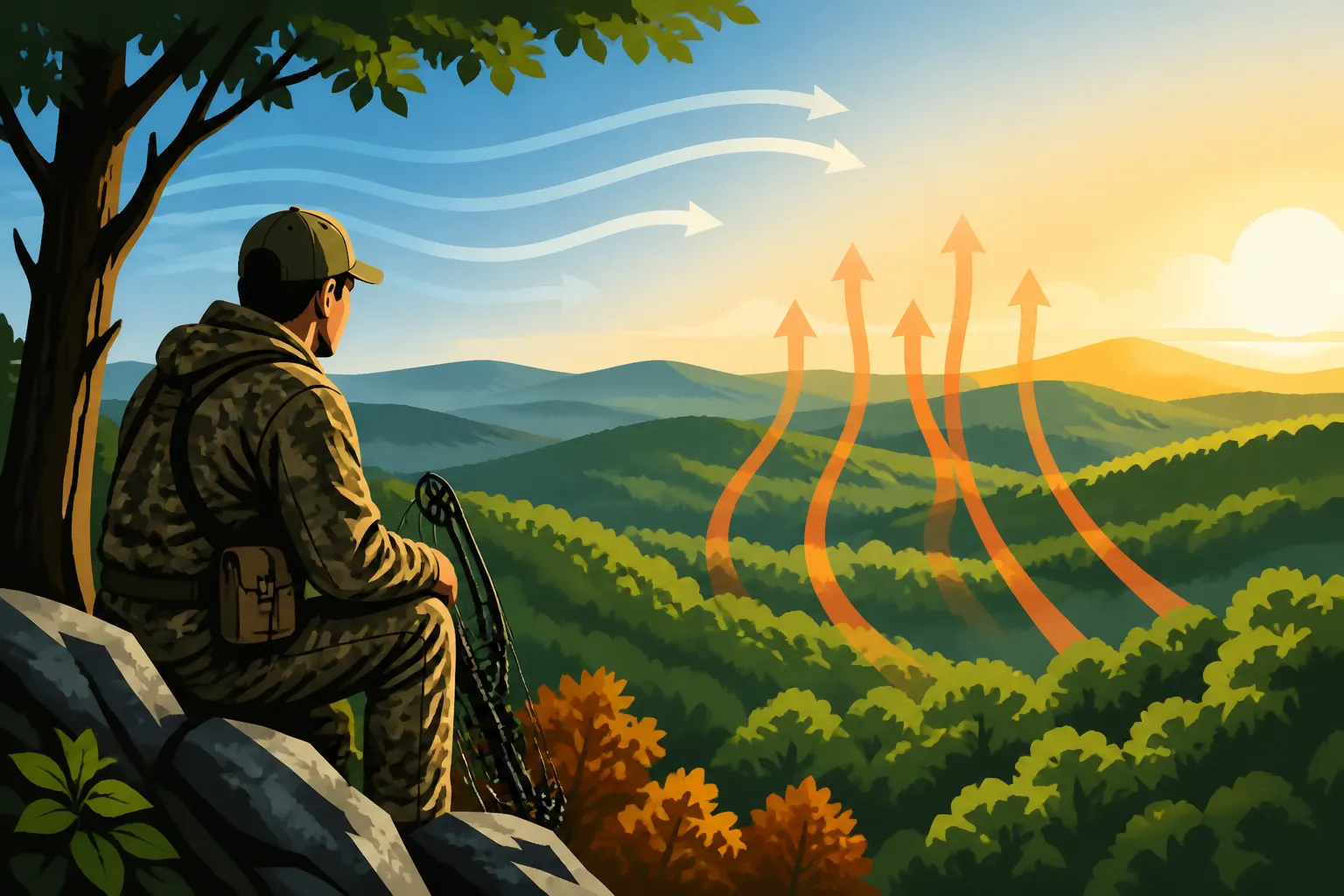
Thermals are essentially localized air movements driven by temperature differences, and they are huge players in the Upstate. Think of them as the rising and falling columns of air. As the sun comes up and begins to warm the earth, it doesn't warm everything evenly. Darker soil, rocks, and south-facing slopes heat up faster than shaded areas, valleys, or north-facing slopes. As the air above these warmer spots heats up, it becomes less dense and rises, creating an updraft. This is a morning thermal, carrying your scent up the ridge or out of a hollow.
Conversely, as the sun sets and the earth cools, the air near the ground becomes cooler and denser than the air higher up. This cooler, heavier air then flows down the slopes and into the valleys, creating a downdraft. This is an evening thermal, carrying your scent down the ridge or into a hollow. This daily cycle of updrafts in the morning and downdrafts in the evening is predictable, but it's also constantly interacting with the larger prevailing winds, making it a nuanced challenge. A strong prevailing wind can often override or significantly alter thermal patterns, but weaker winds allow thermals to dominate. Neglecting thermals is a common mistake that can leave your scent lingering exactly where deer are trying to feed or bed.
Predicting and Reading Wind Patterns in the Upstate
So, how do we, as hunters, decode this complex aerial ballet? It takes a combination of modern tools, old-fashioned observation, and an understanding of how the land itself directs air. This isn't just guesswork; there's a science to it, and the more you learn, the more predictable the "unpredictable" becomes.
Tools and Techniques for Real-Time Wind Assessment
In today's hunting world, we have more tools at our disposal than ever before to help with wind assessment. Relying solely on a weather app's general wind direction for your county is a recipe for disaster on an Upstate ridge. Instead, you need real-time, localized information. A good weather app that provides detailed, hourly wind direction and speed for your specific location is a must. Many advanced hunting apps, like GoHunt, integrate detailed topographical maps with localized wind forecasts, allowing you to visualize how the wind might flow over specific ridges and into hollows.
However, technology isn't perfect, and the best tool is still your own observation. Carry a wind checker (a small squeeze bottle of powder or a milkweed stem) and use it constantly. Before you even get to your stand, check the wind. When you climb into your stand, check it again. Every 15-20 minutes, or whenever you notice a slight change in the leaves or feel a different breeze, check the wind. Watch how the powder drifts not just where you are, but how it carries into the woods, especially towards known deer travel corridors or bedding areas. Pay attention to the subtle cues: the way leaves rustle, the direction smoke from a distant fire drifts (if visible), or even how spiderwebs catch on branches. When you're trying to figure out the best approach for Hunting the Rut in the Upstate Zone, especially when bucks are moving actively, knowing the exact wind direction at all times is absolutely non-negotiable.
How Topography Shapes Air Movement
The Upstate's varied topography – its steep ridges, deep hollows, saddles, and narrow draws – acts like a giant, natural wind tunnel and deflector system. Air doesn't flow uniformly; it's channeled, redirected, and swirled by these features. A prevailing west wind, for instance, might be funneled directly up a steep hollow that runs east to west, creating a much stronger updraft than you'd expect. Conversely, if a ridge has a pronounced saddle, the wind will often dip down into that saddle and then rise again, creating a unique eddy or swirling effect that can carry your scent in unexpected directions.
Consider how air behaves when it hits a sheer face versus a gently sloping hill. A cliff face will often create significant updrafts or downdrafts right along its edge, while a gradual slope might see a more consistent flow. Using an advanced mapping tool like GoHunt can help you visualize these topographical features in 3D, allowing you to anticipate how the wind will interact with them before you even step foot in the woods. By understanding how the contours of the land itself dictate air currents, you can start to predict where your scent will go and, more importantly, where it won't go. This knowledge is especially valuable when you're scouting potential stand sites or planning your approach routes to avoid busting deer before you even get settled.
Tactical Application: Using Wind and Thermals to Your Advantage
Now that we understand the mechanisms, how do we translate this knowledge into actual hunting success? It’s about more than just avoiding detection; it’s about using these natural air movements to conceal your presence, direct your scent away from deer, and even help you find them.
Stand Placement for Consistent Scent Control
Choosing the right stand location in the Upstate is a strategic chess match against the wind and thermals. Your primary goal is to ensure your scent is carried away from where the deer are likely to be, whether it's a bedding area, a travel corridor, or a feeding zone. This often means rethinking conventional wisdom. For instance, if you're hunting a morning sit, you might want to position yourself on the downwind side of a ridge crest or a bench, allowing the rising thermal to carry your scent harmlessly over the deer below. Conversely, for an evening hunt, you might want to be lower on the slope, letting the descending thermal take your scent into a valley where deer are less likely to be, or even below a primary travel route.
Saddles and draws, while excellent deer funnels, are notorious for swirling winds. If you plan on Hanging a Stand on a Sumter Forest Ridge near one of these features, you absolutely need to assess the prevailing wind and thermal patterns on multiple scouting trips before the season. Sometimes, the "perfect" deer sign in a saddle is only huntable on very specific wind conditions, and trying to force it on an iffy wind is a guaranteed bust. Think about the dominant direction of thermals at different times of day and choose a stand that maximizes your scent advantage during that specific window. A good strategy is to have multiple stand options for the same general area, allowing you to adapt to the day's specific wind and thermal forecast.
Still-Hunting and Stalking with the Wind
Still-hunting and stalking on an Upstate ridge demands an even more intimate understanding of wind and thermals than stand hunting. When you're moving, your scent cone is constantly shifting. The golden rule is always to hunt into the wind, but with thermals, it gets more complicated. In the mornings, as you're moving uphill, your scent will be rising with the updraft. This can be an advantage if you’re trying to move along a ridge or gain elevation without deer above you smelling you. However, if you're dropping into a hollow, that same updraft could carry your scent straight to deer that are lower than you.
As the day progresses and into the evening, the thermals switch. Now, as you move downhill or through a hollow, your scent will be carried down the slope. This is ideal for approaching bedding areas that might be lower on a ridge or moving through a creek bottom. However, if you try to move up a ridge in the evening, your scent will precede you like a beacon. Successful still-hunting on Upstate ground, especially in areas like the Sumter National Forest, often means planning your route not just based on deer sign, but on how your scent will travel at different times of the day. Using a portable wind checker every few steps when Still-Hunting Sumter Forest Ridges is non-negotiable. It allows you to make real-time adjustments, skirting around pockets of swirling air or taking advantage of a thermal shift that allows you to close the distance. Even the smallest details matter, from your Packs for a Sumter Forest Day Hunt to the clothes you wear, as anything that creates friction or carries scent can be your undoing.
Leveraging Thermals for Deer Movement and Detection
While we often focus on keeping our scent from deer, intelligent hunters also think about how deer use wind and thermals themselves. Deer are master strategists when it comes to scent. They often bed on ridges or points where they can use a prevailing wind or a thermal to detect predators (like us!) from below, while simultaneously keeping an eye on anything approaching from above. This is why you'll often find them bedding on the leeward side of a ridge, catching the thermal that rises from below, but still having a clear view of the ridge top.
Knowing this allows you to anticipate deer movement. In the morning, deer feeding in valleys or lower slopes will often use the rising thermals to move uphill towards bedding areas on the ridge, feeling safe as their scent travels upwards. In the evening, they'll often reverse this, using the falling thermals to move downhill from their beds to feeding grounds. If you can identify these thermal highways, you can position yourself along them, not just worrying about your scent, but anticipating their movement. Think about setting up an ambush point where deer are likely to cross a specific thermal current as they transition between feeding and bedding areas. It's about thinking like a deer, and using nature's own air conditioning system to predict their next move. Scouting for those key transition zones and observing how the wind and thermals behave there using your GoHunt app for topographic analysis is a vital part of the puzzle for Scouting South Carolina Public Land Before Season.
Here's a quick guide to general thermal behavior through the day in the Upstate:
| Time of Day | Thermal Movement | General Direction of Scent | Best Hunting Strategy |
|---|---|---|---|
| Pre-Dawn | Cool air sinks | Downhill, into valleys | Approach high, set up low, scent goes down. |
| Dawn – Mid-Morning | Sun warms slopes, air rises | Uphill, out of valleys | Approach from low, set up high, scent goes up. |
| Mid-Day | Variable, less predictable | Swirling, localized | Caution, strong prevailing wind might dominate. Still-hunt carefully or wait for thermal consistency. |
| Mid-Afternoon – Dusk | Air cools, begins to sink | Downhill, into valleys | Approach from high, set up low, scent goes down. |
| Night | Cool air sinks | Downhill, into valleys | Consistent downdraft; generally not hunting hours, but good for understanding deer movement. |
Understanding these nuances makes all the difference. It turns the "unpredictable" into something you can anticipate and use.
Disclaimer
Always check the current South Carolina Department of Natural Resources (SCDNR) regulations for specific hunting seasons, bag limits, and legal requirements. Hunting conditions and regulations can change, and it is the hunter's responsibility to stay informed and hunt ethically and legally.