Rifle Scopes for Low-Light Swamp Edges
There's nothing quite like the early morning mist rising from a South Carolina swamp, or the soft glow of twilight painting the edges of a cypress stand. It's a magical time, but for deer hunters, it also presents a very real challenge: incredibly low light. When those big swamp bucks start moving from their bedding areas right at legal shooting time, or slip into a food source just before dark, having the right rifle scope can make all the difference between a successful hunt and a missed opportunity. This guide is all about helping you cut through the gloom and pick a scope that performs when it matters most in our unique Lowcountry environments.
The Unique Challenges of Low-Light Swamp Hunting in South Carolina
Hunting in South Carolina's swamp and lowcountry regions offers some of the most exciting, yet demanding, conditions an outdoorsman can face. The environment itself is a major factor in why low-light optics are so critical here. It's not just about dawn and dusk; it's about the pervasive dimness that the landscape creates.
The South Carolina Swamp Environment
Imagine yourself deep in the Francis Marion National Forest, or the vast lowlands near the ACE Basin, the kind of place where giant cypress trees stand sentinel, draped in Spanish moss, and the undergrowth is a dense tangle of palmetto, gallberry, and hardwoods. This isn't wide-open country with distant vistas. Here, the canopy above is often thick and unbroken, filtering out sunlight even in the middle of the day. As the sun begins to set, or before it truly rises, this natural overhead cover turns the forest floor into a cavernous, shadowy world.
This density means that ambient light, which scopes rely on, is drastically reduced. Shadows are deeper, and distinctions between objects become blurred. Humidity, a constant companion in South Carolina, can also contribute to a hazy, diffused light, especially early in the morning when the air is thick with moisture or a light fog hangs low. Spotting a deer that's only 50 yards away can feel like trying to pick out a needle in a haystack if your optics aren't up to the task. It's a battle against the environment as much as against the deer's natural stealth. Francis Marion National Forest Hunting
Prime Deer Movement Times
It's no secret that deer are often crepuscular, meaning they are most active during the twilight hours of dawn and dusk. This holds especially true in the warmer climes of South Carolina, where deer tend to hunker down during the heat of the day. As the temperatures drop slightly in the late afternoon, or as the first cool breath of morning arrives, deer begin to stage and move, heading to and from feeding areas or seeking out social interaction during the rut.
These are precisely the moments you're most likely to encounter a mature buck. He's not going to stroll across an open field at high noon. Instead, he's going to work the edges, stick to the thickest cover, and appear almost silently at the last possible second. If you're hunting a food plot that's tucked deep into the woods, or sitting over a scrape line along a logging road, you need a scope that can gather every last photon of light available to give you a clear sight picture. These narrow windows of opportunity demand optical performance that can literally illuminate your target. When you're trying to Hunt the Rut in the Coastal Zones, these brief, low-light encounters are often your best bet.
Understanding Scope Basics for Low Light Performance
When you're dealing with challenging light conditions, not all scopes are created equal. Knowing the core components and how they influence light transmission is key to making an informed choice for your swamp hunting adventures. It's not just about magnification; it's about how efficiently your scope can capture and deliver light to your eye.
Objective Lens Size and Light Transmission
The objective lens is the large lens at the front of your scope, the one closest to the muzzle. Its primary job, for our purposes, is to gather light. Generally speaking, the larger the objective lens diameter, the more light it can collect. Think of it like a funnel for light. A 50mm objective lens will gather more light than a 40mm objective lens, all else being equal. This extra light is crucial when trying to resolve an image in dim conditions.
However, there's a practical limit to how large you want your objective. A bigger objective means a larger, heavier scope, which can affect the rifle's balance and handling. It also requires higher scope rings, raising the scope off the rifle and potentially affecting your cheek weld and natural point of aim. In dense swamp cover, where shots are often closer and quick handling is paramount, an overly bulky scope can be a hindrance. A sweet spot for many South Carolina hunters often lies in the 40mm to 44mm range, offering a good balance of light gathering without excessive size. You want enough light to see clearly, but not so much bulk that it slows you down when you're still-hunting through thick palmettos.
Exit Pupil and Its Importance
The exit pupil is essentially the beam of light that leaves the eyepiece of your scope and enters your eye. It's calculated by dividing the objective lens diameter by the magnification setting. For example, a 3-9x40mm scope set at 4x magnification has an exit pupil of 10mm (40mm / 4). At 9x magnification, it's about 4.4mm (40mm / 9). Why does this matter? Because your eye's pupil dilates in low light to let in more light, and for most adults, it can dilate to about 5-7mm in truly dim conditions.
For optimal low-light performance, you want the exit pupil of your scope to be equal to or larger than your eye's dilated pupil. If the scope's exit pupil is smaller, your eye won't be able to utilize all the light the scope gathered. This is why scopes perform so well at lower magnifications in dim light – their exit pupil is larger. A generous exit pupil also provides a more forgiving sight picture, making it easier and quicker to acquire your target, which is a huge advantage when a deer suddenly steps out of the shadows. When you're trying to quickly shoulder your rifle and make a shot during a Warm-Weather Sitting Strategy in South Carolina, a large exit pupil reduces the fumbling.
Coatings and Glass Quality
Beyond the size of the glass, the quality of that glass and the coatings applied to it are absolutely paramount for low-light performance. Think of it like a window: a cheap, dirty window won't let as much light through as a clean, high-quality one. Optical glass varies significantly in its ability to transmit light without distortion. High-definition (HD) or extra-low dispersion (ED) glass types minimize chromatic aberration (color fringing) and maximize clarity, especially important when trying to distinguish antler tines from branches in the gloom.
Then there are the lens coatings. These microscopically thin layers are applied to lens surfaces to reduce glare and internal reflections, and most importantly, to increase light transmission. Basic scopes might have single or partial coatings, but for low light, you absolutely want "fully multi-coated" optics. This means all air-to-glass surfaces have multiple layers of anti-reflective coatings. These coatings drastically reduce light loss within the scope, ensuring that more of the precious ambient light collected by the objective lens actually reaches your eye. This translates to a brighter, clearer, higher-contrast image, allowing you to see definition and color when other scopes just show a dark smudge. Investing in superior glass and advanced coatings is probably the single most impactful decision you can make for low-light capability.
Key Features for Swamp Edge Scopes
Hunting the low-light edges of South Carolina swamps demands specific features from your rifle scope. It's not just about maximum magnification; it's about clarity, quick target acquisition, and the ability to withstand the challenging environment.
Magnification Range for Close Quarters
Unlike hunting vast plains or clear-cuts where long shots are common, swamp edges often mean close-range encounters. A deer might appear at 20 yards, or even closer, especially when working through thick cover. For these scenarios, a scope with a wide field of view and a low minimum magnification is crucial. Scopes with a starting magnification of 1x, 2x, or even 3x are ideal. A 1-4x, 2-7x, or 1-6x variable scope gives you the ability to zoom out for a broad sight picture, making it easier to track a moving deer in dense woods or acquire a target quickly when it steps out suddenly.
While you might appreciate a little more zoom for a longer shot across a small field or cypress pond, excessive magnification can actually be detrimental in the swamps. At higher power, your field of view narrows, and any natural wobble in your hold becomes exaggerated. Furthermore, the exit pupil shrinks at higher magnification, making the image darker – exactly what you don't want in low light. A versatile scope that offers a good low end (1x-3x) and a moderate high end (6x-9x) is typically the best choice. Remember, Rifle Ranges Realistic in Lowcountry Woods are often much shorter than you think.
Reticle Choices for Low Light
The reticle (your crosshairs) is what you use to aim, and in low light, its visibility can be just as important as the image quality. Fine, thin crosshairs that are excellent for precision shooting in bright conditions can completely disappear against a dark background or a deer's dark hide in the shadows. For low-light swamp hunting, a bolder, heavier duplex reticle is often preferred. The thicker outer posts draw your eye to the center, and the finer inner crosshairs still allow for precise aiming.
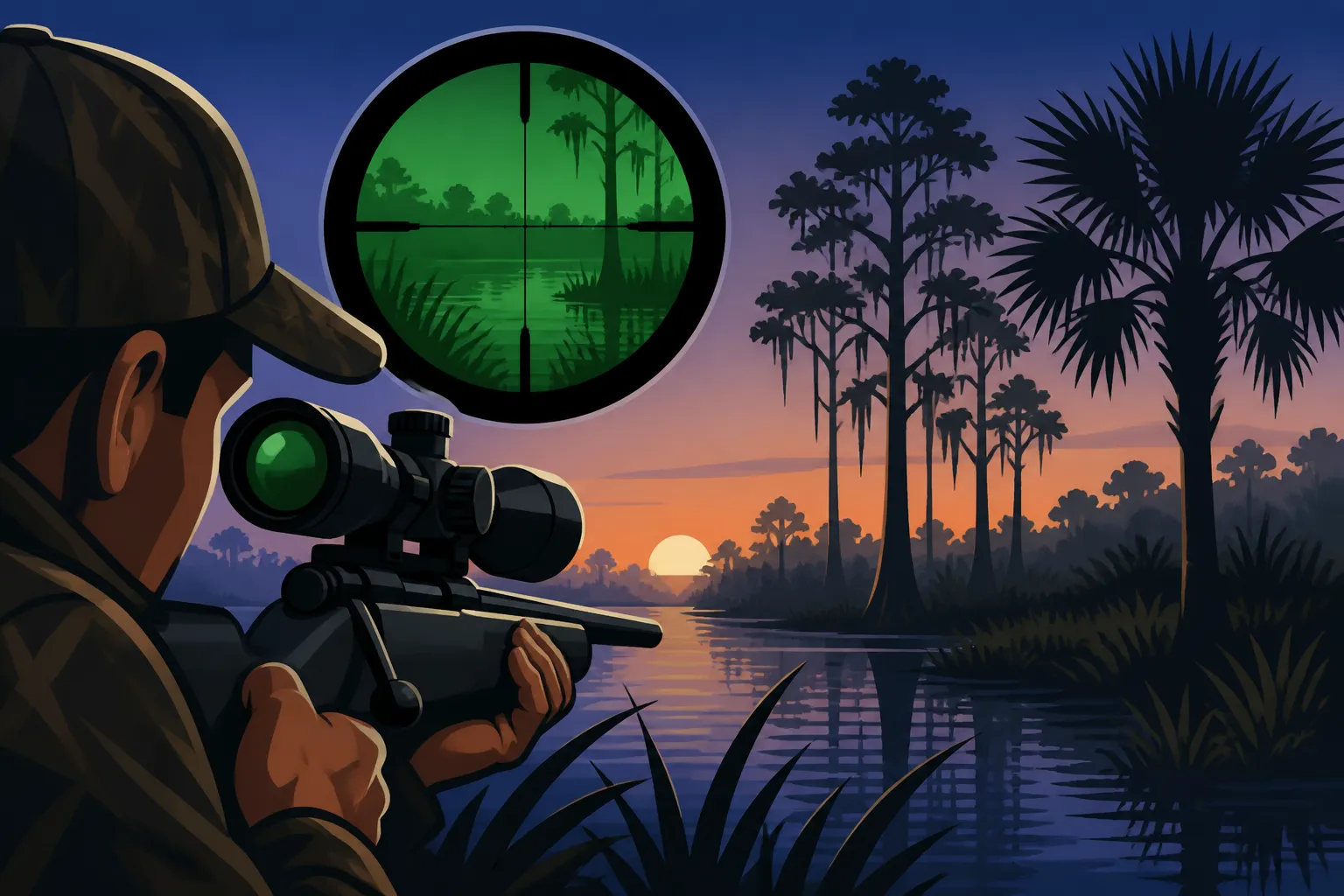
However, the real game-changer for many is an illuminated reticle. This feature allows you to light up the center of your reticle, or the entire reticle, with a soft red or green glow. This provides a distinct aim point that stands out against any background, regardless of how dark it is. Modern illuminated reticles often have multiple brightness settings, so you can dial it down to a subtle glow that doesn't wash out your vision, or crank it up if you're battling strong backlighting. Make sure to check battery life and easy accessibility of the illumination controls. Having a dead battery when that trophy buck steps out is a frustrating scenario you want to avoid.
Durability and Weatherproofing
South Carolina's climate is notoriously harsh on gear, and rifle scopes are no exception. The high humidity, frequent rain showers, and potential for accidental bumps and scrapes demand a scope that can take a beating and keep performing. Durability starts with the scope's construction: a solid, one-piece main tube is generally more robust than a multi-piece design.
Weatherproofing is non-negotiable. Look for scopes that are advertised as being "fog proof" and "waterproof." This typically means the scope's interior has been purged of air and filled with an inert gas like nitrogen or argon, and then sealed with O-rings. This prevents moisture from entering and condensing on the internal lenses, which would render your scope useless on a foggy morning or after a sudden downpour. A truly waterproof scope should be able to withstand immersion in water without leaking. Shock resistance is also critical, as bumping your rifle in a tree stand or during a long walk through thick brush is almost inevitable. A quality scope will hold its zero even after such impacts. Don't let your hunt be ruined by Fogging Optics in South Carolina Humidity.
Practical Considerations and Setup
Having the right scope is one thing; setting it up correctly and knowing how to use it effectively in real-world scenarios is another. A poorly mounted scope or a lack of practice can negate all the advantages of premium optics.
Mounting and Eye Relief
Proper mounting of your rifle scope is foundational to its performance and your shooting comfort. The goal is to achieve consistent eye relief – the optimal distance between your eye and the eyepiece lens – every time you shoulder your rifle. Too close, and you risk getting "scope bit" (the scope hitting your eyebrow during recoil); too far, and you'll struggle to see a full, clear image. Take the time to mount your scope securely in quality rings and bases, adjusting its position until you naturally find a full sight picture when you bring the rifle to your shoulder. If you're using a low-power variable optic (LPVO), ensure you have enough eye relief even at max magnification.
Consider the height of your rings. While a larger objective lens might necessitate slightly taller rings, strive to keep the scope as low to the bore as possible while still clearing the barrel and maintaining proper eye relief. This helps with a consistent cheek weld, which is crucial for accuracy. A good, solid mount ensures your scope holds zero, even after being jostled on a long walk or bumped in a stand. Don't cut corners on mounting hardware; it's the critical link between your rifle and your optics.
Field Testing Your Setup
Zeroing your rifle in bright daylight at a shooting range is just the first step. For low-light swamp hunting, you need to field test your setup in conditions that mimic your actual hunting environment. This means getting out to your hunting property, or a safe area, during the early morning and late evening hours. Practice shouldering your rifle and acquiring targets in the shadows, under a thick canopy, or near a dark tree line.
Pay attention to how quickly you can find your target and how well you can differentiate it from the background. Test your illuminated reticle at different brightness settings to find what works best without causing excessive glare or washing out your vision. Don't be afraid to walk around your hunting area at these times, noting potential shooting lanes and how light behaves at different spots. Use a mapping tool like GoHunt to scout your areas beforehand, marking potential stand locations and understanding the terrain where light might be most challenging. Practice making quick, ethical shots in these challenging conditions, even if it's just dry-firing. The more familiar you are with your rifle and scope in these specific lighting scenarios, the more confident and effective you'll be when a real opportunity arises. Scouting South Carolina Public Land Before Season is not just about finding deer, but understanding the light conditions.
Budget vs. Performance
When it comes to rifle scopes, especially those designed for low-light conditions, there's a strong correlation between price and performance. You don't necessarily need to mortgage your house for a scope, but this is one area where significant compromises to save a few dollars can severely impact your hunting success. Entry-level scopes might offer decent light transmission in bright conditions, but they often fall short when the sun dips below the horizon. The difference in glass quality, lens coatings, and robust construction becomes glaringly apparent in dim light.
Mid-range scopes often strike a fantastic balance, offering excellent clarity, reliable performance, and durable construction without breaking the bank. These are typically a great investment for the dedicated South Carolina hunter. High-end scopes from premium brands push the boundaries of light transmission and clarity even further, often with superior edge-to-edge sharpness and bomb-proof reliability. While diminishing returns apply at the very top end, the extra few minutes of shooting light you gain, or the crisper image that allows you to confidently identify legal antlers, can be priceless. Evaluate what you can realistically afford and aim for the best quality glass and coatings within that budget, prioritizing low-light performance above all else. Remember, you might save a little money on a cheaper scope, but you'll never regret making an ethical shot in challenging conditions thanks to quality glass.
Comparing Scope Types for SC Swamps
The market offers a dizzying array of rifle scopes, but for low-light swamp hunting, certain configurations and characteristics tend to rise to the top. Let's look at how different types might serve you.
Fixed Power vs. Variable Power
For decades, fixed-power scopes were the standard, offering simplicity, robust durability, and often superior optical clarity for their price point due to fewer internal lenses. A classic example might be a 4×32 or 6×40 scope. In thick South Carolina swamps, where shots are generally under 100 yards, a fixed-power scope set at a moderate magnification (like 4x or 6x) could be a very viable and dependable option. The main advantage is that there's nothing to adjust, reducing complexity in the field, and the exit pupil remains constant, which can be beneficial in rapidly changing light.
However, the versatility of variable power scopes has largely made them the preferred choice for most hunters today. A variable scope, like a 2-7×33 or a 3-9×40, allows you to adjust magnification to suit the situation. You can dial down to 2x or 3x for a wide field of view in thick brush or for a quick, close-range shot, maximizing your exit pupil for low-light situations. Then, if a deer steps out a bit further on a field edge, you can crank it up to 7x or 9x for a more precise shot. This adaptability is invaluable, especially as you might transition from deep woods to a semi-open clearing within the same hunt. While potentially having more internal moving parts, modern variable scopes are incredibly robust and offer the best of both worlds for diverse hunting scenarios.
Popular Scope Configurations
Given the blend of close-quarter cover and occasional longer shots across small clearings or lanes, certain scope configurations prove to be particularly effective for South Carolina swamp hunting.
- 1-4×24 or 1-6×24 LPVOs (Low Power Variable Optics): These scopes excel in extremely tight cover, offering true 1x magnification for both-eyes-open shooting like a red dot, combined with enough magnification for closer shots. Their small objective lens means less light gathering, but at 1x or 2x, their exit pupil can still be quite large. They are compact and handle quickly, making them fantastic for quick-moving deer or dense thickets.
- 2-7×33 or 2-8×36: This is often a fantastic middle-ground. The lower magnification provides an excellent field of view and a generous exit pupil for low light, while 7x or 8x is more than enough for typical swamp edge shots. The objective lenses (33mm-36mm) are compact, keeping the scope trim and light, which is great for mobile hunting or when Hunting a Funnel Between Two Swamps.
- 3-9×40 or 3-9×42: This is arguably the most classic and versatile hunting scope configuration. The 40mm or 42mm objective lens gathers ample light, and when set at 3x or 4x, the exit pupil is very forgiving in low light. The 9x top end gives you confidence for those slightly longer shots you might encounter on larger field edges or powerline cuts. For many, this offers the best overall performance for the varied conditions of South Carolina deer hunting. When paired with an illuminated reticle, this is a very hard combination to beat.
| Feature | Ideal for SC Swamps (Low Light) | Considerations |
|---|---|---|
| Objective Lens | 40mm – 44mm (Balance of light & size) | Larger collects more light, but adds weight/bulk; smaller is lighter. |
| Magnification | Low end: 1x-3x; High end: 6x-9x (Variable) | Lower for close quarters, wider FOV; higher for precision at distance. |
| Exit Pupil | >5mm at hunting magnification (e.g., 6-7mm) | Larger for easier eye alignment, brighter image in dim light. |
| Glass Quality | Fully Multi-Coated, HD/ED Glass | Maximizes light transmission, reduces glare, improves clarity/contrast. |
| Reticle | Heavy Duplex or Illuminated (Red/Green) | Bolder for visibility, illuminated for absolute certainty in dark. |
| Durability | One-piece tube, Fog/Waterproof (Nitrogen/Argon purged) | Essential for South Carolina's humidity, rain, and rugged terrain. |
| Eye Relief | Generous (3.5" – 4"+) | Prevents "scope bite," aids quick target acquisition. |
Evaluating Different Scope Tiers for Value
When you're looking at scopes, you'll quickly notice a wide range of price points. It's helpful to think of them in tiers, not just in terms of cost, but in the performance and features you gain for that investment.
At the entry-level, you might find scopes that are quite affordable. These can be adequate for hunting in brighter conditions or very close ranges, but they typically compromise on glass quality, coatings, and often durability. In low-light swamp conditions, these scopes will likely struggle, offering a dimmer, less clear image and making it harder to distinguish details. They might lack illuminated reticles or robust weatherproofing. For the serious hunter relying on those critical twilight minutes, they often fall short.
Moving up to the mid-range tier, you start to see significant improvements. Here, manufacturers invest in better optical glass, more advanced fully multi-coatings, and more rugged construction. You'll often find features like illuminated reticles, precise adjustments, and excellent waterproofing. These scopes offer a substantial leap in low-light performance, providing brighter, crisper images that extend your effective hunting time. They represent a sweet spot for value, giving you a serious advantage in the field without requiring a second mortgage. Brands in this tier often provide very dependable performance, and you can trust them to hold up to the rigors of a South Carolina hunting season. When I'm planning out a new stand location using GoHunt, I always consider how much light will be available at dawn and dusk, and that impacts my scope choice.
The premium tier is where optical performance reaches its zenith. These scopes feature the absolute best glass, cutting-edge coatings, and meticulous craftsmanship. They excel in transmitting the maximum amount of light, offering superior edge-to-edge clarity, incredible contrast, and often a wider field of view. Their mechanical components are incredibly precise and durable, ensuring repeatable adjustments and rock-solid zero retention. While the investment is substantial, these scopes offer an unparalleled advantage in the most challenging low-light conditions, potentially giving you those extra crucial minutes of legal shooting light that make all the difference when Hunting Coastal Maritime Forest Edges or trying to Read a Tidal Creek for Deer Movement just before dark. For the hunter who demands the absolute best and refuses to compromise on optical performance, this tier delivers.
Ultimately, the best value isn't necessarily the cheapest price tag. It's about finding the best combination of light transmission, clarity, features, and durability that you can afford, knowing that your scope is a critical tool for ethical and successful hunting in South Carolina's unique swamp environments.
Disclaimer
This article is for general informational purposes only and does not constitute professional advice. Laws, prices and regulations vary by location and change over time. Consult a qualified professional for guidance on your specific situation.