Coolers for a Warm August Kill
There's nothing quite like the excitement of an early August deer or hog hunt in South Carolina, but that thrill can quickly turn into anxiety when you're staring down a downed animal in 90-degree heat. Meat spoilage is a very real, very swift threat when temperatures are soaring, and a poor cooler strategy can turn your hard-earned trophy into a total loss. This guide is all about equipping you with the knowledge to select the right coolers and employ smart tactics to ensure your warm-weather kill makes it from the field to your freezer, perfectly preserved and ready for the table.
Why August Kills Are a Cooler's Worst Nightmare in South Carolina
Let's face it, August in South Carolina is a special kind of beast. It’s not just warm; it’s hot, and the humidity feels like you’re breathing soup. This environment is absolutely brutal on game meat, and if you don't have a solid plan, all your effort in the stand or tracking through the woods can be for naught.
The Reality of South Carolina's August Heat
When you tag an animal in August, the ambient air temperature is often still pushing into the upper 80s or even low 90s, especially in the coastal zones where the season often starts earlier. Hunting the Earliest Coastal Zone Opener really drives home just how sweltering those first few weeks can be. The ground is radiating heat, the air is thick and still, and there's no cool breeze to speak of. This isn't like hunting in a crisp November morning where the animal can cool naturally for a bit. Here, every minute counts. The internal temperature of a freshly killed deer or hog is high, and without rapid intervention, that heat can cause bacteria to multiply at an alarming rate. It's a constant battle against the elements, and understanding this relentless heat is the first step to beating it.
The Race Against Time
Once an animal is down, a biological clock starts ticking. Bacteria, naturally present on the hide and in the gut, begin to proliferate rapidly in warm conditions. These aren't just external threats; enzymes within the muscle tissue itself start to break down the meat if it doesn't cool quickly. This process is what leads to that sour, gamey taste and even outright spoilage. We're talking hours, not days, for things to go south. A deer lying in 90-degree heat can start to show signs of spoilage in just a few short hours, especially if the gut cavity isn't opened immediately to release internal heat. The key is to get that core body temperature down as fast as humanly possible, ideally below 40 degrees Fahrenheit, to halt or significantly slow bacterial growth. This immediate cooling is paramount, and it means having your system ready to go before you even step foot in the woods.
Common Mistakes Hunters Make
I've seen it happen countless times, and I've even made a few of these mistakes myself in my younger days. The most common error is underestimating the amount of ice needed. Hunters will bring a single bag or two for a medium-sized cooler, thinking it'll be enough. In August, that ice will melt into a puddle in no time, leaving your meat swimming in tepid water. Another frequent misstep is using a cheap, thin-walled cooler that simply can't hold its temperature. These coolers are fine for cold drinks on a picnic, but they are absolutely inadequate for preserving hundreds of pounds of valuable game meat. Finally, delaying processing or getting the animal cooled is a huge mistake. Whether it's taking too long to get the animal out of the woods, not field dressing properly, or simply not having enough ice at camp, every delay compounds the risk of spoilage. Being prepared with the right gear and knowledge is non-negotiable for warm-weather hunting.
Essential Features of a High-Performance Cooler for Game Meat
When you're dealing with South Carolina's summer heat, your ordinary beach cooler just won't cut it. You need something built for extreme conditions, something that can stand up to the challenge of preserving your hard-won venison or hog meat. Thinking of your cooler as an extension of your hunting strategy, just like your rifle or bow, will serve you well.
Insulation Power
The heart of any good game cooler is its insulation. This isn't just about keeping things cold; it's about maintaining a consistent, low temperature for an extended period, which is crucial when you might have a long drive home or if you're waiting for a processor to open.
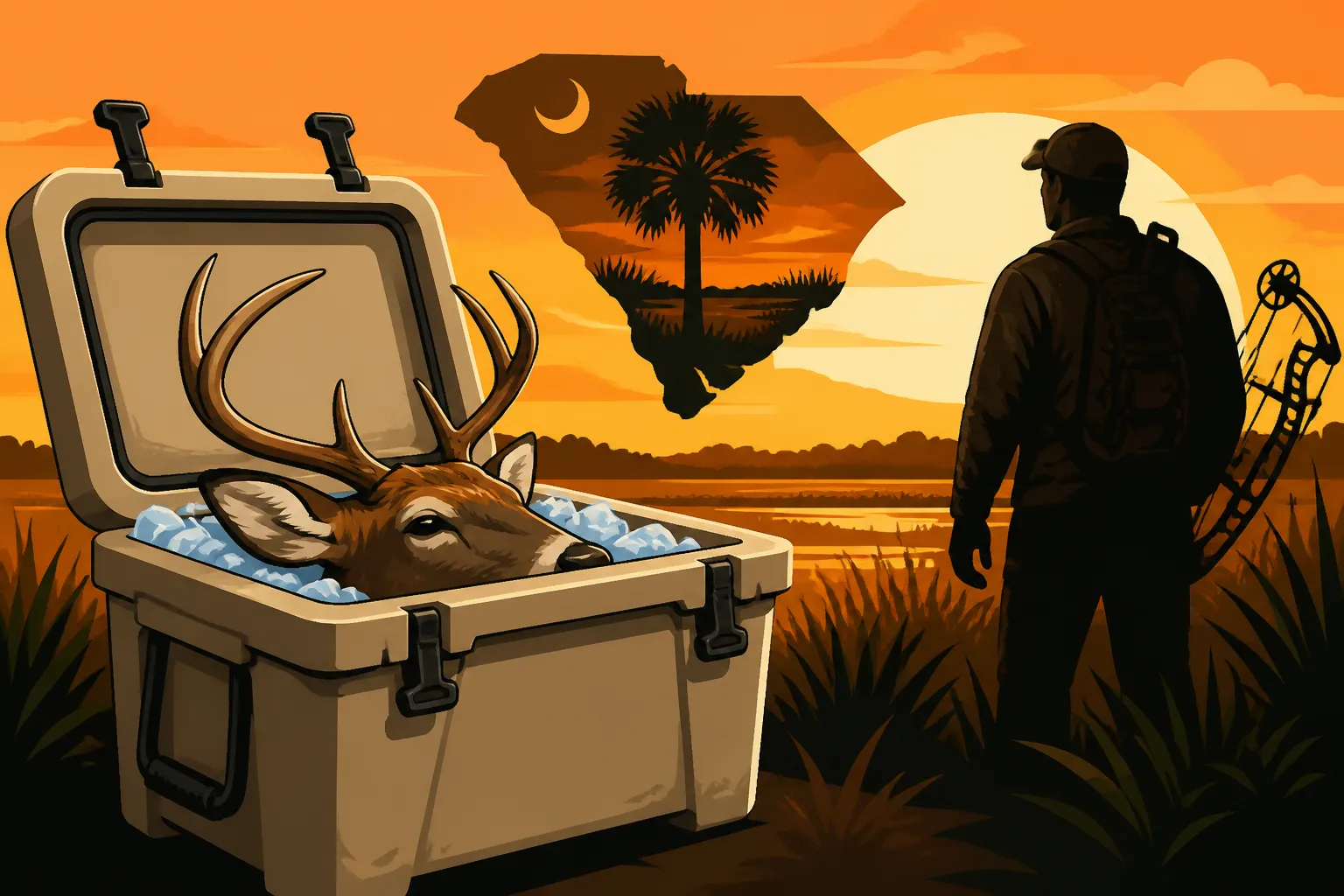
Rotomolded coolers, often referred to as "super coolers," are the gold standard for game retrieval in warm climates. These are manufactured using a process called rotational molding, which creates a single, seamless piece of plastic for the cooler body and lid. This construction allows for exceptionally thick, uniform insulation throughout, usually polyurethane foam injected under pressure. The seamless design eliminates weak points where heat can seep in. Think of the difference between a cheap plastic cup and a high-quality insulated tumbler; it's that kind of leap in performance.
Beyond the thick walls, look for features like freezer-grade gaskets around the lid. These create an airtight seal, preventing cold air from escaping and warm air from entering. Heavy-duty latches (often rubber T-handles) are essential for compressing that gasket and maintaining the seal. Drain plugs should be large for quick draining and leak-proof, sometimes even threaded. Investing in a quality rotomolded cooler from a reputable brand that prioritizes insulation will pay dividends in meat quality and peace of mind. Many hunters swear by brands like RTIC or YETI for their proven performance in brutal conditions, and it’s wise to consider one built to last when dealing with precious meat.
Size and Capacity
This is where many hunters make another critical miscalculation. A whole deer or hog takes up a surprising amount of space, especially when you factor in all the ice you'll need. For most South Carolina deer, a 70-100 quart cooler is a good starting point if you're quartering the animal. For larger deer, like some of the bigger bucks you might find in the Midlands, or a sizable feral hog, you might need an even larger single cooler, or more likely, two coolers. Hunting South Carolina's Year-Round Feral Hogs means you might be targeting some truly massive animals that require serious cooling capacity.
A common rule of thumb is that you'll need roughly one pound of ice for every pound of meat you plan to store. So, for a 150-pound field-dressed deer, you're looking at around 150 pounds of ice. That's a lot of ice, and it takes up space.
Consider your primary game:
- Small Deer/Hogs (under 100 lbs field dressed): A single 70-quart cooler might suffice if quartered meticulously, but 100-quart is safer.
- Average Deer/Hogs (100-175 lbs field dressed): Plan for at least one 100-120 quart cooler, or a combination of smaller ones. Often, a 150-quart will comfortably hold a quartered deer and plenty of ice.
- Large Deer/Hogs (175+ lbs field dressed): You'll almost certainly need two large coolers (e.g., two 100-quart coolers) or one extra-large cooler (200+ quarts).
It's always better to have too much space and too much ice than not enough. If you’re hunting public land or planning a long recovery, having two coolers might be easier to manage than one massive, heavy cooler. Remember, you'll be dealing with this in the heat, potentially tired, and possibly alone.
Durability and Portability
Hunting isn't a delicate affair, and your gear needs to be able to handle abuse. A cooler designed for game meat needs to withstand being thrown in the back of a truck, dragged across pine straw and mud, and loaded with heavy, icy contents.
Look for features like:
- Heavy-duty rotomolded construction: As mentioned, this provides structural integrity.
- Integrated hinges: Rather than thin plastic hinges that can snap, integrated, often stainless steel, pin hinges are much more durable.
- Robust handles: Rope handles with comfortable grips are popular, allowing two people to carry a heavy load. Molded-in handles also work well for lighter lifting.
- Tie-down points: These are crucial for securing your cooler in your truck bed or on an ATV. The last thing you want is your cooler sliding around or, worse, falling out on a bumpy dirt road. Many quality coolers, including those from brands like GoHunt, feature molded-in tie-down slots that make securing them simple and effective.
- Non-slip feet: These prevent the cooler from sliding around, whether in the back of your vehicle or on wet camp ground.
While larger coolers can be heavy, especially when full, consider if you'll be solo or with a hunting partner. Sometimes, two smaller, more manageable coolers are better than one behemoth that's impossible to lift on your own. Portability also involves how easily it cleans; smooth interior walls are a huge plus for washing out blood and grime.
Strategic Cooler Packing and Ice Management Techniques
Having the right cooler is only half the battle. Knowing how to properly pack it with ice and meat, especially after a warm August kill, is where you truly preserve the quality of your harvest. This isn't just about throwing ice in; it's about a systematic approach to rapid cooling.
Pre-Chilling and Ice Selection
This step is absolutely critical and often overlooked. Before you even leave for your hunt, pre-chill your coolers. Fill them with sacrificial ice or even frozen water bottles a day or two before your trip. This brings the internal temperature of the cooler walls down significantly, meaning your "working" ice won't have to waste energy cooling the plastic itself. Dump this initial ice just before you load your real ice supply.
When it comes to ice, not all forms are created equal:
- Block ice: This is your best friend for long-term cooling. Block ice has less surface area than crushed or cube ice, so it melts much slower. It's fantastic for lining the bottom and top of your cooler.
- Cube/Crushed ice: While it melts faster, cube ice is excellent for filling voids and making direct contact with the meat, drawing heat out quickly. It's often best used in conjunction with block ice.
- Frozen water bottles/jugs: These are great for pre-chilling and can also be used in layers. They don't make a mess as they melt, and you can refreeze them.
- Dry ice: While incredibly cold and effective, dry ice requires extreme caution. It's much colder than regular ice and can freeze meat solid, which isn't always desirable if you plan to age it slightly before processing. It also off-gasses carbon dioxide, which can be dangerous in enclosed spaces. If you use it, place it on top of a layer of cardboard or newspaper, and always ensure proper ventilation. For most hunters in South Carolina, regular block and cube ice are sufficient and safer.
Always bring more ice than you think you'll need. Seriously. In August, you're battling extreme heat, and ice melts fast.
Field Dressing and Quartering for Cooler Readiness
The moment your animal is down, the clock is ticking. Your first priority is to get the guts out immediately. Field Dressing a Deer in Warm Weather is a fantastic resource for the specific steps, but the main goal is to remove the primary source of internal heat. Get the cavity open, allow air to circulate, and let that body heat escape.
For most cooler applications, especially in warm weather, quartering the animal is the most efficient approach. This means breaking the deer or hog down into its major muscle groups: two front shoulders, two hindquarters, and the backstraps and tenderloins.
- Advantages of quartering:
- Faster cooling: Smaller pieces cool down much quicker than a whole carcass.
- Easier transport: Quarters are lighter and fit into coolers better.
- Better ice contact: You can pack ice more effectively around individual pieces.
- Cleaner meat: You can remove hair, dirt, and blood much more thoroughly when breaking the animal down.
Once quartered, try to get the meat into game bags if possible, as this keeps it cleaner and allows some air circulation while protecting it from direct ice melt if not fully submerged. Consider boning out some parts, like the front shoulders, to save space and remove additional heat sources.
Layering Meat and Ice
This is the technique that makes all the difference. Don't just dump meat on top of ice. Think in layers.
- Bottom Layer: Start with a generous layer of block ice at the bottom of your cooler. This acts as a cold foundation.
- Meat Layer 1: Place your largest cuts of meat (e.g., hindquarters) directly on the block ice.
- Ice Layer 2: Now, pack cube ice around and over these meat cuts, filling all the voids.
- Meat Layer 2: Add your next layer of meat (e.g., front shoulders).
- Ice Layer 3: More cube ice to fill voids and cover.
- Top Layer: Finish with a thick layer of block ice on top. Cold air sinks, so having a good ice cap is crucial.
The goal is to maximize direct contact between the meat and the ice. Ensure that no meat is touching the warm cooler walls or exposed to the ambient air. As the ice melts, drain the water regularly. While some hunters advocate for letting meat sit in icy water (which does cool it rapidly), clean, fresh ice is generally preferred for quality. If meat must sit in water, ensure the water is still very cold and change it if it starts to get murky. Some folks like to use Game Bags for Warm September Days to keep meat from getting waterlogged, which is a smart move.
Transport and Storage Considerations
Once your cooler is packed, your job isn't quite over. How you transport and store it until final processing can still impact meat quality.
- Keep it out of the sun: Never leave your cooler in direct sunlight. If it's in the back of your truck, throw a wet blanket, tarp, or even an old sleeping bag over it. The evaporation from a wet blanket will actually help keep the cooler surface cooler.
- Secure it: Use the tie-down points to secure the cooler in your vehicle. A heavy cooler sliding around can cause damage to your vehicle, the cooler, or even other people.
- At home/camp: If you're not going straight to a processor or to butcher it yourself, keep the cooler in the coolest spot available – a garage, shed, or even inside an air-conditioned house if space allows. Periodically check the ice level and add more if needed. Keep that drain plug closed during transport, but open it periodically to drain off excess water, then close it again to maintain temperature.
By following these strategic steps, you'll dramatically increase the chances of your warm-weather kill making it to the table as delicious, high-quality game meat.
Beyond the Cooler: Maximizing Meat Quality in Warm Weather
While a top-notch cooler and smart packing are fundamental, they're part of a larger ecosystem of meat care that begins the moment your animal is down. Every step you take, from field to freezer, impacts the final product, especially in the relentless South Carolina heat.
The Importance of Rapid Cooling
We've talked about it, but it bears repeating: speed is your absolute best friend. The quicker you can drop that internal temperature, the less chance bacteria have to multiply and enzymatic breakdown has to begin. This is why thorough field dressing and efficient quartering are so crucial. Simply opening the body cavity helps, but getting those quarters separated and making direct contact with ice is the real game-changer.
Think about it like this: a large, intact mass of meat retains heat for a very long time. Breaking it down into smaller pieces increases the surface area exposed to the cold, allowing heat to dissipate much faster. If you're hunting deer in areas like Francis Marion National Forest, where dragging a whole deer can be a real ordeal, having the tools and knowledge for a quick quartering job in the field becomes even more vital. Every minute spent reducing that core temperature is an investment in the flavor and safety of your meat.
Processing Quickly or Finding a Processor
Even with the best cooler in the world, game meat isn't meant to sit for days in ice water, especially not in warm temperatures. Ideally, once the meat is thoroughly chilled in your cooler, you want to get it processed within 24-48 hours.
If you're a do-it-yourself hunter and plan to butcher your own deer or hog, make sure your workspace is clean, cool, and ready. This might mean setting up in an air-conditioned garage or shed, or waiting until the coolest part of the day. Having all your knives, cutting boards, and vacuum sealer bags ready will help you work efficiently. If you're going the DIY route, you might be interested in resources like Butchering a Deer at Camp for tips.
For many hunters, especially those without the time, space, or expertise for home butchering, finding a reputable local game processor is the way to go.
- Research in advance: Don't wait until you have a deer in the truck to start calling processors. Know their hours, pricing, and specific requirements before season opens. Some processors have limited capacity during peak season.
- Communication is key: Let them know you have a warm-weather kill and that you've taken steps to cool it. They appreciate clean, well-cared-for meat.
- Check reporting requirements: Remember that even after the meat is dropped off, you still have South Carolina Deer Reporting Requirements to adhere to.
No matter which route you choose, the principle remains: swift, hygienic processing is the ultimate goal after rapid cooling. This two-pronged approach ensures the highest quality meat for your table.
Using Game Bags
Game bags are often an afterthought, but they play a crucial role in maintaining meat quality, especially in warmer conditions. They're not just for backcountry hunters; they're valuable for any hunter aiming for clean, high-quality meat.
- Protection from contaminants: Game bags protect your meat from dirt, leaves, pine needles, and insects. While quartering, you'll inevitably get some debris on the meat. A good game bag acts as a barrier.
- Air circulation: High-quality game bags are typically made from breathable, synthetic material or cotton pillowcase-like fabric. This breathability is important because it allows the meat to "breathe" and form a protective pellicle (a dry, slightly firm surface layer) which helps prevent spoilage. If meat is completely sealed in plastic in warm conditions, it can sweat and create an anaerobic environment, which can lead to off-flavors.
- Keeps meat clean in cooler: Inside the cooler, game bags prevent direct contact with ice and water if you choose to let some water accumulate. This helps avoid waterlogging and keeps the meat drier, which is generally preferred for quality. Game Bags for Warm September Days are a smart investment, keeping your meat pristine from the field to the kitchen. Quality brands, like those often reviewed by GoHunt for their effectiveness and durability, can make a real difference in this regard.
Long-Term Storage Prep
Once your meat is cooled and processed, proper long-term storage is the final piece of the puzzle. Freezing is the most common and effective method for preserving game meat for many months.
- Vacuum sealing: This is by far the best method for freezing. Vacuum sealers remove all the air from around the meat, preventing freezer burn and extending its shelf life significantly.
- Freezer paper/heavy-duty freezer bags: If you don't have a vacuum sealer, wrap meat tightly in freezer paper, ensuring no air pockets, and then place it in heavy-duty freezer bags. Double-wrapping is often a good idea. Label everything with the date and cut.
- Rapid freezing: Place packages in the coldest part of your freezer, spread out initially so they freeze quickly, rather than stacking them, which can slow the freezing process.
By combining diligent cooling in the field with meticulous processing and proper long-term storage, you can enjoy the fruits of your South Carolina warm-weather hunt long after the season ends. Knowing South Carolina's Four Game Zones and their differing season dates will help you anticipate when these warm weather challenges are most likely to occur.
| Cooler Type | Pros | Cons | Ideal SC Hunting Scenario |
|---|---|---|---|
| Rotomolded | Superior insulation, extremely durable, excellent ice retention. | Heavy, expensive, often bulky. | Essential for early season (August/September) deer/hog hunts, especially on public land like Sumter National Forest Hunting where recoveries might be longer, or when traveling a significant distance home. |
| Hard-Sided | Good balance of cost and performance, decent ice retention, durable. | Insulation not as robust as rotomolded, may not retain ice as long. | Suitable for cooler weather hunts, shorter trips, or for separating different cuts of meat. Can work for smaller game in warm weather if you refresh ice frequently. |
| Soft-Sided | Lightweight, portable, easy to carry, flexible for tight spaces. | Limited ice retention, prone to punctures, smaller capacity. | Best for light duty, like carrying water or snacks on a quick scouting trip or a dove hunt. Not recommended for preserving game meat in South Carolina's heat for more than an hour or two. |
| Electric/Powered | No ice needed, consistent temperature, can be powered by vehicle. | Requires power source, can drain battery, less durable, limited capacity. | Niche use for keeping already chilled items cool during transport, but not typically powerful enough to rapidly chill warm game meat. Best as a secondary cooler for drinks or pre-cooked meals, not for fresh game in a warm environment. |
| Styrofoam | Very cheap, extremely lightweight, disposable. | Very poor insulation, fragile, breaks easily, virtually no ice retention. | Absolutely not suitable for game meat in warm South Carolina weather. Might serve as an emergency backup for ice storage if nothing else is available, but meat will spoil quickly. |
Disclaimer
This article is for general informational purposes only and does not constitute professional advice. Laws, prices and regulations vary by location and change over time. Consult a qualified professional for guidance on your specific situation.