Canada Geese on South Carolina Farmland
The sight of a vast flock of Canada geese descending on a freshly cut cornfield or a winter wheat patch is enough to get any South Carolina waterfowler's heart pumping. But let's be real, finding these birds consistently on private farmlands, navigating permissions, and figuring out their ever-changing routines can feel like cracking a secret code. This guide is all about breaking down those barriers, helping you understand how to locate, approach, and ethically harvest Canada geese that call South Carolina's rich agricultural lands home.
The Shifting Landscape of Canada Goose Populations on South Carolina Farmland
Gone are the days when Canada geese were primarily a transient spectacle, just passing through South Carolina on their way further south. Over the past few decades, a significant population of resident Canada geese has made our state their year-round home, and they've developed quite a fondness for our abundant farmlands. Understanding this shift is the first step in successful hunting.
Distinguishing Between Resident and Migratory Flocks
It's easy to lump all Canada geese together, but the truth is, the birds we see on South Carolina farmlands often fall into two distinct categories: the true migratory birds passing through from up north, and our growing population of resident geese. Each group has its own quirks, and recognizing them can really inform your hunting strategy.
Our resident geese, sometimes affectionately (or frustratingly) called "giant Canadas," are the descendants of birds released in restoration efforts decades ago. They've found a paradise here with mild winters, plenty of water, and an endless buffet of agricultural crops. Unlike their migratory cousins who are driven by the primal urge to travel thousands of miles, these local birds are largely content to stick around. This means their daily patterns are often more predictable, moving between specific roosting waters and feeding fields within a relatively small home range. They tend to be a bit more accustomed to human activity, which can make them seem less wary, but don't let that fool you—they're still incredibly intelligent birds.
Migratory geese, on the other hand, are the travelers. They show up primarily in late fall and winter, driven by colder weather further north. These birds are often more skittish and prone to packing up and leaving an area if pressured too much. Their patterns can be less consistent, as they might be exploring new feeding grounds or simply staging before continuing their journey. While South Carolina Waterfowl Zones and Seasons dictate general hunting periods, knowing which population you're targeting can help you adjust your calling, decoying, and overall approach to be more effective.
Why South Carolina Farmland is a Goose Magnet
South Carolina's diverse agricultural landscape provides an irresistible smorgasbord for Canada geese, both resident and migratory. This isn't just a casual pit stop for them; it's a strategic dining destination that offers everything a goose needs to thrive.
First and foremost are the food sources. Our farmlands are rich in grains and vegetation that geese absolutely adore. Think vast fields of corn stubble after the fall harvest, where kernels of golden goodness are readily available. Then there are the winter wheat fields, lush green carpets emerging in the cooler months, offering tender shoots for grazing. Soybeans, peanuts, and various other crops all contribute to a year-round pantry that keeps the geese well-fed. These fields are like open-air buffets, drawing in large numbers of birds who can feed efficiently and replenish their energy stores, especially important for those long-distance travelers.
Beyond the food, water is an equally critical component. Most agricultural areas in South Carolina have abundant water sources nearby. This could be large, natural farm ponds, winding rivers and creeks that crisscross the landscape, or even drainage ditches and flooded low spots within fields themselves. Geese need water not just for drinking, but also for roosting at night, where they feel safer from predators, and for loafing during the day. A field adjacent to a decent body of water is often a prime candidate for holding geese, as it offers the perfect balance of food and refuge.
Finally, South Carolina's open farmlands offer a sense of security that geese crave. The expansive, unobstructed views allow them to spot potential predators, like coyotes or even eagles, from a great distance, giving them ample time to take flight. This open environment also provides easy take-off and landing zones, which is crucial for large, heavy birds like Canada geese. They often prefer to rest or "loaf" in these open fields after feeding, away from dense cover where predators might lurk. This combination of abundant food, accessible water, and open, secure loafing areas makes South Carolina farmland an irresistible haven for these big birds.
Mastering the Art of Scouting and Locating Geese in Agricultural Settings
You can't shoot a goose that isn't there, and you certainly can't consistently find success without dedicated scouting. Finding Canada geese on South Carolina farmlands is less about luck and more about understanding their habits and knowing how to read the landscape. It requires patience and observation, but the payoff of being in the right place at the right time is absolutely worth it.
Reading the Fields for Fresh Sign and Behavior
When you're out scouting, you're essentially playing detective, looking for clues that geese have left behind. The first and most obvious sign is droppings. Geese are voracious eaters, and what goes in must come out, frequently and in abundance. Fresh, dark green droppings indicate recent activity, likely within the last day or two. If you find older, dry, or faded droppings, the birds might have moved on. Pay attention to the density of the droppings; a field littered with them signals a preferred feeding spot.
Beyond droppings, look for other visual cues of feeding. Geese graze, pulling up tender shoots, and in a cornfield, they'll pick up fallen kernels, sometimes leaving behind a noticeably "cleaned" area of stubble. In winter wheat or rye, you might see patches where the green shoots have been clipped short. Observing geese in flight can also give you crucial information. Watch their morning fly-outs from communal roosts – often large bodies of water like wide rivers or reservoirs – and track their flight path to potential feeding fields. Similarly, observe their evening returns. These flight lines are often consistent and can lead you directly to their preferred dining spots.
Finally, don't overlook loafing areas. These are spots where geese gather to rest, digest, and socialize between feeding sessions, or where they might spend the bulk of the day if they've already had their fill. These can be specific elevated spots within a field, a dry knoll, or even a shallow, flooded depression that offers a bit of water. Observing these patterns – where they feed, where they loaf, and how they travel between the two – is key to understanding their daily routine and predicting where they’ll be when the season opens.
Leveraging Technology and Local Intelligence for Success
In today's hunting world, technology is a powerful scouting tool, but it's most effective when combined with good old-fashioned local knowledge and relationship building. You're trying to figure out where the geese are, and sometimes, the best information isn't found on a screen.
Mapping tools, like those offered by GoHunt, are invaluable for initial reconnaissance. You can use satellite imagery to identify potential agricultural fields, locate large ponds or rivers that might serve as roosting sites, and pinpoint access points or natural cover for blinds. Layers showing property lines can also be critical, helping you understand land ownership before you even step foot on a property. While these apps won't tell you exactly where the geese were yesterday, they provide a fantastic starting point for identifying promising areas that warrant an in-person visit. You can map out your route to potential fields, mark observed goose activity, and plan out possible blind locations, all from your phone or computer.
However, the real "gold" often comes from developing relationships with local farmers. These folks are out in their fields every single day; they know where the geese are feeding, when they arrive, and where they seem to disappear to. Politely asking for permission to hunt their land (and respecting their answer, no matter what) can open doors to incredible opportunities. This also links directly to the importance of Getting Private Land Permission in South Carolina. A simple knock on the door, a friendly conversation, and an offer to help with any potential crop damage can go a long way. They often view geese as a nuisance, and you might be offering a service. They're also often aware of other wildlife on their land, which could lead to insights about South Carolina’s Year-Round Hog Rule on Private Land, if that's something you're also interested in.
Don't underestimate simply driving around and observing from a distance. A pair of good binoculars can help you spot flocks in distant fields without disturbing them. You might even learn from other hunters, observing where they set up (respectfully, of course, and from afar). Combine your digital research with boots-on-the-ground scouting and friendly farmer chats, and you'll dramatically increase your chances of finding those elusive goose strongholds.
Effective Hunting Strategies for South Carolina Farmland Geese
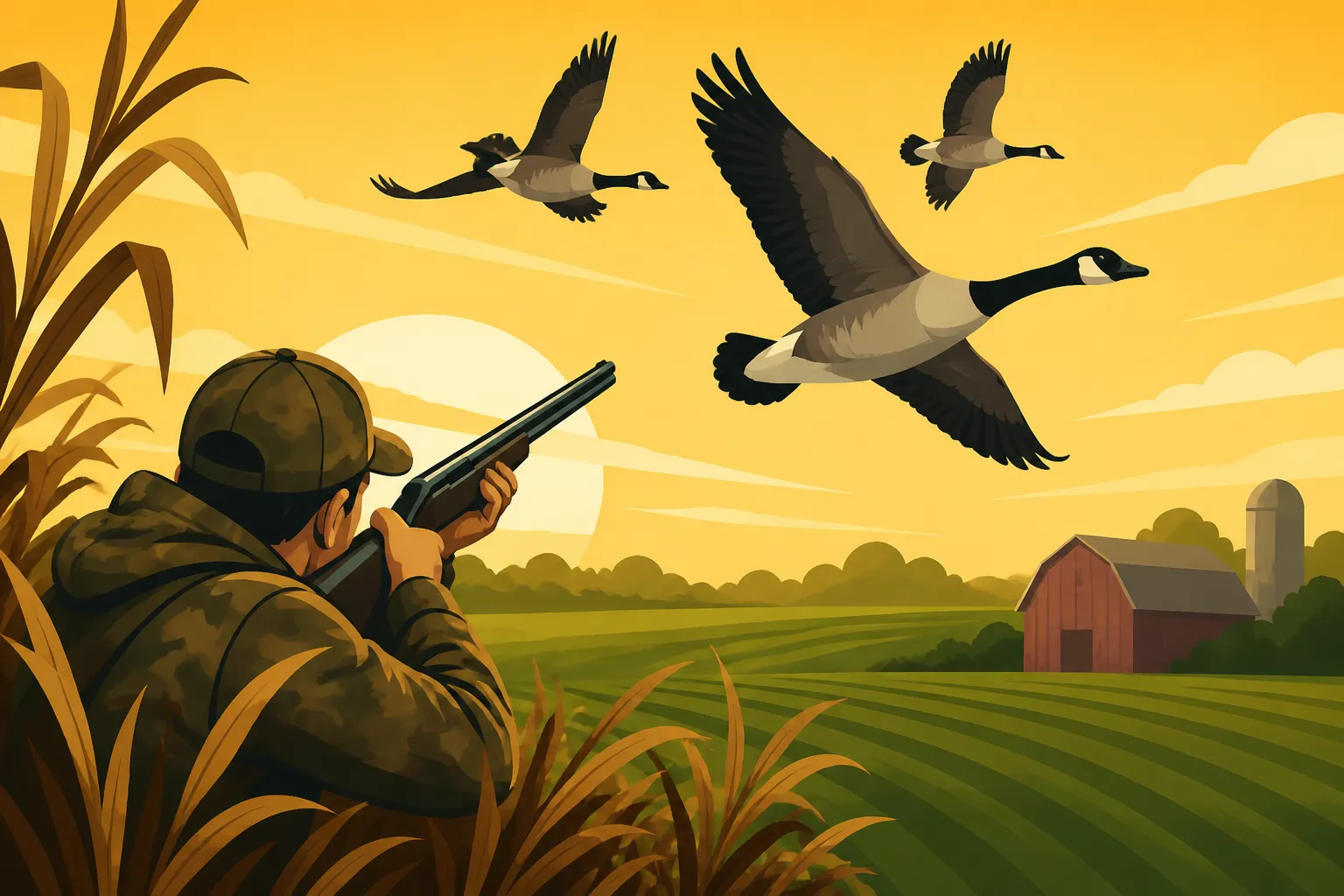
Once you've done your scouting and have a good idea of where the geese are, the real fun begins: setting up to hunt them. Goose hunting on farmland requires a blend of art and science, knowing how to present a convincing spread of decoys, speak their language, and remain absolutely invisible until the opportune moment.
Decoy Spreads and Concealment for Field Hunting
Successfully luring Canada geese into shooting range hinges on a convincing decoy spread and impeccable concealment. Geese are wary birds, especially once they've been hunted a bit. Your spread needs to look natural, like a contented flock feeding or loafing.
There's a wide variety of decoy types available, each with its pros and cons. Full-body decoys are incredibly realistic and effective but can be bulky and expensive. Shells offer a good balance of realism and portability, while silhouettes are the most compact and affordable, though less convincing up close. Many hunters use a mix, placing full bodies closer to the blind and filling out the edges with shells or silhouettes. Motion decoys, like flags or windsock decoys, can add vital movement, mimicking actively feeding birds and catching the attention of distant geese. For a field setup, a spread of at least two to three dozen decoys is a good starting point, but the more the merrier, especially for larger, more visible flocks.
The layout of your decoys is just as important as their quality. Geese prefer to land into the wind, so understanding the prevailing wind direction is crucial. A common and effective spread is a "J" hook or a loose "U" shape, with the open end of the "J" or "U" facing into the wind. This creates a natural-looking landing zone right in front of your blind. Place small family groups of decoys, varying their postures (feeders, sentries, resters) to enhance realism. Always leave a clear, spacious landing strip within your spread where you expect the geese to commit. The techniques can be similar to those used in Layout Blind Hunting Lowcountry Rice Fields, just adapted for different terrain and species.
Finally, concealment is paramount. Geese have incredible eyesight. Layout blinds, designed to blend seamlessly into a field environment, are the go-to for field hunting. They keep you low to the ground and allow you to pop up quickly when the birds are in range. Brush your blind in heavily with local vegetation—corn stalks, wheat stubble, or whatever material is naturally in the field. The goal is to make your blind disappear completely. If you don't have layout blinds, natural cover like hay bales, hedgerows, or treelines can work, but always prioritize breaking up your outline and blending into the background.
Calling Techniques and Sound Discipline
Calling Canada geese is an art form, not just about making noise. It's about convincing a flock to change its course, drop altitude, and commit to your spread. It requires understanding what different calls mean and knowing when to use them—and perhaps more importantly, when to stay silent.
You'll want a repertoire of calls, from the deep, resonant "honk" of a dominant gander to the softer "clucks" and "murmurs" of contented feeding birds. Start with a series of aggressive "hail calls"—loud, long honks—to get the attention of distant flocks. As they turn and begin to approach, switch to more reassuring "come-back calls," often a series of shorter, pleading honks. Once they're closer and circling, soften your calling significantly. This is when the "clucks" and "murmurs"—short, soft, guttural sounds—become incredibly effective, mimicking a contented flock on the ground. Think of it as a conversation; you're trying to draw them in, then make them feel comfortable enough to commit.
Reading the geese's reaction to your calls is critical. If they respond positively, circling and losing altitude, you're doing something right. If they flare or seem hesitant, you might be calling too much, too loudly, or using the wrong call. Sometimes, silence is the most effective call of all. As geese get very close and are about to commit, often the best thing to do is stop calling altogether and let the realism of your decoy spread do the rest of the work. Overcalling can easily spook birds, especially those that have been pressured. Learning to recognize the subtle body language of an approaching flock—their wingbeats, their head movements, their overall posture—will help you decide whether to call, what to call, or to simply let them come.
Pass-Shooting and Jump-Shooting
While decoying is the primary method for field hunting geese, there are other tactics that can be employed, though they require different considerations and ethical standards. Pass-shooting and jump-shooting are less common for large numbers of geese on farmland, but can be effective in certain situations.
Pass-shooting involves positioning yourself along a known flight path between a roost and a feeding area, or between two feeding areas. The goal isn't to draw the birds in, but to intercept them as they fly past. This requires precise timing and a deep understanding of their consistent flight corridors. It's often employed along river bends, over prominent treelines, or at the edges of large fields that geese frequently cross. The challenge with pass-shooting is that birds are often high and moving fast, making ethical shot placement more difficult. It's crucial to know your effective shooting range and to only take shots at birds that are well within that range to ensure a clean kill. Avoid sky-busting or taking wildly optimistic shots, as this often leads to wounded birds and frustrated hunters.
Jump-shooting, where you stalk birds on the ground or water and then "jump" them into flight for a shot, is rarely a viable or ethical method for large flocks of Canada geese in open farmlands. Their keen eyesight and open surroundings make it nearly impossible to approach within effective range undetected. It's more commonly used for ducks on smaller creeks or ponds. However, in very specific situations, such as finding a small group of geese loafing in a secluded farm pond surrounded by thick cover, a careful stalk might allow for a jump-shot opportunity. Always consider the terrain, the bird's awareness, and your ability to get within a responsible shooting distance before attempting this method. Ethical hunting demands that we respect the game and strive for clean, humane harvests.
Essential Gear and Regulatory Compliance for Goose Hunters
Being prepared with the right gear and a solid understanding of the regulations is just as important as knowing how to call and decoy. Having reliable equipment ensures your safety and comfort, while adhering to the law protects you and the future of the sport.
Firearm and Ammunition Choices for Geese
When it comes to goose hunting, you're dealing with big, tough birds, so your firearm and ammunition choices need to reflect that. The 12-gauge shotgun is, without a doubt, the most popular and versatile choice for goose hunting. Its balance of firepower, ammunition availability, and manageable recoil makes it ideal for the task. Some dedicated goose hunters opt for a 10-gauge, which delivers an even heavier payload, but it comes with increased recoil and often a heavier firearm. Pump-action and semi-automatic shotguns are preferred for their ability to deliver follow-up shots quickly, crucial when multiple birds commit to the decoys.
Choke tubes are critical for patterning your shotgun effectively for geese. A modified or improved modified choke is often a good starting point, providing a balance of pattern density and spread at typical goose-shooting ranges (25-45 yards). For longer shots, or if you consistently find birds hanging on the fringes, a full or extra-full choke might be considered, but it requires careful patterning to ensure sufficient pattern density without blowing out the pattern too quickly. Patterning your shotgun with your chosen ammunition at various distances before the season is absolutely essential; every gun and choke combination is unique.
Ammunition choice is perhaps the most crucial element for ethical goose hunting. Federal law requires the use of non-toxic shot for all migratory bird hunting. This means lead shot is strictly prohibited. Steel shot is the most common and affordable option, but many hunters prefer bismuth or tungsten-based loads for their superior density, which translates to better energy retention and deeper penetration, especially at longer ranges. Shot sizes like BB, BBB, or T are typically recommended for Canada geese. These larger pellets deliver the kinetic energy needed to reliably bring down a tough bird. For more insights on choosing the right shotgun and ammunition for migratory birds, you might check out advice for Shotguns for South Carolina Dove and Quail, which often shares principles applicable to geese.
Understanding South Carolina's Goose Hunting Regulations
Navigating hunting regulations can sometimes feel like a maze, but it's absolutely non-negotiable for a responsible hunter. For Canada geese in South Carolina, understanding the specific rules for migratory birds is paramount.
South Carolina's waterfowl seasons are set annually, typically falling within the framework established by the U.S. Fish and Wildlife Service. While duck seasons might have different splits and closures, Canada geese often have a more consistent season, sometimes extending for a longer period. It's crucial to consult the current year's SCDNR Waterfowl Regulations brochure or their website for precise dates in your South Carolina Waterfowl Zones and Seasons. Don't just assume previous years' dates are the same.
Bag limits are also strictly enforced. The daily bag limit specifies how many geese you can harvest in a single day, and there's also a possession limit, which dictates how many legally harvested birds you can have in your possession (including those at home in your freezer). These limits can change, so always verify them for the current season by checking resources like South Carolina Duck and Goose Bag Limits. Violating these limits can result in significant penalties, including fines and license suspension.
Finally, proper licensing and stamps are required. Beyond your basic South Carolina Resident Hunting License Options (or nonresident equivalent), migratory bird hunters need additional endorsements. You'll need a valid state migratory waterfowl stamp, a federal duck stamp (available at your post office or online, as outlined in South Carolina Federal Duck Stamp Requirement), and proof of Harvest Information Program (HIP) certification. HIP certification is a free, brief survey that helps wildlife agencies gather data on migratory bird harvests, and it's mandatory for anyone hunting ducks, geese, doves, or other migratory game birds. Be sure to complete your South Carolina HIP Certification for Bird Hunters before heading afield. Always carry proof of all your licenses and stamps with you while hunting.
Respecting the Land and Ensuring a Safe Hunt
Hunting on private farmland is a privilege, not a right. Building and maintaining good relationships with landowners is the bedrock of consistent access and a positive public image for hunters. Beyond that, safety should always be your absolute top priority in the field.
The Critical Importance of Landowner Relations
Hunting opportunities on quality private land are increasingly hard to come by, and securing permission is often about more than just asking. It's about establishing a relationship built on trust and respect, which is why resources on Getting Private Land Permission in South Carolina are so vital.
Think of your first interaction with a landowner as an interview. Be polite, dress neatly, and be prepared to explain your intentions. Offer to share some of your harvest, offer to help with chores around the farm, or simply offer to help manage geese that might be causing crop damage. Once you have permission, treat their property as if it were your own—or even better. Leave absolutely no trace behind. This means picking up every spent shotgun shell, all your trash, and ensuring you don't damage fences, crops, or any other property. Driving only on designated paths and being mindful of livestock or other farm operations are also crucial.
Communication is key. If your plans change, let them know. If you encounter any issues, report them. A landowner who trusts you is far more likely to grant permission year after year, and potentially even open up additional hunting opportunities. Remember, you are an ambassador for all hunters. One disrespectful act can close doors for many others down the line. A strong, positive relationship with landowners is truly priceless, not just for the hunt itself, but for the preservation of hunting traditions on private lands.
Safety First in the Field
No goose is worth risking your life or the lives of others. Basic firearm safety rules are paramount, even for seasoned hunters. Always treat every firearm as if it's loaded. Keep the muzzle pointed in a safe direction, away from people, vehicles, or structures. Keep your finger off the trigger until you're ready to shoot and have identified your target beyond a doubt. Know your zone of fire, especially if you're hunting with partners in a blind. Communicate clearly and frequently to avoid swinging your muzzle across another hunter.
In a layout blind, it's easy to get excited as geese are committing. Ensure your shotgun is loaded only when geese are approaching and you are preparing to shoot. When climbing out of the blind or moving around, unload your firearm. Be acutely aware of what's behind your target. Geese are often shot with wide-open fields behind them, but always double-check for farmhouses, roads, or livestock.
While blaze orange is typically not required when hunting migratory birds, where stealth and camouflage are essential, it's a good idea to wear it when walking to and from your blind, especially during periods when other hunting seasons (like deer) might be open. Once you're in your blind and concealed, you can remove it, but have it ready for when you pack up. Reviewing general safety guidelines, such as those found in South Carolina Blaze Orange Requirements, can always provide a good refresher. Always inform someone of your hunting location and expected return time, especially if you're hunting alone in a remote area. A well-planned and safe hunt is always a successful hunt, regardless of the harvest.
Goose Hunting Considerations Table
| Feature | Resident Canada Geese | Migratory Canada Geese |
|---|---|---|
| Origin/Home Range | Year-round South Carolina residents | Travel from northern breeding grounds |
| Behavior | Often less wary, predictable daily patterns, localized movements | More skittish, variable patterns, broader movements |
| Primary Attractant | Consistent access to food, water, and loafing areas | Food and rest during long journeys, staging grounds |
| Hunting Season | Often available throughout extended waterfowl seasons | Primarily present during colder late fall/winter months |
| Scouting Tip | Focus on consistent roost-to-feed patterns on known fields | Look for large influxes of birds during cold fronts |
| Calling Strategy | Mellow, contented clucks/murmurs; subtle coaxing | More aggressive hail calls to grab attention; varied calls |
| Decoy Spread | Can be effective with smaller, realistic spreads | Larger spreads often more effective to draw distant birds |
| Pressure Tolerance | May tolerate moderate pressure if food is abundant | More likely to abandon an area quickly if pressured |
Disclaimer
Hunting is an inherently dangerous activity. The information provided in this guide is for informational purposes only and should not be considered a substitute for professional instruction, adherence to all applicable laws and regulations, and sound judgment in the field. Always prioritize safety, obtain proper licenses and permits, and respect wildlife and landowners. Refer to the most current South Carolina Department of Natural Resources (SCDNR) regulations before engaging in any hunting activities.