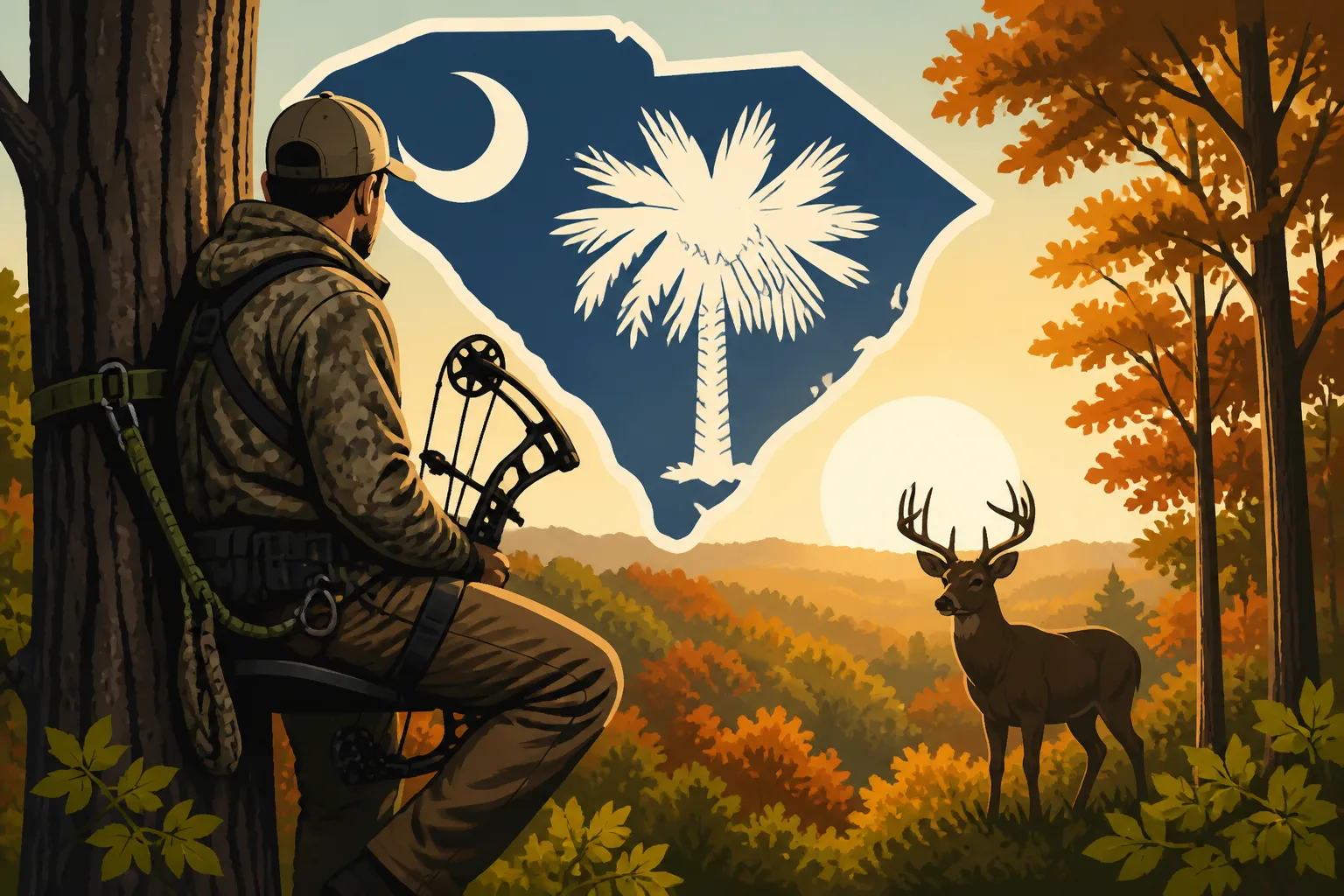
Saddle Hunting in South Carolina Hardwoods
The heavy, clunky nature of traditional treestands can really limit your ability to adapt on the fly, especially when you're trying to pinpoint those elusive South Carolina whitetails in dense, sprawling hardwood forests. The frustration of hauling a bulky stand through thick undergrowth, only to find the perfect tree is just out of reach, is a common one. This guide is all about embracing the nimble, silent world of saddle hunting, giving you the freedom to move, set up quickly, and stay hidden deep within the Palmetto State's magnificent hardwoods, ensuring you're always in the best possible position for success.
Why Saddle Hunting Excels in South Carolina Hardwoods
South Carolina's hardwood forests are a hunter's dream, yet they present unique challenges. From the sprawling bottomlands of the Lowcountry to the rolling ridges of the Upstate, these areas are often characterized by dense canopy, varied terrain, and deer that are constantly on the move, chasing mast crops like acorns and hickory nuts. Traditional ladder stands or even bulky hang-ons can be cumbersome and noisy to deploy, making it tough to stay mobile and react to changing conditions. This is where saddle hunting truly shines, offering an unparalleled advantage in adaptability and stealth.
The Mobile Advantage in Diverse Terrain
Imagine you've scouted a beautiful ridge in Sumter National Forest, littered with white oak trees dropping acorns, and you've identified a promising travel corridor. You get there opening morning, only to find the wind has shifted, or the deer are now feeding just a bit further down a subtle bench you didn't anticipate. With a traditional stand, you're pretty much stuck, potentially blowing your hunt. This scenario is all too common in South Carolina's diverse terrain, where conditions can change in a heartbeat.
Saddle hunting, however, transforms you into a highly mobile hunter. Your entire setup—saddle, climbing sticks, ropes—is incredibly lightweight and packable. You can hike deeper, faster, and more quietly into those less-pressured areas where the big bucks often hide. If the wind changes, or if you notice fresh sign indicating deer have moved to a different feeding area, you can pack up your entire setup in minutes and be on a new tree within a matter of moments, adjusting your setup to exactly where the deer are. This flexibility is particularly invaluable when you're pursuing deer in areas like the Enoree Ranger District, where the hardwoods might transition quickly into thick pines or creek bottoms, and deer movement can be very localized. Being able to quickly move and Hang a Stand on a Sumter Forest Ridge or adapt to a new tree along a Reading a Ridge for Upstate Deer line is a game-changer.
Stealth and Low Impact
One of the biggest struggles for any hunter is minimizing their presence. Deer in South Carolina, especially on public land, are often wary and highly sensitive to unnatural sounds and smells. Clanking metal from climbing sticks or the rustle of a bulky pack can send them scattering long before you even get settled. Saddle hunting drastically reduces your signature, both auditory and visual.
The soft materials of a saddle and the quiet operation of climbing sticks (especially when using rope or strap attachments) make your ascent nearly silent. You become part of the tree, blending into its silhouette rather than sitting as an obvious protrusion. This low-profile setup is a huge benefit in the relatively open understory of many South Carolina hardwoods, where deer can easily spot an exposed hunter. Furthermore, because you're using lightweight, packable gear, you leave less impact on the forest floor, minimizing disturbance to deer trails and bedding areas. It's about becoming a ghost in the woods, something that’s exceptionally difficult with heavier, more conventional equipment.
Essential Gear for a South Carolina Saddle Hunter
Stepping into the world of saddle hunting means adopting a new set of gear designed for mobility and efficiency. It’s not just about the saddle itself; it's about the entire system working together, especially when you consider the unique climate and challenges of hunting in South Carolina’s hardwood forests. From the heat and humidity to the need for durable climbing solutions, your gear choices can make or break your hunt.
The Saddle System and Ropes
At the heart of saddle hunting is, of course, the saddle. This isn't your grandfather's stand; it's a specialized harness that allows you to lean against the tree, rather than sit on it. When choosing a saddle for South Carolina, comfort and breathability are key. Our early archery seasons can be brutally hot and humid, so a saddle designed with mesh or lightweight fabrics can make a huge difference in comfort during those long waits. You'll want to ensure it has ample attachment points for your various accessories and a strong, reliable bridge that connects you to the tree. Brands often offer different levels of padding and design, so trying a few on, if possible, can help you find one that fits your body type and preferences.
Beyond the saddle, your rope system is critical. This includes your lineman's belt and your tree tether. The lineman's belt keeps you secure to the tree as you ascend, allowing you to use both hands for climbing stick placement. The tree tether then connects your saddle to the tree once you're at hunting height, giving you freedom to maneuver around the trunk for shot opportunities. Look for ropes that are quiet, durable, and easy to adjust. Many hunters prefer a system that allows for quick adjustments with a single hand, which is crucial when you're trying to stay quiet and efficient. Always practice with your ropes at ground level first to ensure you understand how to safely and effectively use them. Treestand Safety Gear for Wet Ground is a crucial topic to review, even though saddles have a different setup, the principles of staying safe aloft are universal.
Climbing Methods for Hardwoods
Getting up the tree quietly and efficiently is half the battle in saddle hunting. While traditional climbing stands are out, you'll rely on climbing sticks, steps, or even one-sticking methods. For the often-gnarly and limby hardwoods found across South Carolina, individual climbing sticks tend to be the most versatile option. They allow you to navigate around branches and uneven trunks, providing a stable platform for your feet as you work your way up. When selecting sticks, consider their weight, packability, and how quietly they deploy. Aluminum sticks are popular for their light weight, but some hunters prefer quieter strap-on models over those with metal-on-metal connections.
| Climbing Method | Pros | Cons | Best for SC Hardwoods |
|---|---|---|---|
| Individual Sticks | Highly versatile, good for limby trees | Can be slower to set up, more pieces to carry | Excellent, adaptable to varied tree shapes |
| One-Sticking | Extremely lightweight, fast once mastered | Steep learning curve, requires an aider | Advanced users, ideal for minimal gear |
| Screw-in Steps | Very quiet, lightweight per step | Damages trees, not allowed on public land | Private land only, very low profile |
| Rope Ladders | Compact, quiet | Can be unstable, difficult on large trees | Niche use, less common for hunting |
Many saddle hunters in South Carolina also utilize an aider – a short strap or rope loop that attaches to a climbing stick, allowing you to get more height with fewer sticks. This can shave precious pounds off your pack and make for a faster ascent. When you're trying to make your pack for a Packs for a Sumter Forest Day Hunt as light as possible, every ounce counts. Regardless of your chosen method, practice, practice, practice at home. Getting proficient at climbing silently and safely will significantly boost your confidence and effectiveness in the field.
Warm-Weather Clothing and Bug Protection
South Carolina's hunting seasons, especially archery, start when temperatures are still very much in the warm-to-hot range, coupled with high humidity. This isn't just uncomfortable; it impacts your scent control and focus. Lightweight, breathable clothing is non-negotiable. Look for moisture-wicking fabrics that dry quickly and help regulate your body temperature. Layering is still important, even in warmer weather, to adapt to temperature swings between predawn darkness and midday heat. Light-colored base layers can help reflect some sun, while an outer layer in a good camo pattern helps you blend in. Warm-Weather Clothing for South Carolina Hunters is a critical consideration for comfort and stealth.
The other major component of warm-weather hunting in South Carolina is bug protection. Mosquitoes, ticks, and gnats aren't just annoying; they can ruin a hunt and pose health risks. Permethrin-treated clothing is a must for tick protection, and a good insect repellent (either spray-on or a thermacell-style device) is essential to keep the biting insects at bay. Imagine trying to stay still and focused on a deer when you're swatting mosquitoes every few seconds—it's nearly impossible. Many hunters find platforms like GoHunt invaluable for satellite imagery to identify prime hardwood tracts and potential access points, but also for checking on potential insect hatch activity based on local weather. Integrating these protections into your routine will make your time in the South Carolina hardwoods far more enjoyable and productive.
Strategies for Success in Hardwood Forests
Saddle hunting, while incredibly versatile, requires a different approach than traditional stand hunting. It's not just about the gear; it's about how you use that gear to maximize your chances in the unique environment of South Carolina's hardwood forests. From selecting the perfect tree to understanding how deer move through these areas, a thoughtful strategy is paramount.
Tree Selection and Scouting
In a hardwood forest, good tree selection for a saddle hunter goes beyond just finding a straight trunk. You're looking for a tree that offers natural cover, allows for clear shooting lanes, and ideally places you within range of the anticipated deer movement. This means scouting is absolutely critical. Before the season, spend time walking through the hardwoods, identifying key features like ridge lines, creek crossings, subtle funnels, and most importantly, preferred mast trees. White oaks, red oaks, and hickory trees are often goldmines in the fall. Using mapping applications, often with features found on platforms like GoHunt, allows you to digitally scout areas, identify potential bedding and feeding areas, and mark promising trees.
When you get into the field, look for a tree that offers good bark texture for climbing sticks to bite into and is free of large limbs within your intended hunting height. You don't want to fight major obstructions as you ascend. However, once at height, those smaller limbs and trunk characteristics can actually provide excellent concealment, breaking up your outline. Remember, from a saddle, you're leaning around the tree, so a slightly larger diameter tree can offer more cover. Pay attention to the surrounding timber – is there thick undergrowth or open woods? This will influence how deer approach and how you'll need to position yourself for a shot. Scouting South Carolina Public Land Before Season is invaluable for this preparation.
Managing the Wind and Thermals
Wind and thermals are paramount in any hunting scenario, but for a saddle hunter who is often closer to the trunk and sometimes higher up, understanding these air currents becomes even more critical. In South Carolina's hardwood bottoms, thermals can be particularly tricky, often rising in the morning as the sun hits the canopy and falling in the evening as temperatures drop. On ridges, the wind can swirl and shift unexpectedly, especially where terrain features funnel or block air currents. You need to be acutely aware of how the air is moving around your chosen tree.
This awareness starts long before you even leave home. Check multiple wind forecasts and understand the topography of your hunting spot. Staying updated on wind and thermal patterns, often accessible through advanced mapping features on platforms like GoHunt, becomes a non-negotiable part of your pre-hunt strategy. Once you're on site, confirm the actual wind direction with a powder bottle or milkweed. As a saddle hunter, your mobility means you can almost always choose a tree that gives you the wind advantage. If the wind unexpectedly shifts mid-hunt, your lightweight setup might even allow you to quickly descend, move to a new tree, and re-establish your position before the deer realize you were ever there. Ignoring the wind in South Carolina's hardwoods is a surefire way to spook deer. Wind and Thermals on an Upstate Ridge goes into greater detail on these critical environmental factors.
Shot Angles and Deer Behavior
Shooting from a saddle is different from a traditional stand, and it requires practice. Because you're leaning into the tree, your body position and anchor points will be unique. You'll likely be shooting at more downward angles, which means paying extra attention to your shot placement to avoid hitting the shoulder blade or spine and ensure a clean pass-through. Practice shooting from various positions around a tree in your backyard, mimicking the angles you might encounter in the field. Swiveling around the tree to shoot from your dominant side or off-side is a key advantage of saddle hunting, but it requires smooth, quiet movement.
Understanding deer behavior in South Carolina's hardwoods will guide your setup. During the early season, deer will be focused on water sources and early mast. As fall progresses, acorns become the primary draw, and deer will pattern heavily around active oak trees. During the rut, bucks will cruise through timber looking for does, often using subtle terrain features like benches or faint trails. Set up anticipating where a deer will be, not just where it is now. If you're on a known travel corridor, consider setting up higher to get a clearer view over brush and to allow for better shot angles. Your ability to adjust your position quickly as a saddle hunter means you can fine-tune your setup to the exact moment a deer presents an ethical shot, making every movement count.
Disclaimer
This article is for general informational purposes only and does not constitute professional advice. Laws, prices and regulations vary by location and change over time. Consult a qualified professional for guidance on your specific situation.