Game Carriers for Swamp Terrain
Dragging a deer out of a South Carolina swamp can feel like an Olympic event you never trained for, with mud sucking at your boots, thick palmettos snagging every step, and water obstacles that seem to appear out of nowhere. It's an exhausting, often frustrating task that can turn a successful hunt into a grueling ordeal if you're not prepared. This guide is here to walk you through the best game carriers specifically designed for the unique challenges of swamp terrain, helping you get your trophy and meat out with less back-breaking effort.
The Unique Challenges of South Carolina Swamp Terrain
Let's be real, South Carolina's swamps and lowcountry bottoms are beautiful, but they're also a hunter's endurance test when it comes to game retrieval. It’s not just flat ground with some puddles; we're talking about a complex, dynamic environment that can swallow a lesser game carrier whole.
Imagine you've just dropped a nice buck deep in a WMA off the Santee River. You’re stoked, but then the reality sets in: it's a hundred yards back to solid ground through a mix of shallow cypress knees, mucky depressions, and dense undergrowth. A typical deer cart with bike tires isn't going to cut it here; those narrow wheels will just dig in and stop dead. You'll spend more time pulling the cart out of the mud than you will actually moving the deer. This isn't your grandfather's dry pine woods; this is a whole different beast. The soft, silty bottom, combined with standing water and tangled vegetation, creates a perfect storm for traditional retrieval methods to fail miserably. You need gear that floats, glides, or at least doesn't resist the terrain at every turn.
Types of Game Carriers Best Suited for Swamps
When tackling South Carolina's notorious swamps, you need to think beyond the simple drag rope or the wheeled cart designed for open fields. The right tool for this job makes all the difference, transforming a potential nightmare into a manageable challenge.
Heavy-Duty Game Sleds
These are often your best friend in truly mucky, wet conditions. A good game sled is essentially a large, durable plastic tub designed to slide over surfaces rather than roll. The key here is the smooth, slick bottom that minimizes friction, especially when pulled over mud, leaves, and even through shallow water. Many are made from thick, high-density polyethylene, which is incredibly tough and resistant to punctures from stumps or sharp branches that might be hidden just under the surface.
Think about sliding a deer, even a heavy one, across a slick, wet surface. It's much easier than trying to roll a cart over obstacles. While they still require muscle, the effort is directed horizontally, not vertically to lift over roots or out of ruts. Look for sleds with a raised lip or high sides to keep your game secure and prevent it from falling off mid-drag, especially when traversing uneven ground or when you have to push through a thick patch of privet. Some models even come with integrated ropes and handles, making it easier to attach to yourself or even to a small ATV if the rules allow and conditions permit. This can be a real game-changer for solo hunters or for Dragging a Deer Out of a Swamp that seems endless.
Specialized Backpack Frame Carriers
For those moments when you can't slide, you have to carry. While not ideal for a full, unquartered deer in deep mud, a strong backpack frame carrier shines when you need to navigate truly dense, overgrown areas or steep banks leading out of a swamp. This method usually involves quartering your deer or at least boning out the meat to reduce weight and bulk. It's a lot of work up front, but it pays dividends in maneuverability and stealth.
A good frame carrier distributes the weight directly onto your hips, saving your shoulders and back. Look for designs with comfortable, padded hip belts and shoulder straps, and a sturdy aluminum or steel frame that can handle heavy loads. While quartering a deer may not always be practical or preferred, especially in warm South Carolina early season, for some of the more remote, challenging swamp pockets, it's often the only realistic option. Being able to go hands-free also allows you to use trekking poles for stability in slippery conditions or to push away thorny vines. Don't forget to consider how to keep your meat cool in a warm Lowcountry environment when breaking down an animal far from the truck; good game bags are crucial here.
Deer Carts with Wide, Pneumatic Tires
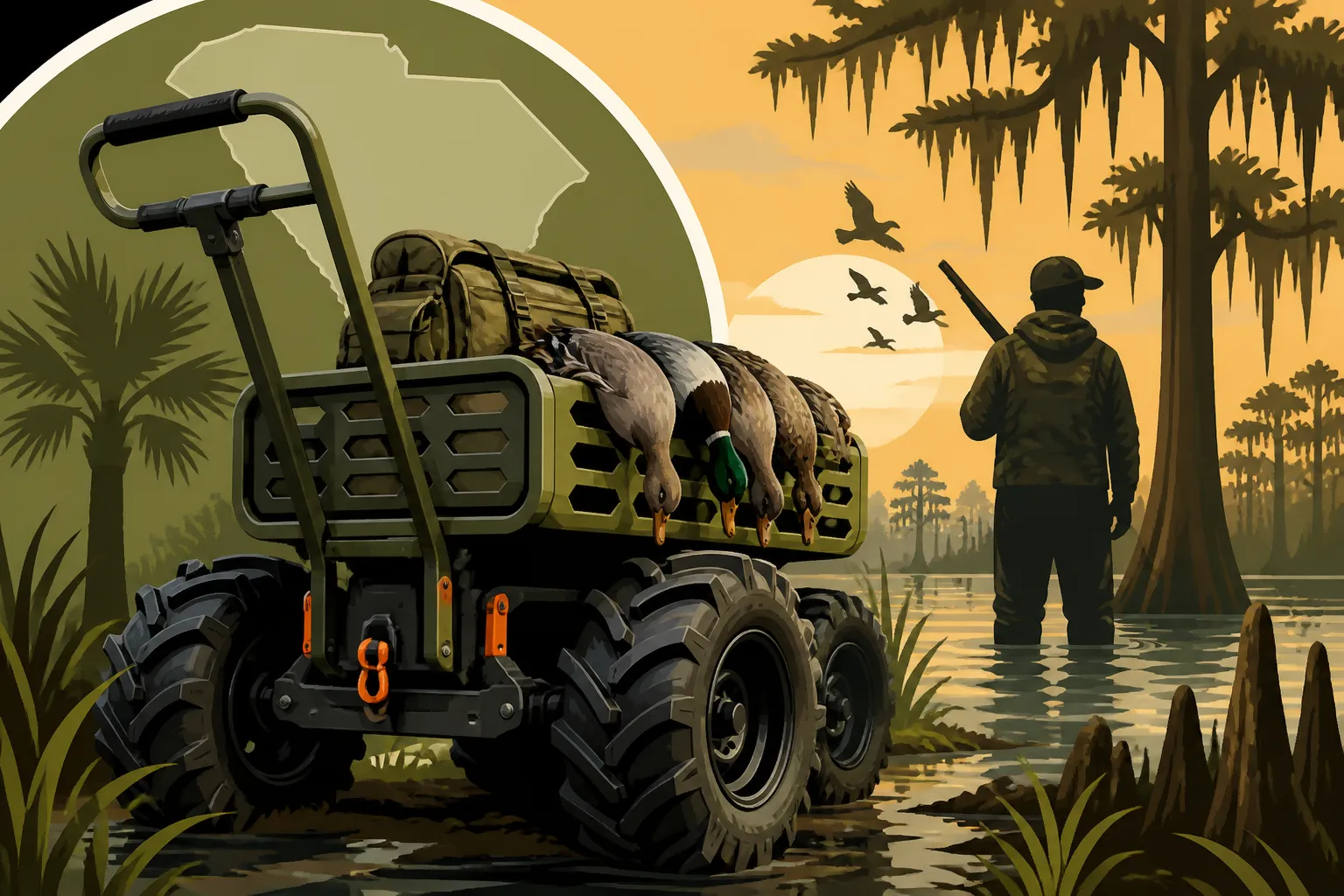
While I mentioned earlier that traditional carts can struggle, there are some specialized deer carts that can work in certain swampy conditions. The critical difference is the tires. Forget those narrow, hard plastic wheels; you need wide, pneumatic (air-filled) tires. These larger, softer tires offer a greater surface area, which helps distribute the weight and prevents them from sinking as deeply into soft mud or sand. Think of them like the fat tires on a beach bike or an ATV.
These carts are best for areas that might have intermittent muddy sections or shallow water crossings, rather than truly deep, continuous swamp. They can bridge small ruts and roll over roots more effectively than their narrower-wheeled counterparts. If your swamp hunting involves traversing some dryer sections with occasional wet ditches or flooded areas, a heavy-duty cart with these wider tires might be a viable hybrid solution. Always check the load capacity and construction; welds and axle strength are paramount when dealing with heavy, uneven loads over rough ground. Remember that even with great tires, a cart will still struggle in deep, sticky mud where a sled would simply glide.
Features to Look For in a Swamp-Worthy Game Carrier
Choosing the right game carrier for South Carolina's challenging swamp terrain isn't just about picking a type; it's about dissecting the details. The devil is truly in the features when you're knee-deep in muck.
Material Durability and Resistance
This is probably the most crucial aspect. Swamps are full of unseen hazards: submerged stumps, sharp cypress knees, jagged rocks, and thorny vines. Your carrier needs to stand up to abuse. For sleds, look for thick, virgin high-density polyethylene (HDPE). This material is flexible enough to absorb impact without cracking but rigid enough to maintain its shape under a heavy load. Avoid thin, brittle plastics that might splinter on the first impact with a hidden log. For carts and frames, seek out marine-grade aluminum or heavy-gauge steel. It needs to be rust-resistant, as it will inevitably get wet and stay wet for extended periods. When checking out gear, I often consult resources like GoHunt to see user reviews on how different materials hold up to real-world abuse.
Consider the ropes and straps as well. They should be UV-resistant, rot-proof nylon or polypropylene with heavy-duty buckles or knots that won't slip. A common frustration is a cheap rope snapping when you're halfway out of a nasty bog. You want something robust enough to handle the sheer force of pulling a substantial deer through thick resistance.
Weight and Portability
You’re already hauling your rifle, your pack, maybe some Snake Boots for South Carolina Swamp Ground, and all your usual hunting gear into the swamp. The last thing you need is a game carrier that feels like a lead anchor before you even put a deer in it. While durability often adds weight, there's a balance. A lightweight sled that still maintains its toughness is ideal. For backpack frames, look for aluminum frames that offer strength without excessive bulk.
Portability also means how easy it is to carry into your hunting spot. Can it be strapped to your existing pack? Does it fold down? Or is it something you'll have to cache or drag in separately? If you're Still-Hunting Sumter Forest Ridges and then drop down into a low-lying, wet creek bottom, you need something manageable to get there. Some sleds are designed to be rolled up or folded, which is a fantastic feature for hunters who have a long walk to their stand before they even consider the retrieve.
Ergonomics and User Comfort
Pulling a heavy deer through a swamp is going to be hard work no matter what, but a well-designed carrier can significantly reduce strain and discomfort. Look for features like padded hip belts and shoulder straps on frame carriers, or comfortable, wide grab handles on sleds. If you're using a sled, a good quality harness that distributes the pulling force across your hips and shoulders, rather than just your arms, is an absolute must. Imagine trying to pull a 150-pound deer for a quarter-mile through knee-deep mud using only a flimsy rope that cuts into your hands—no thanks!
Some sleds come with a sturdy pull rope with a comfortable handle, allowing two people to pull simultaneously, or for a single person to get a better grip. These small details can prevent blisters, chafing, and overall exhaustion. After all, the goal is to enjoy the hunt, not suffer through the retrieve. When you're tired, mistakes happen, and the last thing you want is an injury deep in the woods or to damage your hard-earned game.
Tips for Using Game Carriers Effectively in Swamp Conditions
Even with the best game carrier, success in a South Carolina swamp comes down to strategy and technique. It's about working smarter, not just harder.
Route Planning and Scouting
Before you even step foot in the woods, spend time planning your exit strategy. Use aerial maps on your phone or a dedicated GPS unit like a GoHunt-enabled device to identify potential paths of least resistance. Look for slightly higher ground, natural ridges, or even old logging roads that might provide a firmer path out of a wet area. Pay attention to water depth indicators from previous rainfall or tidal charts if you're hunting coastal marshes.
Scouting isn't just for deer; it's for your retrieve, too. If possible, walk potential drag routes before the season. Understand where the deep pockets of mud are, where downed trees might create obstacles, and where the vegetation is thickest. Knowing this ahead of time can save you hours of struggle and frustration after you've made a kill. For example, if you're Hunting Lowcountry Swamp Deer, you'll quickly learn that an extra 50 yards walking around a particularly nasty cypress bay can be far easier than 20 yards trying to drag through it.
Field Dressing and Reducing Weight
This is a critical step, especially when hunting in warm South Carolina weather. Field dressing immediately after the kill not only helps cool the meat quickly but also significantly reduces the weight of the animal. Removing the viscera can lighten a deer by 20-30 pounds, making a substantial difference when you're pulling it through resistance. For hunters using backpack frames, breaking the animal down further into quarters or even boning out the meat is essential.
While it might feel like extra work initially, properly field dressing at the kill site, even in primitive conditions, pays off immensely during the retrieve. Carry a good, sharp field dressing knife and some game bags. Knowing Field Dressing a Deer in Warm Weather techniques will serve you well. It's not just about weight, but also about hygiene and meat preservation, especially if you have a long trek back to your truck.
Teamwork and Mechanical Advantage
If you're lucky enough to hunt with a buddy, leverage teamwork. Two people pulling a sled or a cart is exponentially easier than one. Communicate, coordinate your movements, and take turns being in the lead or assisting from behind. Even a basic drag rope with two handles can make a difference.
For solo hunters or those facing particularly challenging sections, consider bringing a small, lightweight block and tackle system. This isn't always practical, but for truly enormous deer or exceptionally tough terrain, it can provide a mechanical advantage that allows you to pull a deer out of a deep bog or up a steep bank that would otherwise be impossible. Sometimes, even a sturdy stick or small log used as a lever can help pry a stuck sled free. Remember, every little bit of advantage helps when you're fighting against mud and gravity.
Here's a quick comparison of popular game carrier types for swamp terrain:
| Carrier Type | Pros for Swamp Terrain | Cons for Swamp Terrain | Ideal Use Case |
|---|---|---|---|
| Heavy-Duty Sled | Glides over mud/water, durable, low friction | Requires pulling power, can get snagged by thick brush | Continuous wet, muddy, or shallow water areas; solo or two-person retrieves |
| Backpack Frame | Excellent for dense brush, steep banks; hands-free | Requires quartering/boning, limited full animal capacity | Very thick cover, steep inclines/declines, long retrieves; meat only |
| Wide-Tire Deer Cart | Rolls over small obstacles, less drag than narrow wheels | Still struggles in deep, sticky mud/water; can sink | Mixed terrain with intermittent wet spots; semi-firm ground |
Staying Safe and Hydrated
Hunting in South Carolina, especially in the swamp, means dealing with heat, humidity, and often, biting insects. A grueling retrieve can quickly lead to dehydration or heat exhaustion. Always carry more water than you think you'll need. Take frequent breaks, especially if you're feeling lightheaded or overly fatigued. Even if you're focused on retrieving your game, your personal safety comes first. Bug spray is your friend, particularly in the earlier seasons when mosquitoes and gnats are thick. You might be focused on how to get the deer out, but checking out Bug Protection for Early Archery Season is just as vital.
Remember, a successful hunt isn't just about the shot; it's about the responsible and safe retrieval of your animal. Being prepared with the right gear and knowledge for South Carolina's unique swamp conditions will make all the difference between a triumphant haul and a back-breaking ordeal. Always be prepared, stay safe, and enjoy the rich hunting opportunities our state offers.
Disclaimer
This article is for general informational purposes only and does not constitute professional advice. Laws, prices and regulations vary by location and change over time. Consult a qualified professional for guidance on your specific situation.