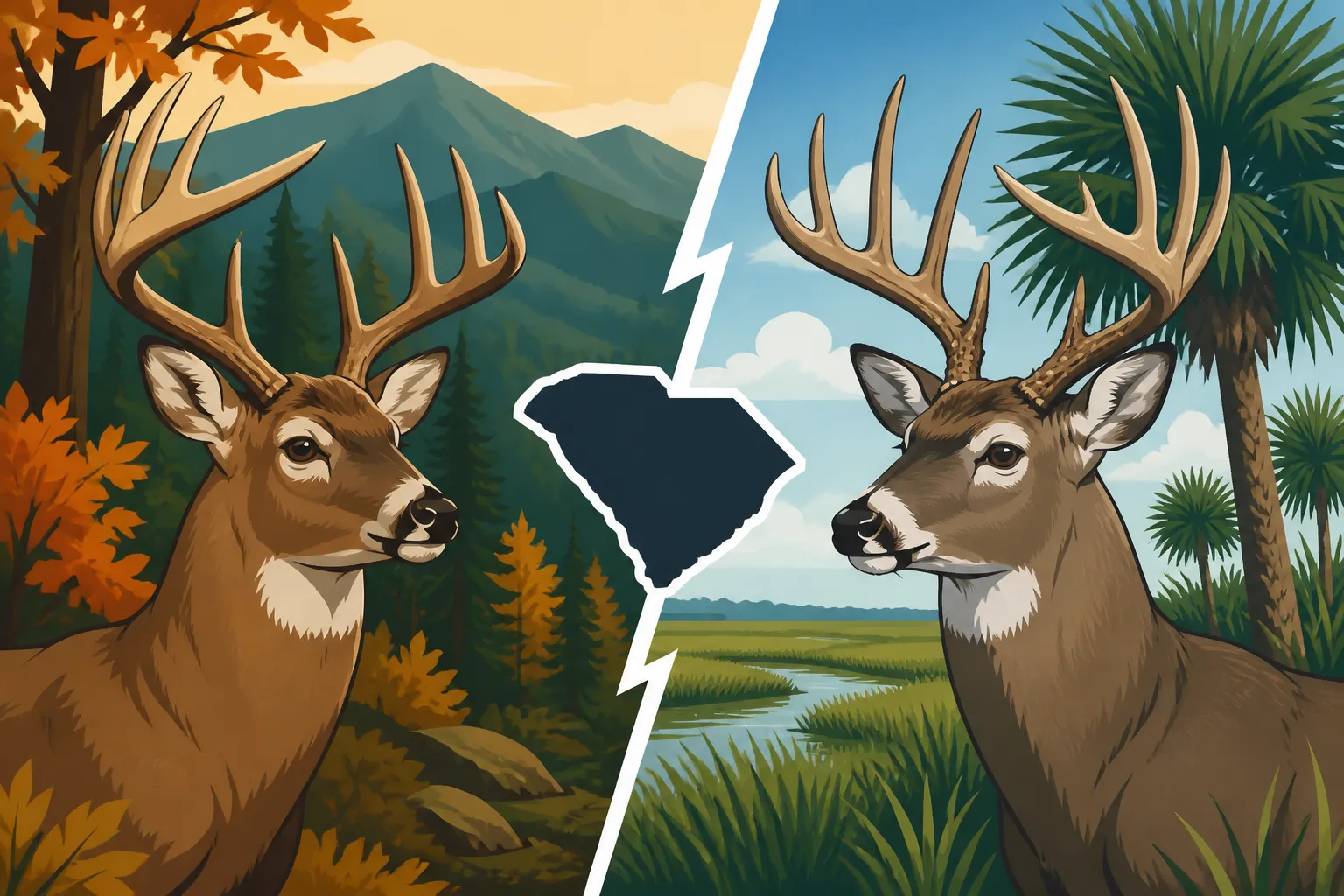
Upstate Versus Lowcountry Deer
Trying to understand the vast differences in deer hunting experiences across South Carolina can feel like comparing two completely different sports. Many hunters, especially those new to the state or looking to explore new areas, often get frustrated trying to reconcile the tales of massive Lowcountry harvests with the hard-earned Upstate trophies. This guide is here to unravel the distinct characteristics of deer and hunting tactics in South Carolina's Upstate and Lowcountry regions, helping you prepare for success no matter where you chase whitetails.
The Geographic Divide: Understanding South Carolina's Diverse Landscapes
South Carolina is a state of remarkable geographical contrasts, and nowhere is this more apparent than when you compare its mountainous Upstate with its sprawling coastal Lowcountry. These differing environments dramatically influence deer behavior, populations, and, by extension, the strategies hunters employ.
The Rugged Upstate Terrain
When you head up to the Upstate, you're entering a world of rolling hills that quickly escalate into the foothills and lower ranges of the Appalachian Mountains. Think dense hardwood forests, steep ridges, and rocky creek bottoms. Areas like the Sumter National Forest are prime examples, offering challenging terrain that demands physical endurance and a keen understanding of elevation and thermals. This isn't flat country; you'll be climbing, descending, and navigating thick cover that often hides deer remarkably well. The sheer scale of the landscape means deer densities are generally lower than in other parts of the state, and finding sign requires dedicated scouting. The cooler temperatures, especially later in the season, also play a role, making gear choices and clothing layers crucial.
The Expansive Coastal Plain Lowcountry
Shift your focus to the Lowcountry, and you're greeted with an entirely different picture. This region is characterized by vast, flat expanses, dominated by longleaf pine forests, swampy river bottoms, and extensive agricultural fields. From the tidewater marshes near Charleston to the rich farmlands further inland, water is a constant presence, influencing everything from travel corridors to food sources. This is where you find iconic hunting grounds like the ACE Basin, known for its mix of hardwoods, pines, and fields. The terrain here is generally much easier to traverse, though a low-lying swamp can present its own set of challenges, from thick briars to hidden water. The warmer climate, even into late fall and early winter, means different considerations for game care and hunter comfort.
Deer Characteristics: Size, Antlers, and Behavior
The environment doesn't just dictate where deer live; it shapes them. The deer you encounter in the Upstate will often look, act, and even taste differently from their Lowcountry counterparts, a testament to adaptation and available resources.
Upstate Deer Adaptations
Upstate deer, particularly those residing in the rugged mountain and foothill regions, tend to be smaller in body size compared to their Lowcountry cousins. This isn't a sign of poor health but rather an adaptation to a less abundant and more dispersed food supply. They are often leaner, more athletic, and incredibly wary, accustomed to navigating challenging topography and avoiding predators like coyotes and even black bears. Their antlers, while sometimes impressive, can often be smaller on average due to the nutritional limitations of their habitat. However, don't let average antler size fool you; mature bucks in the Upstate, especially those that have survived several hunting seasons in such demanding conditions, possess exceptional genetics and are truly hard-earned trophies. Their survival instincts are finely tuned, making them incredibly difficult to pattern. They rely heavily on cover and elevation to avoid detection, often bedding high on ridges and dropping into draws for water and browse.
Lowcountry Deer Characteristics
In stark contrast, Lowcountry deer often boast a larger average body size. This substantial difference can be attributed to the rich agricultural landscape and the diverse, abundant forage found in the flatlands, swamps, and river bottoms. Corn, soybeans, peanuts, and a host of natural browse contribute to a higher protein diet, leading to increased body mass and, often, more significant antler development. While Lowcountry deer might not always sport massive racks, the potential for mature bucks to grow impressive headgear is certainly present, especially in areas with good age structure.
However, the sheer density of deer in many Lowcountry areas can sometimes lead to different challenges. With so much available food and less expansive, rugged terrain, deer may not travel as far, and their patterns can be tied more directly to specific food sources or thick bedding areas within the flatlands. This high density is a major reason why the state has historically issued such liberal bag limits in many coastal counties, allowing hunters to contribute to herd management. From a behavioral standpoint, Lowcountry deer can sometimes seem less wary, simply because there are so many of them and they encounter humans more frequently in agricultural settings. Yet, they still excel at vanishing into the dense, often swampy, cover, making a clean shot and recovery critical.
Hunting Strategies: Adapting to the Environment
Success in South Carolina deer hunting hinges on understanding the unique challenges and opportunities each region presents. What works like a charm in a Lowcountry swamp might send deer scattering across an Upstate ridge.
Upstate Tactics for Mountain Whitetails
Hunting the Upstate requires a more proactive, mobile approach. Still-hunting is a highly effective tactic here, demanding stealth, patience, and a keen eye for subtle deer sign in the vast timber. Instead of waiting for deer to come to you, you're slowly moving through their habitat, trying to intercept them. Understanding how deer use elevation is paramount. Deer will often bed high on a ridge to catch thermal drafts that carry scent upwards, allowing them to detect predators approaching from below. Conversely, in the mornings, they might drop into draws or creek bottoms.
Learning to interpret these air currents is vital, especially when you're Reading a Ridge for Upstate Deer. A valuable resource like GoHunt can help you analyze topographical maps to identify saddles, benches, and funnels where deer movement is concentrated. Hunters often focus on natural funnels, transition zones between different timber types, or areas with oak mast where acorns provide a crucial food source. Long walks are the norm, and being physically prepared to hike several miles, often with significant elevation changes, is a must. The season here starts later, giving deer a chance to grow and reducing early season pressure, making Hunting the Latest Upstate Zone Opener a unique experience.
Lowcountry Approaches for Swamp and Field Deer
The Lowcountry, with its high deer densities and flatter terrain, often lends itself to more static hunting methods. Treestands and ground blinds are popular choices, strategically placed overlooking agricultural fields, logging roads, or the edges of dense swamp thickets. Scouting here focuses on identifying active food sources—whether it's a freshly cut soybean field or a patch of late-season browse—and tracking entry and exit points to bedding areas.
For those tackling the truly wet ground, Hunting Lowcountry Swamp Deer can be an adventure, often requiring chest waders and a willingness to get muddy. Understanding the subtle movements of deer along the edges of these impenetrable areas is key. Similarly, Hunting Coastal Rice Field Edges demands patience and precision, as deer often emerge from cover at last light to feed in these open areas. Thermal imaging or night vision can be incredibly useful tools for scouting hog activity in these open areas, though always check regulations for their use during deer season. The abundant food sources mean deer aren't as pressured to move long distances, so intercepting them between bedding and feeding is the name of the game. Access to private land in the Lowcountry is often through leases or hunting clubs, but good public land opportunities still exist if you know where to look.
Population Dynamics and Herd Health
The sheer number of deer and the overall health of the herd vary significantly between the Upstate and Lowcountry, influencing everything from hunting pressure to antler quality.
Upstate Deer Density and Challenges
The Upstate generally has lower deer densities compared to the Lowcountry. This isn't necessarily a bad thing; lower densities can often lead to a healthier herd where individual deer have better access to quality forage. However, it also means hunters must work harder to find deer. Predators like coyotes and black bears play a more significant role in fawn recruitment and overall herd dynamics in the Upstate, adding another layer of challenge for deer survival. The available food sources in the national forests and privately owned timberlands can be less nutrient-rich and more dispersed than in agricultural areas, impacting overall deer health and antler growth potential.
Understanding the South Carolina Deer Population Estimate and specific Upstate Deer Density figures can help set realistic expectations. For public land hunters, this often means scouting vast amounts of territory to find pockets of deer activity. The hunt becomes more about the challenge of finding and outsmarting a wary animal in its natural, rugged environment, rather than filling a freezer quickly. Conservation efforts in these areas often focus on habitat improvement, such as prescribed burns, to enhance natural forage and create more favorable conditions for whitetails.
Lowcountry Deer Abundance and Management
The Lowcountry, particularly its agricultural regions and river bottoms, boasts some of the highest deer densities in South Carolina. This abundance stems from a combination of fertile soils, extensive food plots, and year-round agricultural production that provides a consistent, high-calorie diet. While this means more opportunities for hunters, it also presents management challenges, particularly in terms of crop damage. Farmers often deal with significant losses due to deer browsing, which is why the South Carolina Department of Natural Resources (SCDNR) implements liberal antlerless deer limits in these zones.
Monitoring South Carolina Deer Harvest Records reveals a consistent trend of high deer takes in the Lowcountry, reflecting both the population size and the longer, more permissive hunting seasons. The goal here is often herd control, aiming to keep populations in balance with the habitat's carrying capacity and mitigate agricultural impact. While some hunters might focus solely on trophy bucks, many also prioritize harvesting antlerless deer to manage the local herd and ensure future health. This region is a testament to how abundant a deer population can become when provided with consistent food and cover, though it also underscores the need for active management to prevent overpopulation and disease.
Season Structure and Regulatory Differences
South Carolina's unique four-zone system means that hunting seasons vary dramatically across the state. These differences are particularly pronounced when comparing the Upstate (Zone 1) and the Lowcountry (Zone 4), directly impacting when and how you can hunt.
Upstate Season Dates and Restrictions
The Upstate, primarily Game Zone 1, experiences a significantly shorter and later deer season compared to the coastal regions. This is by design, intended to allow bucks more time to mature and to coincide with a later, more defined rut. Typically, the archery season in Zone 1 doesn't open until mid-September, with gun season following in October, and the season closing around the end of December or early January. This later start and earlier close often surprise hunters accustomed to the long, early seasons found elsewhere in the state. For example, South Carolina's Four Game Zones clearly lays out these disparities.
On public lands within the Upstate, such as portions of the Sumter National Forest, additional restrictions may apply, including specific weapon types, antler point restrictions, or a reduced bag limit compared to private land. Hunters must meticulously check WMA regulations and hunt schedules to avoid violations. The later season also means that hunting conditions can be colder, requiring different gear and preparation. The more compact season also means that hunting pressure can be concentrated, especially on opening days or during the peak rut. GoHunt's mapping features can be a game-changer here, allowing you to identify public land boundaries and specific WMA rules quickly, even when out of cell service.
Lowcountry Season Lengths and Bag Limits
In stark contrast, the Lowcountry, encompassing Game Zones 3 and 4 (the latter often referred to as the Coastal Zone), boasts some of the earliest and longest deer seasons in the country. Archery season in Zone 4, for instance, typically opens in mid-August, giving hunters a unique opportunity to pursue deer in warmer weather, sometimes before antlers are fully hardened. The primitive weapons season often starts shortly after, followed by a rifle season that can run well into January 1st, or even later on private land in some zones. This lengthy season provides ample opportunity for hunters, and as discussed in South Carolina Deer Season Structure Explained, reflects the robust deer populations in these areas.
The bag limits in the Lowcountry are also generally more liberal. Residents typically receive tags for up to six antlered deer and an unlimited number of antlerless deer on private land, provided they are reported through the Game Check system. This allows for aggressive herd management and helps address agricultural depredation. Hunters should pay close attention to the specific county they are hunting in, as even within the Lowcountry, slight variations can exist. For example, Hunting the Earliest Coastal Zone Opener offers a unique set of challenges and opportunities that simply don't exist in the Upstate. The extended season means hunters have many chances to fill their tags, but also need to be mindful of early-season heat and its impact on game recovery.
Gear and Preparedness for Each Region
Your hunting gear needs to be as adaptable as the South Carolina landscape. The differences between the Upstate and Lowcountry dictate not just your tactics, but also your equipment choices.
Upstate Gear Considerations
When heading to the Upstate, especially to the national forests or more remote WMA lands, think "mobile and rugged." You'll be doing a lot more walking, often up and down hills, so comfortable, supportive hiking boots are non-negotiable. Layered clothing is crucial due to the fluctuating temperatures; mornings can be chilly in October and November, but midday climbs will work up a sweat. Consider merino wool or synthetic base layers that wick moisture. A lightweight, durable pack is essential for carrying water, snacks, extra layers, and your field dressing kit.
For optics, quality binoculars (8x or 10x magnification) are invaluable for spotting deer in dense timber or across clear-cuts. A good rangefinder is also key for judging shots, as terrain can play tricks on distance perception. Since shot opportunities can sometimes be longer in more open Upstate timber or across clearings, a flat-shooting rifle, as discussed in Rifle Setups for South Carolina Deer Hunting, might be preferred, zeroed for slightly longer distances. Lastly, a reliable GPS or a phone app like GoHunt with offline map capabilities is critical for navigation in areas with limited cell service.
Lowcountry Gear Essentials
Hunting the Lowcountry brings its own set of gear requirements, often focused on heat, moisture, and static comfort. Snake boots are almost a necessity, particularly for early season hunts or when traversing thick, low-lying areas where venomous snakes are prevalent. The persistent humidity and potential for sudden downpours mean good quality rain gear is paramount. Lightweight, breathable hunting clothing is a must, especially for those August and September archery openers when temperatures can easily be in the 80s or 90s. Bug repellent, often with a high DEET concentration or a Thermacell unit, is your best friend against mosquitoes and gnats.
Because Lowcountry hunting often involves sitting in a treestand or ground blind for extended periods overlooking a food source or travel corridor, comfort items like a good seat cushion and a quiet climbing or ladder stand are important. While rifle setups can vary, shots are generally shorter in the thicker cover, so many hunters opt for versatile calibers or shotguns. After the shot, quick game care is vital due to the warm weather. A large cooler, plenty of ice, and game bags are essential for preserving your harvest, as detailed in Warm-Weather Clothing for South Carolina Hunters and general meat care advice. Don't forget a sturdy game cart if you're on relatively flat ground, as dragging a heavy deer out of a swamp can be a monumental task.
Comparing Upstate and Lowcountry Deer Hunting
To quickly recap the key differences between hunting in South Carolina's Upstate and Lowcountry, take a look at this comparison table:
| Feature | Upstate (Game Zone 1) | Lowcountry (Game Zones 3 & 4) |
|---|---|---|
| Terrain | Hilly, mountainous, dense hardwoods, steep ridges. | Flat, swamps, river bottoms, agricultural fields, pine forests. |
| Deer Body Size | Generally smaller, leaner, more athletic. | Generally larger, heavier, higher fat content. |
| Antler Potential | Often smaller on average, but mature bucks are hard-earned. | Potential for larger antlers due to nutrition, higher density. |
| Deer Density | Lower | Higher (especially in agricultural areas) |
| Primary Food Sources | Acorns, natural browse, limited agriculture. | Agricultural crops (corn, soybeans), natural browse, food plots. |
| Hunting Season | Later start (mid-September archery), shorter season. | Earlier start (mid-August archery), longer season (into January). |
| Bag Limits | Often more restrictive, especially on public land. | More liberal (unlimited antlerless on private land in Zone 4). |
| Typical Tactics | Still-hunting, still-hunting, understanding thermals, long walks. | Stand hunting (treestands, ground blinds), scouting food sources. |
| Key Gear Needs | Hiking boots, layered clothing, lightweight pack, good optics. | Snake boots, bug repellent, lightweight breathable clothes, cooler, rain gear. |
| Hunting Challenge | Finding deer, physical endurance, navigating rugged terrain. | Managing high populations, heat, bugs, quick game recovery. |
Disclaimer
Please remember that hunting regulations and seasons can change. Always consult the most current South Carolina Department of Natural Resources (SCDNR) regulations before planning any hunt. This guide is for informational purposes only and does not supersede official state regulations.