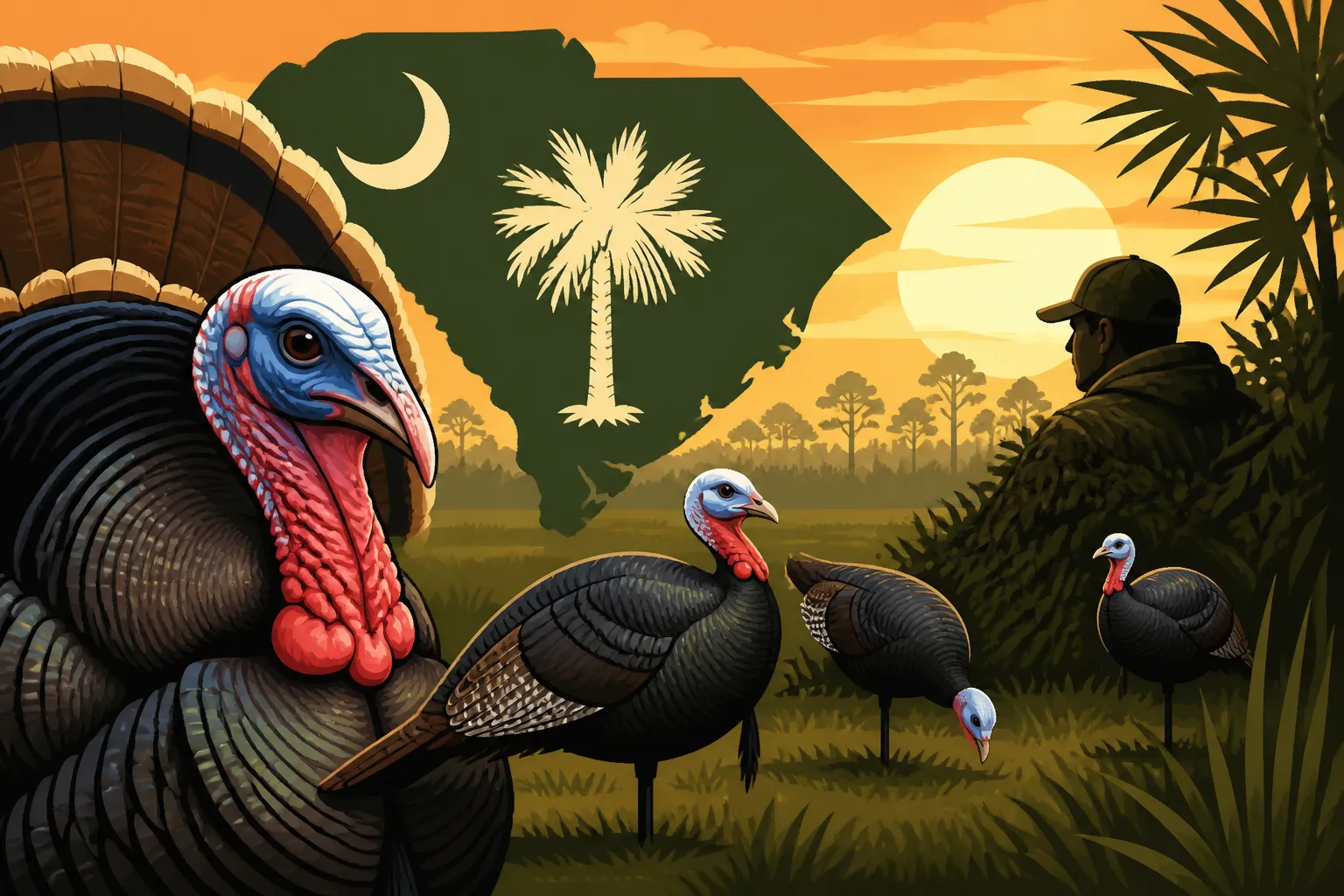
Turkey Decoys That Work on Pressured Birds
There's nothing quite like the thrill of a gobbler hammering back at your call, but when those birds have been hunted hard, they can get wary, smart, and downright frustrating. You might feel like you're doing everything right, but they hang up at 80 yards, or they sneak in silent from behind, busting you before you even know they're there. This guide is all about helping you understand why those pressured South Carolina turkeys are so cagey and, more importantly, how to use decoys effectively to draw them into range, even when they've seen it all.
Understanding Pressured Birds and Their Behavior
Hunting a turkey that's been called to, spooked, or even shot at before is a completely different ballgame than going after a naive bird. These aren't your grandfather's turkeys; they've learned lessons, and those lessons make them incredibly cautious.
Why Turkeys Become Pressure-Shy
Imagine you're a gobbler in a place like Francis Marion National Forest or a popular WMA in the Lowcountry. From opening day in March (or April 10th depending on where you're hunting, always check the South Carolina Spring Turkey Season Rules) until the season closes, you're constantly hearing yelps, clucks, and purrs from unseen hens. Then, sometimes, a few of those "hens" are joined by strange-looking plastic birds, and moments later, a loud boom. It doesn't take many encounters like that for a gobbler to connect the dots.
Over time, these birds learn to associate certain sounds, visual cues, and even common setup locations with danger. They become "educated" in the worst way for hunters. This isn't just about avoiding humans; it's about avoiding anything that deviates from their normal, natural daily routine. They become hypersensitive to anything that feels a little off, whether it's a decoy that looks too static, a call that's too aggressive, or an approach that seems too direct.
This pressure fundamentally changes their approach. Instead of rushing in, they'll circle, they'll hang up, and they'll try to get an advantage by spotting you first. This is why a traditional setup that worked wonders in a less-pressured area can feel completely useless here in South Carolina. We've got plenty of birds, but many of them have been through the gauntlet, especially on public lands where hunter numbers can be high.
Reading the Signs of a Wary Gobbler
How do you know you're dealing with a pressured bird? The signs are often subtle, but unmistakable once you know what to look for. One of the most common frustrations is the gobbler that "hangs up." He'll gobble his head off, he'll even respond to your calls, but he just won't commit. He might stay 80, 100, or even 120 yards out, strutting and drumming, waiting for the "hen" to come to him. He's testing your patience and your realism.
Another classic sign is the wide circle. Instead of a direct approach, he'll swing way out, using terrain features like creek beds, logging roads, or thick pines to stay out of sight, trying to get behind you or downwind to pinpoint the source of the call. Often, these birds come in completely silent, making it even harder. You won't hear that last gobble, that tell-tale drumming. He'll just appear, and if you're not constantly scanning, he'll bust you before you can even raise your shotgun.
It’s not just about hearing the gobble; it’s about observing their body language and approach patterns. Are they strutting towards you, or pacing back and forth? Are they looking nervous, or confident? Pay attention to how they use cover, how they scan the surroundings before stepping into the open. That's when you know you're up against a smart, experienced bird that has likely dodged a few hunters in his day. This keen observation is critical before you even think about setting up your decoys.
Decoy Selection for South Carolina's Wary Gobblers
When you're facing birds that have been "educated," your decoy strategy needs to shift from trying to impress them to trying to reassure them. Less can often be more, and realism is paramount.
The Less-Is-More Philosophy
Forget those elaborate setups with multiple gobblers, jakes, and a whole flock of hens. While that might work on an unpressured farm bird in a wide-open field, a gobbler that's heard every call and seen every trick will likely find it suspicious, if not downright intimidating. Think about it: a single hen feeding peacefully, or a jake and a hen subtly interacting, looks far more natural and less threatening than a full-on bachelor party in his territory.
For pressured birds, a single hen decoy is often your best bet. A feeding hen suggests contentment and safety, while an alert hen might pique curiosity without being aggressive. You're trying to project a sense of normalcy, not a challenge. If you do opt for a jake, ensure it's a submissive posture, perhaps feeding or slightly tucked, rather than an aggressive full-strut jake that could make a dominant gobbler hang up or intimidate a satellite tom.
The goal isn't to create a dynamic scene, but a believable one. A single, natural-looking decoy, strategically placed, offers just enough visual stimulation to pull a bird into range without raising any red flags. It gives that gobbler something real to focus on other than your calling, providing just the edge you need when every other tactic seems to fail.
Realistic Poses and Subtlety
The days of brightly colored, cartoonish plastic decoys are long gone, especially for wary turkeys. Modern gobblers have seen it all, and a decoy that doesn't look completely natural will send them packing. You need realism in every detail: the feather patterns, the paint scheme, the eye detail, and even the subtle texture of the body. Brands like GoHunt offer incredibly detailed and realistic decoys that can make all the difference, mimicking the exact feather structure and coloration of wild South Carolina turkeys.
Think about the message your decoy's pose sends. A feeding hen is low to the ground, head down, suggesting a relaxed bird that feels safe. This can put a cautious gobbler at ease. A breeding pose, with a hen lying down and a jake or tom mounted, can be incredibly effective at triggering a jealous response, but it also signals a very specific, high-stakes situation. A half-strut tom, rather than a full-strut, might challenge a gobbler without making him feel completely outmatched, making him more likely to approach to investigate.
However, be cautious with full-strut gobbler decoys. While they can be deadly on aggressive, unpressured birds, they can also intimidate or simply be ignored by older, wiser gobblers who have learned to avoid direct confrontations or are simply not in a dominant mood. Sometimes, a full-strut tom is just too much, sending the message that this spot is taken, causing your target gobbler to move on rather than engage. Subtlety in pose is key to convincing a pressured bird that what he's seeing is truly another turkey, and not a trap. We've talked about Turkey Calls Worth Carrying in South Carolina before, and a subtle visual often pairs best with subtle audio.
Motion and Movement (Subtly!)
Adding motion to your decoy setup can be a game-changer, but again, subtlety is paramount. A perfectly still, plastic bird can look unnatural, especially in a slight breeze when real turkeys would be shifting and preening. The goal is to create just enough movement to catch a gobbler's eye and make the decoy appear alive, without making it look like a carnival ride.
Simple wind-activated fanning decoys, or those with spinning wings, can add a realistic flicker of movement that mimics a preening or stretching bird. Some hunters even rig up string systems that allow them to gently twitch a decoy's head or tail from their blind, adding that vital spark of life at just the right moment. This kind of nuanced movement can make a huge difference to a bird that's scrutinizing every detail from a distance.
Avoid anything that looks overly mechanical or has exaggerated, repetitive movements. Motorized decoys with constant, identical motion can often look fake to wary birds who are used to the natural, unpredictable movements of their wild counterparts. The aim is to create an illusion of life that enhances realism, not detracts from it. Think gentle swaying, a slight head turn, or a subtle tail fan flutter – just enough to say, "I'm real, and I'm safe."
Strategic Decoy Placement and Scenario Planning
Where you put your decoy is just as important as what kind of decoy you're using. For pressured birds, a poor placement can ruin your hunt before it even begins.
Positioning for the Approach
The first rule of decoy placement for pressured turkeys is to position them so that the gobbler has to come into your optimal shooting lane to investigate. You never want a gobbler to approach your decoy from a direction that puts him out of range or, worse, directly behind you where he can spot you in your blind or against your tree. Anticipate his most likely approach, which for a wary bird will often involve circling downwind or using cover.
Angle your decoy so that the gobbler will face it head-on or quartering-to when he gets within range. This typically means placing the decoy 15-20 yards out, slightly off to your left or right (if you're right-handed, slightly to your left) so that when he steps into position to admire the "hen" or challenge the "jake," his head is up, and he presents a clean shot. If the decoy is facing you, the gobbler will often approach from behind it, putting him directly in front of you and potentially spotting your movement.
Don't forget the sun! Position your decoy with the sun at your back, if possible, so that it illuminates the decoy clearly for the gobbler, making it pop, while simultaneously casting your setup in shadow. This also makes it harder for the gobbler to see into your setup due to glare. Planning your setup meticulously is crucial, and tools like the GoHunt app or website can help you analyze terrain and plot your decoy strategy, visualizing how a gobbler might approach from different angles given the available cover and topography.
Utilizing Terrain and Cover
Pressured turkeys are masters of using the terrain to their advantage. They will stick to cover, use dips and rises, and avoid wide-open areas where they feel exposed. Your decoy placement should capitalize on this knowledge, drawing them out just enough. If you're hunting Turkey Tactics for Lowcountry Field Edges, for example, you wouldn't just plop your decoy in the middle of a vast soybean field.
Instead, place your decoy just inside the edge of a field, perhaps 5-10 yards from the timber line, or on a logging road that skirts a thicket. The idea is to make the gobbler feel like he's still largely under cover while still getting a good look at your decoy. A subtle rise in a field, a small knoll, or even a clump of palmettos can serve as a natural "curtain" for a gobbler to sneak behind before popping out for that final visual check.
Avoid setting decoys in areas that offer no cover at all or force the bird into a completely exposed approach. A wary gobbler will often hang up at the edge of the timber, expecting the hen to come to him. By placing your decoy tantalizingly close to the edge of his perceived safe zone, you encourage him to take those last few steps into range. Think about where you'd feel safe if you were a turkey, and set your decoy there, giving him that same comfort. For those tough public land birds, knowing Where Francis Marion Bucks Bed can give you an idea of where deer feel safe, and turkeys often share similar preferences for security cover.
Pairing Decoys with Calling Strategies
Decoys and calling are a tandem, especially with pressured birds, but the balance shifts. You're not relying on calling to drag them in entirely; you're using it to get their attention, and then letting the visual do the heavy lifting. Often, soft, subtle calls pair best with minimalist, realistic decoy setups. Instead of aggressive cutting and yelping, try soft clucks, purrs, and subtle yelps – just enough to say "I'm here, I'm safe, come find me."
Once the gobbler responds and starts moving in your direction, ease off the calling. Let the decoy work its magic. A pressured bird is often looking for visual confirmation, and if he hears constant calling as he approaches, it can make him suspicious. He's thinking, "Why is she still talking when I'm right here?" Let him focus on the decoy. The visual of a contented hen or a submissive jake can be far more convincing than another series of calls, particularly when he’s getting close to range.
Know when to completely shut up. As the gobbler gets within 50-60 yards, he's processing what he sees more than what he hears. Any unnecessary movement or sound from you can break the illusion. Many times, the softest purr or a simple cluck will be the final convincer, especially if he hangs up. But sometimes, absolute silence, letting the visual be the only thing he focuses on, is what it takes. It's a delicate dance of sound and sight. This nuanced approach applies whether you're Calling a South Carolina Gobbler Off the Roost or trying to seal the deal mid-morning.
Common Pitfalls and Advanced Tactics
Even with the best decoys and placements, a few mistakes can still send a wary gobbler packing. Avoiding these pitfalls and employing a few advanced tactics can turn a frustrating hunt into a successful one.
Decoy Pitfalls to Avoid with Pressured Birds
One of the biggest mistakes is over-calling when a bird is close. As mentioned, once a gobbler is committed and approaching, especially within 70-80 yards, he's actively looking for that hen. If you keep hammering away on the call, it can sound unnatural. Real hens often go quiet when a gobbler is strutting nearby, letting him do the work. Too much calling can make him suspicious or, worse, locate your exact position and identify it as not where the decoy is.
Another pitfall is poor concealment. A decoy is a visual aid, but it's not a magical shield. If you're not well-hidden, blending into your surroundings, a gobbler will spot you before he even pays attention to the decoy. This is especially true on public lands where birds are accustomed to scanning for human shapes. Ensure your blind is brushed in thoroughly or your back is against a wide tree that completely breaks up your silhouette. Remember, a pressured gobbler is looking for anything out of place.
Finally, not being ready when the gobbler appears silently is a common mistake. Wary birds often come in without a sound, and if you're not constantly scanning your shooting lanes, you'll be caught off guard. You need to be able to raise your shotgun smoothly and quietly without drawing attention. Practicing your setup and movement beforehand can make all the difference, especially in the thick cover we often encounter here. For public land hunting, familiarity with South Carolina WMA Turkey Rules might also guide your choices in blind or cover usage.
GoHunt and Scouting for Decoy Success
For pressured turkeys, scouting isn't just a suggestion; it's absolutely essential. You need to know their travel routes, their preferred strutting zones, and where they tend to hang up. Modern scouting tools, including those available through platforms like GoHunt, allow you to study satellite imagery, topo maps, and even public land boundaries from your couch, giving you an immense advantage. You can identify pinch points, saddles, or small clearings where a decoy setup might be most effective.
Setting up on fresh sign – tracks, droppings, and strut marks – is always better than relying on a historical spot. Turkeys move, and what was hot last week might be cold today. Use your boots on the ground, but use your digital tools to narrow down your search. GoHunt can help you mark these locations and plan your approach, identifying potential entry and exit routes that minimize disturbance, cross-referencing historical data or public land boundaries that GoHunt might provide.
Before bringing in calls or decoys, spend some time observing natural bird behavior in your target area. Watch how they move across fields, where they enter and exit timber, and their preferred strutting areas. This reconnaissance gives you invaluable insight into their habits, allowing you to place your decoys in a spot that feels natural and safe to them. You can't just guess with pressured birds; you need to understand their daily patterns. This intense scouting is similar to what's needed for deer hunting, as described in Scouting South Carolina Public Land Before Season.
The "Fader" or "Sneaker" Setup
One advanced tactic for those extremely hung-up gobblers is the "fader" or "sneaker" decoy setup. This involves using a single hen decoy on a string, positioned some distance from your blind (perhaps 40-50 yards), with the string running back to your position. When a gobbler hangs up out of range, gobbling but refusing to commit, you can gently pull the decoy slowly away from him, simulating a hen that's losing interest and walking off.
This subtle movement, away from the gobbler, can often trigger his instincts to pursue. He sees the "hen" walking away, and his primal urge to breed (or at least investigate before she's gone) kicks in. He often drops his guard, covers those last few yards, and comes strutting into range, trying to cut her off. This tactic requires careful planning to ensure the string is hidden and doesn't get snagged, but it can be incredibly effective when everything else fails.
It's a high-reward, high-risk maneuver that requires practice to execute smoothly. You don't want the decoy to jerk or move too quickly, as that would look unnatural. A slow, deliberate "fade" is what you're aiming for. This kind of dynamic approach is a hallmark of skilled turkey hunters, embracing mobility and adaptability, much like the tactics discussed in Run-and-Gun Turkey Tactics on Public Land. Sometimes, it's about making the bird think he's losing something, rather than gaining something.
Here's a quick look at how different decoy types might fare with pressured turkeys:
| Decoy Type | Best Use for Pressured Birds | Pros | Cons |
|---|---|---|---|
| Single Hen (feeding) | Drawing cautious gobblers into a comfortable, safe scene | Non-threatening, highly natural, easy to transport | May not grab attention from very distant birds |
| Single Hen (alert/upright) | Piquing curiosity without aggression, often paired with calls | Visible, suggests vigilance but not a threat | Can sometimes make gobblers wary if they scrutinize it |
| Breeding Pair (hen/jake) | Eliciting a jealous response from dominant toms | Can be highly effective at triggering aggression | Might be too much for very wary birds, can look complex |
| Half-Strut Jake/Tom | Challenging a gobbler subtly, inviting a fight | Less dominant than full-strut, but still a challenge | Can still be ignored if the bird isn't feeling dominant |
| Full-Strut Tom | Generally not ideal for pressured birds | Looks impressive, can work on naive birds | Too aggressive, can spook or intimidate wary gobblers |
| Motion Decoy (subtle) | Adding realism to a static setup, catching distant eyes | Breaks up unnatural stillness, mimics real movement | Too much motion can look artificial or distracting |
Disclaimer
This article is for general informational purposes only and does not constitute professional advice. Laws, prices and regulations vary by location and change over time. Consult a qualified professional for guidance on your specific situation.