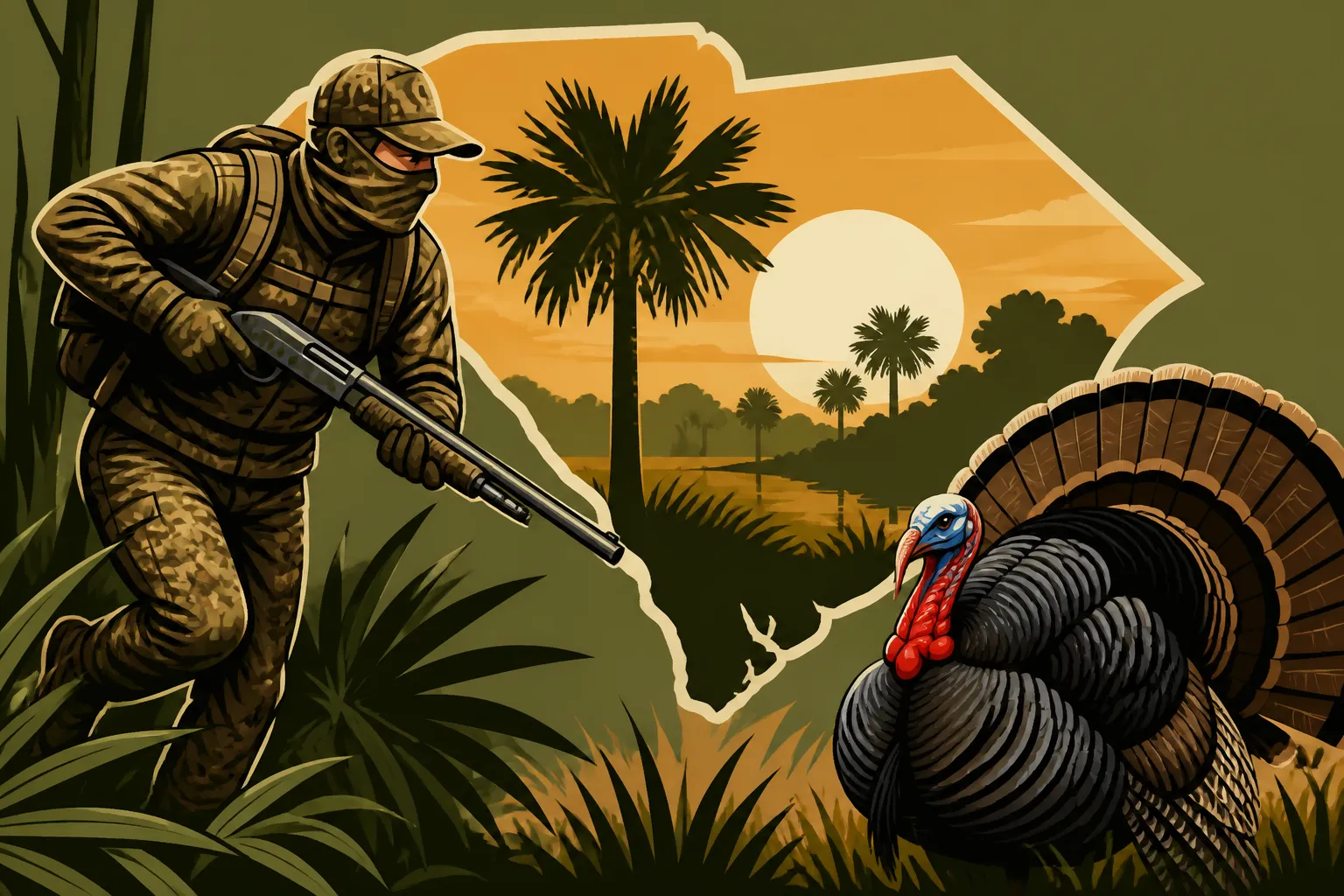
Run-and-Gun Turkey Tactics on Public Land
Hunting turkeys on public land in South Carolina can feel like an impossible puzzle. Birds that sounded off aggressively on the roost suddenly go silent, pressured by early morning traffic, and seem to vanish into thin air. You’ve likely experienced the frustration of busting birds you never even knew were there, or calling incessantly to dead air. This guide is all about embracing a dynamic, highly mobile approach – the "run-and-gun" method – to consistently put yourself in front of South Carolina gobblers, even on heavily hunted tracts where traditional sit-and-wait tactics often fall short.
Understanding South Carolina Public Land Turkeys
Public land turkeys in our beautiful state are a different breed, shaped by consistent human interaction and the sheer amount of diverse habitat they call home. They aren't the same birds you might encounter on a sprawling private plantation, and understanding these distinctions is the first step toward successful run-and-gun hunting.
The Challenge of Pressured Birds
Let's be real, public land turkeys see and hear a lot more than their private land counterparts. From the earliest opening days of archery season through the close of spring turkey season, these birds are constantly exposed to human presence. They've heard every call in the book, seen plenty of hunters, and learned to associate certain sounds and movements with danger. This intense pressure makes them inherently warier, more prone to "gobble and go," or even to shut down completely after fly-down. You'll find they often gobble less on the limb, fly down silently, and are much more reluctant to commit to a call or come into an open area.
This translates to birds that are less patient and more likely to circle wide or approach from unexpected angles. They rarely offer those picture-perfect, straight-line charges you dream of. Their defensive mechanisms are honed by survival, forcing us as hunters to abandon static setups and adopt a more proactive, adaptable strategy. If you try to hunt them like they haven't seen a human since last spring, you're going to be disappointed. We have to acknowledge their intelligence and adjust our entire approach to outsmart them.
Typical Public Land Habitats
South Carolina boasts an incredible variety of public land, from the rolling hills and hardwood ridges of the Sumter National Forest in the Upstate to the dense pine plantations and cypress swamps of the Francis Marion National Forest and various Wildlife Management Areas (WMAs) in the Lowcountry and Pee Dee regions. Each of these habitats presents unique challenges and opportunities for the run-and-gun hunter. In the Upstate, you might find birds using steep terrain, following creek bottoms, or strutting on flat ridge tops. Here, calling can carry further, but birds can also pinpoint you quickly.
In the Lowcountry, you're often dealing with thick undergrowth, palmetto flats, and standing water. Visibility is limited, and birds might roost over water, making them harder to approach silently. Pine plantations, common across the state, can be a maze of rows, offering both cover and frustration. Understanding the specific habitat you're in – whether it's mature hardwoods, recently thinned pines, or a swamp edge – will dictate your movement, calling strategy, and setup choices. For example, a bird in a dense swamp might only respond to close, soft calls, while a bird on an open ridge might tolerate louder, more frequent locators.
Seasonal Behavior Shifts
Turkey behavior isn't static; it shifts significantly as the spring season progresses, and public land birds are no exception. Knowing what to expect, and when, can drastically improve your run-and-gun success. Early in the season, especially right after the statewide opener, birds might still be grouped up, a little less wary, and more vocal. They haven't been heavily pressured yet, and gobblers are eager to find hens. This is often when you can get away with more aggressive calling and see birds respond relatively quickly.
As you move into mid-season, many gobblers become "henned up." They're surrounded by real hens and have less incentive to come to your calls. This is where patience and persistence truly pay off. You might need to be extra mobile, trying to locate a lonesome gobbler or one that's been temporarily abandoned by his harem. Late season brings a different challenge: fewer hens are receptive, and the remaining gobblers, though often less vocal, can be desperate to breed. These late-season birds have also survived weeks of hunting pressure, making them the wariest of all. This is when very subtle, realistic calling, combined with extreme mobility, becomes paramount. Understanding these shifts helps you adjust your run-and-gun pace and calling intensity.
Essential Gear for the Mobile Turkey Hunter
When you’re constantly on the move, every ounce counts, and every piece of gear needs to serve a purpose. The run-and-gun strategy demands a streamlined setup that allows for quick transitions and silent movement.
Lightweight Shotgun and Ammunition
Your shotgun is your primary tool, so it needs to be an extension of yourself – light, quick-handling, and dependable. Forget the heavy, long-barreled setups designed for static blind hunting. A shorter barrel (22-24 inches) will maneuver through thick South Carolina brush much more easily. Many hunters opt for a 12-gauge, but a 20-gauge loaded with modern Tungsten Super Shot (TSS) ammunition is an absolutely deadly combination, offering reduced weight and recoil without sacrificing terminal performance. The lighter 20-gauge allows for faster swings and less fatigue when you’re carrying it all day, trekking miles across public ground.
Consider adding a red dot sight to your shotgun. In the heat of the moment, when a gobbler suddenly appears at 30 yards after a fast approach, a red dot provides incredibly quick target acquisition. You just put the dot on the turkey's head and squeeze. When patterning your gun, ensure it throws a dense, even pattern at your effective ranges, typically 30-45 yards in the kind of thick cover you’ll often find on public land. Don't be afraid to experiment with different choke tubes and ammunition brands to find what works best for your specific setup.
Calling Arsenal for Versatility
The run-and-gun strategy hinges on your ability to locate and then entice birds, often with minimal setup time. This means your calling arsenal needs to be diverse yet compact. Mouth calls, or diaphragm calls, are your absolute best friend. They allow for hands-free calling, meaning you can yelp, cut, or cluck while carrying your shotgun, scanning the woods, or making last-minute adjustments. Master a few different yelps, cuts, and clucks on a diaphragm, and you’ll be ready for almost any situation.
In addition to mouth calls, a small, quiet slate or glass call is invaluable for producing realistic, softer purrs and clucks when a bird is closing the distance. They offer a slightly different tone and texture that can be just the ticket to seal the deal. For locating distant birds, a good locator call – like an owl hooter, crow call, or even a coyote howl – is essential. You want to provoke a "shock gobble" without sounding like a turkey yourself, which can sometimes spook wary birds. The key is to carry only what you need and be proficient with each call. Don't weigh yourself down with a dozen calls if you only use three effectively. Many experienced hunters find that a couple of diaphragms, a slate, and a locator call are more than enough to be highly effective.
Comfortable and Concealing Clothing
You’re going to be walking, sitting on the ground, and probably sweating, so your clothing needs to be comfortable, durable, and offer maximum concealment. Lightweight, breathable layers are critical for South Carolina's notoriously variable spring weather, where a morning chill can quickly turn into a warm, humid afternoon. Start with a moisture-wicking base layer, add a light mid-layer if needed, and top it with a good quality camouflage outer shell. Look for fabrics that are quiet, especially when rubbing against brush, and quick-drying.
Full camouflage, from headnet to gloves, is non-negotiable. Break up your outline as much as possible. A good pair of snake boots is not just a luxury but a necessity, especially when hunting in the Lowcountry's swampy or thick brushy areas, where copperheads and rattlesnakes are common. Support for your feet will also be paramount during long days on the move. Finally, invest in a quality turkey vest or lightweight pack. It should have enough pockets to organize your calls, ammunition, water, snacks, and perhaps a small ground pad, all while providing a comfortable carry. The ability to sit down quickly and comfortably against a tree is invaluable in a fast-paced run-and-gun scenario. Check out options like the Turkey Vests With a Kickstand Seat for quick, comfortable setups.
Mastering the Run-and-Gun Calling Strategy
The art of run-and-gun turkey hunting isn't just about walking around and yelping. It's a strategic dance between aggressive locating, subtle enticement, and knowing when to make your move. This strategy demands confidence in your calling and a keen understanding of turkey behavior.
Aggressive Locating and Soft Finishing
The core of run-and-gun is mobility. You're not waiting for the birds to come to you; you're going to them. This often starts with aggressive locating. Move quickly but quietly through likely turkey habitat, stopping every 150-200 yards to broadcast loud, confident locator calls – an aggressive series of cuts, yelps, or even a loud crow or owl hoot. The goal is to get a shock gobble, and sometimes you need to be loud enough to penetrate dense timber or wind. Don't be afraid to experiment with your Turkey Calls Worth Carrying in South Carolina.
Once you get a response, the game changes entirely. Now, it's about closing the distance rapidly but stealthily. Use terrain, timber, and any available cover to move in on that bird. As you get closer, your calling should become much softer and more enticing. Switch from loud cuts to subtle clucks, purrs, and soft tree yelps. The goal is to sound like a hen that's just out of sight, drawing him in for that final few yards. Resist the urge to keep hammering him with loud calls; that often makes pressured birds hang up. Remember, you're trying to whisper sweet nothings, not yell an invitation.
Reading the Gobbler's Mood
Not all gobblers are created equal, and on public land, this is especially true. A key part of the run-and-gun strategy is quickly "reading" the bird's mood and adjusting your approach. Is he gobbling enthusiastically at every call? He might be a "hot" bird, eager to commit. In this case, you can be a bit more aggressive in your movement and calling, perhaps pushing a little harder. Is he gobbling softly or infrequently, or only at your locator calls? He might be "hung up" with hens or just plain wary. This is when extreme patience and subtle tactics are needed.
If a bird is gobbling hard but not coming, he might be expecting you to come to him, or he might be with hens. Consider trying to circle wide to get ahead of him or move to a different angle. If he shuts up completely after you call, he might be working his way in silently, or he might have moved off. Trust your gut; often, if you feel like you need to move, you probably do. The constant evaluation of his responses, combined with silent movement and strategic setups, will put you in a shooting position. This is the cat-and-mouse game at its finest, a true test of a hunter's skill. Knowing when to keep calling and when to shut up and wait is critical. For more on handling those first morning calls, check out Calling a South Carolina Gobbler Off the Roost.
Decoy Use on Public Land
Decoys can be a powerful tool, but on public land, they need to be used with extreme caution and strategy. The run-and-gun approach generally favors a minimalist decoy setup, if any at all. A single hen decoy, or perhaps a jake decoy to challenge a dominant gobbler, can be effective. The key is portability and quick deployment. You don't want to be fumbling with stakes and multiple decoys when a bird is closing fast.
Safety is paramount when using decoys on public land. Other hunters might mistake your decoy for a real bird, or even mistake you for a bird if you're not careful. Always set your decoy where you have a clear backdrop and are confident in your shooting lane. Never carry an exposed decoy when moving. When you do deploy one, ensure you are sitting against a solid, wide tree trunk, wearing a headnet and gloves, and positioning the decoy 15-20 yards in front of you. This allows the bird to focus on the decoy and present a good shot opportunity. Sometimes, especially in dense cover, no decoy is the best decoy, letting your calling do all the work. For detailed advice, consider how Decoy Placement for Pressured South Carolina Birds applies to your specific scenario.
Scouting and Interpreting Public Land Turkey Sign
Success in run-and-gun hunting isn't just about calling; it starts long before opening day with meticulous scouting. Knowing where the birds are, what they’re doing, and how they’re moving is paramount, especially on public land where patterns can be less predictable.
Pre-Season Digital Scouting
Before you ever set foot in the woods, the internet offers a wealth of information. Tools like onX Hunt and GoHunt are indispensable for digital scouting. Start by studying aerial maps to identify potential roosting areas (tall pines near water or along ridges), natural funnels (where two ridges converge or a creek bend), open clearings (strutting zones), and potential travel corridors between different habitat types. Look for logging roads, power lines, and old two-tracks that can serve as access points or travel routes for both you and the turkeys.
These digital maps also show property boundaries, allowing you to focus your efforts on public land and avoid accidental trespass. You can pinpoint areas with varying timber ages, which often indicates different food sources or cover. For example, a recently thinned pine stand might have good ground cover for bugging, while mature hardwoods offer acorns. Identifying these features helps you narrow down vast tracts of public land into manageable, high-potential areas, giving you a serious edge before you even tie your boots. This is a critical first step to Scouting South Carolina Public Land Before Season.
Boots-on-the-Ground Reconnaissance
Digital scouting is a great start, but there's no substitute for getting your boots on the ground. A few weeks before the season, or even earlier, spend time walking the areas you've identified. Look for actual turkey sign:
- Droppings: Round, J-shaped droppings indicate a gobbler. Hen droppings are usually coiled. Fresh droppings are soft and moist.
- Feathers: Body feathers can tell you turkeys are in the area. Primary wing feathers often indicate a roost.
- Tracks: Look for three distinct toes pointing forward. Gobbler tracks are generally larger.
- Dusting bowls: Shallow depressions where turkeys "dust bathe" to clean their feathers. Fresh ones will have loose dirt.
- Strut marks: Drag marks from a gobbler's wingtips in soft dirt.
Listen for gobblers at dawn or dusk. Position yourself in a high-point area or near a creek bottom and listen for fly-down cackles or evening gobbles. This helps confirm active roost sites. Pay attention to food sources, too. What's greening up? Are there any leftover acorns? Turkeys will follow the food. Combining your digital insights with real-world observations creates a comprehensive picture of turkey activity. For more on finding active roosts, check out Roost Hunting South Carolina Gobblers.
Fresh Sign Versus Old Sign
Interpreting the age of the sign you find is crucial. Old sign indicates turkeys were there at some point, but fresh sign tells you they are there now. A gobbler track that’s sharply defined and still moist from morning dew is far more exciting than a faded track baked hard by the sun. Fresh droppings, loose feathers that haven't been bleached by the sun, or a recently used dusting bowl are all indicators that you're in an active area.
Don't spend too much time hunting an area with only old sign, especially if you're run-and-gunning. You want to be where the birds are, not where they were. As you walk, train your eyes to quickly identify fresh indicators. This quick assessment allows you to either commit to an area or move on quickly, optimizing your time and effort. In the run-and-gun world, every minute you spend in an unproductive spot is a minute lost from finding a hot gobbler.
Adaptability: The Key to Public Land Success
No matter how well you plan or how skilled you are, public land turkey hunting will throw you curveballs. Other hunters, changing weather, and unpredictable turkey behavior demand a high degree of adaptability from the run-and-gun hunter.
Dealing with Other Hunters
It's an unfortunate reality of public land: you're rarely alone. Especially during opening weekends or peak gobbling activity, you're bound to encounter other hunters. This can be frustrating, especially when another hunter moves in on a bird you're working or sets up in "your" spot. The key is to manage your expectations and adapt. First and foremost, safety is paramount. Always be aware of your surroundings, and consider wearing a bit of blaze orange when moving between setups, removing it once you're settled against a tree.
When you do encounter other hunters, stay calm and be courteous. Sometimes, you can gain valuable information about bird activity or where not to go. If a bird you're working gets pressured by another hunter, don't get discouraged. Often, that bird will move to a less accessible area, which might just be where you can get to him with your run-and-gun approach. Have backup plans: scout multiple areas so you can quickly relocate if your primary spot is occupied. This mobility is a huge advantage on pressured lands. For a taste of what to expect, think about Opening Weekend Crowds on the Coastal Zones even though it primarily discusses deer. The principle of adjusting to pressure is the same.
Weather and Its Impact
South Carolina weather can be notoriously fickle, and it significantly impacts turkey behavior and your hunting strategy. A beautiful, calm morning can quickly turn into a windy, rainy mess.
- Rain: Turkeys often go silent in the rain and seek heavy cover. If it's a light drizzle, you might still get a response, but heavy rain usually means a tough hunt. Focus on areas with thick canopy and be extra patient.
- Wind: Wind is a run-and-gun hunter's nemesis. It makes it hard for you to hear gobbles, and it makes it hard for turkeys to hear your calls. Strong winds can also make turkeys nervous, keeping them in protected areas. In windy conditions, focus on sheltered creek bottoms, pine thickets, or leeward sides of ridges. Increase your calling volume to cut through the wind, but be mindful of how sound travels.
- Temperature: Hot weather, especially late in the season, can make birds less active and less vocal. They might spend more time loafing in shade. Early season cool snaps, however, can make birds more active.
Being adaptable means having the right gear for the weather and adjusting your tactics. On windy days, you might need to move closer to a bird to get a response. On rainy days, focusing on roost sites longer might be your best bet. Always be prepared for a change in conditions, both mentally and with your clothing. Remember the guidelines for South Carolina Spring Turkey Season Rules and South Carolina WMA Turkey Rules to ensure your tactics align with regulations under changing conditions.
Post-Roost Movement Patterns
Just because a gobbler flew down in one spot doesn't mean he'll stay there. Public land gobblers, especially when henned up or pressured, can cover significant ground after fly-down. Understanding these post-roost movement patterns is crucial for run-and-gun success. After fly-down, gobblers will often gravitate towards strutting zones – open areas like old logging roads, clearings, or field edges where they can display for hens. They’ll also move to preferred feeding areas, often following their hens.
Your job is to anticipate these movements. If you heard a bird gobble on the roost but he flew down silent and moved off with hens, try to circle wide and get ahead of them. Set up in a likely travel corridor or a strutting zone you've scouted. Sometimes, a silent approach to these areas is more effective than calling. If a gobbler is alone, he might roam more widely, making him a prime target for your aggressive locating calls. Being able to visualize where a turkey might go after leaving the roost and beating him there is the ultimate run-and-gun advantage. Remember that on public land, turkeys are always moving and adapting to pressure, so you must, too.
| Call Type | Pros | Cons | Best Use |
|---|---|---|---|
| Diaphragm Call | Hands-free, versatile, wide range of sounds | Takes practice, can get wet/lose tone | Locating, finishing, aggressive calling when moving |
| Slate/Pot Call | Realistic, easy to learn, good volume control | Requires two hands, can be noisy when moving | Soft finishing, varied tones, drawing attention from a distance |
| Box Call | Loud, easy to use, good locator | Bulky, can squeak, hard to be subtle | Locating distant birds, aggressive calling in open country |
| Locator Calls | Provokes shock gobble | Can spook wary birds if overused | Identifying roosted birds, breaking silence, confirming presence |
Disclaimer
Hunting involves inherent risks, including but not limited to those associated with firearms, archery equipment, and outdoor conditions. Always prioritize safety, adhere to all local and state hunting regulations, and ensure you have the necessary licenses and permits. The information provided in this guide is for informational purposes only and should not replace professional guidance or personal experience.