Turkey Calls Worth Carrying in South Carolina
Hunting wild turkeys in South Carolina is a truly unique experience, but anyone who's spent a frosty morning in the hardwoods or a humid afternoon in the lowcountry knows that getting a gobbler to commit can be an exercise in frustration. The dense cover, varied terrain, and often pressured birds demand not just persistence, but a nuanced understanding of their language. This comprehensive guide will walk you through the essential turkey calls worth carrying in your vest, helping you decode those gobblers and bring them into range.
Understanding the South Carolina Gobbler's Language
Before we even talk about specific calls, it's crucial to understand what you're trying to mimic and why. Turkeys communicate in a complex symphony of sounds, and knowing when to use what, and with what intensity, is often the difference between success and a silent walk back to the truck. It’s not just about making noise; it’s about speaking their language convincingly.
The Nuances of Different Vocalizations
Think about a real hen turkey in the woods. Her calls aren't just loud, generic yelps. They're soft tree yelps at dawn, excited cutting when she's ready to move, contented clucks while feeding, and sharp putts of alarm. Each sound carries a specific message, and a gobbler is listening for those nuances. For example, a soft series of clucks and purrs can be incredibly effective when a gobbler is close and you don't want to spook him with aggressive calling. Conversely, a string of loud, sharp cuts might be necessary to get a distant bird to acknowledge your presence or to challenge a dominant gobbler. The key is to convey confidence and authenticity, making the gobbler believe there's a real hen nearby. Consistency in your calling is paramount; a garbled, inconsistent sound will often make a bird turn the other way faster than no call at all.
Adapting to Local Pressure and Habitat
South Carolina's turkey hunting pressure varies wildly, from vast tracts of national forest where birds might be wary, to private land where they might be a bit more accustomed to human presence (though never truly "tame"). Heavily hunted birds often respond best to subtle, less aggressive calling, or even silence after an initial contact. They’ve heard it all, and a slight deviation from the norm or an overly enthusiastic caller can instantly put them on high alert. Habitat plays a huge role too. In the thick pine plantations and swamp bottoms of the lowcountry, sound doesn't travel far. You might need a louder, more piercing call to cut through the vegetation. However, in the more open hardwoods of the upstate or along wide-open field edges, softer, more realistic calling might be all that's needed once a bird is within a few hundred yards. Using a scouting tool like GoHunt to visualize the terrain you'll be hunting can really help you anticipate how far your calls will carry and what might be most effective.
The Core Foundation: Friction Calls
Friction calls are, for many, the bread and butter of turkey hunting. They produce sound by rubbing a striker across a surface, offering incredible versatility and realistic tones. They’re often the first calls a new turkey hunter learns to use effectively, and for good reason – they’re relatively easy to master and can produce a wide array of vocalizations.
Slate Calls: Versatility and Classic Sound
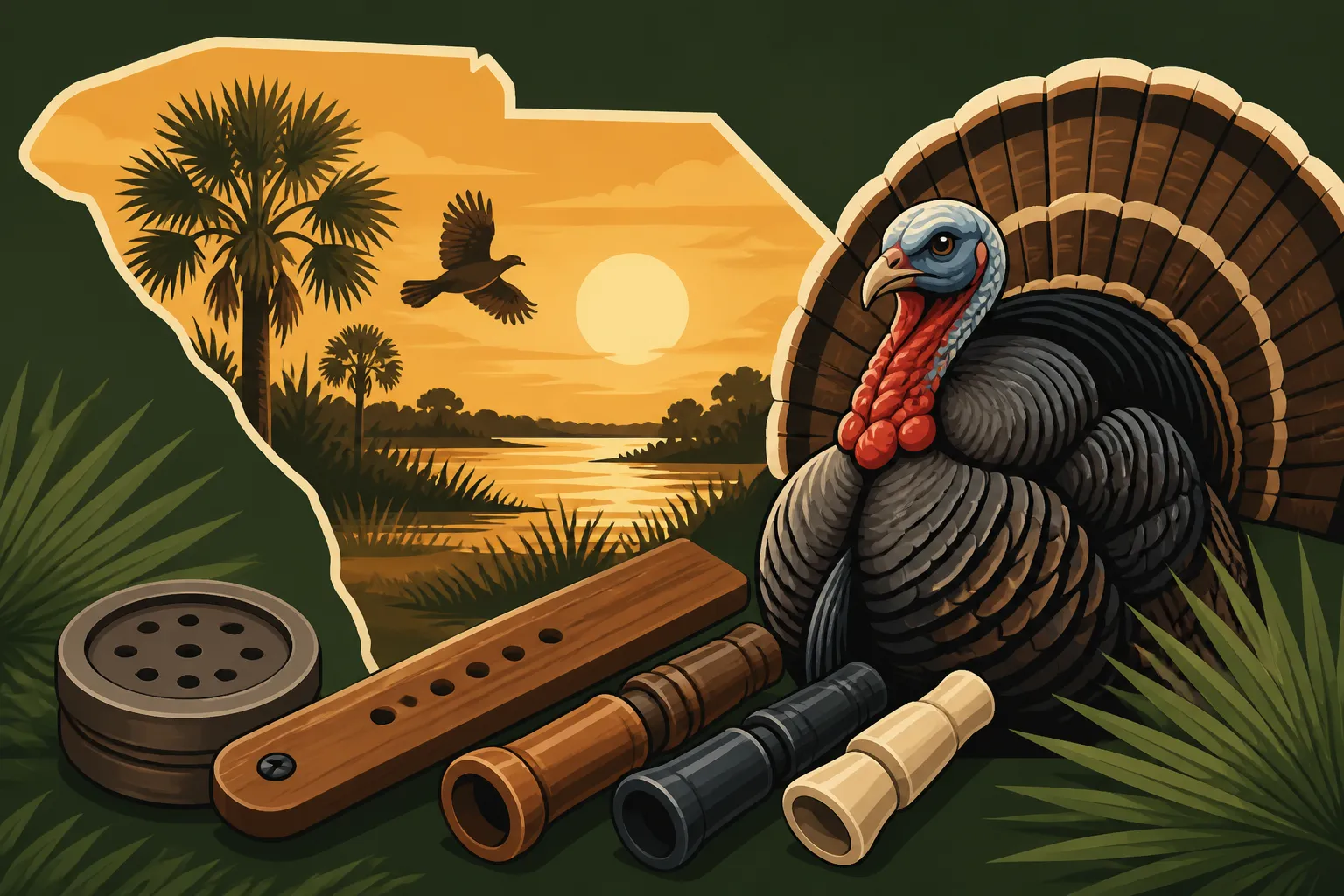
A slate call is often considered the quintessential friction call, and for good reason. It’s incredibly versatile, capable of producing soft, subtle purrs and clucks perfect for closing the deal on a wary gobbler, or sharp, clear yelps and cuts to get a distant bird’s attention. The magic of a slate call lies in its ability to mimic the natural rasp and tone of a real hen. You can vary the sound dramatically by changing strikers – from a soft cedar or persimmon for quiet, seductive calls, to a harder dymondwood or carbon for louder, more aggressive sequences. The biggest challenge with slate, especially in the notoriously humid South Carolina spring, is keeping the surface dry and conditioned. A little piece of sandpaper or a conditioning stone is essential to roughen up the slate and maintain its crisp sound. If you’re hunting in a drizzling rain or heavy fog, a damp slate can be frustratingly quiet. Still, for its sheer realism and adaptability, a good slate call is indispensable. Calling a South Carolina Gobbler Off the Roost often starts with subtle tree yelps, which a slate call excels at.
Pot Calls: Glass and Aluminum for Crisp Tones
Pot calls, sometimes called push-pull calls, are similar to slate but often feature different surface materials like glass, aluminum, or even ceramic. These materials offer distinct tonal qualities. Glass calls tend to produce a higher-pitched, crystal-clear sound, capable of cutting through wind or thick timber to reach distant birds. They’re excellent for loud, sharp yelps and excited cutting that can really rile up a gobbler. Aluminum calls, on the other hand, often have a slightly sharper, more metallic rasp, which some hunters find incredibly realistic for mimicking an aggressive hen. Both glass and aluminum require conditioning, much like slate, to maintain optimal sound. The choice between them often comes down to personal preference and what sound you feel most confident producing. Having both a slate and a glass or aluminum pot call in your vest gives you a fantastic range of tones and volumes to adapt to any situation or gobbler’s mood.
Box Calls: Simplicity and Volume
The humble box call is a classic for a reason: it's incredibly easy to learn and can project sound a long, long way. For hunters new to turkey calling, or those who just want a reliable, loud option, a box call is a fantastic starting point. With a simple push or pull of the lid across the sound board, you can produce realistic yelps, clucks, and even cuts with minimal practice. The key advantage of a box call in the South Carolina woods is its volume. If you’re trying to locate a bird across a large clear-cut, an open field, or a vast bottomland swamp, the deep, resonating yelps of a box call will carry. Hunting Lowcountry Swamp Deer shares terrain similar to where turkeys roam, and in that dense environment, projecting sound is critical. While perhaps not as nuanced as a skilled diaphragm caller, a well-made box call can still be deadly effective. Just remember to keep the lid and sound boards chalked for consistent friction, and be careful not to get it too wet, as that can mute its sound.
The Intimacy of Mouth Diaphragm Calls
If friction calls are your workhorses, mouth diaphragm calls are your precision tools. They offer unparalleled hands-free operation, allowing you to keep your gun shouldered and ready as a gobbler approaches. While they have a steeper learning curve, mastering a diaphragm call unlocks a level of realism and versatility that few other calls can match.
Types of Diaphragm Calls: Reeds and Cuts
Diaphragm calls come in a bewildering array of shapes and sizes, primarily defined by the number of reeds and the cut of those reeds. You’ll find single-reed calls, which are generally easier to blow and produce a softer, higher-pitched sound – great for subtle purrs and tree yelps. Double and triple-reed calls offer more volume and a deeper, raspy tone, excellent for aggressive yelps and cutting. Beyond the number of reeds, the "cut" of the top reed is where things get really interesting. Common cuts include the "batwing," "ghost," and "V-cut." Each cut manipulates the airflow differently, producing unique sounds. A batwing, for instance, often gives a very raspy, mature hen sound, while a ghost cut might offer a cleaner, sharper yelp. Experimenting with different reed counts and cuts is part of the fun, and you’ll find that one or two become your absolute go-to’s for sounding like the dominant hen in the woods.
Mastering the Diaphragm: From Yelps to Cuts
Learning to use a diaphragm call effectively takes time, patience, and practice. It involves placing the call in the roof of your mouth, sealing it with your tongue, and forcing air over the reeds. It sounds complicated, and initially, it can feel that way, but with consistent effort, it becomes second nature. Start with simple yelps, focusing on a clear, consistent sound. Once you’ve got that down, you can begin to introduce clucks, purrs, and then more aggressive cutting. The beauty of a diaphragm is the incredible control you have over volume and cadence, all without moving your hands. This is absolutely critical when a gobbler is circling in close, trying to pinpoint the source of your call. Being able to subtly cluck or purr with your gun up, ready to shoot, gives you a significant advantage. Many hunters watch videos or listen to actual hen turkeys to refine their sounds, striving for that perfect, irresistible cadence that drives a gobbler wild.
Locator Calls: Getting a Response
Sometimes, the best turkey call isn't a turkey call at all. Locator calls are designed to make a gobbler shock gobble, revealing his position without him feeling pressured to come to you. They are an essential part of scouting and hunting, especially when you're trying to find that first bird of the morning.
Owl Hoots and Crow Caws: Shock Gobbles
The classic locator calls in South Carolina are the owl hoot and the crow caw. As dawn breaks, an owl hoot can often prompt a sleepy gobbler on the roost to sound off. Hooting at regular intervals, especially in areas where owls are common, can pinpoint a bird before his feet even hit the ground. During the day, particularly after the morning fly-down, a sharp, realistic crow caw can do the same trick. Gobblers often can’t resist responding to a crow’s call, especially if it sounds like an actual crow flying overhead. It’s a natural reflex, not a response to a potential hen, making it a low-pressure way to locate birds. I’ve had many a morning start with a loud hoot echoing through the Francis Marion National Forest, followed by a thunderous gobble, letting me know exactly where I needed to set up. Roost Hunting South Carolina Gobblers highlights the importance of these early morning sounds.
Coyote Howls and Pileated Woodpecker Cackles
While less common, coyote howls and pileated woodpecker cackles can also be effective locator calls. A coyote howl is particularly good in areas where coyotes are prevalent, as it's a sound that can often trigger an instinctual response from a gobbler. It's a bit more aggressive and can sometimes carry further than a crow caw, making it useful in larger, more open areas. The distinctive, almost maniacal cackle of a pileated woodpecker is another great option. These birds are common throughout South Carolina's timbered areas, and their loud calls can sometimes get a gobbler to announce his presence. The key with all locator calls is to use them sparingly and strategically. You're trying to get a shock gobble, not annoy the bird into silence. Listening for the nuances of how a gobbler responds – a half-hearted gobble versus a booming, enthusiastic one – can also tell you a lot about his mood and willingness to come in.
Electronic Calls and Ethical Considerations
In the modern hunting world, technology offers many tools, but it's vital to understand which ones are legal and ethical, especially when it comes to turkey hunting in South Carolina. There's a big difference between using a handheld manual call and relying on electronics.
Legality and Ethical Boundaries for Turkeys
This is a critical point that cannot be stressed enough: Electronic calls are illegal for hunting wild turkeys in South Carolina. Period. The South Carolina Department of Natural Resources (SCDNR) explicitly prohibits the use of electronic calls or devices that emit recorded or amplified sounds to attract turkeys. This regulation is in place to maintain fair chase principles and protect the wild turkey population from undue pressure. While electronic calls might be legal for other species, such as Night Hunting Hogs With Lights on Private Land or coyotes, they are strictly forbidden for turkeys. Any hunter caught using an electronic call for turkeys faces significant penalties, including fines and potential loss of hunting privileges. It's simply not worth the risk, and it goes against the spirit of ethical turkey hunting.
The Hunter's Skill and Tradition
Part of the immense satisfaction of turkey hunting comes from the challenge of outsmarting a wary gobbler using your own skill and understanding of his behavior. There’s a deep connection to tradition in calling a bird into range with a handmade box call or a diaphragm you’ve painstakingly practiced with. It's about learning the subtle language, adapting to the bird's mood, and mastering the craft of calling. This is where the true beauty of turkey hunting lies – in the personal connection to the wild, the mimicry, and the intense chess match between hunter and bird. Relying on an electronic device to do the calling for you diminishes this experience and removes much of the skill and art form inherent in the sport. Embrace the challenge of learning to call; it's a journey that enriches every moment you spend in the turkey woods.
Building Your South Carolina Turkey Call Arsenal
No single call is a magic bullet, but a thoughtfully assembled arsenal of calls, combined with consistent practice, will significantly increase your success rate in the varied landscapes of South Carolina. Think of your call collection as a toolbox, each with a specific purpose.
Matching Calls to Conditions and Confidence
The best call for any given situation is often the one you have the most confidence in and that best suits the conditions. On a windy day, a loud box call or a sharp glass pot call might be necessary to reach a gobbler. In thick cover, a diaphragm allows you to call quietly while keeping your gun up. When a bird is hung up at 60 yards, a subtle slate call with soft purrs and clucks might be the persuasive element he needs. It's not about carrying every call known to man, but rather having a few calls you've mastered. I always carry at least one friction call (often a slate for its versatility), a couple of diaphragm calls with different reed configurations, and a reliable locator call. This combination covers most scenarios you'll encounter. Before the season, I often use a hunting app like GoHunt to mark potential roosting sites and plan my approach, considering which calls I'll use at specific points during the hunt. South Carolina Spring Turkey Season Rules emphasizes staying prepared.
Maintenance and Practice: Honing Your Craft
Your calls are tools, and like any tool, they require maintenance and practice. Friction calls need their surfaces conditioned (sanded for slate/glass, chalked for boxes) and strikers cleaned. Diaphragm calls should be rinsed and allowed to air dry to prevent mold and prolong their life. Storing calls properly, away from extreme heat or moisture, is also key.
But beyond physical maintenance, consistent practice is the most important "maintenance" you can perform. The off-season is the perfect time to hone your skills. Listen to real turkeys, watch instructional videos, and spend time in your backyard or truck practicing different calls and sequences. The more realistic and confident you sound, the better your chances will be. A gobbler can often tell a hesitant or unnatural call, and that's enough to send him packing. Become fluent in the language of the wild turkey, and you'll find much greater success and enjoyment in your South Carolina turkey hunts.
| Call Type | Ease of Use | Volume | Versatility (Sounds) | Hands-Free? | Best for SC Conditions |
|---|---|---|---|---|---|
| Slate Pot Call | Medium | Medium | High | No | Close-range, subtle, all-around |
| Glass Pot Call | Medium | High | High | No | Loud, cutting, open terrain, windy days |
| Box Call | Easy | Very High | Medium | No | Locating, cutting through thick cover |
| Diaphragm Call | Difficult | Medium to High | Very High | Yes | Close-range, hands-free, nuanced calling |
| Owl Hoot/Crow Caw | Easy to Medium | High | Low (Locator only) | No | Roost locating, shock gobbling |
Disclaimer
This article is for general informational purposes only and does not constitute professional advice. Laws, prices and regulations vary by location and change over time. Consult a qualified professional for guidance on your specific situation.