South Carolina Whitetail Color Phase Rarities
We’ve all spent countless hours in the South Carolina woods, whether perched high in a treestand or still-hunting through the swamps, and for the most part, we expect to see the same familiar sight: a beautiful, camouflaged whitetail deer. But every once in a long while, nature throws us a curveball, presenting a deer that looks strikingly different, a true rarity that can leave you wondering if your eyes are playing tricks on you. This guide is here to shed some light on those unusual sightings, breaking down the fascinating world of South Carolina whitetail color phase rarities and what makes them so special.
The Standard Palette: Understanding Typical South Carolina Whitetail Coloration
Before we dive into the extraordinary, it’s helpful to ground ourselves in the ordinary. The vast majority of white-tailed deer you’ll encounter across South Carolina sport a coat that's perfectly adapted for their environment. This typical coloration is a masterclass in natural camouflage, allowing them to blend seamlessly into the diverse landscapes of our state, from the dense pine plantations of the Midlands to the ancient bottomland hardwoods of the Lowcountry.
Their standard summer coat usually leans towards a reddish-brown hue, often with a sleeker, finer texture. This lighter, warmer shade helps them melt into the vibrant green foliage of spring and summer. As the seasons shift and the leaves begin to turn, so does the deer’s wardrobe.
Seasonal Shifts in Coat Color
Come fall and winter, our South Carolina whitetails undergo a noticeable transformation. Their coats thicken and grow much longer, becoming denser and more insulated to protect them from cooler temperatures and damp conditions. The color typically deepens to a grayish-brown, sometimes almost a steel gray, providing superior camouflage against the muted tones of leafless trees and dormant undergrowth. You’ll notice the contrast vividly if you compare a deer observed in August to one you see in December. The fawns, of course, have their own distinctive spotted pattern, a perfect disguise against predators in their early weeks, which they shed as they mature. This seasonal change is a vital part of their survival strategy, and it’s something every hunter intuitively recognizes as part of the rhythm of the woods.
Subtle Regional Differences
While the general color scheme holds true across the state, you might even notice some subtle regional variations in the "typical" deer coat. For instance, deer in the denser, darker swamps of the South Carolina Lowcountry might sometimes appear a touch darker or richer brown compared to those ranging across the more open, sandy fields of the Sandhills region, where a lighter, more faded brown might prevail. These aren’t dramatic differences, mind you, but rather slight nuances in the genetic makeup of local populations, or perhaps simply how the ambient light plays on their fur in different habitats. Think of it like a slight variation in hair color within a human family – all related, but each with unique undertones. These small distinctions add another layer of appreciation for the adaptability of White-Tailed Deer Across South Carolina.
Unveiling Genetic Anomalies: South Carolina's Rare Whitetail Color Phases
Now, let's talk about the real head-turners. These are the deer that stop you in your tracks, making you question if you're truly seeing what you think you're seeing. Rare color phases in whitetail deer are the result of genetic mutations, specific genes that alter the production or distribution of pigment in their hair follicles and skin. While truly rare, these extraordinary individuals do occasionally appear in our South Carolina woods, offering a glimpse into the diverse genetic potential of the species.
Albinism: The Pure White Ghost of the Woods
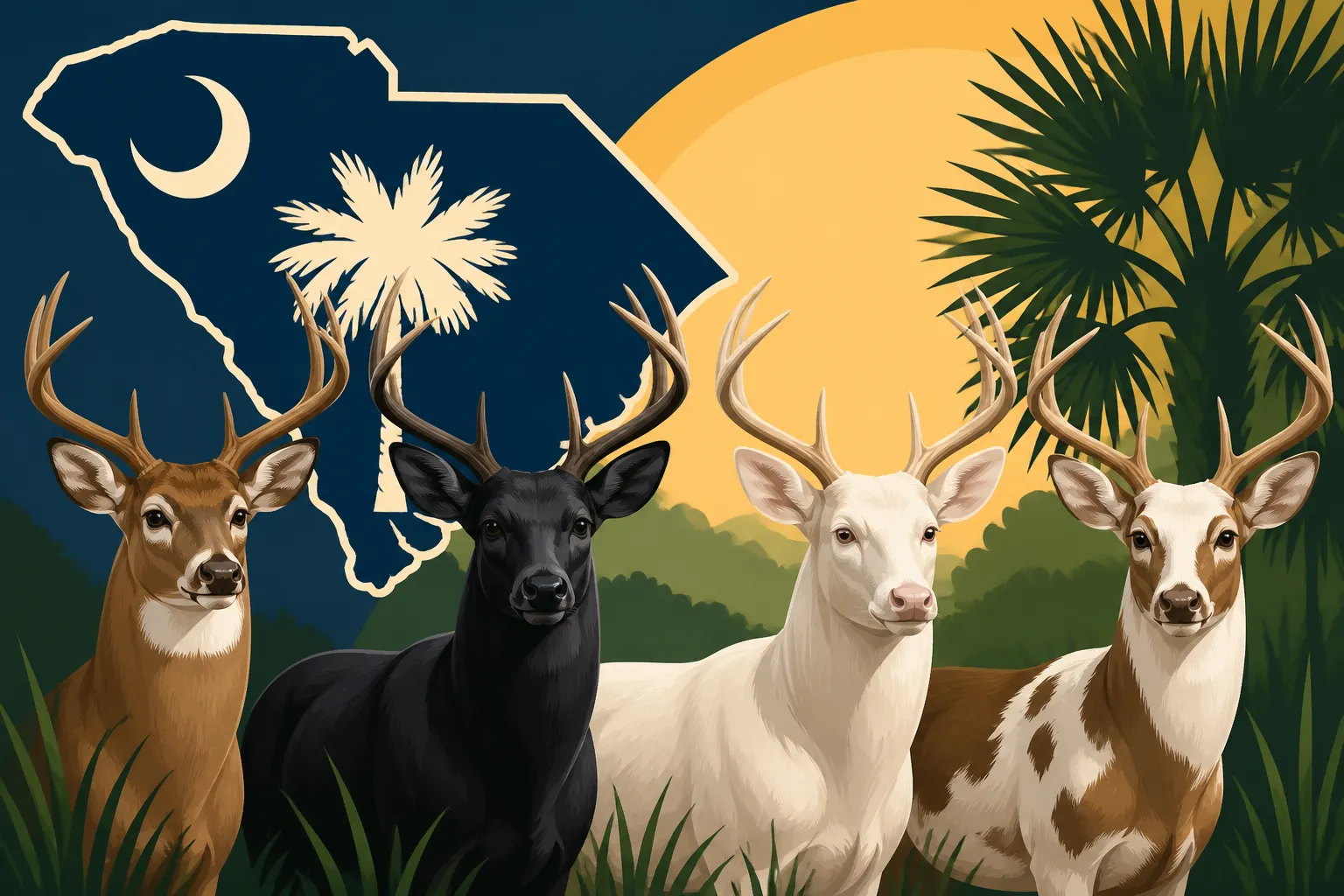
When most people think of a "white deer," they're probably picturing an albino. Albinism is a genetic condition characterized by the complete absence of melanin, the pigment responsible for color in skin, hair, and eyes. An albino deer will have startlingly pure white fur, but the most definitive characteristic is their pink or reddish eyes. This isn't because their eyes are actually pink, but rather due to the blood vessels showing through the unpigmented iris.
Albino deer are incredibly striking and, unfortunately, often face challenges in the wild. Their pure white coats make them stand out starkly against most natural backgrounds, severely reducing their natural camouflage. This can make them more vulnerable to predators and potentially less successful hunters themselves. Because of their rarity and unique appearance, seeing an albino deer is considered a truly special event for any outdoors enthusiast.
Leucism and Piebaldism: Patches of White
More commonly encountered than true albinism, though still quite rare, are deer with leucism or piebaldism. These conditions result in partial loss of pigmentation, meaning the deer will have white fur, but not the tell-tale pink eyes of a true albino.
- Leucism is a general term for reduced pigmentation. A leucistic deer might have a mostly white coat with normal-colored eyes (usually brown) and nose. The white is typically a creamy white, not the stark, blinding white of an albino. They retain some pigment, just not in all areas or to the full extent.
- Piebaldism is a specific type of leucism where the deer exhibits irregular patches of white and normal-colored fur. Imagine a brown deer with splashes of stark white across its body – often on the legs, belly, neck, or head. The amount and location of these white patches can vary dramatically from deer to deer. Some might have just a few white spots, while others could be nearly 70% white, resembling a pinto horse. These deer also retain their normal eye and nose coloration. Piebald deer, especially those with extensive white patching, can also experience other physical deformities like bowed noses, short legs, or internal organ issues, making their survival a bit tougher than their typically colored counterparts.
These deer, with their unique patterns, are often the ones you might spot and do a double-take. They are beautiful anomalies, a testament to the diverse genetic tapestry within the deer population.
Melanism: The Elusive Black Deer
While white deer often grab headlines, their exact opposite, the melanistic deer, is perhaps even rarer and certainly more elusive, especially in South Carolina. Melanism is caused by an overproduction of melanin, resulting in a deer with a coat that is predominantly, if not entirely, black or a very dark, smoky gray. These deer look like shadows moving through the woods, almost phantom-like.
Melanistic whitetails are incredibly uncommon, so much so that many seasoned hunters will go their entire lives without seeing one. Unlike albino or piebald deer, which might be at a disadvantage due to lack of camouflage, a melanistic deer might actually blend better into certain dark, shaded environments, like dense swamp bottoms or deep timber. However, their sheer rarity means they are a genetic marvel rather than a common adaptation. Spotting a melanistic deer in South Carolina would truly be a once-in-a-lifetime experience, sparking conversation and awe among anyone fortunate enough to witness it.
Here’s a quick overview of these rare color phases:
| Color Phase | Key Characteristics | Eye Color | Rarity in SC | Camouflage Impact |
|---|---|---|---|---|
| Normal Whitetail | Reddish-brown (summer), grayish-brown (winter) | Brown | Common | Excellent |
| Albinism | Pure white fur, no pigment at all | Pink/Red | Extremely Rare | Poor (stands out) |
| Leucism | White or creamy white fur, but normal eye color | Normal (Brown) | Very Rare | Variable, often poor |
| Piebaldism | White patches mixed with normal brown fur | Normal (Brown) | Very Rare | Variable, can be poor if extensive white |
| Melanism | Entirely black or very dark gray fur | Normal (Brown) | Extremely Rare | Potentially good in dark timber, otherwise poor |
Encountering and Appreciating These Rare Deer in the Palmetto State
So, what are your chances of actually seeing one of these unique deer in South Carolina? To be frank, the odds are incredibly slim. Even a piebald deer, which is the most "common" of the rarities, is still a very infrequent sighting. True albinos and melanistic deer are so rare that a single individual can become legendary in a local hunting community.
Odds of a Sighting and What to Do
Your best bet for spotting one of these genetic wonders is simply to spend a lot of time in the woods, scouting and hunting regularly. While there's no specific region in South Carolina known for higher concentrations of these deer, consistent observation over many years increases your chances. If you do happen upon one, whether it’s a pure white albino or a strikingly dark melanistic individual, take a moment to appreciate the incredible diversity of nature. Many hunters choose to simply observe and enjoy the sight, letting these rare creatures continue their journey.
If you capture a photo or video, it’s always fascinating to share it with fellow outdoor enthusiasts. The South Carolina Department of Natural Resources (SCDNR) monitors wildlife populations, and while a single sighting might not impact management, a pattern of sightings in a specific area could be of scientific interest. You can often report unusual wildlife sightings through their official channels, contributing to their understanding of our state's diverse fauna. Tools like the Go Outdoors SC App are fantastic for general scouting, but for something truly out of the ordinary, sometimes just enjoying the moment is the best approach.
Ethical Considerations for Hunters
This is where the discussion often turns, and it's a topic that brings up a lot of personal opinions. If you're out during South Carolina Deer Season Structure Explained and one of these rare deer walks into your shooting lane, what do you do?
Legally, in South Carolina, if a deer is a legal target (e.g., an antlered buck during buck season, or an antlerless deer during antlerless season) and you have the appropriate tags and licenses, you can harvest it regardless of its color phase. There are no specific regulations protecting albino, leucistic, piebald, or melanistic deer from harvest.
However, many hunters choose not to take these animals. There’s a strong ethical argument to let such rare individuals continue to exist, appreciating them for their uniqueness rather than harvesting them. Some feel that taking such an animal removes a rare genetic trait from the local population, even if that impact is negligible. Others might feel it’s a "trophy of a lifetime" and a story to tell. Ultimately, the decision rests with the individual hunter, guided by their personal ethics and respect for the resource. What's important is to understand that these animals are not protected by law in South Carolina, but they hold a special place in the hearts of many who enjoy the outdoors. Every hunter needs to make their own decision, perhaps considering the potential to observe this unique animal again. For more on general hunting rules, consider articles like South Carolina Hunting Licenses and What They Cost.
Beyond the Extremes: Other Noteworthy Color Variations
While albinism, leucism, piebaldism, and melanism represent the most dramatic departures from the norm, deer can exhibit other, more subtle, but still interesting color variations and markings that aren't quite as rare but certainly catch the eye.
The "Blue" Deer and Other Unique Shades
Occasionally, you might hear hunters refer to a "blue deer." This isn't an actual blue color, of course, but refers to a particularly strong steel-gray winter coat, often with almost iridescent undertones, that can appear bluish in certain light conditions. These deer aren't genetically distinct in the same way an albino is; rather, they represent an extreme on the spectrum of normal gray winter coats. They're often beautiful and stand out from the typical brown-gray, perhaps a genetic predisposition towards a cooler, ashier tone in their winter fur.
Similarly, some deer might have a more pronounced reddish hue in their summer coat that persists slightly longer into fall, or a particularly golden tan in areas. These are all part of the natural variation within a healthy deer herd, showcasing the subtle beauty and adaptability of the species.
Distinct Markings and Patterns
Beyond overall body color, some deer might also exhibit unique markings or patterns that are a little out of the ordinary. This could include:
- White "stockings": Deer with noticeably white lower legs, almost as if they're wearing socks. This is usually due to a minor genetic expression related to piebaldism, but not extensive enough to classify them as true piebalds.
- Unusual facial patterns: Sometimes a deer will have a more pronounced white blaze on its face, or a distinct white patch around its eyes or jawline that is beyond the usual white markings seen on a whitetail. These can give a deer a truly individual look, making them easier to recognize if you encounter them repeatedly.
- Scarring or injury-induced color changes: It's also worth noting that injuries, scars, or even some skin conditions can sometimes affect hair growth and pigmentation, leading to patches of discolored or white fur that aren't genetic in origin. These are not true color phase rarities but can certainly make a deer stand out.
These less extreme variations, while not as dramatic as a pure albino or melanistic deer, still add to the rich tapestry of wildlife we're privileged to share the woods with here in South Carolina. Every deer is unique, but some are just a little more unique than others, and recognizing these subtle differences makes every moment in the field a little more interesting.
Disclaimer
This article is for general informational purposes only and does not constitute professional advice. Laws, prices and regulations vary by location and change over time. Consult a qualified professional for guidance on your specific situation.