South Carolina Mallard and Wood Duck Numbers
It can be incredibly disheartening to wake up before dawn, drive to your favorite public land, and set out a perfect spread of decoys, only to sit through legal shooting hours without a single duck breaking the horizon. Waterfowlers in South Carolina often find themselves wondering about the actual numbers of the mallards and wood ducks that call our state home, or at least a winter refuge, and what those numbers mean for hunting success. This guide aims to pull back the curtain on these two cherished species, offering a deeper understanding of their populations and how you can use this knowledge to become a more effective duck hunter here in the Palmetto State.
The Mallard Migration Through South Carolina
Mallards, with their iconic green heads and unmistakable quack, are a staple of waterfowl hunting across North America. While they might be prevalent, understanding their presence in South Carolina requires a look at their migratory patterns and how our state fits into the larger Atlantic Flyway. We're not a breeding ground for these magnificent birds, but rather a crucial wintering destination, and their numbers here can vary significantly year to year.
Tracing the Greenhead's Journey to Our Lowcountry
Think of South Carolina as a preferred winter vacation spot for mallards. Most of the mallards we see here originate from breeding grounds far to our north, in the prairie potholes of the Midwest, Canada, and the Great Lakes region. As the northern latitudes freeze over and food sources become scarce, these birds begin their arduous journey south, following ancient migratory routes down the Atlantic Flyway. Our state, with its relatively mild winters and abundant wetlands, tidal marshes, and agricultural fields, acts as a magnet for these weary travelers.
The sheer volume of birds that decide to winter here can fluctuate wildly, dependent on conditions both in their breeding grounds and along the migration corridor. A productive breeding season up north, coupled with favorable weather during their southward flight, often translates to a healthy influx of mallards into South Carolina. They're looking for open water that won't freeze, readily available food like waste grain in harvested fields or natural aquatic vegetation, and safe roosting areas. You'll often find them concentrated in major river systems, large impoundments, and especially the vast coastal marshes and old rice fields that line our coast. For more on this broader picture, check out South Carolina Waterfowl on the Atlantic Flyway.
Reading the Annual Mallard Population Forecast
So, how do biologists figure out how many mallards are out there, and more importantly, how many might make it to our neck of the woods? It's a massive undertaking involving extensive aerial surveys of breeding populations in the spring, primarily in those critical prairie regions. These surveys give wildlife agencies an estimate of the breeding duck population and the number of ponds available for nesting and brood-rearing. This data is the foundation for setting hunting regulations across the flyways.
Here in South Carolina, our numbers are heavily influenced by these northern conditions. A severe drought in the prairies can devastate a breeding season, leading to fewer birds overall. Conversely, a wet spring can mean boom years for duck production. Beyond breeding success, the weather during migration also plays a huge role. Early, hard freezes up north can push birds south quickly and in large numbers, often resulting in strong early-season hunting in South Carolina. However, if the weather stays mild further up the coast, birds might "short-stop" in states like North Carolina or Virginia, meaning fewer greenheads make it all the way down to us. Staying informed through federal and state waterfowl reports can give you a general idea of what to expect each season. While no app can predict exactly where ducks will land, tools like GoHunt can help you scout and understand land features where birds might concentrate.
Understanding South Carolina's Wood Duck Population
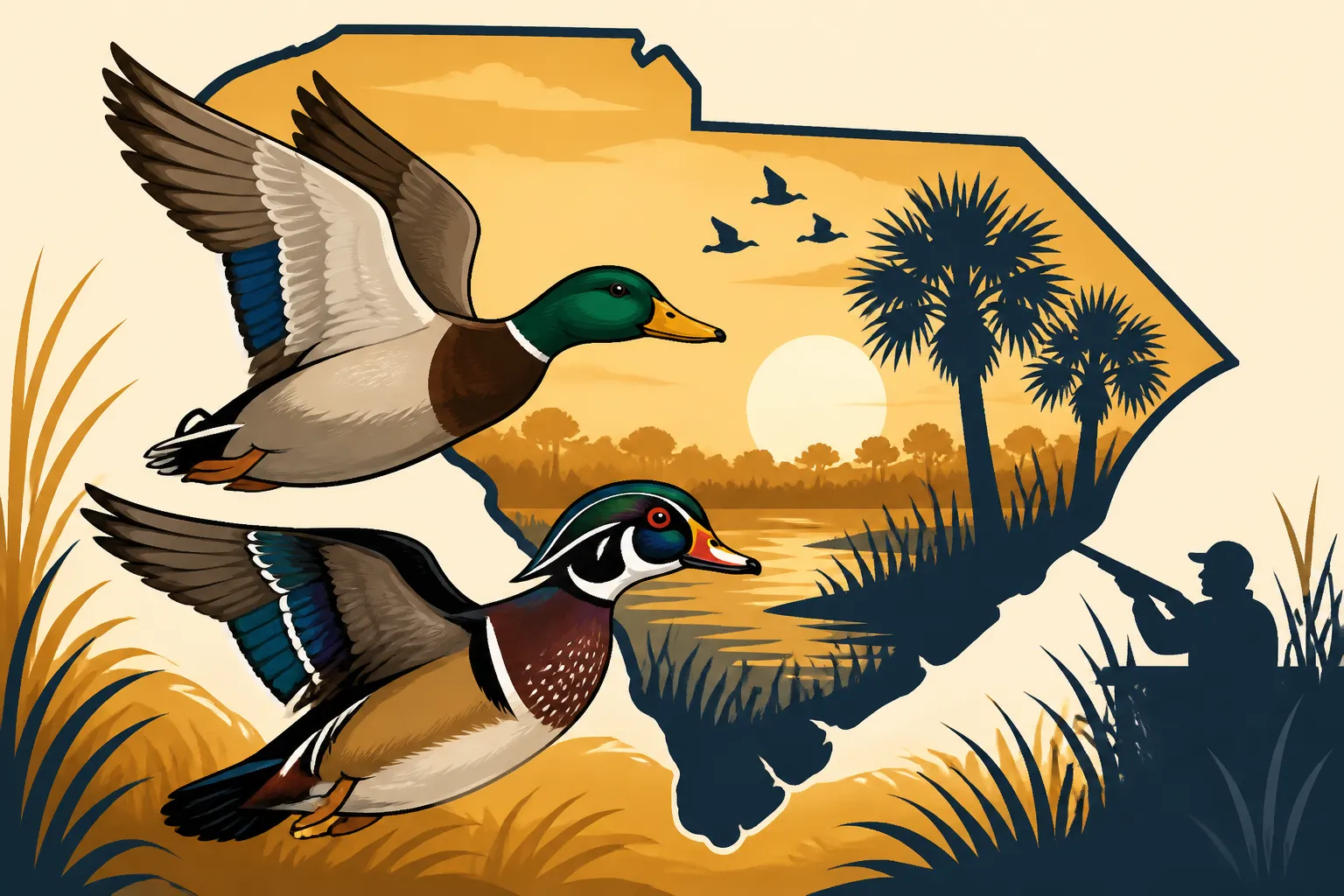
While mallards are the flashy, well-traveled celebrities of the duck world, the wood duck is our quiet, often overlooked, but incredibly important native resident. Unlike mallards, which are mostly passing through, wood ducks consider South Carolina their permanent home, breeding, raising their young, and often wintering right here in our state. Their vibrant plumage and swift, agile flight through timber make them a challenging and rewarding bird to pursue.
The Resilient Native: Wood Duck Breeding and Roosting Habits
Wood ducks are truly a marvel of adaptation, perfectly suited to the forested wetlands and river bottoms of South Carolina. Instead of nesting on the ground like many other duck species, they lay their eggs in tree cavities, often old woodpecker holes, high above the water. This unique nesting strategy helps protect their clutches from ground predators, though it does make them dependent on mature trees with suitable cavities. When natural cavities are scarce, they readily use man-made nest boxes, which have been a huge success story in wood duck conservation across the state.
These birds are early breeders, often starting their nesting activity in late winter or very early spring, long before many other duck species. After hatching, the ducklings, usually within 24 hours, take a remarkable leap of faith, jumping from their tree cavity down to the water or forest floor below. They're incredibly independent from the start, following their mother to forage in dense cover. You'll find them scattered throughout the state wherever there's suitable wooded swamp, beaver ponds, or slow-moving creeks. Their preference for these secluded, timbered areas means they often go unnoticed by hunters focused on more open water. For tips on hunting these specific habitats, consider Jump-Shooting South Carolina Creeks for Wood Ducks.
Local Factors Affecting Our Wood Duck Abundance
Because wood ducks are largely year-round residents, their population numbers in South Carolina are more directly tied to local habitat conditions and less to distant breeding grounds. The health of our forested wetlands, the stability of water levels in our swamps and rivers, and the availability of suitable nesting sites are paramount. A prolonged drought can severely impact wood duck production by drying up critical wetlands and making foraging difficult. Conversely, too much flooding at the wrong time can wash out nests or make access to food challenging for broods.
Conservation efforts, particularly nest box programs and the preservation of bottomland hardwood forests, have been incredibly beneficial for wood ducks. Their numbers have rebounded significantly from historical lows, thanks to these targeted efforts. However, ongoing threats like habitat loss due to development, timber harvesting practices that remove old-growth trees with cavities, and increased predation can still impact local populations. Hunters and conservationists play a vital role in monitoring and improving wood duck habitat. These local populations tend to be more stable than the highly variable mallard numbers, but they are still sensitive to environmental changes right here in our backyard.
Factors Influencing Waterfowl Numbers in the Palmetto State
It's not just about what happens up north or how many trees we have; a complex web of environmental factors continuously shapes the mallard and wood duck numbers we see in South Carolina. Understanding these broader influences can help hunters anticipate good seasons, or at least understand why a particular year might be tougher.
The Critical Role of Habitat: Food, Water, and Cover
Habitat, simply put, is everything for waterfowl. Both mallards and wood ducks need a specific combination of food, water, and cover to survive, thrive, and reproduce. For mallards, this often means large expanses of shallow water, whether it's vast coastal marshes, flooded agricultural fields (especially cut corn or soybeans), or managed impoundments. These areas provide the caloric intake they need to survive the winter. They are masters at exploiting waste grain in farm country, making those areas prime hunting spots. Consider Hunting a Standing Cornfield in Farm Country or Hunting Coastal Rice Field Edges.
Wood ducks, on the other hand, are creatures of the deep woods and swamps. Their ideal habitat is flooded timber, beaver ponds, and slow-moving creeks choked with vegetation. They feed on acorns, nuts, and aquatic invertebrates found in these secluded spots. Without these specific habitats, both species would struggle immensely. The ongoing efforts to protect and restore these critical wetland areas, whether through public land management or private conservation programs, are essential. When we talk about Hunting Flooded Timber for Mallards, we're really talking about preserving the ecosystems these birds rely on.
Weather Patterns and Their Far-Reaching Effects
Weather is perhaps the most unpredictable, yet undeniably powerful, factor influencing waterfowl numbers in South Carolina. Global and regional weather patterns dictate everything from breeding success to migration timing and where birds ultimately decide to spend their winter. A severe, prolonged winter in the Midwest and Northeast can act as a "push" factor, forcing large numbers of ducks, including mallards, further south to escape frozen conditions. When this happens, our coastal plain can see exceptional numbers of birds.
Conversely, mild winters up the Atlantic Flyway can lead to a phenomenon known as "short-stopping." If ducks can find open water and sufficient food sources in states further north, they may choose not to complete their migration all the way to South Carolina. This can leave us scratching our heads, wondering where all the birds went. Locally, specific weather events, like strong cold fronts or heavy rainfall, can also concentrate birds or scatter them. Heavy rains might flood new areas, creating temporary feeding grounds, while a sudden cold snap might freeze up small ponds, pushing birds to larger, open bodies of water. For a deeper dive, check out Duck Migration Timing Through South Carolina.
Applying Population Insights to Your Hunt Strategy
Understanding the dynamics of mallard and wood duck populations isn't just for biologists; it's a powerful tool for hunters looking to increase their success. By combining this knowledge with smart scouting and adaptable tactics, you can make the most of your time afield.
Scouting Smart for Mallards and Wood Ducks
Armed with knowledge about population trends, your scouting efforts become much more focused and efficient. If national mallard numbers are down, or if the north has had a mild winter, you know you'll need to work harder to find the birds that have made it to South Carolina. This means intensifying your scouting for specific food sources and undisturbed loafing areas. Mallards are often found where there's waste grain, so driving backroads near agricultural fields or even walking the edges of public land fields can be productive. Using satellite imagery or apps like GoHunt can highlight potential feeding and roosting areas, even when you're at home.
For wood ducks, scouting means looking for their preferred timbered water. This might involve walking creek bottoms, exploring beaver swamps, or paddling canoes through flooded woods. Look for fresh droppings on logs, "jumps" of birds flushing from cover, or signs of feeding activity. Their presence is often tied to very specific pockets of habitat. Scouting South Carolina Public Land Before Season provides excellent general guidance that can be applied to waterfowl as well. Remember, wood ducks often use the same roosting spots evening after evening, so identifying these can be gold for a morning hunt.
Adapting Your Tactics to Current Conditions
The numbers are just one piece of the puzzle; how you hunt is the other. If mallard numbers are robust, you might get away with more aggressive calling and larger decoy spreads. However, if birds are scarce or heavily pressured, a more subtle approach is often best. Smaller, more realistic spreads, coupled with light calling, can be more effective for wary birds. Consider a spread that mimics what the birds are seeing, perhaps focusing on feeders rather than high-head sentries. For some general decoy principles, look at Decoy Spreads for ACE Basin Divers.
For wood ducks, stealth is paramount. They are incredibly agile and can slip into dense cover unnoticed. Instead of traditional large spreads, a few wood duck decoys in a natural-looking cluster can be effective, especially if you set up along a natural flight path or in a known feeding area. Often, jump-shooting small creeks or setting up quietly in a timber hole at first light for birds coming off the roost can be highly successful. Whether it's mallards or woodies, flexibility is key. Be prepared to move your setup if the birds aren't working, or to shift your focus from one species to another based on what the day is offering.
Here's a quick comparison of our two favorite South Carolina ducks:
| Feature | Mallards in South Carolina | Wood Ducks in South Carolina |
|---|---|---|
| Primary Status | Migratory winter resident, mostly non-breeding | Year-round resident and primary breeder |
| Breeding Season | Primarily breed in northern latitudes (Canada, Midwest US) | Breed extensively throughout South Carolina |
| Preferred Habitat | Large open water, sheet water, flooded agricultural fields, coastal marshes | Wooded swamps, beaver ponds, forested wetlands, slow creeks |
| Diet | Grains, seeds (corn, rice), aquatic vegetation, invertebrates | Acorns, nuts, seeds, insects, aquatic plants |
| Population Drivers | Northern breeding ground success, migration weather, flyway conditions | Local habitat health, water levels, nest box availability, predation |
| Hunting Strategy Tip | Focus on major wintering areas, cold fronts, waste grain fields | Target wooded sloughs, creeks, beaver ponds; often jump-shooting or morning roost hunts |
| Typical Harvest Timing | Mid-to-late season when cold pushes birds south | Early season for local birds, consistent throughout season |
Understanding these differences and the broader population trends for both mallards and wood ducks will equip you to make more informed decisions, enhancing your hunting experience in the varied and beautiful wetlands of South Carolina. Whether you're chasing the majestic greenhead or the elusive woodie, being prepared with knowledge is always your best bet.
Disclaimer
This article is for general informational purposes only and does not constitute professional advice. Laws, prices and regulations vary by location and change over time. Consult a qualified professional for guidance on your specific situation.