Hunting Bears Over Natural Mast in the Mountains
Hunting bears in South Carolina's mountains without relying on bait can feel like a daunting task, a true test of woodsmanship and patience when you're used to more predictable methods. It's a game of chess against an animal that often moves silently through the thickest cover, and figuring out where they'll be when they aren't hitting a consistent food source can be incredibly frustrating. This guide will walk you through understanding bear behavior, pinpointing natural food sources, and employing effective hunting strategies to increase your odds of success in the challenging terrain of the Upstate.
Understanding Mountain Bear Behavior and Natural Mast
When you're chasing black bears in the mountains of South Carolina, particularly in the Upstate, you're looking for a completely different set of clues than you would in other parts of the state or when hunting over bait. These bears are wild, wary, and constantly on the move, driven by their insatiable appetite for calories. To find them, you've got to think like them, which means understanding their primary food sources – often referred to as "mast" – and how those change throughout the hunting season. This isn't just about identifying a single oak tree; it's about recognizing the entire buffet nature provides and how bears exploit it.
Seasonal Mast Availability
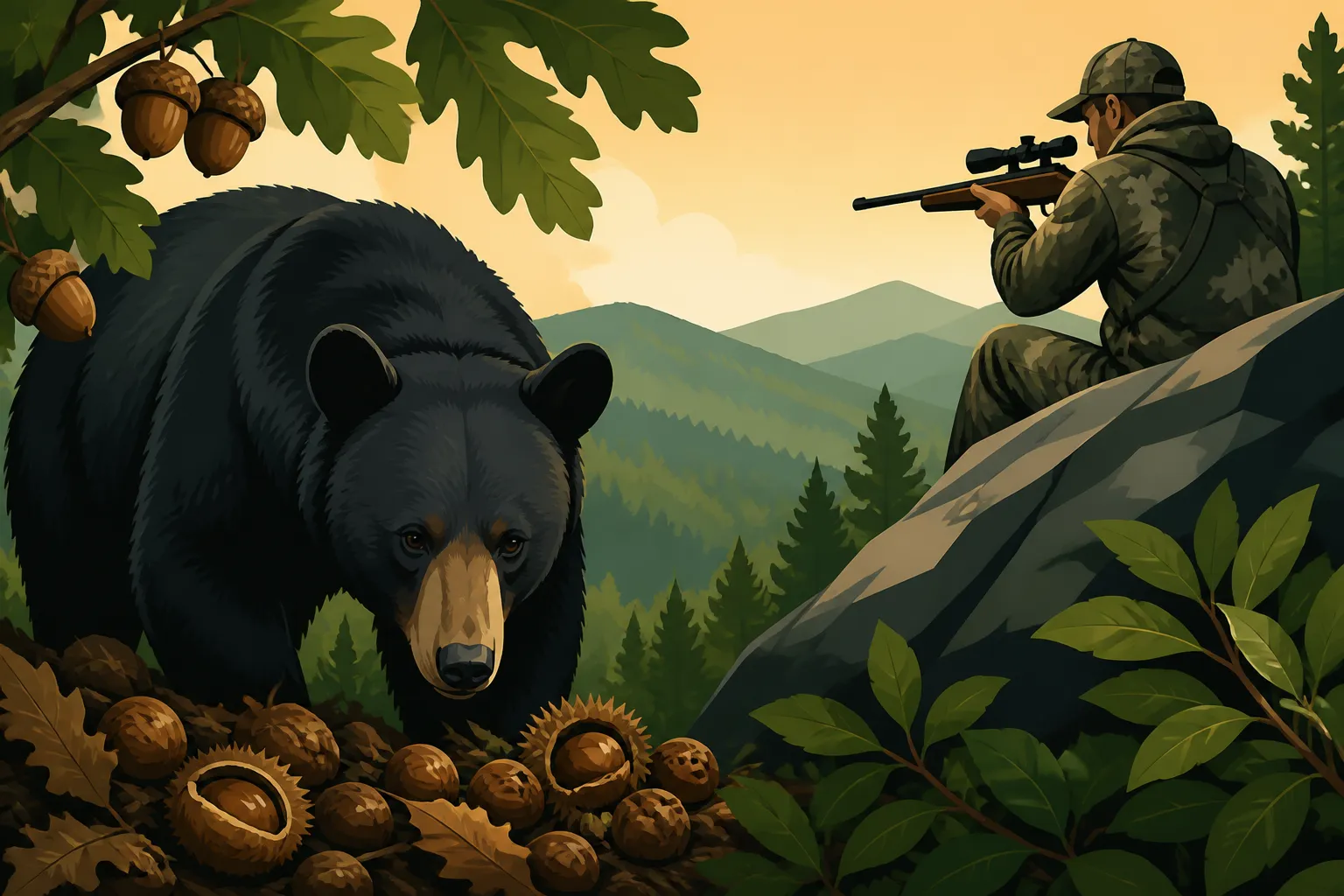
The mountain bears in South Carolina, especially those calling the Sumter National Forest home, are incredibly attuned to the rhythm of the seasons and the availability of natural foods. Early in the fall, they're often gorging on soft mast, like blackberries, blueberries, and even wild grapes, found in clear-cuts and along forest edges. As the temperatures cool and these soft mast sources dwindle, their focus shifts dramatically to hard mast – acorns, hickory nuts, and beechnuts. This is where your scouting efforts become critical. Different species of oak trees drop their acorns at different times, and some years are simply better for mast production than others. A red oak acorn crop might be booming one year, drawing bears in for weeks, while the white oaks are barren. Understanding these cycles, knowing which trees produce what, and when they drop it, is like having a secret roadmap to their feeding grounds. If you're not seeing much sign around one type of mast, it’s time to move on to the next available natural buffet.
The challenge truly lies in the inconsistency. One ridge might be loaded with acorns, while the next over is completely bare due to microclimates or tree age. This variability forces bears to travel, sometimes covering significant ground to find the best food sources. This is where the informational value of tools like South Carolina's Black Bear Population becomes crucial, helping you understand where densities are highest and, by extension, where their food needs are most concentrated. Their entire year revolves around packing on fat for the winter den, so finding abundant, high-calorie mast is paramount to their survival. This intense drive is what we as hunters try to key into.
Bear Movement and Feeding Patterns
Mountain bears are creatures of habit when it comes to feeding, but those habits are directly tied to mast availability. Once they find a productive area, they'll often "crater" there, spending days or even weeks in the vicinity, moving between bedding areas and feeding sites. These feeding sites can be surprisingly small – a single productive oak or a patch of wild fruit bushes. Their movements typically follow the path of least resistance: old logging roads, game trails, and creek bottoms. After filling up, they'll often retreat to dense, thick cover to bed down, especially north-facing slopes with heavy laurel or rhododendron thickets that offer thermal cover and security.
What this means for the hunter is that identifying fresh feeding sign is key. You're not just looking for a few scattered acorns; you're looking for areas where the ground has been torn up, bark scraped, or scat is abundant. The timing of their movement also plays a significant role. Bears are most active during low-light conditions – dawn and dusk – but can feed throughout the day in secluded, secure areas, especially if the mast crop is exceptional. During the peak of the rut, male bears might shift their focus slightly, but even then, calories are king. Understanding these patterns allows you to anticipate where a bear might be moving next, or where they're likely to return to feed. It’s a bit like predicting the weather, but with more scat and torn-up earth.
Scouting for Mast Crops and Bear Sign
Successful mountain bear hunting without bait hinges entirely on meticulous scouting. You can’t just walk into the woods on opening day and expect to stumble upon a bear. You need to know what they’re eating, where they’re eating it, and how they’re moving between those critical areas. This means hitting the woods long before the season opener, sometimes weeks or even months in advance, to map out the ever-changing natural pantry of the forest. This proactive approach saves you countless hours of blind searching during the precious hunting days.
Identifying Key Mast Trees
The first step in effective scouting is knowing your trees. In the Upstate, you’re primarily looking for oak species – white oaks, red oaks, chestnut oaks, and scrub oaks – along with hickory, beech, and even black gum. Each of these trees produces a different type of mast, with varying nutritional values and drop times. White oaks, for example, produce acorns that are less bitter and highly preferred by bears, often dropping earlier than red oak varieties. Hunting Blue Ridge Escarpment Ridgelines can often lead you to diverse stands of these mast producers.
Beyond just identifying the species, you need to assess the health of the mast crop. Are the branches heavy with acorns? Are there signs of insect damage or disease? A healthy, abundant crop in a specific area can act like a magnet for bears, drawing them in from miles around. Look for "mast factories" – a cluster of mature, productive trees that consistently drop a good crop. These areas become hot spots year after year, even if the surrounding forest is less productive. Don't forget about softer mast in early season too, like wild grapes along creek bottoms or berry patches in sun-drenched clearings. A useful tool like the GoHunt app or the Using the Go Outdoors SC App can help you mark these locations on a map for future reference, allowing you to build a comprehensive picture of potential feeding zones.
Locating Fresh Bear Sign
Once you've identified potential mast-producing areas, it's time to dig into the detective work of finding fresh bear sign. This is where the rubber meets the road. Don't just look for tracks; bears leave a wealth of clues if you know what to look for.
- Scat: This is perhaps the most obvious and informative sign. Fresh scat tells you a bear is in the area, and its contents can tell you what they're eating (acorns, berries, insects). Look for distinct piles, often dark and berry-filled, or a mashed-up mess of acorn hulls. The freshness (how moist, how intact) gives you an idea of how recently the bear was there.
- Tracks: While often elusive in the leaf litter, clear tracks in muddy areas near water sources or on well-used game trails confirm presence and give an indication of size. Look for the distinct five toes and the heel pad.
- Rub Trees: Bears will often rub against trees to mark territory or to scratch an itch. Look for hair on the bark and distinctive claw marks, usually on smaller saplings or pines.
- Torn-Up Ground/Flipped Rocks: Bears are powerful excavators. They'll root around for grubs, nuts, or even mushrooms, leaving behind disturbed earth or flipped rocks. In a good mast crop, you'll see large areas of torn-up leaves and soil directly under the producing trees, often called "craters."
- Broken Branches: If you find broken branches on fruit trees or even smaller oaks, it indicates a bear may have climbed up to reach higher mast.
- Trails: Follow well-used game trails, especially those leading from bedding areas (dense laurel thickets or steep north-facing slopes) to feeding areas. These are prime ambush locations.
The fresher the sign, the better your chances. Old, dried-out scat or faded tracks mean the bear has moved on. You want to focus on areas with active, fresh sign, which indicates recent and repeated use.
Utilizing Technology for Scouting
In today's hunting world, technology can be a powerful ally in the challenging terrain of the South Carolina mountains. While nothing beats boots on the ground, tools can help you be more efficient.
Mapping apps like those offered by GoHunt are invaluable. They allow you to:
- Pinpoint Mast Trees: Mark specific oak groves, hickory stands, or berry patches you find during scouting.
- Track Bear Sign: Log locations of fresh scat, tracks, or rub trees.
- Analyze Topography: Identify potential bedding areas (steep, thick cover), travel corridors (saddles, creek bottoms, old logging roads), and water sources.
- Understand Access: Identify public land boundaries, roads, and trails, which is critical for Andrew Pickens Ranger District Bear Hunting or other WMA areas.
Satellite imagery can help you identify different timber types, clear-cuts (potential soft mast), and thick cover from your couch before you even step foot in the woods. During scouting trips, use a GPS or your phone's mapping app to mark every piece of sign, every potential food source, and every promising travel corridor. This creates a detailed map that you can reference during your actual hunt. Remember, mountains can be disorienting, and a reliable GPS system is not just a convenience, it's a safety tool.
Effective Still-Hunting and Stand Hunting Tactics
Once you’ve done your homework and identified productive mast areas with fresh bear sign, it’s time to put a plan into action. Hunting bears over natural mast in the mountains often requires a blend of patient observation and calculated movement. You're not calling them in; you're inserting yourself into their world and hoping to intersect their natural movements. This approach demands a keen eye, an understanding of scent and wind, and a willingness to be completely immersed in the environment. This is where the true challenge and reward of mountain bear hunting lies.
The Art of Still-Hunting Mountain Bears
Still-hunting is a highly effective, yet incredibly difficult, method for hunting bears in the thick, often steep terrain of the Upstate. It involves moving slowly, deliberately, and quietly through the woods, pausing frequently to observe, listen, and scan for any sign of movement. This isn't a casual stroll; it's a methodical creep.
Here’s how to approach it:
- Slow Down to a Crawl: Think in terms of steps per minute, not yards. Take one or two steps, then stop for several minutes, scanning every shadow, every cluster of rhododendron, and every downed log. Use your binoculars constantly to pick apart distant cover. Bears often blend in incredibly well, and their black fur can look just like a shaded rock or a burnt stump.
- Hunt into the Wind: This is non-negotiable. Bears have an incredible sense of smell, and if they catch your wind, your hunt is over. Always be conscious of the wind direction, and adjust your route accordingly. This is where understanding Wind and Thermals on an Upstate Ridge becomes critical, as mountain thermals can shift dramatically throughout the day.
- Focus on Travel Corridors: Instead of just wandering aimlessly, still-hunt along old logging roads, bench cuts, creek bottoms, and subtle saddles that connect bedding areas to feeding zones. These natural funnels concentrate bear movement.
- Look for Subtle Clues: Your eyes should be constantly searching for that slight shift in color, the glint of black fur, or the subtle sway of a branch. Bears are often subtle in their movements. Listen for the crunch of leaves, the snapping of twigs, or the sound of acorns being cracked.
- Be Ready for a Shot: Because encounters can be sudden and close, always be prepared to shoulder your rifle quickly and quietly. You might only get a small window of opportunity. For more specific guidance on this approach, consider reviewing Spot-and-Stalk Tactics for Upstate Bears.
Still-hunting requires immense patience and mental discipline, but it puts you in an active hunting role, allowing you to cover ground and adapt to changing conditions.
Strategic Stand Placement
While still-hunting is active, strategically placed stands or ground blinds can also be highly effective, especially if you’ve identified a specific area with consistent bear activity. This method, often favored during Hunting Zone 1 Still-Gun Bear Season, relies on the bear’s predictable patterns to bring them to you.
Key considerations for stand placement:
- Proximity to Fresh Mast: The stand needs to be overlooking the most productive mast trees you've identified, particularly those with significant fresh sign. Don't be afraid to set up on a single, isolated oak if it's dropping heavily.
- Prevailing Wind: This is paramount. Position your stand so your scent will be carried away from the expected approach of the bear. Always scout a few different stand locations for varying wind directions, giving you options. Even with the best Scent Control Gear for South Carolina Humidity, wind is your primary defense.
- Escape/Entry Routes: Plan your approach and exit routes carefully. You want to get to and from your stand without disturbing the area or leaving residual scent. Use creek beds, deep ravines, or ridges to minimize your impact.
- Cover and Background: Choose a stand location that offers good cover to break up your outline, but still provides clear shooting lanes. A dense pine or hardwood with a busy background helps you disappear.
- Observe from a Distance: Before committing to a stand, spend some time observing the area from afar. Use binoculars to watch for bear activity, confirming their movement patterns before you climb into your stand.
Remember, bears are smart. If they sense danger or repeated human intrusion, they'll quickly alter their patterns. Keep your presence minimal and quiet.
Wind and Thermals in Mountain Terrain
Hunting in the South Carolina mountains means you're not just dealing with horizontal wind; you're contending with complex thermals. Thermals are air currents driven by temperature changes, and they can play havoc with your scent.
- Morning Thermals (Down Drafts): As the sun rises and the air warms, thermals generally begin to rise. However, in shaded hollows and on cooler slopes, cold air will often drain downhill, creating a "down draft." This means your scent will be pulled down into the hollows and valleys.
- Evening Thermals (Up Drafts): As the day progresses and the sun sets, the ground cools, and air begins to fall down the slopes, creating an "up draft" that carries your scent uphill.
- Ridge Top Complexity: On ridgelines, the wind can swirl unpredictably, making scent control even more challenging. You might have a prevailing wind, but cross-currents and eddies are common.
To combat this, pay close attention to the time of day and the terrain. Plan your still-hunting routes or stand locations to take advantage of these patterns. In the morning, you might want to hunt lower on a slope, knowing your scent will be carried downhill. In the afternoon, you might move higher up, letting the rising thermals carry your scent away from the valley floor. Always carry a wind checker (talcum powder, milkweed seeds, or a commercial product) and use it constantly. Your success in mountain bear hunting without bait often boils down to how well you manage your scent.
Post-Shot Considerations and Recovery
Taking a shot at a black bear in the wild, rugged mountains of South Carolina is an exhilarating moment, but it's only the first step. The true test often comes after the shot: ensuring a clean kill, efficiently tracking, and safely recovering your animal from challenging terrain. Bears are tough, and they can cover ground quickly, even when mortally wounded. Preparing for this phase of the hunt is just as crucial as the shot itself.
Shot Placement on a South Carolina Black Bear
Effective shot placement is critical for a quick, humane kill and successful recovery. Bears are stout animals with heavy bone and thick fat layers, and their vitals are positioned a bit differently than a deer.
- Broadside Shot: This is almost always the preferred shot. Aim for the "crease" just behind the front shoulder, about one-third of the way up the body. This will typically penetrate both lungs and possibly the heart. A double-lung shot is usually fatal but can allow the bear to run a short distance.
- Quartering Away: If the bear is quartering slightly away, aim to enter through the last few ribs on the side closest to you, angling toward the opposite shoulder. This should hit the vitals and potentially break the off-shoulder, slowing the animal.
- Avoid Head-On or Straight-On Shots: These present very small vital targets and a high risk of wounding. Bears also have thick skulls that can deflect bullets.
- Aim for the Shoulder (Bone): While often avoided for deer, a shot that breaks a bear's shoulder or leg bone can be beneficial, immobilizing them or significantly slowing their escape, especially if you anticipate a difficult tracking job in steep country. However, ensure your bullet will still reach the vitals.
Remember that a bear's fur can be deceiving, making the animal look bigger than it is. Take your time, confirm your shot placement, and wait for the best opportunity. For a deeper dive into this vital topic, consult Shot Placement on a South Carolina Black Bear.
Tracking and Recovery Challenges
Even with a perfect shot, tracking a bear can be a monumental task, particularly in the dense undergrowth and steep inclines of the South Carolina mountains. Bears don't always leave a clear blood trail, especially if their thick fur and fat absorb internal bleeding.
- Mark the Spot: Immediately after the shot, pick out a landmark (distinctive tree, rock, or clump of laurel) that marks where the bear was standing. This is your "last seen" point.
- Wait: Resist the urge to immediately pursue. Give the bear at least 30-60 minutes, or even longer for a questionable shot, to expire. A wounded bear can be dangerous and difficult to track.
- Grid Search: Start at the last seen point and begin a meticulous grid search for blood, broken branches, or disturbed leaves. Look low to the ground, high up on bushes (where a bleeding bear might brush), and on the undersides of leaves.
- Form a Team: If possible, recruit experienced friends or family members to help track. More eyes on the ground can make a huge difference. Move slowly and systematically.
- Look for Natural Funnels: Wounded bears often follow the path of least resistance – creek beds, old logging roads, or downhill toward thick cover. Anticipate where it might have gone.
- Bring Plenty of Water, Lights, and Marking Tape: Tracking can take hours, potentially into the night. You'll need illumination, hydration, and plenty of marking tape to flag the trail.
- Utilize a Tracking Dog: In South Carolina, licensed tracking dogs are permitted to recover wounded game. If you've exhausted your options, calling a local tracking dog service can be invaluable. This often provides the best chance for recovery in challenging conditions.
Recovering a bear can be physically demanding. Be prepared for steep climbs, slippery slopes, and thick brush. The effort is worth it for the ethical recovery of the animal. After a successful recovery, consult Handling a Bear After the Shot for next steps.
Carcass Care in Remote Areas
Once you've located your bear, the work isn't over. Proper field care is essential, especially in warm South Carolina weather, to preserve the meat and hide.
- Field Dress Immediately: Get the guts out as quickly as possible to allow the carcass to cool. Bears have a lot of body heat, and spoilage can happen rapidly. Position the bear to allow blood to drain downhill.
- Skinning: If you plan to preserve the hide (for a rug or mount), skin the bear as soon as possible. This also helps with cooling the meat. Bear fat can have a strong flavor, and removing as much as possible during skinning and butchering is usually recommended.
- Quartering and Packing: Depending on the size of the bear and the distance to your vehicle, you may need to quarter the animal to pack it out. This is where a good frame pack and game bags become indispensable. Cut the bear into manageable pieces, ensuring you have the necessary tools like a sharp knife and a bone saw.
- Cooling and Transport: Once quartered, get the meat cooled down quickly. If it's warm, place meat in game bags and hang them in a shaded, airy spot if immediate transport isn't possible. Transport the meat in coolers packed with ice.
- Mandatory Checking: Don't forget South Carolina's bear checking requirements. You must report your harvest to the South Carolina Department of Natural Resources (SCDNR) as specified in the regulations for Zone 1 Bear Still-Gun Season Rules. This usually involves taking the bear (or specific parts) to a check station or reporting online.
Hunting bears over natural mast in the mountains is a demanding but incredibly rewarding experience, connecting you deeply with the wilderness and the instincts of a truly wild animal. It requires dedication, preparation, and respect for the challenge.
Disclaimer
Hunting is a challenging and inherently risky activity. This guide provides general information for hunting bears over natural mast in the mountains of South Carolina and should not be considered a substitute for personal research, professional training, or strict adherence to all local, state, and federal hunting regulations. Always prioritize safety, ethical hunting practices, and responsible wildlife management. Regulations can change, so it is your responsibility to consult the latest South Carolina Department of Natural Resources (SCDNR) guidelines before heading afield.