Which South Carolina Counties Have the Most Hogs
It's no secret that feral hogs have become a serious issue across South Carolina, causing immense frustration for landowners and presenting a unique, year-round challenge for hunters. If you're tired of seeing signs of these destructive animals and want to focus your hunting efforts where they're most concentrated, this guide is here to help you pinpoint the counties where these tenacious critters truly thrive, and how to approach finding them.
Understanding Feral Hog Distribution in South Carolina
Before we dive into specific counties, it's really helpful to understand why certain areas become hotbeds for feral hogs. These aren't just random occurrences; hog populations explode where conditions are just right for their survival and rapid reproduction. It’s a combination of habitat, food, and water that really dictates where you'll find the highest numbers.
Why Some Areas Become Hotbeds for Hogs
Feral hogs are incredibly adaptable, but they truly flourish in environments that offer a trifecta of benefits: dense cover for hiding, abundant food sources, and easy access to water. Imagine a dense river swamp surrounded by agricultural fields — that's a hog's paradise, a place where they can root for food in the fields at night and retreat to impenetrable thickets during the day. Their incredible reproductive rate means that even a small founding population can quickly balloon into a significant problem. A sow can have multiple litters in a single year, and piglets reach breeding age remarkably fast. This biological advantage means that if an area is suitable, it won't be long before the hog numbers are staggering, causing significant Crop Damage Hogs Cause in South Carolina.
The Role of Landscape in Hog Concentration
When you look at a map of South Carolina, you'll start to see a pattern emerge with hog populations. River bottoms are absolute magnets, offering consistent water, soft ground for rooting, and often dense, undisturbed cover. The fertile soil in these areas also produces a wide array of natural food sources like acorns, roots, and tubers. Beyond the river systems, agricultural landscapes are another huge draw. Fields of corn, soybeans, and peanuts are essentially giant buffets for hogs. They'll move in, often at night, to gorge themselves, then slip back into nearby woods or swamps. This often creates a situation where hogs are constantly moving between food plots and bedding areas, making them somewhat predictable if you can locate both elements. Understanding South Carolina Feral Hog Diet and Rooting Damage helps you identify where they might be feeding.
Top South Carolina Counties for Feral Hogs
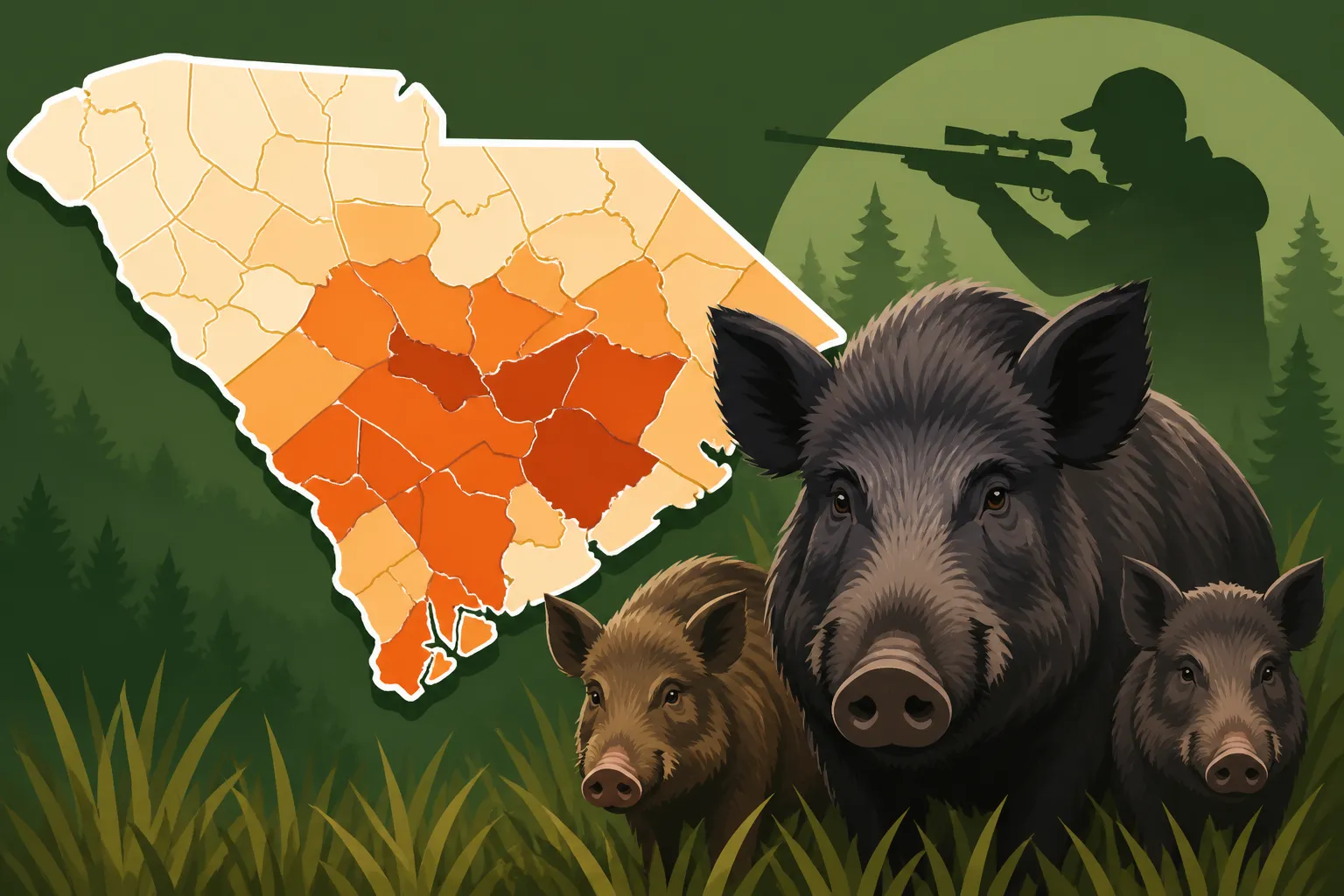
While feral hogs can be found in all 46 counties of South Carolina, their distribution is far from uniform. Certain regions and, more specifically, certain counties consistently report higher densities and more significant issues with these animals.
The Coastal Plain's Hog Haven
Without a doubt, the Lowcountry and Southern Coastal Plain counties are generally where you'll find the highest concentrations of feral hogs in South Carolina. This region is characterized by extensive river systems, vast swamps, and productive agricultural lands, creating the perfect storm for hog proliferation.
Counties like Colleton, Beaufort, Jasper, Hampton, and Allendale are almost synonymous with high hog numbers. These areas feature major river systems such as the Combahee, Ashepoo, Edisto, and Savannah, all of which create expansive, often remote, swamp ecosystems. These swamps offer incredible cover, making it difficult for hunters and trappers to access and control populations. Adjacent to these swamps, you have vast tracts of agricultural land growing corn, soybeans, and even rice, providing an endless food supply. Landowners here often face persistent challenges from these animals, and it’s a big reason Why Lowcountry Hogs Reproduce So Fast.
Further north along the coast, Orangeburg and Georgetown counties also stand out. Orangeburg, while not strictly coastal, boasts significant river frontage along the Edisto and North Edisto, along with large farming operations. Georgetown County is a patchwork of tidal marshes, swamps, and agricultural fields, particularly rice fields, which are very attractive to hogs. The sheer acreage of suitable habitat and food sources here supports thriving populations.
Midlands and Pee Dee Pockets
Moving inland, the Midlands and Pee Dee regions also have significant hog populations, though perhaps not as universally dense as the southern Lowcountry. These areas often see concentrations of hogs tied closely to major river systems and large-scale farming.
In the Midlands, counties like Sumter and Clarendon are notable. These counties are home to parts of the Wateree and Santee River systems, and also feature extensive agricultural production. The combination of dense river bottom hardwoods and adjacent fields creates prime habitat. Similarly, the Pee Dee region counties such as Florence, Marion, and Dillon see substantial hog activity. These counties are dissected by the Great Pee Dee River and its tributaries, and they are major agricultural hubs, especially for row crops like corn and tobacco. The river bottoms provide the sanctuary, and the fields provide the buffet. If you're looking for public land opportunities, areas like the Santee National Wildlife Refuge or parts of the Francis Marion National Forest within these counties can be very productive for Hunting South Carolina's Year-Round Feral Hogs.
Upstate Presence
While typically less dense than the Lowcountry or parts of the Pee Dee, the Upstate also contends with a growing feral hog population. The hogs here tend to be concentrated along major river drainages like the Savannah, Saluda, and Broad Rivers and their tributaries. Counties such as Anderson, Abbeville, and Greenwood often see localized hot spots, especially near these river corridors and adjacent farmlands. Feral Swine Sightings in Upstate South Carolina are becoming more common, indicating their continued spread. The mountainous terrain of the extreme Upstate (e.g., Oconee, Pickens) might offer less ideal habitat overall, but even there, river valleys and lower elevation agricultural zones can hold significant numbers. The key difference in the Upstate is that the hogs are often more transient or concentrated in specific pockets rather than being spread across broad regions.
Here’s a simplified look at some of the top counties and their general characteristics regarding feral hog populations:
| Region | Key Counties (High Hog Density) | Primary Habitat/Food Influences | Notes |
|---|---|---|---|
| Southern Coastal Plain | Colleton, Beaufort, Jasper, Hampton, Allendale | Vast river swamps (e.g., Combahee, Ashepoo, Savannah), extensive agriculture | Consistently high numbers, year-round pressure. |
| Central Coastal Plain | Orangeburg, Georgetown, Berkeley, Dorchester | Major river systems (Edisto, Santee), tidal marshes, agricultural fields | High densities, particularly near water and crops. |
| Midlands | Sumter, Clarendon, Calhoun, Aiken | River bottoms (Wateree, Santee), large-scale row crop agriculture | Significant populations, often concentrated around rivers and farms. |
| Pee Dee | Florence, Marion, Dillon, Williamsburg, Horry | Great Pee Dee River system, rich agricultural lands | High numbers, especially in fertile river bottoms and farm country. |
| Upstate | Anderson, Abbeville, Greenwood, McCormick | Savannah, Saluda, Broad River corridors, localized agriculture | Generally lower density but significant localized populations. |
Factors Influencing Hog Numbers in Specific Counties
It's not just about broad geography; several localized factors can really crank up the hog pressure in one particular county compared to its neighbor, even within the same game zone. Understanding these nuances can help you zero in on specific areas.
Habitat and Food Availability
Think about it from a hog's perspective: where can they eat well and not be bothered? That's where they'll be. Counties with large acreages of undisturbed, dense cover—like massive river swamps, thick clear-cuts, or large tracts of impenetrable pine thickets—provide sanctuary. When these cover areas are directly adjacent to prime food sources, such as sprawling cornfields, peanut fields, or hardwood bottoms heavy with acorns, you have a recipe for huge hog numbers. This combination allows them to feed heavily and then quickly retreat to safety. In counties dominated by vast pine plantations without much undergrowth or diverse food sources, you might find fewer hogs unless there are consistent supplemental feed sources or nearby agricultural fields drawing them in. Using an app like GoHunt can help you scout aerial images to identify these critical habitat elements, like where fields meet thick cover.
Human Activity and Pressure
The intensity of hunting and trapping efforts can also significantly impact local hog populations within a county. In some areas, landowners, hunting clubs, and even state agencies are actively engaged in year-round hog removal efforts, sometimes utilizing techniques like Trapping South Carolina Feral Hogs or Night Hunting Hogs With Lights on Private Land. These sustained pressures can keep populations somewhat in check, even in otherwise ideal hog habitat. Conversely, in areas with less hunting pressure, perhaps on large, undeveloped tracts of land or where landowners aren't actively managing for hogs, populations can explode unchecked. It's a constant battle, and the effort put in by local communities really makes a difference. Hunters need to be aware of the South Carolina Feral Hog Regulations to ensure they're always hunting legally.
Reproductive Prowess
We can't talk about hog numbers without circling back to their astonishing ability to reproduce. This isn't just a statewide phenomenon; it plays out county by county. If a county has stable populations of sows, especially those with good nutritional resources, they will continue to produce multiple litters per year. This high reproductive rate means that even after a successful hunting season or trapping effort, populations can rebound with alarming speed. It's a major reason why hog hunting is a year-round endeavor, and why a county that was hit hard last year can still have a strong population this year. This biological reality means that sustained, consistent effort is required to manage them effectively.
How to Research and Locate Hot Zones on Your Own
While knowing which counties generally have the most hogs is a great start, the real success comes from pinpointing specific hot zones within those counties. This requires a bit of detective work and leveraging modern tools.
Utilizing Mapping Tools and Local Resources
Modern mapping applications are invaluable for identifying potential hog hot spots. Platforms like GoHunt allow you to overlay satellite imagery with public land boundaries, property lines (if available), and topographical maps. Look for areas where dense cover (swamps, thickets, clear-cuts) meets food sources (agricultural fields, oak ridges, river bottoms). You can often spot well-worn game trails leading from cover to food, which are prime indicators.
Don't forget local resources either. While specific, real-time data on hog numbers by county isn't always readily available to the public in a detailed, map-based format, you can often find general reports or speak to local wildlife biologists or game wardens who can offer insights into particularly problematic areas. They often see the brunt of South Carolina Songbird Nest Predation by Hogs and other issues. Local feed stores, gas stations, and even online hunting forums can also be unexpected sources of local intelligence.
Scouting for Fresh Sign
There's no substitute for boots on the ground (or waders in the swamp!). Once you've identified a promising area on a map, get out there and scout. Hogs leave very distinctive sign. Look for:
- Rooting: This is perhaps the most obvious sign. Hogs use their powerful snouts to dig up soil, searching for roots, tubers, grubs, and other edibles. It looks like a rototiller has gone through the area.
- Tracks: Hog tracks are cloven, similar to deer, but they tend to be rounder and the dewclaws (the two small marks behind the main hooves) often register, especially in soft ground.
- Wallows: Hogs love to wallow in mud to cool off and coat themselves in a protective layer against insects. These muddy depressions are a clear sign of hog presence.
- Rubs: Hogs will rub themselves against trees, fence posts, or anything sturdy to remove mud, loose hair, and parasites. Look for mud and hair rubbed off at various heights.
- Scat: Their droppings are highly variable depending on their diet but are typically cylindrical and segmented.
Fresh sign, especially rooting, tells you that hogs are actively using the area. If you find old, dried-up wallows and no fresh rooting, they might have moved on.
Connecting with Local Landowners and Hunters
One of the best ways to find where the hogs are is to simply talk to people. Local landowners, especially farmers, are often desperate for help managing hog populations. They can tell you exactly which fields are getting hit the hardest and where the hogs are coming from. Offering to help them out can be a win-win: you get access to prime hunting ground, and they get some relief from the damage. Similarly, connect with other hunters in the area. Most hog hunters are passionate about their pursuit and are often willing to share general information about hog movements and problem areas, especially if you're respectful and offer to help. Knowing the local sentiment can also give you insight into effective tactics, such as Running Dogs on South Carolina Feral Hogs or simply setting up a blind for an ambush.
Disclaimer
This article is for general informational purposes only and does not constitute professional advice. Laws, prices and regulations vary by location and change over time. Consult a qualified professional for guidance on your specific situation.