South Carolina Songbird Nest Predation by Hogs
It's heartbreaking to walk through a quiet patch of woods in South Carolina, listening for the cheerful trill of a cardinal or the complex song of a thrasher, only to realize that the silence feels deeper than it should. Many of us are recognizing a growing problem that directly impacts our beloved songbirds: the rampant nest predation caused by feral hogs. This guide will dive deep into why these invasive animals pose such a significant threat to avian populations and what steps can be taken to protect these vital species.
The Hidden Threat: Understanding Feral Hog Predation on Songbird Nests
Feral hogs are, without a doubt, one of the most destructive invasive species we face in South Carolina. While much of the conversation around them focuses on the extensive agricultural damage they cause or their impact on deer and turkey populations, their insidious role in wiping out songbird nests often flies under the radar. These aren't just minor disturbances; we're talking about a significant, widespread threat that can decimate local songbird populations.
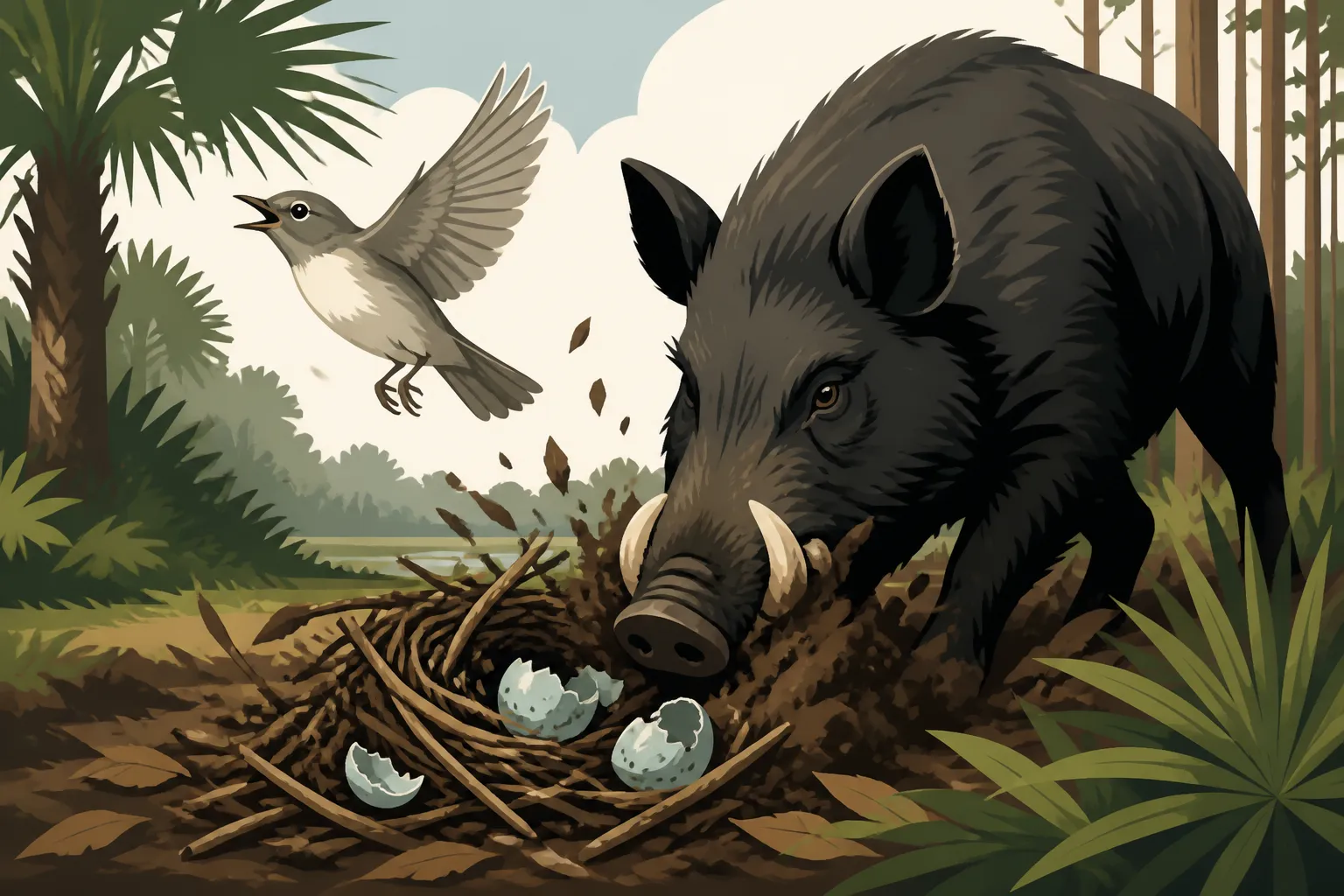
Imagine a small warbler, diligently building its intricate nest in a low-lying shrub, or a ground-nesting quail carefully concealing her clutch of eggs. These efforts are often undone in moments by a rooting hog. Feral hogs are opportunistic omnivores, meaning they'll eat just about anything they can find, and that includes the protein-rich eggs and helpless chicks of ground-nesting and low-nesting birds. This isn't just a casual snack; it's a consistent, destructive foraging behavior that directly impacts the reproductive success of countless songbird species across our state. It's a silent catastrophe unfolding in our woods and fields.
Why Songbirds Are Especially Vulnerable
Our South Carolina songbirds, particularly those that nest on or near the ground, are incredibly vulnerable to feral hog predation. Think about the common yellowthroat, building its cup-shaped nest in a thicket just inches off the ground, or the eastern towhee, whose nest might be right on the forest floor, cleverly hidden but not invisible to a searching snout. These birds didn't evolve alongside a prolific, ground-rooting predator like the feral hog, so they lack the natural defenses or adaptations to cope with such a threat. Their camouflage, while effective against avian or reptilian predators, is often useless against a hog's keen sense of smell.
Furthermore, many songbirds have a relatively small clutch size and only one or two nesting attempts per year. If a hog discovers and destroys a nest, that's often the entire reproductive effort for that breeding pair gone for the season. This constant pressure, multiplied across vast numbers of hogs, creates an unsustainable situation for many local songbird communities. The impact isn't just on single nests, but on the long-term viability of these delicate populations.
The Scope of the Problem in South Carolina
The problem isn't localized to just one area; it's a statewide issue. From the coastal plains to the Piedmont, wherever feral hogs roam, songbird nests are at risk. In dense swamps or managed pine forests, hogs are constantly moving, rooting, and consuming anything palatable they find. Studies often track the impact of feral hogs on larger game species like deer and turkey, but the cumulative effect on smaller, less visible species like songbirds is equally, if not more, devastating. It's a quiet erosion of biodiversity that often goes unnoticed until the absence of familiar bird songs becomes strikingly apparent.
The sheer numbers of Feral Hogs Across South Carolina mean that finding truly safe nesting grounds for our avian friends becomes increasingly difficult. These animals reproduce at an alarming rate, compounding the issue year after year. Every new generation of hogs means more snouts searching, more ground rooted, and more nests destroyed. The cycle is relentless, and without significant intervention, the pressure on our songbird populations will only continue to mount.
Why Hogs Are So Effective at Finding Nests and Eggs
Understanding the specific traits that make feral hogs such formidable nest predators helps us grasp the gravity of the situation. It's not just that they're hungry; it's their unique combination of senses and behaviors that turns them into highly efficient egg and chick destroyers. They're built for this kind of foraging, and our native wildlife, especially vulnerable songbirds, simply don't stand a chance against their relentless searching.
These animals are equipped with a powerful sense of smell, far superior to ours, allowing them to detect food items buried underground or hidden by vegetation. This sensory advantage, combined with their strong rooting instinct, turns them into living rototillers that systematically scour the landscape.
A Nose for Trouble: The Power of Scent
Hogs have an incredible sense of smell, arguably their most potent weapon in the constant search for food. They can detect odors from surprisingly far away and can pinpoint the exact location of food items hidden beneath the soil or dense foliage. This acute olfaction is what allows them to sniff out a perfectly camouflaged bird's nest on the ground, even if it's been carefully constructed to blend in visually. The scent of eggs, nesting material, or even the birds themselves can be a dead giveaway.
Imagine a hen sitting tight on her nest, perfectly still, blending into the surrounding leaves and twigs. To a human eye, she's practically invisible. To a hog's nose, however, she might as well be waving a flag. This makes any ground nest or low-lying shrub nest a prime target, regardless of how well it's hidden from sight. It's a frustration for conservationists and bird lovers alike, knowing that even the most dedicated parental camouflage is no match for a hog's snout.
The Rooting Instinct: A Destructive Search Pattern
Beyond their incredible sense of smell, feral hogs possess a deeply ingrained rooting instinct. This isn't just a casual digging; it's a systematic excavation of the soil in search of roots, tubers, insects, and, yes, protein sources like eggs and chicks. They will turn over vast expanses of ground, leaving behind a tell-tale landscape that looks like a tiller has passed through.
This rooting behavior directly interferes with nesting. A hog doesn't need to specifically target a nest; it simply roots through an area, and if a nest happens to be in its path, it's discovered and consumed. This indiscriminate searching means that even areas with relatively low hog density can still experience significant nest predation simply because of the sheer amount of ground a single hog can disturb in a day. It's an ecological bulldozer, leaving destruction in its wake, and our feathered friends bear a heavy brunt of it. This rooting also contributes to the Crop Damage Hogs Cause in South Carolina, demonstrating their widespread destructive impact.
The Ecological Ripple Effect: Beyond Just Nests
The impact of feral hog predation on songbirds doesn't exist in a vacuum. It creates a domino effect throughout the ecosystem, altering food webs, changing habitat, and exacerbating other environmental problems. When one component of a delicate system is disrupted so significantly, the consequences are felt far and wide, often in ways that aren't immediately obvious.
It's tempting to think of this as just a "bird problem," but it's much more interconnected than that. Songbirds play crucial roles in insect control, seed dispersal, and as indicators of ecosystem health. Their decline due to hog predation signals a broader imbalance that affects everything from plant regeneration to the availability of food for other predators.
Impact on Insect Populations and Plant Life
Many songbirds are voracious insect eaters, especially during the breeding season when they need high-protein food for their growing chicks. Caterpillars, beetles, spiders, and countless other invertebrates form the bulk of a songbird's diet. When songbird populations decline due to nest predation, there are fewer birds to consume these insects. This can lead to localized increases in insect populations, which, in turn, can put more pressure on plant life, especially young seedlings and agricultural crops. It’s a classic example of how interconnected nature truly is.
Furthermore, the rooting behavior of hogs doesn't just destroy nests; it also severely impacts plant communities. By disturbing the soil and consuming seeds, tubers, and young plants, hogs can alter forest regeneration patterns and change the composition of plant species in an area. This, in turn, can reduce the very habitat and food sources that songbirds and other wildlife rely on, creating a double whammy of environmental degradation.
Competition and Disease Concerns for Other Wildlife
The presence of a massive feral hog population also means increased competition for resources with native wildlife. Hogs consume acorns, various seeds, fungi, and other food items that are also vital for deer, squirrels, turkeys, and even black bears. While the direct competition for food might not seem to immediately affect songbirds, a weakened or stressed ecosystem overall makes all species more vulnerable.
Beyond competition, feral hogs are known carriers of numerous diseases, some of which can be transmitted to other wildlife, livestock, and even humans. While direct transmission to songbirds is less studied, the general increase in disease vectors and pathogens in the environment adds another layer of stress to native populations. The collective burden on the ecosystem is immense, and the decline of songbirds is just one symptom of this larger issue caused by unchecked hog populations. The South Carolina Department of Natural Resources (SCDNR) monitors wildlife health, and continued vigilance is critical given the widespread impact of hogs.
Mitigation Strategies: What Can Be Done to Protect Songbirds
Addressing the issue of songbird nest predation by feral hogs requires a multifaceted and sustained effort. There's no single silver bullet, but rather a combination of direct hog management and habitat considerations. It's a challenging problem, but with dedication and community involvement, we can make a difference for our avian residents. We've seen firsthand how persistent efforts can yield results, even against such a prolific and destructive animal.
Landowners and wildlife managers have a critical role to play here. Simply hoping the problem goes away isn't an option. We need active, aggressive management strategies to reduce hog numbers to a point where their ecological impact, particularly on sensitive species like songbirds, becomes manageable.
Intensive Trapping and Removal Programs
One of the most effective strategies for reducing feral hog populations is intensive trapping. This isn't just setting a single box trap and hoping for the best; it involves strategic placement of large, corral-style traps equipped with smart technology that allows for remote monitoring and activation. This ensures that entire sounders (family groups) of hogs can be captured at once, rather than just individuals. Many hunters use platforms like GoHunt to scout areas and understand wildlife movement, which can indirectly aid in identifying potential trapping locations for hogs, given their shared interest in tracking animal patterns.
Once captured, the hogs are humanely euthanized and removed from the landscape. This continuous, systematic removal is essential because of Why Lowcountry Hogs Reproduce So Fast. Their rapid breeding cycles mean that if you only remove a few individuals, the population quickly rebounds. Local wildlife agencies and private landowners often work together on these programs, realizing that a collaborative approach yields the best results.
| Strategy | Effectiveness Level | Target Hog Group | Key Benefit | Challenge |
|---|---|---|---|---|
| Intensive Corral Trapping | High | Entire Sounders | Significant population reduction | Requires consistent monitoring and setup |
| Snaring | Moderate | Individual Hogs | Cost-effective for smaller scale | Can have non-target catches, needs skill |
| Hunting with Dogs | Moderate | Individual/Small Sounders | Covers large areas quickly | Can disperse hogs, requires specific permits |
| Night Hunting (Private) | Moderate | Individual Hogs | Utilizes hog's nocturnal habits | Limited to private land, specific gear needed |
| Exclusion Fencing | Low (for large areas) | Localized | Protects specific small areas | Expensive, difficult for large tracts |
Encouraging Hog Hunting on Private Lands
While public land regulations exist for hog hunting, encouraging and facilitating hog hunting on private lands is another crucial component of population control. In South Carolina, there's no closed season or bag limit for feral hogs on private property, recognizing them as an invasive pest. This gives landowners and hunters significant flexibility. Tools that help hunters identify property boundaries and land ownership, like those often available through services like GoHunt, can be incredibly helpful for hunters seeking permission to access private land for hog control.
Whether it's through traditional spot-and-stalk, still hunting, or even Running Dogs on South Carolina Feral Hogs, every hog removed contributes to alleviating the pressure on our native wildlife, including songbirds. Promoting ethical and effective hunting practices, and supporting hunters who are willing to dedicate their time to hog control, is vital for long-term success. It's a constant battle, and hunters are often on the front lines.
Habitat Management and Nesting Area Protection
Beyond direct hog removal, thoughtful habitat management can also play a role in protecting songbird nests, though this is often secondary to reducing hog numbers. Creating and maintaining diverse habitats, with dense nesting cover, can theoretically offer more hiding places for nests. However, the pervasive nature of hog rooting often negates the benefits of even the densest cover if hog numbers remain high. We need to focus on reducing the primary threat first.
One consideration is managing vegetation in ways that might make it harder for hogs to access certain areas, such as maintaining thorny thickets or creating brush piles that are challenging for larger animals to navigate. Protecting critical nesting areas by making them less accessible to hogs, perhaps through small-scale exclusion fencing if feasible for extremely sensitive sites, could be an option. But ultimately, the most impactful measure for protecting songbirds from feral hog nest predation is directly addressing the South Carolina Feral Hog Regulations and reducing the sheer number of hogs on the landscape. It's a big undertaking, but the vibrant songs of our feathered friends are worth fighting for.
Disclaimer
This article is for general informational purposes only and does not constitute professional advice. Laws, prices and regulations vary by location and change over time. Consult a qualified professional for guidance on your specific situation.