How Wild Hogs Spread Across South Carolina
It's a frustrating reality for anyone who cares about wildlife or farmland in our beautiful state: wild hogs have become an undeniable and growing presence across South Carolina. Their rapid expansion poses significant challenges for hunters, landowners, and conservationists alike, transforming ecosystems and impacting agricultural livelihoods. This comprehensive guide delves into the intricate story of how these incredibly resilient animals managed to colonize nearly every corner of the Palmetto State, exploring their history, biological advantages, and the human factors that have contributed to their widespread proliferation.
The Unwelcome Invasion: A Brief History of Wild Hogs in South Carolina
When we talk about wild hogs in South Carolina, it's not a simple story of one arrival. It's a complex tapestry woven from centuries of history, blending different lineages into the resilient, destructive force we know today. Understanding this background is crucial to grasping the sheer scale of their current distribution and the challenges they present.
Early Introductions and Domestic Escapes
The history of pigs in the Americas dates back to the very first European explorers. Think Hernando de Soto, who famously brought pigs as a living larder on his expedition through the Southeast in the 1500s. Many of these animals escaped, vanishing into the dense forests and swamps, where they quickly reverted to a wild state. These were the ancestors of what we often call "piney woods rooters" or "razorbacks" – domestic hogs that, over generations, developed the traits necessary for survival in the wild: thicker hides, longer snouts, leaner bodies, and a sharper instinct for evasion. They became incredibly adept at foraging in the diverse habitats of South Carolina, from the coastal marshlands to the Upstate mountains.
Fast forward to colonial times and beyond, and the practice of allowing domestic pigs to free-range was common throughout rural South Carolina. Farmers would often turn their livestock out to forage in the woods, only rounding them up for slaughter. It was inevitable that some of these animals would elude capture, further contributing to the feral population. These escaped domestic pigs, often larger and less "wild" than the earlier Spanish introductions, still possessed the inherent hardiness of their species, and their descendants quickly joined the growing ranks of wild hogs. This constant infusion of domestic genetics into the wild population meant a continuous supply of new bloodlines, often leading to bigger animals with higher reproductive potential.
The Rise of Modern Feral Hogs
While these early introductions and escapes laid the groundwork, the wild hog problem truly escalated with the introduction of Eurasian wild boar. These European cousins of domestic pigs were first brought to the United States in the early 20th century, primarily for sport hunting in fenced enclosures. However, much like their domestic counterparts, these highly aggressive and adaptable animals inevitably escaped. The Eurasian boar brought a suite of "wilder" characteristics to the existing feral pig populations in South Carolina: increased size, darker coloration, thicker coats, tusks that grew larger and sharper, and a heightened sense of caution around humans.
When these escaped Eurasian boars bred with the existing feral domestic pigs, the result was a hybrid animal – often larger, tougher, and even more prolific than either parent stock. This hybridization created the modern feral hog that we contend with today across South Carolina. These aren't just farm pigs gone wild; they are a formidable mix of genetics, perfectly engineered for survival and rapid reproduction in almost any environment. Their genetic makeup makes them incredibly resilient to disease, capable of thriving on a wide range of food sources, and masters of evading capture or detection. This genetic blending is a key reason why we see such a wide variation in size, color, and temperament among wild hogs in the state, from the black, stout, long-snouted animals common in deeper swamps to the more multicolored individuals found nearer agricultural fields. Understanding South Carolina Feral Swine Genetics and Origin is vital to appreciate the challenge.
Understanding the Hog's Advantage: Why They Spread So Fast
If you've spent any time in the field, you've likely seen the signs: rooted-up soil, distinct tracks, or perhaps even a sounder of hogs crashing through the underbrush. Their success in spreading so rapidly across South Carolina isn't just luck; it's a testament to a perfect storm of biological advantages that make them one of the most successful invasive species on the planet.
Incredible Reproductive Rates
One of the primary drivers behind the explosive growth of wild hog populations in South Carolina, and their subsequent spread, is their truly incredible reproductive potential. Sows can become sexually mature at just six months of age, sometimes even earlier if food resources are abundant. This means a hog born in spring could theoretically be having her own litter by late fall or early winter. And it doesn't stop there. Unlike deer or bears, which typically have one breeding season per year, wild hogs can breed year-round in favorable conditions.
A typical litter size for a mature sow ranges from 4 to 12 piglets, with an average often hovering around 5-6. What truly sets them apart, however, is their ability to produce multiple litters within a single year. It's not uncommon for a sow to farrow two litters annually, and in prime conditions, some have been documented to have three litters. This means a single sow can contribute anywhere from 10 to 30 new hogs to the population in a year, and those offspring are quickly able to start reproducing themselves. When you consider that piglets have relatively few predators beyond coyotes and bobcats, especially in their early weeks, and that sows are fiercely protective, a small sounder can quickly become a large problem, pushing out into new territories as their numbers swell. It really drives home the point of Why Lowcountry Hogs Reproduce So Fast.
Adaptability and Omnivorous Diet
Another secret to the wild hog's widespread success is its unparalleled adaptability. These animals are true generalists, capable of thriving in an astonishing array of habitats across South Carolina. Whether it's the dense, muddy swamps of the Lowcountry, the open pine forests of the Sandhills, the oak-hickory ridges of the Upstate, or even the suburban fringes near agricultural fields, wild hogs find a way to make it home. They don't require highly specialized diets or specific environmental conditions, which means fewer barriers to their expansion.
Their diet is equally flexible. Wild hogs are opportunistic omnivores, meaning they'll eat just about anything they can get their snouts on. A huge portion of their diet comes from rooting for underground tubers, roots, and invertebrates, but they also consume nuts (especially acorns), fruits, fungi, insects, small reptiles, eggs, fawns, and even carrion. This incredibly varied diet allows them to exploit whatever food sources are seasonally available, preventing starvation and enabling them to survive lean times. If acorns are plentiful, they'll gorge. If crops are ripe in a nearby field, they'll move in. If deer fawns are being born, they'll actively hunt them. This dietary flexibility means they can establish themselves almost anywhere there's enough biomass to support them, and they are constantly on the move seeking out new food.
Social Structure and Group Movement
Wild hogs are highly social animals, typically living in groups called "sounders." These sounders usually consist of several sows and their offspring, often led by an older, experienced sow. While mature boars may be solitary or join sounders temporarily during breeding, the core of the hog population operates in these cohesive family units. This social structure plays a significant role in their spread for several reasons.
First, the collective knowledge of the sounder helps ensure survival. Experienced sows know where the best food sources are, where to find water, and where to seek cover from danger or extreme weather. This learned behavior is passed down through generations, allowing sounders to efficiently exploit new territories. Second, the sheer numbers within a sounder offer protection. While a lone piglet might be vulnerable, a group of hogs, especially with protective mothers, is a more formidable challenge for predators. Finally, as sounders grow, they exert increased pressure on local resources. When a particular area becomes too crowded or rooted out, the sounder, or parts of it, will naturally disperse to seek new, less-pressured foraging grounds. This natural dispersal mechanism means that as populations swell, they are constantly pushing the boundaries of their range, effectively colonizing new areas of South Carolina.
Human Impact and Contributing Factors to Spread
While the biological advantages of wild hogs are undeniable, their explosion across South Carolina simply wouldn't have reached its current scale without direct and indirect human influence. We, unfortunately, have played a significant role in facilitating their spread, often unknowingly or with misguided intentions.
Illegal Translocation and 'Sport' Releases
Perhaps the most egregious human-driven factor contributing to the rapid and widespread distribution of wild hogs across South Carolina is illegal translocation. Despite clear regulations against it, some individuals have intentionally trapped hogs in one area and released them in another, often on their private land, for hunting purposes. This practice, sometimes referred to as "trap-and-transfer" or simply "stocking," is incredibly damaging because it introduces hogs to previously uncolonized areas, bypassing natural dispersal patterns entirely.
These illicit releases are not random; they are often targeted at properties that lack hogs but offer ideal habitat, such as secluded river bottoms, dense swamp forests, or areas adjacent to agricultural fields. The individuals responsible might believe they are enhancing hunting opportunities, but in reality, they are actively contributing to an ecological disaster, creating new breeding populations in areas that were once free of these destructive animals. Once established, even a small number of released hogs can quickly reproduce and begin the cycle of rooting and damage that plagues landowners. This is why laws surrounding South Carolina Feral Hog Regulations are so strict, aiming to curb this harmful practice.
Habitat Alteration and Agricultural Practices
Modern land use and agricultural practices in South Carolina, while essential for our economy, have also inadvertently created ideal conditions for wild hog proliferation and spread. Large-scale farming, particularly row crops like corn, soybeans, and peanuts, provides an irresistible and abundant food source for hogs. These fields offer easy foraging, especially during planting and harvest times, drawing hogs from surrounding natural habitats. The edges of these fields, often bordered by dense woods or riparian corridors, provide perfect cover for hogs to bed down during the day before moving into the fields at night.
Furthermore, timber harvesting and pine plantation management, common across much of South Carolina, can also create beneficial environments for hogs. Newly clear-cut areas often result in a flush of vegetation, providing excellent forage and thick cover for piglets. As pine plantations grow, the dense understory provides secure bedding areas. River systems and drainages, which often snake through both agricultural and forested lands, act as natural travel corridors, allowing hogs to move quickly and discretely between different food sources and bedding grounds. These interconnected landscapes, shaped by human activity, essentially create a superhighway for hog expansion.
Limited Natural Predation
Unlike many native prey species, wild hogs in South Carolina face very few effective natural predators, especially once they reach a larger size. While coyotes, bobcats, and even alligators might take an occasional piglet, adult hogs are large, powerful, and aggressive animals perfectly capable of defending themselves and their young. A mature sow, especially one with a sounder, is a formidable opponent that most predators will avoid. The only real "predator" of consequence for adult wild hogs is man.
This lack of natural population control means that once a hog sounder establishes itself, its numbers can grow unchecked, limited only by food availability and disease. Without any significant top-down pressure from predators, the hogs are free to exploit resources, reproduce rapidly, and continually push into new territories. This absence of natural checks and balances is a critical factor in their ability to spread and maintain high population densities across the state, making human intervention through active management and hunting the primary method of control.
Geographic Spread Across South Carolina's Diverse Landscapes
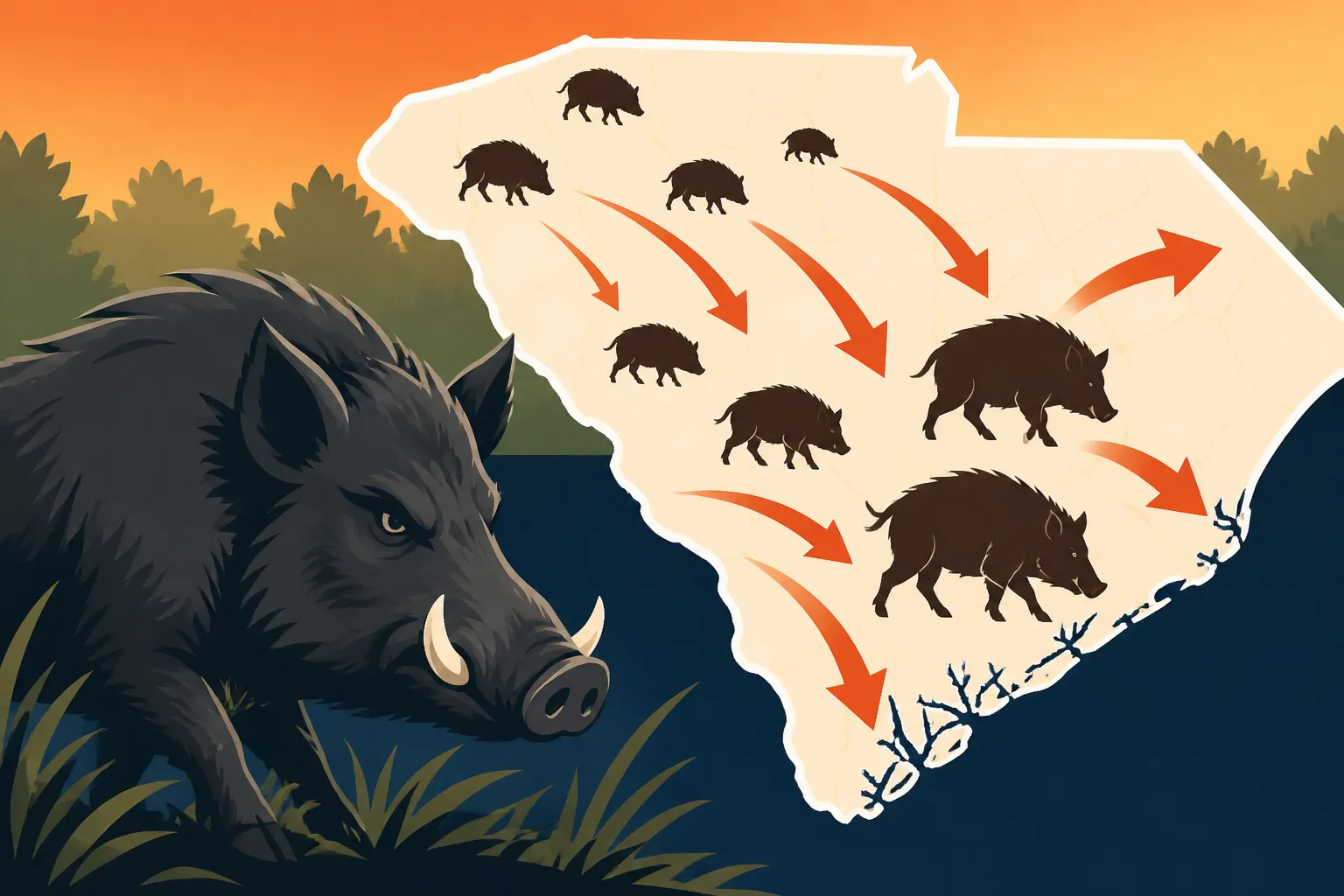
Wild hogs haven't just spread in South Carolina; they've spread across its incredibly diverse landscapes, adapting their movements and habits to fit each unique environment. From the salty marshes to the mountain foothills, their signs are now a common sight.
Lowcountry Swamps and Coastal Plains
The Lowcountry of South Carolina, with its sprawling swamps, tidal marshes, and dense bottomland hardwoods, has long been a stronghold for wild hogs. This region provides ideal cover, abundant water, and a year-round food supply, including acorns, roots, and invertebrates. The vast, interconnected waterways like the Santee River, Edisto River, and the Black River system act as natural highways for hogs, allowing them to travel great distances and colonize new areas that might otherwise be isolated. These riparian corridors are especially critical, as they offer both travel routes and dense refuge from human disturbance.
Hogs in these areas thrive on the rich, muddy soils, constantly rooting for food. Hunters familiar with Hunting Lowcountry Swamp Deer will tell you that it's rare to find a swamp edge or cypress stand that doesn't show signs of hog activity. The sheer inaccessibility of many of these swamp systems means that large tracts of land serve as de facto refuges where hogs can reproduce and grow with minimal human pressure. As populations swell in these core areas, individuals or smaller sounders inevitably spill out onto adjacent coastal plains, into agricultural fields, and even closer to human developments, further expanding their range. The pressure on agricultural lands along the coast is especially pronounced, leading to significant Crop Damage Hogs Cause in South Carolina.
Upstate Forests and Piedmont Farmland
Moving inland to the Upstate, the landscape shifts dramatically to rolling hills, extensive forests, and productive Piedmont farmland. While different from the coastal swamps, these areas offer their own set of advantages for wild hog expansion. The mountainous terrain and deep forests of the Andrew Pickens Ranger District of Sumter National Forest, for example, provide vast expanses of relatively undisturbed habitat. Here, hogs rely heavily on mast crops like acorns and hickory nuts, particularly in the fall, which fuels their breeding cycles and allows them to build fat reserves. They'll also find plenty of roots, grubs, and fungi in the rich forest soils.
Further east in the Piedmont, the mix of dense timber and scattered agricultural fields creates a mosaic of habitat that hogs readily exploit. They will bed in the thick pine or hardwood stands during the day and venture into corn, soybean, or peanut fields at night to feed. River and creek bottoms, even in the Upstate, continue to serve as crucial dispersal corridors, connecting pockets of suitable habitat. Hunters exploring Still-Hunting Sumter Forest Ridges or Reading a Ridge for Upstate Deer will increasingly encounter hog sign, a testament to their successful colonization of these once hog-free regions. Stories of Feral Swine Sightings in Upstate South Carolina are becoming more common, signaling their firm establishment in this part of the state.
Midlands River Bottoms and Urban Edges
The Midlands region, characterized by its major river systems like the Congaree, Wateree, and Saluda, and a mix of agriculture, pine forests, and growing urban areas, presents yet another challenge in understanding hog spread. The extensive river bottomlands are incredibly fertile and provide a constant source of food and cover. These areas are prime habitat for hogs, acting as both breeding grounds and linear pathways for expansion. As hogs move along these river systems, they encounter an increasing interface with human activity.
It's not uncommon now to find hog sign even on the fringes of towns and cities in the Midlands. While they typically prefer the cover of dense vegetation, their nocturnal habits allow them to venture remarkably close to suburban developments, especially when drawn by easy food sources like gardens, cultivated fields, or even garbage. This proximity to human habitation creates unique management challenges and highlights how adaptable these animals are. The presence of hogs along these river bottoms, acting as arteries of spread, ensures that they can continually push their boundaries, moving from wild, remote areas into agricultural and even semi-urbanized landscapes.
The Devastating Consequences of Widespread Feral Hogs
The rapid spread of wild hogs across South Carolina isn't just an interesting biological phenomenon; it's an ecological and economic catastrophe. The devastation they leave behind affects farmers, threatens native wildlife, and even poses potential public health risks.
Agricultural Damage and Economic Loss
For South Carolina's agricultural community, wild hogs are nothing short of a plague. Their constant rooting behavior, driven by their search for tubers, roots, and invertebrates, can utterly destroy fields of crops. Imagine a cornfield just weeks before harvest, meticulously cultivated and ready for yield, only to be torn apart by a sounder of hogs overnight. They don't just eat the grain; they knock down stalks, trample plants, and create muddy, rooted-up patches that are impossible to harvest. This results in direct, tangible financial losses for farmers, impacting their livelihoods and the state's agricultural output.
The damage isn't limited to row crops. Hogs will decimate peanut fields, root up pasturelands meant for livestock, and damage delicate irrigation systems. They'll target watermelon patches, dig up pecan groves, and tear through vegetable gardens. Beyond direct crop consumption and destruction, their rooting can compact soil, increase erosion, and even spread weed seeds from one area to another. The financial burden extends to the costs of implementing deterrents like fencing (which often proves ineffective against determined hogs) and the labor involved in attempting to control their populations. The economic impact is profound and widespread, affecting everything from small family farms to large agricultural operations. Data on Crop Damage Hogs Cause in South Carolina paints a grim picture for many producers.
Environmental Degradation and Wildlife Impacts
Beyond the farm, wild hogs inflict extensive damage on South Carolina's natural ecosystems. Their incessant rooting activity profoundly alters soil composition, disturbing native plant communities. They destroy sensitive wetlands, muddy stream banks, and contribute to increased water turbidity, harming aquatic life. This rooting can also expose buried archeological sites, damaging irreplaceable historical resources.
Perhaps most concerning is their impact on native wildlife. Hogs directly compete with native species like deer, turkeys, and squirrels for critical food sources such as acorns and other mast crops, particularly in years of limited production. This competition can put stress on native populations, making them more vulnerable to disease and reducing their reproductive success. Even more directly, wild hogs are notorious predators of ground-nesting birds, consuming the eggs and chicks of species like wild turkeys, quail, and various songbirds. They will also prey on fawns, particularly during the spring fawning season. The disruption they cause to habitat and direct predation creates an imbalance in ecosystems, threatening biodiversity across the state. The specific concern of South Carolina Songbird Nest Predation by Hogs is a testament to the broad ecological harm they inflict.
Disease Vectors and Public Health Concerns
Wild hogs aren't just destructive; they can also be carriers of numerous diseases and parasites, posing risks to livestock, pets, and even humans. They can carry diseases like brucellosis, leptospirosis, pseudorabies, and E. coli, which can be transmitted to domestic animals, leading to illness, reproductive issues, and economic losses for livestock producers. While pseudorabies doesn't affect humans, brucellosis can, causing flu-like symptoms that can become chronic.
The potential for disease transmission is heightened by the sheer number of hogs and their wide-ranging movements. Hogs can contaminate water sources with their feces, spreading pathogens that can affect both wildlife and human health, especially in areas where people recreate or draw water. While the risk of direct transmission to humans through casual contact is low, hunters handling harvested hogs should always take precautions, wearing gloves and practicing good hygiene. Regular monitoring and testing of hog populations for these diseases is an ongoing effort by state wildlife agencies to understand and mitigate these public health risks, demonstrating another layer of the significant challenge posed by their widespread presence.
| Disease/Parasite | Affected Species | Potential Impact | How Hogs Spread It |
|---|---|---|---|
| Brucellosis | Hogs, Cattle, Humans, Dogs | Reproductive failure, flu-like symptoms, chronic illness | Direct contact, ingestion of contaminated tissues, contact with contaminated fluids |
| Pseudorabies | Hogs, Cattle, Dogs, Cats | Respiratory, neurological, and reproductive issues (fatal in non-swine) | Direct contact, nasal secretions, ingestion of infected tissues |
| Leptospirosis | Hogs, Cattle, Wildlife, Humans | Kidney/liver damage, reproductive issues, fever, headaches | Contact with contaminated urine or water |
| E. coli / Salmonella | Hogs, Wildlife, Humans | Gastrointestinal illness | Fecal contamination of water, soil, food |
| Roundworms, Lungworms | Hogs, Wildlife | Impaired growth, respiratory issues, organ damage | Fecal-oral route, ingestion of intermediate hosts |
Strategies for Managing the Spread and Mitigating Damage
Given the extensive damage and rapid proliferation of wild hogs across South Carolina, proactive management strategies are absolutely essential. It's not about eradication, which is largely impossible given their numbers and resilience, but about control and mitigation to protect our agriculture and natural resources.
Trapping and Removal Efforts
One of the most effective tools in managing wild hog populations and curbing their spread is intensive trapping. Trapping allows for the removal of entire sounders at once, which is far more efficient than individual hunting efforts, especially for larger, more elusive groups. Modern trapping methods utilize large corral traps, often equipped with remote-controlled gates that can be triggered once an entire sounder is inside, observed via cellular trail cameras. This technology allows for precision and minimizes the chances of educating the hogs to avoid traps.
Successful Trapping South Carolina Feral Hogs requires a strategic approach. It involves careful scouting to identify active hog travel routes and feeding areas, pre-baiting traps with attractive feed like soured corn for several days or even weeks to habituate the sounder, and then patiently waiting for the optimal moment to trigger the trap. The goal is to remove as many hogs as possible from an area to reduce immediate damage and slow down their reproductive output. This method is particularly vital for landowners dealing with significant agricultural damage, offering a way to quickly reduce local populations.
Regulated Hunting and Public Participation
Hunting plays a crucial role in the overall effort to manage wild hog populations in South Carolina, acting as a valuable tool for direct control and engaging the public in conservation. Unlike many other game species with restrictive seasons and bag limits, wild hogs can be hunted year-round on private land in South Carolina, with no bag limit. This aggressive allowance reflects the state's recognition of their invasive status and the need for constant pressure. Hunters can pursue hogs using a variety of methods, including firearms, archery equipment, and even night hunting with lights on private land. Engaging in Night Hunting Hogs With Lights on Private Land can be particularly effective, as hogs are often most active after dark.
While recreational hunting alone is unlikely to control statewide populations due to their prolific breeding, it significantly contributes to localized reduction efforts and helps to keep hogs wary of humans, dispersing them from areas of high agricultural value. Public land hunting for hogs is also permitted on many Wildlife Management Areas (WMAs) and national forests, often concurrent with deer or other game seasons, providing additional opportunities for hunters to contribute. The willingness of South Carolina hunters to pursue these challenging animals is a vital component of the broader management strategy, offering a way for individuals to directly impact the problem while enjoying outdoor recreation.
Integrated Management Approaches
Ultimately, effectively managing the spread and impact of wild hogs in South Carolina requires an integrated approach that combines multiple strategies and involves collaboration between landowners, hunters, and state agencies. This means employing trapping, hunting, and other removal methods in a coordinated fashion, rather than relying on a single technique. For example, a landowner might utilize intensive trapping in their fields to address immediate damage, while also allowing hunters to pursue hogs in adjacent wooded areas to maintain pressure. For those who want to know specific rules and opportunities, consulting the South Carolina Hog Hunting Permit Requirements is essential.
Education and awareness are also key components of an integrated strategy. Informing the public about the dangers of illegal translocation, the signs of hog activity, and the importance of reporting sightings helps in monitoring and preventing new infestations. Technologies like the GoHunt app can be invaluable for hunters and landowners alike, allowing them to mark hog sign, track movement patterns, and plan their hunting or trapping efforts more effectively. State agencies like the South Carolina Department of Natural Resources (SCDNR) continue to research hog biology and behavior, develop new control techniques, and provide resources and guidance to landowners and hunters. By combining all these efforts, South Carolina stands a better chance of mitigating the extensive damage caused by wild hogs and slowing their relentless spread across the state.
Disclaimer
The information provided in this guide is for general informational purposes only and does not constitute legal advice. Hunting regulations and wildlife management practices are subject to change. Always consult the most current South Carolina Department of Natural Resources (SCDNR) regulations and local ordinances before engaging in any hunting activities. It is your responsibility to understand and adhere to all applicable laws and regulations.