Night Hunting Hogs With Lights on Private Land
There’s nothing quite like the frustration of seeing your carefully tended food plots or freshly planted fields absolutely torn to shreds overnight by a marauding sounder of feral hogs. These destructive animals don't just graze; they root up everything in their path, leaving behind a wake of agricultural damage that can cost farmers and landowners thousands. If you’re a South Carolina landowner, or have permission to hunt private land, you know the conventional daytime approach often falls short. This comprehensive guide will walk you through the ins and outs of night hunting hogs with lights on private land, providing you with the knowledge and tactics to effectively combat this persistent problem under the cloak of darkness.
Understanding South Carolina's Year-Round Hog Regulations
Before you even think about stepping foot outside after sunset with a firearm, it's absolutely crucial to understand the legal landscape surrounding feral hog hunting in South Carolina. Thankfully, the Palmetto State has taken an aggressive stance against these invasive critters, offering landowners and hunters significant flexibility to control their populations.
The Special Status of Feral Hogs
Unlike deer, turkey, or even small game, feral hogs in South Carolina are classified as an invasive, non-native species, and they are not considered game animals. This distinction is incredibly important because it means many of the regulations that apply to traditional game species simply don't apply to hogs. The state considers them a nuisance and a threat to native wildlife, ecosystems, and agricultural interests, thus encouraging their removal.
On private land, the rules for hunting feral hogs are remarkably liberal. You can hunt them year-round, 24 hours a day, without a closed season or bag limit. This aggressive stance reflects the urgent need to manage their booming populations. It’s a huge relief for landowners who are constantly battling their destructive habits. To learn more about the broader rules, check out our guide on South Carolina Feral Hog Regulations. It covers everything from trapping to other control methods.
Legal Use of Lights and Night Vision
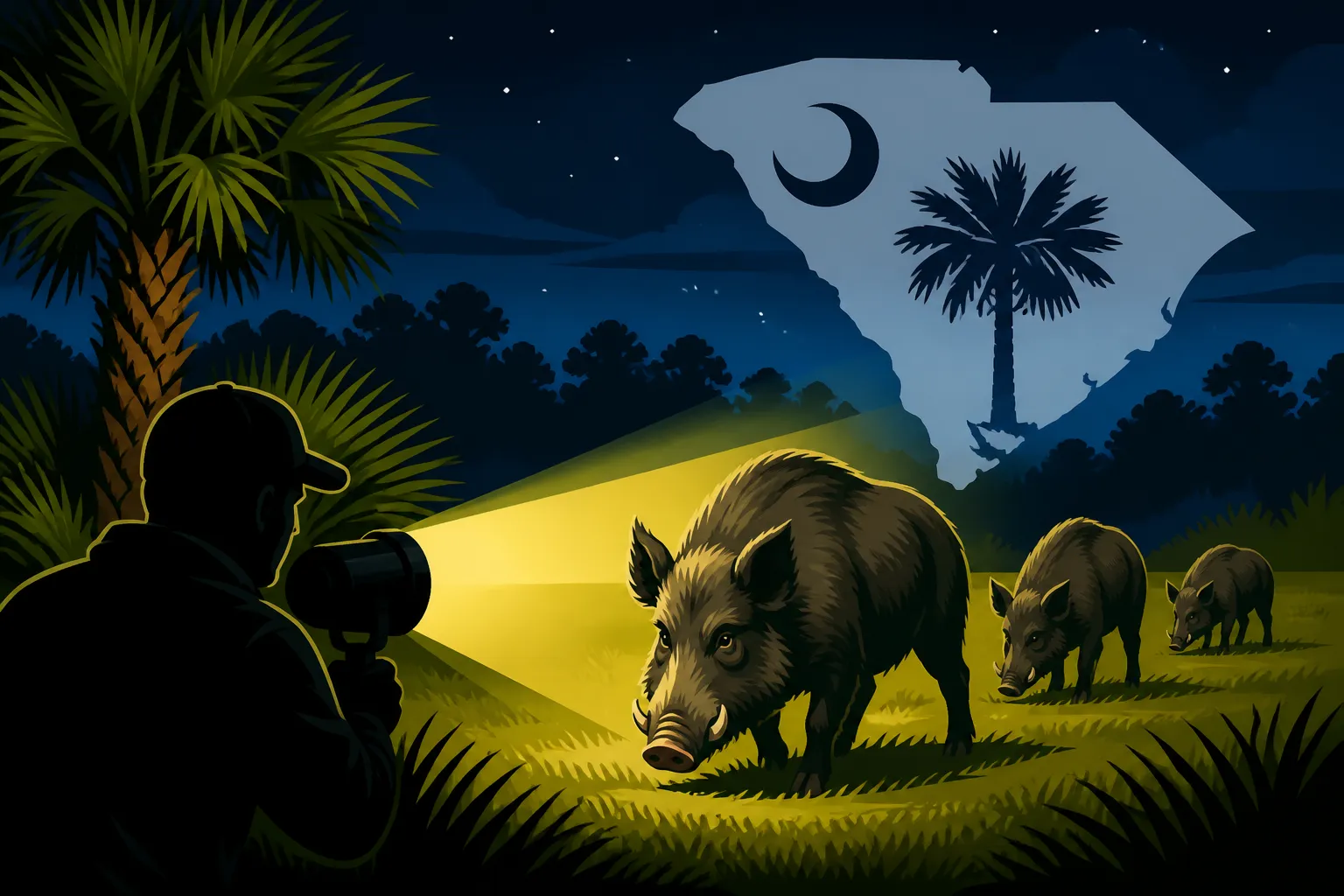
This is where night hunting truly comes into its own. South Carolina law specifically permits the use of artificial lights, including spotlights, vehicle headlights, and even advanced thermal or night vision devices, when hunting feral hogs on private land. This is a game-changer because hogs are predominantly nocturnal, often waiting until the cool, quiet hours after dark to emerge from thick cover and feed. Trying to hunt them during the day can feel like a fruitless endeavor when they're bedded down in dense swamps or overgrown thickets.
Being able to use lights allows you to flip the script, turning their nocturnal habits into a strategic advantage for you. Imagine spotting a sounder rooting up a freshly planted field under the beam of your spotlight or picking them out with a thermal scope as they move through a shadowed treeline. This capability is what makes night hunting so incredibly effective, allowing you to intercept them when they are most active and vulnerable. However, remember this allowance is strictly for private land. Public lands, such as Wildlife Management Areas (WMAs) and National Forests, often have much stricter rules, usually prohibiting night hunting and the use of artificial lights. Always verify the specific rules for any public land you plan to hunt on.
The Importance of Landowner Permission
Even with liberal state laws regarding hog hunting, landowner permission is paramount. You absolutely must have explicit permission from the property owner to hunt on their land, especially at night. It's not just a courtesy; it's a legal requirement. Trespassing, even inadvertently, can lead to serious legal consequences, including fines and charges. Before you even scout a spot or set up your gear, have a clear conversation with the landowner. Discuss your plans for night hunting, including the use of lights, firearms, and any other equipment. Clarify boundaries, access points, and any specific requests or concerns they might have.
Sometimes, a simple verbal agreement is sufficient, but for night operations, a written permission slip, detailing the dates, times, and activities allowed, can provide an extra layer of protection for both you and the landowner. It also ensures everyone is on the same page, preventing misunderstandings or accidental calls to law enforcement from neighbors who might hear shots or see lights in the dark. A good relationship with the landowner is the foundation of any successful private land hunt, particularly when you’re operating under unique circumstances like night hunting. You might even find opportunities to expand your hunting access by offering to help control hogs on neighboring properties if you have proper permission.
Essential Gear for Effective Night Hunting
Night hunting feral hogs with lights requires a specific set of tools to ensure both effectiveness and safety. It’s not just about having a bright flashlight; it's about integrating various pieces of equipment to give you the upper hand in low-light conditions.
Lighting Systems and Their Strategic Use
The most fundamental piece of gear for night hunting with lights is, well, the lights themselves! But it's not a one-size-fits-all situation. You'll want a combination of broad illumination and focused beams.
Types of Lights and Colors
When it comes to lights, you have a few options, and the color often plays a significant role in how hogs react.
- White Lights: These are the most common and provide the brightest, truest illumination. They're excellent for identifying targets clearly and for recovery after the shot. However, hogs can be very sensitive to sudden bright white light, often scattering immediately. This means you need to be quick once the light hits them.
- Red Lights: Many night hunters swear by red lights because hogs, like many animals, perceive red light differently than humans do. It's thought to be less alarming to them, allowing you a few extra precious seconds to get on target before they bolt. Red light also helps preserve your own night vision.
- Green Lights: Similar to red, green lights are often touted as being less disruptive to wildlife. They offer good contrast against foliage and can illuminate targets effectively without causing immediate panic in hogs. Many hunters find green light to be a good compromise between visibility and discretion.
You’ll want a high-powered spotlight, ideally one that mounts directly to your firearm or to a helmet for hands-free operation. Look for models with adjustable beams – a wide flood for scanning and a tight spot for identifying and aiming. Battery life is critical, so always carry spares or have a portable power bank. Brands like Streamlight and Wicked Lights offer excellent firearm-mounted options that switch between colors.
Mounting and Power Solutions
How you mount your lights is as important as the light itself. A dedicated weapon light securely attached to a Picatinny rail is ideal for precise aiming. If you’re using a handheld spotlight, you’ll need a shooting stick or bipod to stabilize your shot. Many hunters also use vehicle-mounted spotlights when hunting from a truck or ATV, which can cover large fields quickly. Just ensure you’re not violating any local ordinances about shooting from a vehicle or public roads.
Consider remote pressure switches for your weapon-mounted lights, allowing you to activate them without taking your hand off the grip. For power, rechargeable batteries are a must. Many high-lumen lights drain batteries quickly, so having multiple sets charged and ready, or a robust portable power station, can make or break your hunt. Nothing is worse than having your primary light die when a sounder is in your crosshairs.
Advanced Optics: Thermal and Night Vision
While lights are effective, thermal and night vision optics elevate night hunting to an entirely different level, offering unparalleled stealth and detection capabilities. The discussion around Thermal Scopes Legal for South Carolina Hogs is particularly relevant here, highlighting the state's forward-thinking approach to hog management.
Night Vision Devices
Traditional night vision devices (NVDs) intensify ambient light, allowing you to see in near-darkness. They come in various generations, with Gen 2 and Gen 3 offering increasingly clear and detailed images.
- Monoculars and Binoculars: These are great for scanning and spotting hogs at a distance. They allow you to survey an area without alerting animals with a visible light source.
- Scopes: Night vision rifle scopes can be direct mounts or clip-on units that attach to your existing daytime scope. They provide a clear sight picture for aiming, especially when paired with an IR illuminator (an invisible infrared light source) to boost their performance in total darkness.
The advantage of night vision is its passive nature. You’re not emitting any visible light, making you much harder for hogs to detect. This allows for closer approaches and more relaxed shots.
Thermal Imaging Devices
Thermal imagers detect heat signatures rather than light, allowing you to see animals even in complete darkness, thick fog, or dense brush that would render traditional night vision useless. Hogs, being warm-blooded, stand out brilliantly against cooler backgrounds.
- Monoculars: Handheld thermal monoculars are indispensable for scanning large areas and quickly identifying hogs. You can spot them moving through tall grass, treelines, or even hidden behind light cover that would block your view with a spotlight. Many hunters find a good thermal scanner to be the single most impactful piece of gear for night hunting. A reliable thermal spotter, perhaps from a brand like Pulsar or ATN, can help you locate targets long before they even know you’re there.
- Rifle Scopes: Thermal rifle scopes mount directly to your firearm and provide an astonishingly clear thermal image for aiming. The ability to see heat signatures means hogs have nowhere to hide, even on the darkest, cloudiest nights. The clarity and distinction of a hog’s heat signature against the cooler environment makes target identification incredibly reliable, reducing the chance of misidentification.
While an investment, thermal optics are arguably the most effective tool for night hog hunting, allowing you to locate, stalk, and take down hogs with unparalleled efficiency. They let you observe hog behavior undisturbed, often providing opportunities for multiple shots on a sounder before they fully realize they're in danger. A comprehensive mapping tool like GoHunt can further enhance your thermal hunting by allowing you to mark hot spots and plan your approach based on terrain.
Firearms, Ammunition, and Supporting Gear
Choosing the right firearm and ammunition is crucial for humane and effective hog dispatch, especially under the pressure of a night hunt.
Suitable Firearms and Calibers
Most modern sporting rifles (AR-style platforms) are incredibly popular for night hog hunting due to their versatility, capacity, and ease of mounting accessories like lights and optics. Calibers like .223/5.56, 6.5 Grendel, .300 Blackout, and .308 are all excellent choices, offering a good balance of accuracy, range, and terminal performance on hogs. Many hunters in South Carolina also favor these for deer, as you can read about in South Carolina Legal Firearms for Deer Hunting.
Shotguns loaded with buckshot or slugs can also be effective at closer ranges, particularly in dense cover where hogs might burst out suddenly. Whatever firearm you choose, make sure it’s one you are intimately familiar with, especially in terms of its controls and safety features, which you'll need to operate by feel in the dark.
Ammunition Choice
For hogs, you want ammunition designed for deep penetration and reliable expansion to anchor these tough animals quickly. Bonded bullets or those designed for tough hide and bone are excellent choices. For popular calibers, brands like Federal Fusion, Hornady SST, or Barnes TSX are often recommended. If you're using a .223, opt for heavier, bonded bullets (60+ grains) for better performance on larger hogs.
Other Essential Supporting Gear
- Hearing Protection: Crucial, especially if shooting multiple times. Electronic hearing protection allows you to still hear ambient sounds like hog movement while protecting your ears from muzzle blast.
- Good Boots/Footwear: You’ll be walking in the dark, often over uneven terrain. Snake boots are a wise investment in South Carolina, given the prevalence of venomous snakes, particularly during warmer months.
- First-Aid Kit: Accidents happen, especially at night. A well-stocked first-aid kit is non-negotiable.
- Two-Way Radios/Communication: If hunting with a partner, reliable communication is essential. Cell service can be spotty in rural areas.
- Game Cart/Recovery Gear: Hogs can be heavy. A game cart can save your back during recovery. For smaller hogs, a good pack might suffice, similar to what's needed for a Packs Built for a Sumter Forest Day Hunt.
- Bug Repellent: South Carolina nights can be swarming with mosquitoes and other biting insects.
Gear Comparison Table: Light vs. Thermal vs. Night Vision
Here's a quick comparison to help you weigh your options for night hunting optics and lights:
| Feature | Artificial Lights (White/Red/Green) | Night Vision Devices (NVDs) | Thermal Imaging Devices (TMDs) |
|---|---|---|---|
| Detection | Good, but hogs react to visible light | Good in low ambient light (moon/stars) | Excellent, detects heat signatures |
| Stealth | Low, visible light can alert hogs | High, passive light amplification | Very High, passive heat detection |
| Target ID | Excellent, true color/detail (white light) | Good, green-tinted image, can be grainy | Good, heat signature outlines, less detail |
| Visibility | Requires clear line of sight, can be hindered by fog | Needs ambient light, affected by dense fog/smoke | Excellent, sees through light fog, smoke, brush |
| Cost | Low to Moderate | Moderate to High | High to Very High |
| Battery Life | Moderate (can be short for high lumen) | Good | Moderate to Good (depends on model) |
| Environmental | Best in clear conditions | Best with some ambient light | Performs well in total darkness, some fog |
Effective Tactics and Strategies for Night Hunting Hogs
Having the right gear is only half the battle; knowing how to use it effectively is what truly counts. Night hunting hogs with lights requires a thoughtful approach, focusing on scouting, positioning, and a disciplined engagement strategy.
Scouting and Pre-Hunt Preparation
Your success in night hunting hinges heavily on thorough daytime scouting. You need to know where the hogs are, what they’re doing, and how they’re moving before the sun goes down.
Identifying Hog Hotspots
Look for fresh sign: rooting, tracks, scat, and rubbed trees. Hogs often create "hog wallows" – muddy depressions where they cool off and remove parasites. These areas, along with active feeding zones, are prime spots. Check around agricultural fields (corn, soybeans, peanuts, sweet potatoes are favorites), oak ridges where acorns drop, and creek bottoms. A helpful resource for understanding these patterns is Reading South Carolina Mud for Fresh Deer Movement, which has principles that apply equally well to hogs.
Focus on transition areas – the edges where thick cover meets open feeding grounds. Hogs will often bed down in dense swamps or thickets during the day and emerge along these edges at night. Use mapping apps like GoHunt to mark these locations, noting potential entry and exit routes for both you and the hogs. Look for game trails that are heavily used, indicating frequent travel. Setting up trail cameras can provide invaluable information about when and how hogs are using certain areas, helping you to pinpoint their nocturnal patterns. They can also show you if a large sounder is consistently visiting a particular food source.
Setting Up for the Night Hunt
Once you've identified a hotspot, plan your setup carefully. You'll want to position yourself downwind of where you expect the hogs to appear. Hogs have an incredible sense of smell, and they will bust you instantly if they catch your scent. Elevated positions, like treestands or ground blinds, can help keep your scent dispersed, but a mobile approach is often more effective for night hunting where you need to react to shifting hog movements.
If you choose a stationary setup, ensure your blind is brushed in well and offers a clear line of sight for your lights or optics. Test your equipment during daylight hours to ensure everything is functioning correctly and you're comfortable operating it in the dark. For instance, practice activating your light, finding your scope, and cycling the action. Make sure you have a solid backstop for any shots you might take. This means knowing what's behind your target and ensuring it's a safe area for bullet impact, which is even more critical in the dark.
Approach and Engagement
The moment of truth – approaching the hogs and taking your shot – requires patience, precision, and quick decision-making.
Silent Approach and Spotting
Once the sun sets, approach your designated hunting area with extreme caution and stealth. Move slowly, listening for any sounds of hog activity – grunts, squeals, or the distinct sounds of rooting. If you're using thermal or night vision monoculars, scan the area constantly. This passive scanning allows you to locate hogs without giving away your position. Even when using a red or green light, keep it off until you've confirmed a target area with your passive optics or a brief, sweeping scan.
When you spot hogs, observe their behavior. Are they feeding calmly? Are they moving quickly? This will inform your next move. If they are undisturbed, you can often make a slow, calculated stalk to get within effective shooting range. Remember, your goal is to get into a position for a clean, ethical shot before they realize you're there. If you're hunting with a partner, coordinate your movements and communicate silently, often using hand signals or very quiet whispers.
Taking the Shot
Once you’re in position and have identified a target, activate your weapon-mounted light or align your thermal/night vision scope. For spotlight hunting, quickly acquire your target in the beam, place your crosshairs, and make the shot. Speed is key here, as the sudden light can cause hogs to scatter quickly. If using thermal or night vision, take your time to ensure target identification and a clear shot.
Aim for the "boiler room" – the area behind the shoulder – for a humane kill. Hogs are incredibly tough, and a poorly placed shot can lead to a long, difficult tracking job in the dark. If hunting a sounder, try to take down as many as possible quickly, starting with the largest hogs or those presenting the clearest shots. Rapid follow-up shots might be necessary, as the chaos of the first shot will likely send the remaining hogs scrambling. Be prepared to quickly transition to another target if available.
Ethical Considerations and Shot Placement
While South Carolina's regulations are very liberal for hog control, ethical hunting practices still apply. Your goal should always be a quick, humane kill.
Maximizing Success and Minimizing Suffering
Night hunting, especially with lights, can create a sense of urgency. However, never rush a shot if you’re not confident in your ability to place it accurately. A wounded hog running into the dark can be incredibly dangerous and difficult to recover, leading to unnecessary suffering. Make sure you have a stable rest, whether from a shooting stick, a bipod, or kneeling.
If you wound a hog, prioritize tracking and recovering it immediately. Having a good tracking light is essential for following blood trails, which can be challenging to find in the dark, especially on pine straw or heavily rooted ground. Consider bringing a blood tracking dog if permitted and available; they can be invaluable for recovering downed hogs. Our guide on Blood Trailing After Dark in South Carolina can offer more detailed tips for these challenging situations.
Safety First: Prioritizing Hunter Well-being
Hunting at night inherently carries increased risks. Reduced visibility, uneven terrain, and the presence of firearms demand an extra layer of caution and preparation. Your safety, and the safety of anyone hunting with you, must be the absolute top priority.
Backstop Awareness and Target Identification
This is arguably the most critical safety aspect of night hunting. In the dark, it's incredibly easy to lose track of what lies beyond your target.
Knowing Your Shooting Lane
Before you even step out at night, have a solid understanding of the topography of the land. Use daylight hours to scout your shooting lanes and identify any potential hazards or structures beyond your likely shooting zones. Never take a shot without being 100% certain of your target and what lies beyond it. This means carefully considering the trajectory of your bullet and ensuring it will impact a safe backstop, such as a hillside, a thick patch of woods, or simply open ground, well away from homes, roads, or livestock.
The "Know Your Target and Beyond" rule is amplified tenfold at night. Remember that bullets can travel for miles, and what seems like an open field in the dark might have a house or public road just beyond your visible range. A reliable mapping application like GoHunt, with its aerial imagery and property line overlays, can be indispensable for this planning, even in the darkest hours.
Confirming Your Target
Even with advanced thermal or night vision optics, absolutely confirm that your target is indeed a feral hog before pulling the trigger. Thermal imaging shows heat, and while hogs have a distinct signature, other animals (and even people) can also appear. Use your weapon-mounted light (if applicable) for final identification just before taking the shot, if you have any doubt whatsoever. Never assume. Take the extra second to be certain. Misidentification can lead to tragic consequences.
Communication and Emergency Preparedness
Hunting solo at night is inherently riskier than hunting with a partner. If you do go alone, let someone know exactly where you are and when you expect to return.
Hunting with Partners
If hunting with others, clear communication protocols are essential. Establish specific zones of fire to prevent accidental crossfire. Always know where your hunting partners are located. Two-way radios are invaluable for this, as cell service can be unreliable in many rural South Carolina areas. Agree on signals for spotting hogs, taking a shot, or indicating an emergency. Never swing your muzzle in the direction of another person, and always treat every firearm as if it were loaded. When moving through thick cover in the dark, keep firearms pointed in a safe direction.
What to Do in an Emergency
Prepare for the unexpected. Carry a well-stocked first-aid kit that includes supplies for trauma, cuts, and snakebites. Have a fully charged cell phone (even if service is spotty, you might find a signal in an emergency) and a portable power bank. Consider carrying a satellite communication device for truly remote areas. Know how to contact emergency services and provide clear directions to your location. This might mean having pre-marked GPS coordinates or a physical address for the property. Don't forget water and snacks; exhaustion and dehydration can impair judgment.
Environmental Awareness
South Carolina's nocturnal environment presents its own set of challenges that can impact your safety.
Navigating in the Dark
Uneven terrain, hidden obstacles, and unexpected drops are all magnified in the dark. Wear sturdy, comfortable, and protective footwear, such as snake boots, which can also provide ankle support. Move slowly and deliberately. A headlamp (worn but kept off until needed) is a good idea for navigating to and from your stand, but use it sparingly during the actual hunt to avoid spooking game or ruining your night vision. Remember that your eyes need time to adjust to the darkness if you flash a white light.
Wildlife Encounters
Beyond hogs, you might encounter other nocturnal creatures. Raccoons, opossums, and even coyotes are common. Be aware of your surroundings. While rare, a cornered or wounded hog can be extremely aggressive and dangerous, especially a sow protecting piglets or a large boar. Always approach a downed hog with extreme caution, ensuring it is truly expired before handling it.
Post-Harvest: Processing and Aftercare
The hunt isn't over once the shot is fired. Recovering, field dressing, and properly handling the meat are crucial steps, especially when dealing with large animals like hogs in potentially warm South Carolina temperatures.
Field Dressing and Initial Care
The clock starts ticking the moment a hog hits the ground. Rapid field dressing is essential to preserve the meat quality, particularly in South Carolina's often warm and humid climate.
Gutting in the Field
As soon as it's safe to approach, begin field dressing. Make sure the animal is indeed expired. I like to use a long stick to poke it if there's any doubt. Quickly removing the entrails helps to cool the carcass rapidly, which is key to preventing spoilage and off-flavors. Make a careful incision from the breastbone to the pelvis, working around the anus. Take care not to puncture the intestines. Once the organs are removed, you can split the brisket to allow for even faster cooling. This process is very similar to how you would Field Dressing a Deer in Warm Weather.
If you plan to skull-mount the hog, you'll need to know how to properly cape and clean the skull. Otherwise, focus on getting the meat cooled. It’s also a good idea to bring game wipes or a small spray bottle of water for quick cleanup of your hands and knife. Remember to dispose of entrails responsibly, away from high-traffic areas or water sources, often by dragging them deeper into the woods for scavengers.
Cooling the Carcass Quickly
After gutting, elevate the carcass if possible to allow air to circulate around it. If it's a small hog, you might be able to load it into a game cart and transport it quickly. For larger hogs, quartering the animal in the field can make it much more manageable to transport, especially if you're working alone or in difficult terrain. Large game bags are indispensable for this, protecting the meat from dirt and insects while allowing it to breathe. Our article on Coolers for a Warm August Kill emphasizes the importance of immediate cooling, which is even more critical for hogs in any warm weather.
If you have a long drive ahead or expect ambient temperatures to remain high, consider having large coolers filled with ice ready at your vehicle. Pack the body cavity with ice, or place quartered meat directly into iced coolers. The goal is to drop the meat's internal temperature as quickly as possible.
Transportation and Butchering
Once the initial field dressing is done and the carcass is cooling, the next steps involve getting it home and processed into edible cuts.
Secure Transport
Transporting hogs, especially large ones, requires proper planning. If you quartered the hog, ensure the meat is well-iced in coolers and secured. If transporting a whole carcass, place it on a tarp or in the bed of a truck, ensuring it won't slide around or contaminate other items. Covering it with a breathable tarp can protect it from road grime while allowing continued cooling. Respect local regulations regarding transporting harvested game; while hogs aren't game animals, basic decency and preventing biological contamination are still important.
Butchering for the Table
Feral hog meat can be absolutely delicious when properly handled. It's lean and flavorful, similar to domestic pork but often richer. You can butcher the hog yourself at home if you have the space and tools, or take it to a local wild game processor. If butchering at home, make sure your workspace is clean, cool, and well-lit. Remove all silver skin, fat, and any blood-shot areas.
Popular cuts include backstraps, tenderloins, roasts from the hindquarters, and ground meat. Hog fat can be rendered for lard, but it can also carry a strong "boar taint" in mature males, which makes it less desirable for some. Younger hogs, especially sows and piglets, typically have the mildest flavor. Remember to thoroughly cook all wild hog meat, as they can carry parasites like trichinosis. Freezing meat for several weeks can also help kill off some parasites.
Night hunting feral hogs on private land in South Carolina isn't just a thrilling experience; it's a vital tool for managing an ecologically destructive species. By understanding the regulations, equipping yourself with the right gear, employing effective tactics, and prioritizing safety and proper meat care, you can become a highly effective night hunter and a valuable asset to landowners battling the relentless tide of these prolific animals.
Disclaimer
Please note: Hunting regulations can change. It is your responsibility to verify all current rules and laws with the South Carolina Department of Natural Resources (SCDNR) before engaging in any hunting activities. This guide is for informational purposes only and does not constitute legal advice.