First Focal Plane Versus Second
Navigating the world of rifle scopes can feel like trying to read a map in the dark, especially when you start diving into the jargon like "first focal plane" and "second focal plane." It's a common point of confusion for many South Carolina hunters, whether you're stalking deer in the thick Lowcountry swamps or glassing open fields in the Midlands. The difference between these two types of scope designs isn't just technical; it profoundly impacts how you use your reticle for aiming, ranging, and making those critical follow-up shots. This guide is here to demystify FFP and SFP scopes, helping you understand their core differences and figure out which one will truly serve you best in the varied terrain and hunting situations across our beautiful state.
Understanding First Focal Plane (FFP) Scopes
When you pick up a variable power scope, you expect to adjust the magnification to suit your shot. But what happens to your reticle—those crosshairs or elaborate aiming points—when you crank that power ring? With First Focal Plane, or FFP, scopes, the reticle actually changes size along with your target as you adjust the magnification. It's a concept that can take a moment to wrap your head around, but once it clicks, you'll see why it's a favorite among certain hunters.
What FFP Means for Your Reticle
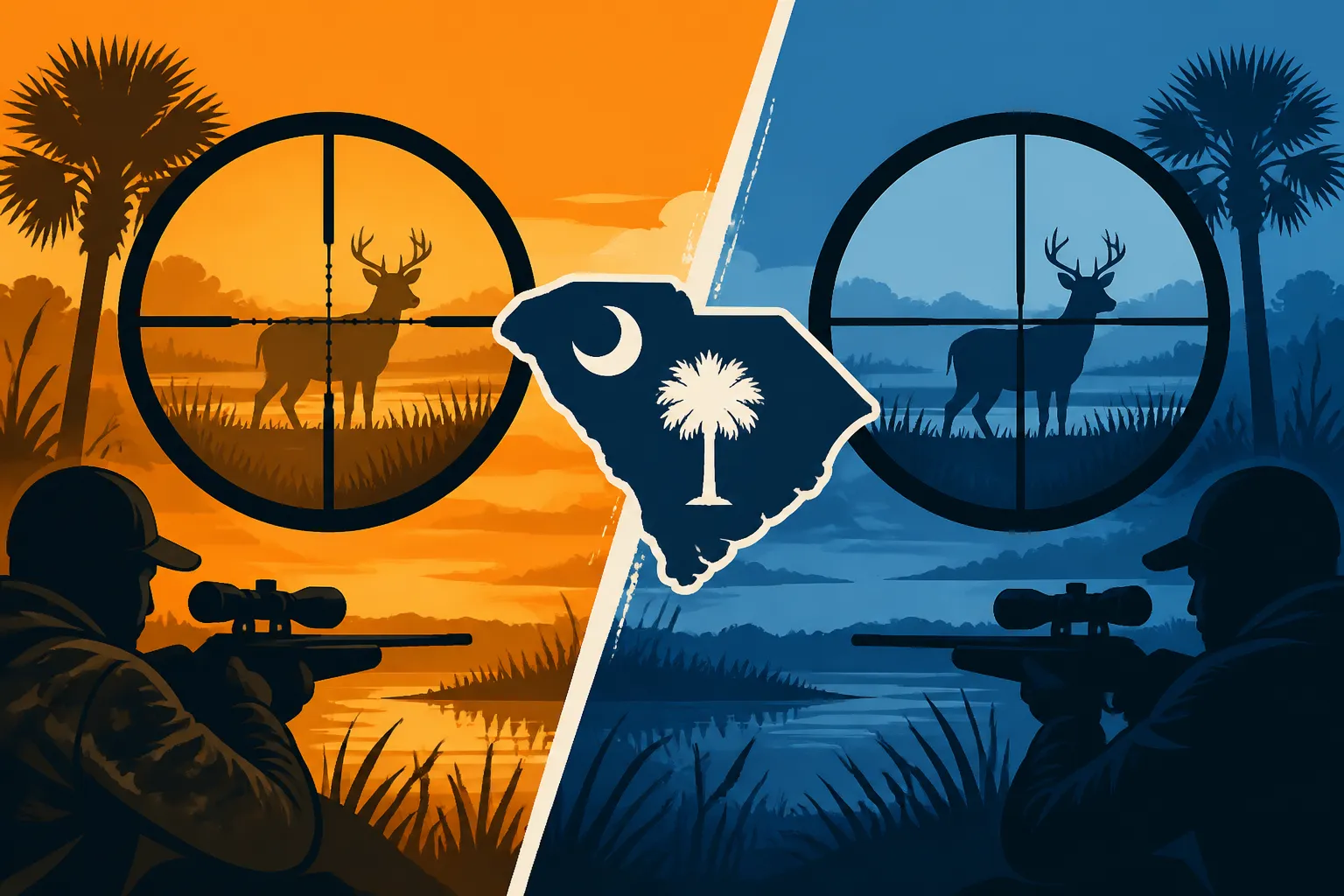
Imagine looking through your FFP scope and zooming in on a distant buck. As the deer appears larger, the reticle lines themselves also appear to get thicker and more prominent. Conversely, as you zoom out to a lower magnification, the reticle appears to shrink, becoming finer. This isn't just a visual trick; it's a fundamental design choice. The reticle is placed in front of the erector assembly, meaning it scales proportionally with the target image. This unique characteristic is what gives FFP scopes their distinct advantage when it comes to consistent aiming and ranging.
Think about a moment when you’re perched on an Upstate ridge, maybe overlooking a distant clear-cut. You spot a deer, and you need to quickly estimate its distance or apply a specific holdover for elevation or windage. With an FFP scope, if your reticle has hash marks for bullet drop compensation or wind holds, those marks represent the exact same measurement relative to your target, no matter if you're on 6x power or cranked up to 24x. This means your ranging calculations and holdover points are always true to life, directly corresponding to your bullet's trajectory at any magnification setting. It’s a huge benefit for precision shooting where every little bit of accuracy counts, particularly if you're regularly engaging targets at varying distances or need to make quick, precise adjustments without thinking twice about your magnification setting. This consistent scaling is particularly beneficial for those building Rifle Setups for South Carolina Deer Hunting that might encounter both short and longer-range opportunities.
Pros and Cons of FFP for South Carolina Hunting
Like any piece of specialized gear, FFP scopes come with their own set of advantages and drawbacks, especially when considering the unique hunting environments found here in South Carolina.
Pros of FFP Scopes:
- Consistent Holdovers and Ranging: This is the big one. As mentioned, your reticle's subtensions (the spacing of the hash marks or dots) remain accurate at all magnification levels. This is incredibly valuable if you frequently adjust your magnification for different scenarios, like transitioning from a quick, close-range shot in thick woods to a more deliberate shot across a food plot. You don't have to remember to be on a specific magnification to use your ballistic reticle correctly.
- Precision for Longer Shots: For hunters who might encounter longer shots, perhaps in areas bordering agricultural fields, or up in the open hardwoods of Sumter National Forest, FFP scopes offer a distinct advantage. The ability to trust your subtensions at any power setting makes calculating and applying holdovers much more intuitive and reliable. If you're using an app like GoHunt to scout terrain and anticipate potential shot distances, an FFP scope helps you adapt quickly to whatever situation unfolds.
- Simpler Ballistic Solutions: Once you’ve developed a ballistic chart for your rifle and chosen ammunition, applying those solutions becomes more straightforward with FFP. Whether you're holding over or dialing, the relationship between your reticle and the target remains constant.
Cons of FFP Scopes:
- Reticle Visibility Challenges: This is perhaps the most commonly cited drawback. At lower magnifications, the reticle in an FFP scope shrinks significantly. In the dense, dark timber of the Francis Marion or a deep Lowcountry swamp before sunrise, that fine reticle can become incredibly difficult to see against a dark background or a shadowed deer. This can lead to missed opportunities on quick, close shots where fast target acquisition is key. Conversely, at very high magnifications, the reticle can become quite thick, potentially obscuring small parts of your target, which can be frustrating for highly precise aiming.
- Higher Cost: Generally speaking, FFP scopes tend to be more complex to manufacture, which often translates to a higher price tag. This can be a significant factor for many hunters, especially those on a budget, who might find that an SFP scope offers better value for their typical hunting needs.
- Learning Curve: While the consistency is a benefit, new users might find the changing reticle size visually distracting at first. It takes some getting used to, and a solid understanding of how it works is crucial to fully leverage its advantages.
So, while FFP offers unparalleled consistency for ranging and holdovers, especially at varied distances, its reticle visibility at low power in dense South Carolina cover is a genuine concern. You might miss that fleeting opportunity if you can't pick up your crosshairs fast enough.
Exploring Second Focal Plane (SFP) Scopes
In contrast to their FFP counterparts, Second Focal Plane (SFP) scopes represent the more traditional and widely adopted design in the hunting world. If you've ever looked through a variable power scope without thinking too much about the reticle's behavior, chances are you were using an SFP. These scopes prioritize a consistent reticle appearance, regardless of the magnification setting, which can be incredibly appealing for many hunting styles.
How SFP Reticles Stay Consistent
With an SFP scope, the reticle is positioned behind the erector assembly. This means that as you adjust the magnification, the target image changes size while the reticle itself remains the same apparent size in your field of view. Imagine again that buck in your scope: as you zoom in from 4x to 12x, the buck gets bigger, but your crosshairs stay the same thickness and spacing relative to your eye.
This consistent reticle size is why SFP scopes have been so popular for decades. For many hunters, especially those primarily focused on straightforward point-and-shoot scenarios at common hunting distances, having a reticle that always looks the same is comforting and intuitive. However, this consistency in appearance comes with a very important caveat: if your reticle has specific holdover points or ranging marks (like mil-dots or BDC reticles), those subtensions are only accurate at one specific magnification setting. This is almost always the highest power setting on the scope, though sometimes it might be another marked power (e.g., 10x on a 3-9x scope). If you're on any other magnification, those marks will no longer represent the true bullet drop or windage values. You'll need to know your scope's specifics or be prepared to use a different aiming strategy. This is a critical distinction that hunters using Rifle Scopes for Low-Light Swamp Edges need to be aware of.
Pros and Cons of SFP for South Carolina Hunting
The SFP design has dominated the hunting market for good reason, offering a practical and often more affordable solution for many hunters. Yet, understanding its limitations is just as important.
Pros of SFP Scopes:
- Always Visible Reticle: This is the primary advantage for many. Your reticle maintains a constant, easily visible size and thickness across the entire magnification range. This is particularly beneficial in low-light conditions, or when hunting in dense, shadowed areas like a creek bottom in the Pee Dee region or a thick patch of pines in the Midlands. You're never going to struggle to see your crosshairs because they've shrunk to an almost invisible thread. Quick target acquisition is a breeze.
- More Affordable: Due to simpler manufacturing processes, SFP scopes generally come at a lower price point than comparable FFP models. This makes them an excellent choice for hunters who want quality optics without breaking the bank, especially if their typical shot distances don't demand constant reticle subtension accuracy.
- Familiarity and Simplicity: For many, an SFP scope is what they’ve always used. The consistent reticle size feels natural and doesn't introduce any new visual complexities that might distract from the task of making a clean shot. It’s perfect for the hunter who sets their magnification once they’re in the stand and rarely changes it.
- Ideal for Close to Medium Ranges: Given that many South Carolina deer shots occur within 150-200 yards, where holdovers might be minimal or can be estimated by feel, an SFP scope shines. For quick shots on a moving hog or a deer slipping through the woods, the clear, consistent reticle is a huge asset.
Cons of SFP Scopes:
- Inaccurate Ballistic Reticle at Most Magnifications: This is the biggest drawback. If your scope has a ballistic reticle (BDC, mil-dots, etc.), those holdover points are only truly accurate at one specific magnification setting (usually the highest). If you're zoomed out, those marks will indicate less hold than is actually needed, leading to shots that land low. This forces you to either stay at max magnification or know your specific scope's subtensions at various power levels—a complicated task for most hunting scenarios.
- Ranging is Difficult (or Impossible): Similarly, if your reticle has ranging capabilities, these will also only be accurate at the designated magnification. Trying to range a deer at half-power using an SFP mil-dot reticle will give you a wildly incorrect distance.
- Less Versatile for Diverse Shooting: If your hunting might involve a wide range of distances, from very close to potentially long shots, and you rely on your reticle for precise holdovers, an SFP scope can become a hindrance unless you consistently operate at its specific true-to-subtension magnification. This can be restrictive in dynamic hunting situations.
For the hunter primarily concerned with clear visibility and quick, intuitive aiming at typical South Carolina hunting distances, the SFP scope remains a robust and reliable choice.
Which Focal Plane Is Right for Your South Carolina Hunt?
Deciding between FFP and SFP isn't about one being inherently "better" than the other. It's truly about matching the scope to your specific hunting style, the terrain you navigate, and the distances you expect to shoot. South Carolina offers such a diverse landscape, from the steep, rolling hills of the Upstate to the flat, dense coastal plains, and each presents different challenges and opportunities.
Matching Scope to Terrain and Hunting Style
Your chosen hunting grounds in South Carolina should heavily influence your scope decision. Let's break down a couple of common scenarios:
Scenario 1: Upstate Ridges and Longer Shots
Imagine you're hunting in the Andrew Pickens Ranger District of Sumter National Forest, maybe on an autumn morning, sitting on a high point overlooking a series of clear-cuts or a long, open hardwood bottom. Here, shot distances can vary significantly. You might have a deer appear at 75 yards in a thicket, or spot one grazing across a ravine at 300 yards. In these situations, an FFP scope truly shines. If you’re trying to accurately range a deer and then use a specific holdover dot on your reticle, an FFP scope ensures that dot represents the correct bullet drop, whether you’re zoomed in to count antler points or zoomed out for a wider field of view. The consistency of the reticle’s subtensions at any magnification is a massive advantage when you're looking at Hunting Blue Ridge Escarpment Ridgelines where ranging and precision are often critical.
Scenario 2: Lowcountry Swamps and Dense Cover
Now, picture yourself deep in the heart of the Francis Marion National Forest, perhaps during an early archery season sit in August, or even later in the rifle season. The cover is incredibly dense, the light can be dim under the canopy, and visibility might only extend 50-75 yards at best. Most shots here will be up close and personal, often quick. In these scenarios, an SFP scope might be your best friend. Why? Because the reticle always stays a comfortable, visible size. When a deer steps out of a palmetto thicket at 30 yards, you don't want to be fumbling to find a tiny, almost invisible FFP reticle. You need to put those crosshairs on the vitals now. For Hunting Lowcountry Swamp Deer, where close-quarters engagements are the norm, the immediate clarity of an SFP reticle, combined with its generally lower cost, often makes it the more practical choice.
Your hunting style also matters. Are you a meticulous long-range shooter who obsesses over ballistic data and regularly dials turrets or uses precise holdovers? FFP is likely a better fit. Are you more of a walk-and-stalk hunter, or do you sit a stand primarily for shots within 150 yards, preferring a simple point-and-shoot approach? An SFP will probably suit you just fine. Tools like the GoHunt app can help you visualize the terrain and anticipate shot distances, which can guide your scope decision before you even hit the woods.
Considering Common South Carolina Shot Distances
It’s easy to get caught up in the allure of long-range precision, but let’s be realistic about what most South Carolina hunters actually face. The vast majority of deer harvested in our state are taken at relatively close distances, often well under 150 yards. In many parts of the Lowcountry and even much of the Midlands, a 100-yard shot can feel like a long one due to the dense woods and undulating terrain.
For these typical South Carolina hunting distances, where bullet drop is often minimal and wind drift can sometimes be ignored, an SFP scope is perfectly adequate. You can set your scope to its highest magnification (where its holdovers are technically accurate) if you need to, but often, a simple point-of-aim hold will work within these closer ranges. You get the benefit of a clear, consistently sized reticle, which aids in quick target acquisition, especially in the often dim conditions under the canopy. For example, if you’re Zeroing at 100 Yards for Field Edge Hunting, an SFP scope will be perfectly dialed in for the distances you're most likely to encounter.
However, if you frequently hunt open fields, clear-cuts, or those Upstate mountain ridges where shots can extend out to 250-300 yards or even more, the FFP advantage becomes much more pronounced. At these distances, even slight errors in holdover can mean a missed deer or, worse, a wounded animal. The ability to trust your reticle's subtensions at any power means you can zoom in for a precise shot without having to do mental gymnastics about how much your holdover marks have changed. If you find yourself needing to estimate distances and apply holds regularly, an FFP scope provides a significant edge in confidence and accuracy.
In summary, for the majority of South Carolina hunters who stick to common deer hunting scenarios in varied but often thick cover, an SFP scope will likely serve them well. For those who push the ethical boundaries of distance or require absolute precision in their aiming solutions, FFP is the way to go.
Here's a quick comparison to help solidify the differences:
| Feature | First Focal Plane (FFP) | Second Focal Plane (SFP) |
|---|---|---|
| Reticle Size | Scales with magnification (gets bigger/smaller) | Remains constant regardless of magnification |
| Subtension Accuracy | Accurate at ALL magnification settings | Accurate at ONLY one specific magnification (usually highest) |
| Reticle Visibility | Can be very fine at low power, thick at high power | Always a consistent, easy-to-see size |
| Ideal for | Long-range, precision, varied magnification use, ranging | Close-to-medium range, quick shots, consistent sight picture |
| Cost | Generally higher | Generally more affordable |
| Learning Curve | Can take getting used to due to changing reticle size | Intuitive, familiar for most hunters |
Making Your Final Decision
After diving into the mechanics of FFP and SFP scopes, the choice can still feel a bit daunting. Remember, this isn't about finding the objectively "best" scope, but rather the best scope for you and your hunting style here in South Carolina.
Budget and Personal Preference
Let's be real, gear costs money, and scopes are no exception. Generally, FFP scopes tend to sit at a higher price point due to their more complex internal design and manufacturing. If you’re working with a tighter budget, you can find some fantastic, high-quality SFP scopes that will absolutely get the job done for most South Carolina hunting scenarios. Don't feel pressured to overspend if your hunting doesn't demand the specific advantages of an FFP. You can often get better glass or more features in an SFP scope at the same price as an entry-level FFP. This is where tools like GoHunt can come in handy, allowing you to research different brands and compare features, reviews, and prices to find the best value for your hard-earned money.
Beyond the dollar signs, personal preference plays a huge role. Some hunters simply prefer the consistent, unchanging reticle of an SFP scope. They like knowing exactly how their crosshairs will appear, regardless of magnification, and find it less distracting. Others appreciate the technical consistency of an FFP, even if it means a shifting reticle appearance. If possible, try to look through both types of scopes before you buy. Visit a local sporting goods store or ask a friend if you can look through their scopes. See how each reticle feels at various magnifications in different lighting conditions. What might feel intuitive to one hunter could feel cumbersome to another. For example, you might look through an SFP scope and find the clarity ideal for 8×42 Versus 10×42 in the Woods discussions, while another hunter values the FFP for its precision.
Training and Familiarity
No matter which focal plane you choose, the most crucial factor in your success will always be your familiarity with your equipment and consistent practice. A state-of-the-art FFP scope is useless if you don't know how to use its reticle effectively, and a basic SFP scope can be deadly accurate in the hands of a hunter who has spent hours at the range.
Once you’ve made your decision, dedicate time to learning your new scope inside and out. If you go with an SFP and plan to use its ballistic reticle, make sure you know exactly which magnification setting makes those subtensions accurate. Practice at that magnification. If you choose an FFP, get comfortable with how the reticle appears at different power settings, and understand how your holdovers remain consistent.
Spend time at the range, shooting from various positions you might encounter in the field. Practice acquiring targets quickly. Understand your rifle’s ballistic trajectory with your chosen ammunition. Dry firing at home, focusing on sight picture and trigger control, can also build muscle memory. Remember, even with the fanciest scope, understanding the Rifle Scope Magnification for South Carolina Deer and how it interacts with your reticle is paramount. The goal is to make your aiming process second nature so that when that moment of truth arrives, you can focus entirely on making a clean, ethical shot. Whether it's the clear visibility of an SFP or the consistent subtensions of an FFP, the best scope is the one you know, trust, and have practiced with. Consider how features like Low-Light Performance in a Scope will impact your ability to acquire a target, regardless of the focal plane.
Disclaimer
This article is for general informational purposes only and does not constitute professional advice. Laws, prices and regulations vary by location and change over time. Consult a qualified professional for guidance on your specific situation.