Binocular Power for Swamp Edge Hunting
Hunting the dense, often humid, and visually complex swamp edges of South Carolina presents a unique challenge for deer hunters. It's frustrating to be out in prime habitat, hearing movement, but struggling to identify what's moving through the thick palmetto and cypress knees because your binoculars aren't cutting it. This guide will dive deep into how to choose the right binocular power to help you spot deer in these tricky, low-light, and often close-quarters environments.
The Unique Demands of South Carolina Swamp Edge Hunting
When you step into the swamp edges of South Carolina, whether it's the Black River bottoms or the fringes of the ACE Basin, you're entering a world unlike open agricultural fields or hardwood ridges. The very nature of this habitat dictates a different approach to your gear, especially your optics. Ignoring these specific conditions can leave you squinting and frustrated, missing key opportunities.
Visibility Challenges in Thick Cover
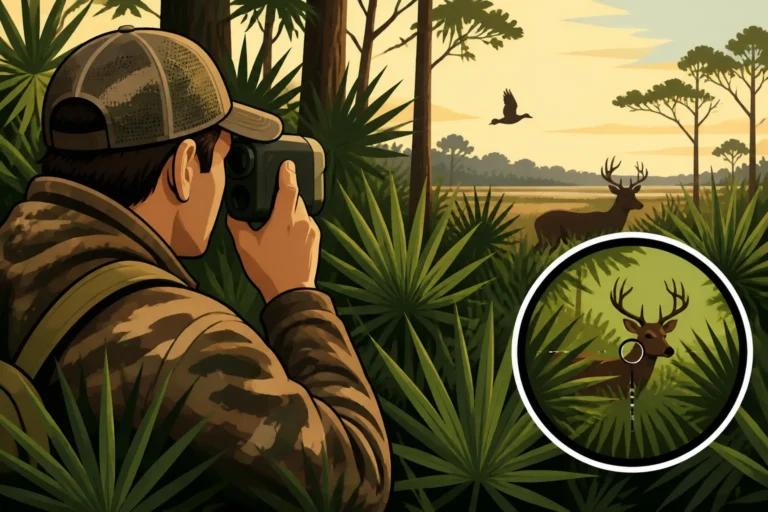
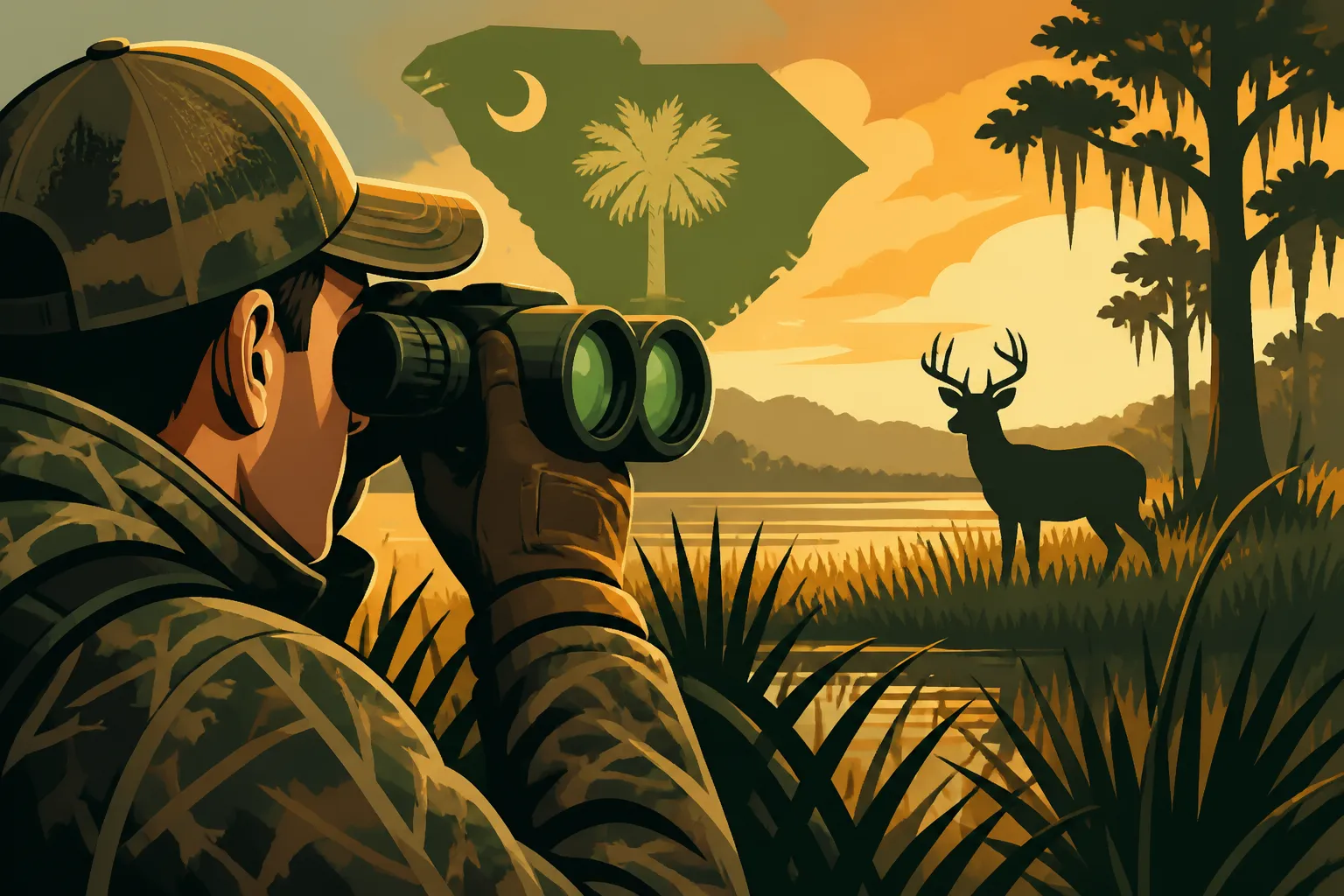
The reality of hunting South Carolina's swamp edges is that visibility is almost always limited. You're rarely looking across vast expanses. Instead, you're trying to pick apart shadows, differentiate between a tree trunk and a deer's leg, or find a flicker of an ear through dense undergrowth at 20, 50, or maybe 75 yards. Pine needles, cypress knees, thick briars, and palmetto fronds create a constant visual obstacle course. High magnification, which might seem appealing, can actually work against you here. It narrows your field of view, making it harder to scan a wide area quickly and effectively, which is exactly what you need when a deer might slip silently through a small opening. Imagine trying to find a needle in a haystack with a magnifying glass that only shows you a tiny part of the haystack at a time; it's a similar struggle. The best scenario for Hunting Lowcountry Swamp Deer is to be able to pick up subtle movements in challenging conditions.
Navigating Dynamic Light Conditions
South Carolina swamps are often canopied by mature trees that filter sunlight, creating a perpetually dim environment. Even on a bright, sunny day, deep in the cypress swamp or under a thick canopy of oaks and pines, it can feel like perpetual twilight. On cloudy days or at dawn and dusk—prime hunting times—the light levels drop even further. This isn't just about brightness; it's about contrast. Deer camouflage is designed to blend seamlessly into these exact conditions. Your binoculars need to gather as much available light as possible and enhance contrast so you can distinguish a deer's body from the busy background. Relying on optics that perform poorly in low light is a surefire way to miss that buck ghosting through the shadows. This is especially true during early mornings or late evenings when you're trying to extend your effective hunting time. For instance, knowing how the light changes when Hunting a Funnel Between Two Swamps can make all the difference.
The Importance of Close-Range Clarity
While deer can appear at longer distances in some swamp scenarios, like crossing a narrow slough or stepping out onto a field edge, a significant portion of your engagements will be up close and personal. A deer might appear silently from behind a thicket at 30 yards, offering only a brief window for observation. In these moments, you need binoculars that provide a clear, crisp image without overwhelming magnification. Too much power can make it difficult to focus quickly on a nearby animal, or even worse, it can make the image jump and shake with every slight hand tremor. You need a stable image that allows you to confirm antlers, assess body language, and make a quick decision. When you're trying to Reading a Tidal Creek for Deer Movement, you're often looking for very subtle cues close to your position.
Decoding Binocular Magnification and Objective Size for Swamps
Choosing binoculars often feels like navigating a maze of numbers and technical jargon. But for swamp edge hunting, understanding two key specifications – magnification and objective lens size – is paramount. They work together to determine how much you see and how clearly you see it.
Understanding the Magnification Number
The first number you see on binoculars, like the "8" in 8×42 or the "10" in 10×42, refers to the magnification. It tells you how many times closer an object will appear through the lenses compared to the naked eye. An 8x binocular makes an object eight times closer, so a deer at 80 yards looks like it's 10 yards away. A 10x binocular makes that same deer look like it's 8 yards away.
In the thick, close-quarters environment of a South Carolina swamp edge, higher magnification isn't always better. While a 10x might seem to bring that deer "closer," it also comes with a narrower field of view (the width of the area you can see) and a more pronounced hand shake. When you're trying to scan a dense area for subtle movement, a narrower field of view means you have to move the binoculars around more, increasing your chances of missing something important or causing unnecessary movement. Furthermore, the natural tremors in your hands become magnified, making it harder to hold a steady image, especially after a long trek through the muck. For many seasoned swamp hunters, an 8x magnification hits that sweet spot. It provides enough power to resolve details like antler points at reasonable swamp distances, while maintaining a wider field of view and a more stable image for quick scanning. It’s a compromise that often pays dividends in these challenging conditions.
The Role of Objective Lens Diameter
The second number in binocular specifications, such as the "42" in 8×42 or 10×42, represents the diameter of the objective lenses (the ones furthest from your eyes) in millimeters. This number is crucial because it directly relates to the binocular's ability to gather light. A larger objective lens can capture more light, delivering a brighter image, which is incredibly important in the dim, shadowed world of a swamp.
Think of it like this: a larger window lets more light into a room. Similarly, a larger objective lens acts as a larger "window" for your eyes, funneling more light to them. This enhanced light gathering capacity is what allows you to see better in low-light conditions, such as dense timber or at dawn and dusk. For swamp edge hunting, an objective lens of 42mm is generally considered the minimum effective size. Many hunters even opt for 50mm or larger objective lenses, especially if low-light performance is their absolute top priority. However, there's a trade-off: larger objective lenses mean heavier and bulkier binoculars. You have to weigh the desire for maximum light against the practicality of carrying a heavier optic through swamps and thickets. Using a mapping tool like GoHunt can help you visualize the density of cover and canopy in areas you plan to hunt, informing your objective lens decision before you even hit the woods.
Balancing Magnification and Exit Pupil for Low Light
The magic really happens when you consider both magnification and objective lens size together. This combination determines the "exit pupil," which is the diameter of the light beam that exits the binoculars and enters your eye. You can calculate it by dividing the objective lens diameter by the magnification (e.g., for 8×42, the exit pupil is 42/8 = 5.25mm; for 10×42, it's 42/10 = 4.2mm).
Why does this matter? In low light, your pupils dilate to let in more light. A young person's pupil can dilate up to 7mm in complete darkness, while an older person's might only dilate to 4-5mm. For optimal low-light viewing, you want the exit pupil of your binoculars to be equal to or greater than your eye's dilated pupil size. If the exit pupil is smaller, you're not getting all the light the binoculars gathered. In the perpetually dim environment of a South Carolina swamp, a larger exit pupil (ideally 5mm or more, especially if you're younger) will provide a noticeably brighter, more comfortable image. This is where an 8×42 (5.25mm exit pupil) often outperforms a 10×42 (4.2mm exit pupil) in terms of low-light performance and perceived brightness. It's not just about seeing further; it's about seeing better when conditions are challenging. When you are Scouting South Carolina Public Land Before Season, testing various exit pupils can help determine what works best for your eyes in real conditions.
Field of View, Eye Relief, and Stability in the Marsh
Beyond magnification and objective size, there are other crucial factors that often get overlooked but can dramatically impact your effectiveness in South Carolina's swampy hunting grounds. These elements affect how comfortably and efficiently you can use your binoculars in dynamic, demanding conditions.
Wider Field of View for Scanning Dense Edges
Field of view (FOV) refers to the width of the area you can see through your binoculars at a specific distance, usually measured in feet at 1,000 yards. In dense cover, a wide field of view is your best friend. Imagine trying to locate a deer that just flickered an ear in a dense thicket. With a narrow FOV, you might have to scan back and forth repeatedly, risking missing the animal as it moves or exposing your own movement. A wider FOV allows you to take in more of the surrounding habitat with a single glance, making it much easier to acquire targets quickly and track movement.
For swamp edge hunting, where deer can appear from anywhere and often don't linger, a wide FOV means less frantic searching and more confident observation. Generally, lower magnification binoculars (e.g., 8x) offer a wider field of view than higher magnification models (e.g., 10x) with the same objective lens. This is another reason why an 8x setup often proves more practical and effective in the thick stuff. You need to be able to quickly scan those crucial transition areas, like where a cypress stand meets a pine flat or a creek bank turns into a clear-cut edge. This helps when Reading a Ridge for Upstate Deer, but the principle applies even more to swamps where visibility is even more restricted.
Eye Relief and Eyeglass Wearers in Humid Environments
Eye relief is the distance from the eyepiece lens to the point where the full field of view is visible. It's a critical factor, especially if you wear eyeglasses or sunglasses while hunting, which many of us do to protect our eyes or correct vision. Binoculars with generous eye relief (typically 16mm or more) allow you to see the entire image without having to press your glasses hard against the eyepieces.
In the humid, often sweaty conditions of a South Carolina swamp, good eye relief is a blessing. It prevents your glasses from fogging up against the binocular's eyepieces and makes for a much more comfortable viewing experience. Without adequate eye relief, you might find yourself constantly adjusting your binoculars or pushing your glasses up, wasting precious seconds when you should be observing. Most quality binoculars designed for hunting will have adjustable eyecups that twist up or down, allowing both eyeglass wearers and non-wearers to find their optimal viewing distance. When you’re spending hours in a stand or still-hunting through muggy conditions, small comforts like proper eye relief make a huge difference in your focus and overall hunting enjoyment. Don't underestimate how much humidity affects all your gear, including optics and Scent Control Gear for South Carolina Humidity.
The Trade-offs of Hand Stability vs. Magnification
Every hunter knows the feeling: you spot a deer, raise your binoculars, and the image shakes. This hand tremor is natural, but its effect is magnified by your optics. The higher the magnification, the more noticeable and disruptive hand shake becomes. In the real world of hunting, you're not always perfectly stable. You might be leaning against a tree, sitting on a wobbly stool, or even standing after a long walk through uneven terrain.
For swamp edge hunting, where you're often in awkward positions or moving stealthily, stability is paramount. An 8x binocular is significantly easier to hold steady than a 10x, especially during extended periods of glassing. This translates to a clearer, more comfortable view and less eye strain. While tripod adapters exist for binoculars, carrying and deploying a tripod in a swamp environment is often impractical for hunting deer. The goal is quick, effective observation, and for that, a stable handheld image often beats a higher-power, shaky one. If you find yourself consistently unable to hold 10x binoculars steady, an 8x is almost certainly the better choice for you. It allows you to focus on the deer, not on trying to keep the image still.
Making Your Final Choice for South Carolina Swamp Success
With all these technical considerations in mind, how do you pull it all together and choose the pair of binoculars that will truly elevate your South Carolina swamp hunting experience? It comes down to a balance of performance, practicality, and personal preference.
Weight and Durability: Essential for Swamp Treks
Hunting in a South Carolina swamp is a workout. You're traversing uneven, often wet, ground, pushing through dense vegetation, and battling humidity and insects. Every ounce of gear counts, and durability is non-negotiable. Heavy binoculars hanging around your neck can become a literal pain, leading to fatigue and distraction. Likewise, a flimsy pair that can't withstand a bump or a splash is simply not going to last in this environment.
Look for binoculars constructed with robust, lightweight materials. Magnesium alloy frames are popular for their strength-to-weight ratio. They should be fully waterproof and fog proof, ideally purged with nitrogen or argon gas to prevent internal fogging, which is a common issue with sudden temperature changes or high humidity. Rubber armor cladding is a huge plus, offering grip, shock absorption, and protection against the inevitable knocks and scrapes. When you're constantly pushing through thickets or trying to Dragging a Deer Out of a Swamp, your gear needs to be tough enough to handle it. You might want to consider a comfortable bino harness to distribute weight and keep your optics secure and readily accessible, rather than letting them bounce around your neck. And don't forget your Rubber Boots for Swamp Walking to complete the swamp-ready ensemble.
Optical Quality and Coating for Foggy Conditions
Even if your binoculars are properly sealed against internal fogging, external fogging of the lenses can still occur, especially when moving from cool air into warm, humid air, or simply due to sweat and breath. High-quality optical coatings on the lenses can help mitigate this. Look for binoculars with multiple layers of anti-reflective coatings (often described as "fully multi-coated"). These coatings not only enhance light transmission for a brighter image but also help repel water and oil, making them easier to clean if they get smudged or wet. Some manufacturers offer proprietary hydrophobic coatings that cause water to bead up and roll off, which is incredibly useful on a damp morning or when a sudden shower rolls through.
The overall optical quality—the clarity, color fidelity, and edge-to-edge sharpness—is also vital. You want an image that is crisp and true-to-life, allowing you to quickly identify subtle details on a deer. While top-tier optics come with a higher price tag, the investment in clear, bright, and durable glass often pays for itself in missed opportunities avoided and improved comfort during long hours afield. Using GoHunt to mark potential observation points or approach routes can help you visualize where high-quality optics will be most beneficial.
Comparing Common Binocular Configurations for Swamp Edges
Let's put it all into perspective with a quick comparison of common binocular configurations and how they stack up for South Carolina swamp edge hunting:
| Configuration | Magnification | Objective (mm) | Exit Pupil (mm) | Field of View (Typical) | Best For Swamp Edges? | Pros | Cons |
|---|---|---|---|---|---|---|---|
| 8×32 | 8x | 32 | 4.0 | Good (e.g., 400 ft @ 1000 yd) | Maybe, but limited | Compact, lightweight, good FOV, stable | Lower light gathering than 42mm, dimmer |
| 8×42 | 8x | 42 | 5.25 | Excellent (e.g., 420 ft @ 1000 yd) | Highly Recommended | Bright, wide FOV, stable, good low light | Slightly larger/heavier than 32mm |
| 10×42 | 10x | 42 | 4.2 | Good (e.g., 360 ft @ 1000 yd) | Good | More reach, good light gathering | Narrower FOV, less stable, less bright in low light |
| 10×50 | 10x | 50 | 5.0 | Good (e.g., 340 ft @ 1000 yd) | Good, but bulky | Very bright, good low light | Heavy, bulky, less stable FOV |
For the vast majority of South Carolina swamp edge hunters, an 8×42 binocular is the sweet spot. It offers an excellent balance of brightness, field of view, and hand-holdable stability, which are the most crucial factors in these challenging environments. If you're physically stronger and prioritize absolute light gathering or a bit more reach, a 10×50 could be an option, but be prepared for the added weight and bulk. Conversely, if extreme lightweight and compactness are your top priority and you mostly hunt during bright daylight, an 8×32 might suffice, but you'll feel its limitations at dawn, dusk, or deep in the shadows. The key is to assess your typical hunting conditions, your physical capabilities, and what feels most comfortable and effective in your hands. Remember, the best binoculars are the ones you actually use consistently and effectively. Make sure to carry Bug Repellent That Holds Up in a Tree Stand as well, because those gnats and mosquitos will test your resolve regardless of your optics.
Disclaimer
This article is for general informational purposes only and does not constitute professional advice. Laws, prices and regulations vary by location and change over time. Consult a qualified professional for guidance on your specific situation.