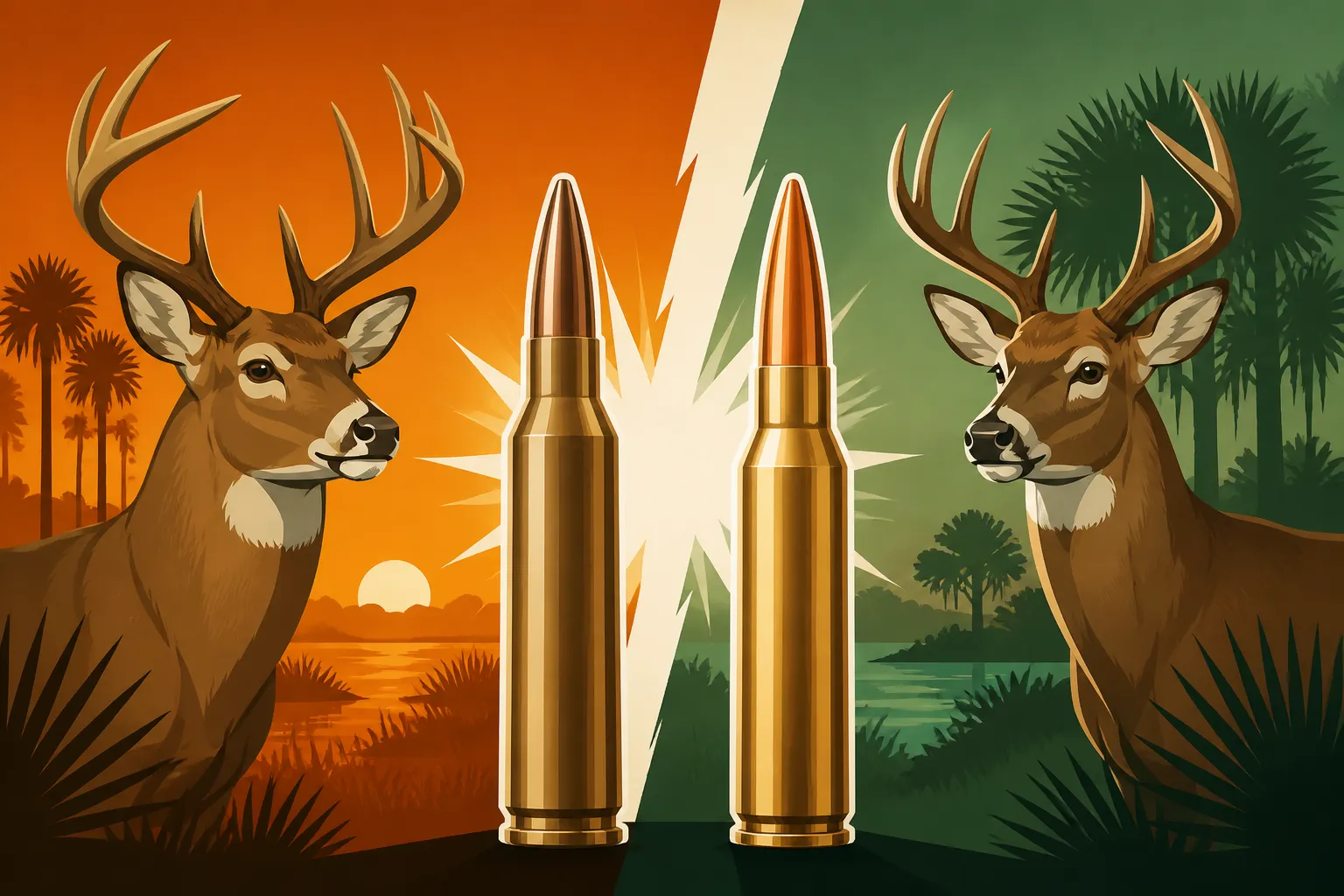
.308 Versus .270 for Whitetails
Choosing a deer rifle can feel like a never-ending debate, especially when you start diving into the nuances of calibers like the .308 Winchester and the .270 Winchester. For many South Carolina hunters, the struggle is real: do you prioritize knockdown power in dense cover, or the flat-shooting trajectory for those longer, open-field shots? This guide will break down the practical differences between these two incredibly popular cartridges, helping you decide which one is the right fit for your specific hunting style and the diverse terrains we encounter across the Palmetto State.
The Great Debate: .308 Winchester vs. .270 Winchester for South Carolina Whitetails
It's a conversation you'll hear around campfires and at gun counters all over South Carolina: which one is better, the .308 or the .270? Both are phenomenal deer cartridges, proven by decades of success in the field. But "better" is a subjective term, often depending on your personal preferences, the type of hunting you do, and even the rifle you're shooting. Let's really dig into what each one brings to the table.
Understanding the .308 Winchester: A Hunter's Favorite
The .308 Winchester, introduced in the mid-20th century, quickly became a global sensation, largely due to its military heritage as the 7.62x51mm NATO. But don't let its military roots fool you; it's an absolute workhorse in the civilian hunting world. What hunters love about the .308 is its efficiency. It delivers excellent ballistic performance from a shorter action, meaning lighter, handier rifles that are a joy to carry through thick woods and swamps. You know, those places where every ounce feels like a pound after a few miles.
When it comes to bullet weight, the .308 typically shines with projectiles ranging from 150 to 180 grains. The 150-grain offerings are zippy and great for deer, while the heavier 165 or 180-grain options offer more kinetic energy for bigger game or if you just prefer a little more punch. Recoil-wise, the .308 is generally considered manageable for most shooters, even those who might be recoil-sensitive. It's a stout push, but not a sharp jab, which contributes to its reputation for accuracy. This manageable recoil makes it easier to stay on target and get back on the animal quickly for a follow-up if needed. For general deer hunting across various South Carolina landscapes, from the rolling hills of the Upstate to the dense lowcountry bottomlands, the .308 is a superb, versatile choice. It performs reliably within typical hunting ranges you'll find here, usually under 200 yards in most timber, but perfectly capable of reaching further when the situation calls for it.
The .270 Winchester: Flat-Shooting Performance
Now, let's talk about the .270 Winchester. This cartridge has been around even longer than the .308, gaining legendary status through the writings of outdoor icons. Its claim to fame? A remarkably flat trajectory and impressive velocity, especially with lighter bullets. If you're looking for a round that "shoots like a laser," the .270 is often the first one mentioned. This characteristic makes it particularly appealing for hunters who anticipate longer shots across open fields, clear-cuts, or expansive powerline right-of-ways, which are common sights in parts of the South Carolina Midlands and even some coastal farm regions.
Typical bullet weights for the .270 range from 130 to 150 grains. The 130-grain bullets are often lauded for their incredible speed and flat flight path, making holdover calculations simpler at extended distances. Heavier 140 or 150-grain bullets maintain more energy downrange and can be excellent choices for deer as well. While the .270 does kick a bit more than the .308, it's still well within the realm of comfortable shooting for most experienced hunters. The slightly sharper recoil is a trade-off for that blistering velocity and flat trajectory. If you frequently hunt areas where you might be Glassing a Powerline Cut at Last Light or need to reach out to a deer across a wide agricultural field, the .270's ballistic profile is truly outstanding. Its ability to maintain energy and accuracy over distance means you can confidently make those longer shots, assuming you've done your part at the range.
Performance in South Carolina Hunting Scenarios
South Carolina offers such a diverse range of hunting environments, from the almost impenetrable swamps and pine thickets of the lowcountry to the steep, hardwood ridges of the Upstate. How these two calibers perform in these different settings can really influence your decision.
Thick Lowcountry Cover and Fast Shots
Imagine still-hunting through a dense pine plantation in coastal South Carolina, or slowly picking your way along the edge of a cypress swamp. Most shots in these environments are going to be up close and personal, often under 75 yards, and sometimes even much closer. Here, a quick, accurate shot is paramount, and the ability to get your rifle on target rapidly matters more than a super-flat trajectory. While neither the .308 nor the .270 is truly a "brush gun" (that's a myth, folks – brush will deflect any bullet), their performance in these tight quarters is similar. Both deliver plenty of energy to drop a whitetail cleanly at these ranges.
The slightly lighter recoil of the .308 might give it a psychological edge for some, allowing for faster target reacquisition. However, with modern rifles, quick follow-up shots are more about practice and rifle balance than a significant difference in recoil between these two. What truly matters here is shot placement and using a bullet designed to expand reliably at lower velocities, which both calibers have in abundance. When you're Hunting Lowcountry Swamp Deer or navigating thickets, you're not usually worried about a 300-yard shot; you're focused on making that 50-yard opportunity count.
Upstate Ridge Lines and Longer Views
Shift your focus to the cooler air and rolling topography of the Upstate, perhaps on a public land hunt in Sumter National Forest. You might find yourself on a high ridge, peering down into a hollow, or across a clear-cut where deer might be feeding. Here, the potential for longer shots, perhaps 150-250 yards, becomes much more real. This is where the .270 Winchester's renowned flat trajectory really starts to earn its keep. With less bullet drop over distance, it simplifies aiming, reducing the need for significant holdover calculations, especially if you haven't meticulously practiced at those exact ranges. This can provide a noticeable confidence boost.
However, the .308 is certainly no slouch in this department either. With modern ballistic reticles and a solid understanding of your rifle and ammunition's performance, the .308 is perfectly capable of ethical shots out to 300 yards and beyond. Many hunters routinely take deer at these distances with a .308, especially when they've invested time in Zeroing a Rifle for Mixed Distances. The key isn't necessarily which caliber can do it, but which one you feel more confident doing it with. For hunters who spend a lot of time Hunting Blue Ridge Escarpment Ridgelines, the flatter shooting nature of the .270 might feel like a natural advantage, even if the .308 is still highly effective.
Recoil, Shooter Comfort, and Confidence
This is where the rubber truly meets the road. The "best" caliber in the world is useless if you flinch every time you pull the trigger. The .308 generally has less felt recoil than the .270, often cited as being roughly equivalent to a .243 Winchester with heavier bullets. This makes it an excellent choice for new hunters, younger shooters, or anyone who is sensitive to recoil. A comfortable shooter is a more accurate shooter, plain and simple. If you're not anticipating a harsh kick, you're more likely to focus on your sight picture and trigger press, leading to better shot placement.
The .270, while having more recoil than the .308, is by no means punishing for most adult shooters. It's a firmer push, but very manageable in a properly fitted rifle. Think of it this way: if you're comfortable shooting a 12-gauge shotgun, a .270 will likely be perfectly fine. For either caliber, a good recoil pad, proper shooting technique, and consistent practice at the range will make a world of difference. Ultimately, the best choice is the one you can shoot most accurately and confidently, because a well-placed shot with either caliber will humanely harvest a South Carolina whitetail.
Practical Considerations Beyond Ballistics
Beyond the numbers on a ballistic chart, there are some very real-world factors that can influence your decision between a .308 and a .270 for hunting in South Carolina.
Ammunition Availability and Cost
Both the .308 Winchester and the .270 Winchester are incredibly popular cartridges, which means you'll find a wide variety of ammunition options on the shelves of sporting goods stores across South Carolina, from Charleston to Greenville. You won't have trouble finding hunting loads from all the major manufacturers in both calibers. However, historically, the .308 might have a slight edge in terms of sheer volume and sometimes a slightly lower price point for basic practice ammunition, partly due to its military adoption. This isn't always the case, and prices can fluctuate wildly, but it's a general trend to be aware of.
For dedicated hunting rounds, prices for both will be comparable. You'll find everything from basic cup-and-core bullets to premium bonded or monolithic projectiles designed for maximum penetration and weight retention. When considering ammunition, it's worth checking out resources like the GoHunt platform, which often has detailed reviews and comparisons of different loads that can help you dial in your choice, no matter which caliber you pick. Experimenting with different bullet weights and designs for your chosen rifle is crucial to finding what shoots best and performs reliably in the field.
Rifle Selection and Weight
Because both calibers are so popular, you'll find a dizzying array of rifle choices chambered in either .308 or .270. Every major rifle manufacturer offers multiple models, from lightweight mountain rifles to heavier, more stable platforms. The .308 often comes in slightly shorter-barreled and lighter rifle configurations due to its efficient powder burn and use in short-action receivers. This can be a significant advantage when you're Dragging a Deer Out of a Swamp or making a long trek into a remote WMA. A compact, lightweight rifle is simply easier to maneuver and carry through thick South Carolina cover.
The .270 typically requires a standard (long) action, which generally means a slightly longer rifle and sometimes a bit more weight. However, modern manufacturing techniques have blurred these lines, and you can certainly find lightweight .270 rifles. The choice here often comes down to personal preference for rifle balance, ergonomics, and how much you're willing to carry. Are you primarily hunting from a static position, like a treestand, or are you covering a lot of ground on foot while Still-Hunting Sumter Forest Ridges? Your hunting style should definitely influence your rifle selection and, by extension, potentially your caliber choice.
Legalities and Regulations in South Carolina
One thing you absolutely don't have to worry about with either the .308 or the .270 is legality in South Carolina. Both are perfectly legal and highly effective cartridges for hunting white-tailed deer, black bear, and feral hogs across the state. South Carolina's hunting regulations are generally quite permissive regarding rifle calibers for big game, focusing more on hunter safety and ethical harvest. For a comprehensive overview, you can always refer to the official South Carolina Legal Firearms for Deer Hunting guidelines.
You won't encounter any minimum caliber restrictions that would exclude either of these popular rounds. The important thing, as always, is to ensure your rifle is sighted in, you're using appropriate hunting ammunition, and you adhere to all other hunting laws. Whether you choose the .308 or the .270, you'll be well-equipped from a legal standpoint to pursue game throughout the Palmetto State.
Making Your Choice: Which Fits Your Hunt?
Ultimately, the decision between a .308 and a .270 comes down to understanding your specific hunting needs and personal preferences. Both are outstanding performers, and you'll find passionate advocates for each.
The Versatile All-Arounder: When .308 Shines
If you're a hunter who values versatility, manageable recoil, and a rifle that's often a bit lighter and more compact for navigating thick South Carolina terrain, the .308 Winchester might be your best bet. It's a fantastic all-around cartridge that excels in most typical deer hunting scenarios in our state. Whether you're making a relatively close shot in a dense bottomland or reaching out to 200 yards across a field edge, the .308 delivers ample energy and accuracy. It's an excellent choice for those who hunt varied habitats and want one rifle that can do it all comfortably.
The .308's ability to cycle quickly in a short-action rifle, coupled with its moderate recoil, also makes it a solid choice for youth hunters or those with smaller frames, helping to build confidence and ensure a pleasant shooting experience. It's a consistent performer that has earned its stellar reputation through sheer effectiveness in the field.
The Reach and Precision Option: When .270 Excels
On the other hand, if your primary hunting spots feature more open country, longer sightlines, and you prioritize a flatter trajectory for those extended shots, then the .270 Winchester is incredibly compelling. Its speed and reduced bullet drop can certainly offer a distinct advantage when distances stretch beyond 200 yards, requiring less holdover and potentially simplifying the shot equation in windy conditions. Many experienced hunters simply love the confidence that comes with knowing their rifle shoots so flat.
If you regularly hunt large agricultural tracts, powerline cuts, or open hardwood ridges in the Upstate where longer shots are the norm rather than the exception, the .270 can truly excel. For precise, long-range engagements, especially if you're comfortable with its slightly more pronounced recoil, the .270 is a hard cartridge to beat.
Test Driving Your Decision
The absolute best way to make your final decision is to, if at all possible, try shooting both calibers. If a friend has a rifle in .308 and another in .270, ask if you can shoot them at the range. Pay attention to how each rifle feels in your hands, how you manage the recoil, and most importantly, how accurately you can shoot it. Remember, confidence in your equipment is paramount. A bullet from a rifle you shoot well is always more effective than one from a "better" caliber that makes you flinch.
Consider visiting a local gun store or a dedicated outdoor retailer like a store that leverages the GoHunt platform for gear recommendations. Talk to the staff about different rifle models and what feels good to you. Don't just focus on the ballistics; think about the entire package – the rifle's weight, balance, and how comfortable it is to shoulder. Rifle Setups for South Carolina Deer Hunting involves more than just caliber; it's about finding a system that works for you. Ultimately, both the .308 and the .270 are superb choices for South Carolina whitetails, and with proper shot placement, either will serve you admirably.
| Feature | .308 Winchester | .270 Winchester |
|---|---|---|
| Common Bullet Wt. | 150-180 grains | 130-150 grains |
| Typical Velocity | ~2,600-2,800 fps (150gr) | ~2,900-3,100 fps (130gr) |
| Recoil (Felt) | Moderate (Generally lighter than .270) | Moderate to Firm (Generally heavier than .308) |
| Action Length | Short Action (often results in lighter, more compact rifles) | Long Action (often results in slightly longer rifles) |
| Trajectory | Good, adequate for most hunting ranges (0-250+ yds) | Very Flat, excellent for extended ranges (0-300+ yds) |
| Typical SC Use | Versatile for diverse terrains (woods, fields) | Excellent for open country and longer shots |
| Ammunition Avail. | Excellent (wide variety, often slightly more budget practice rounds) | Excellent (wide variety) |
Disclaimer
This article is for general informational purposes only and does not constitute professional advice. Laws, prices and regulations vary by location and change over time. Consult a qualified professional for guidance on your specific situation.