.30-30 in Thick Lowcountry Cover
The Lowcountry of South Carolina offers some of the most unique and challenging deer hunting experiences, often characterized by dense, unforgiving cover where visibility shrinks to mere yards. For hunters navigating these thickets, the choice of firearm becomes paramount, often leading to frustration when traditional long-range calibers feel unwieldy or overkill. This guide delves into why the classic .30-30 Winchester remains a steadfast and highly effective choice for deer hunting in South Carolina's dense Lowcountry cover, offering practical insights to help you optimize your setup and tactics for success.
Why the .30-30 Shines in Dense Lowcountry Habitat
When you're slipping through palmetto thickets, scrambling through a cypress swamp, or picking your way along the edge of a dense clear-cut, the kind of rifle you carry makes all the difference. The Lowcountry isn't known for wide-open fields where you're routinely taking 300-yard shots. Instead, it's a place where a deer can be on you and gone in a flash, often at ranges closer than you'd expect. This is precisely where the .30-30 Winchester, a cartridge that has been punching tags for well over a century, truly distinguishes itself.
Short Range, Big Impact
The .30-30 is often perceived as a short-range, "brush-buster" cartridge, and while the "brush-buster" part is mostly a myth (any bullet will deflect if it hits enough resistance), its effectiveness at shorter distances is undeniable. In the Lowcountry, shots on deer rarely exceed 100 yards, and more often, they are within 50. The .30-30 excels in this zone. Its moderate velocity and heavier bullet typically deliver excellent energy transfer upon impact, leading to quick, humane kills. You're not looking for extreme velocity or flat trajectories; you're looking for decisive power at conversational distances.
Imagine still-hunting through a pine plantation that's been recently thinned and is now a tangle of briars and young hardwoods. You catch a flicker of movement—a buck slipping through the dense undergrowth. With a standard deer rifle, that 75-yard shot might feel perfectly reasonable. But in this stuff, a smaller, faster bullet can yaw or deflect if it catches even a twig, leading to a wounded animal. The .30-30, with its typically heavier, slower, and often flat-nosed or round-nosed projectiles, tends to hold a straighter path through minor obstructions more reliably than some of its high-velocity, pointy-bullet counterparts, though it’s crucial to understand no bullet is truly "brush-proof." The real advantage is that its effective range perfectly matches the engagement distances you're likely to encounter when Hunting Lowcountry Swamp Deer or Hunting Coastal Maritime Forest Edges.
Maneuverability in Tight Spaces
Try swinging a 24-inch barreled magnum rifle in a thicket of saw palmetto or trying to shoulder it quickly from a cramped treestand set up deep in a swamp. It's awkward, noisy, and frankly, a recipe for missed opportunities. The beauty of the .30-30 largely comes from the firearms it's typically chambered in: lever-action rifles. These guns are often shorter, lighter, and incredibly well-balanced, making them a joy to carry and handle in tight quarters.
Think about the quick, fluid motions needed when a deer suddenly appears from behind a dense curtain of vegetation. A short lever-action rifle, like a Marlin 336 or a Winchester 94, comes to the shoulder almost instinctively. The overall length of these rifles, often with an 18-to-20-inch barrel, makes them much easier to maneuver through dense woods, clear a shooting lane quickly, or even get into position for a shot from a kneeling or sitting position. This compact design is a huge advantage when you're Still-Hunting Sumter Forest Ridges but also applies to the coastal plain's equally challenging terrain. You can slip through dense cover quietly, without your barrel constantly snagging on vines or branches, giving you a stealth advantage in areas where deer have thick cover to rely on.
Caliber Considerations for Lowcountry Deer Hunting
Choosing the right caliber for Lowcountry deer hunting is less about reaching out to extreme distances and more about reliable performance in often challenging, close-range environments. It's about understanding the practical realities of the terrain and the typical shot opportunities you'll get, rather than getting caught up in ballistic charts designed for open-field hunting.
Understanding Effective Range
Let's be realistic: most deer taken in the South Carolina Lowcountry are within 100 yards, and many are significantly closer. The thick woods, dense undergrowth, and numerous swamps simply don't offer many opportunities for stretching the rifle's legs. A good shot opportunity at 70 yards in the Lowcountry often feels like a long shot due to the limited visibility. The .30-30 is perfectly capable of ethical kills out to 150-175 yards in the hands of a proficient shooter with the right ammunition. However, in our local conditions, you'll rarely be presented with such a clear line of sight.
This means that obsessing over ballistic coefficients or minute-of-angle accuracy at 200 yards is largely moot. What truly matters is a cartridge that delivers reliable expansion and penetration at modest velocities, ensuring maximum energy transfer on impact. The classic .30-30 load, often a 150-grain or 170-grain flat-nosed or round-nosed bullet, is designed for just this purpose. It dumps its energy quickly and effectively within the deer, even if it has to pass through a bit of muscle or shoulder bone. This makes it a great choice for areas where you're working a Scrape Lines Along a Logging Road or trying to get a shot off as a deer busts out of a Hunting a Funnel Between Two Swamps.
Bullet Selection for Brush and Timber
While no bullet can magically "bust" through heavy brush without deflection, certain bullet designs tend to perform better than others when encountering minor obstacles, and they certainly perform well once they reach the deer. For the .30-30, traditional flat-nose and round-nose bullets have a long history of success. These softer-tipped bullets are often designed to expand reliably at the .30-30's modest velocities, and their blunt profile can sometimes be less prone to drastic deflection than a sharp, pointed, high-velocity bullet if it glances off a small twig.
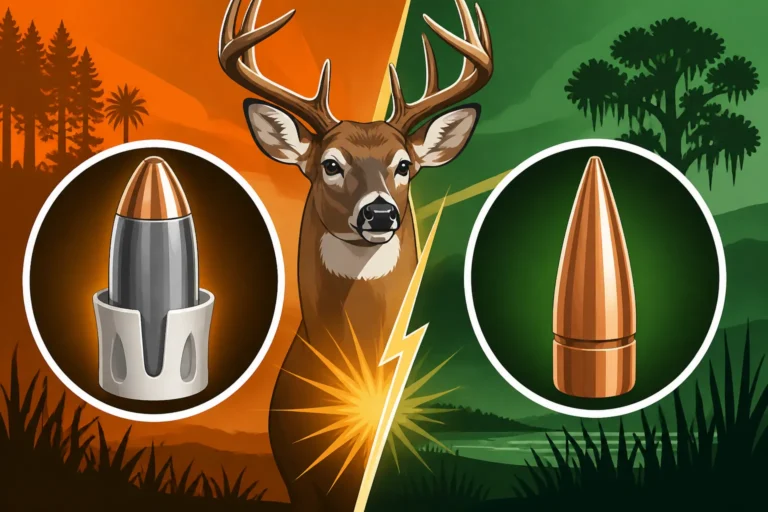
Modern advancements have also brought new options. Hornady's LEVERevolution ammunition, for instance, features a flexible polymer tip that makes it safe to use in tubular magazines while offering a more aerodynamic profile. This can slightly extend the effective range and improve ballistic performance, though for most Lowcountry applications, the difference will be negligible compared to a traditional soft point. The key is to choose a bullet that's engineered for rapid expansion at the .30-30's typical impact velocities, ensuring that when you do connect, you maximize your chances of a quick, clean harvest. It's a critical consideration, especially when every shot counts in dense cover.
Optimizing Your .30-30 Setup for South Carolina's Lowcountry
Having the right rifle is only part of the equation; how you set it up and carry it can significantly impact your success and comfort in the Lowcountry's demanding environment. From choosing the right glass to securing your ammunition, every detail plays a role in making your .30-30 a truly effective tool.
Optics Choices for Quick Shots
For a .30-30 in thick Lowcountry cover, less is often more when it comes to optics. A high-magnification scope is largely unnecessary and can even be a hindrance. Instead, prioritize a wide field of view and excellent low-light gathering capabilities. Many hunters opt for a low-power variable scope, such as a 1-4x, 2-7x, or even a fixed 2.5x or 3x. This allows for quick target acquisition at close range while offering just enough magnification to clearly identify your target in the dim light of deep timber or early morning/late evening.
A simple red dot sight is another fantastic option, especially for truly close-quarters hunting, like when you’re on a deer drive or hunting a very tight bedding area. Red dots offer lightning-fast target acquisition and work incredibly well in low light, without adding significant weight or bulk to your compact lever-action. The crucial factor is ruggedness and reliability – you need an optic that can take a bump or two without losing zero. Regardless of your choice, ensure it's sighted in properly for the distances you expect to shoot. Practical Range in South Carolina Swamp Timber typically means focusing on a 50 to 75-yard zero.
Sling and Carry Considerations
A comfortable and functional sling is non-negotiable for hunting in the Lowcountry. You'll be doing a lot of walking, often pushing through thick vegetation, and having your rifle securely on your shoulder, or cross-chest, frees up your hands for balance, pushing brush aside, or carrying other gear. Look for a sling that is wide enough to distribute the weight comfortably and made from a material that won't slip on your shoulder, especially if you're wearing Warm-Weather Clothing for South Carolina Hunters that might be slick.
For many, a two-point sling that allows for both shoulder carry and a quick transition to a shooting position is ideal. Some hunters even prefer a single-point sling for maximum maneuverability in extremely dense cover, though it can be less comfortable for long treks. When you’re creeping through a cypress bottom, a noisy sling can ruin a stalk. Make sure any buckles or attachment points are quiet and won't clank against your rifle. Accessing maps or scouting intel through an app like GoHunt is much easier when your rifle is secured and not interfering with your movement.
Ammunition Selection and Availability
One of the great advantages of the .30-30 Winchester is its widespread availability and the variety of ammunition on the market. Most sporting goods stores and gun shops will have several brands and bullet weights to choose from, usually 150-grain and 170-grain soft points. For hunting Lowcountry whitetails, either of these bullet weights will be highly effective. The 170-grain offers slightly more penetration, which can be beneficial on larger-bodied deer or if you anticipate angled shots, while the 150-grain typically has a slightly flatter trajectory (though again, this is less critical at our typical ranges).
As mentioned, look for traditional flat-nose or round-nose soft point bullets, or modern flexible-tip options like Hornady LEVERevolution. It's always a good idea to buy a few boxes of the same load and test them in your specific rifle to see what shoots best. Consistency is key, and knowing how your chosen ammunition performs from your rifle will build confidence. Always carry extra rounds in a quiet, accessible holder, whether on your sling, in a buttstock cuff, or in a pocket in your pack. There's nothing worse than running out of ammo when you've finally connected with a big Lowcountry buck.
Practical Hunting Scenarios and Tactics
The .30-30 really shines when paired with tactics suited for the South Carolina Lowcountry. This isn't long-range glassing country; it's about close encounters, quick decisions, and making the most of limited visibility. Your rifle is a tool, and knowing how to wield it effectively in specific situations is what brings venison to the table.
Still-Hunting Through Thickets
Still-hunting is perhaps the quintessential Lowcountry tactic for the .30-30, requiring patience, stealth, and acute awareness. When you’re moving through areas like dense pine thickets, cypress strands, or regenerating clear-cuts, you're constantly aware of the limited sightlines. The goal isn't to cover ground quickly, but to move slowly—often taking a minute or more per step—pausing frequently to scan and listen. With a GoHunt map on your phone, you can track your precise movements and identify potential pinch points or bedding areas ahead.
The compact nature of the .30-30 lever-action is invaluable here. It won't snag as much, allowing you to focus on moving quietly. Keep your rifle shouldered or in a ready position, allowing for a quick, fluid motion to take aim when a deer inevitably bursts from cover. Shots will often be reactive and at very close range, sometimes under 20 yards. Focus on hitting the vitals, and don't rush the shot, even if it feels chaotic. The sheer power of the .30-30 at these ranges means that a well-placed shot will drop a deer quickly, even with the limited visibility.
Stand Hunting in Dense Cover
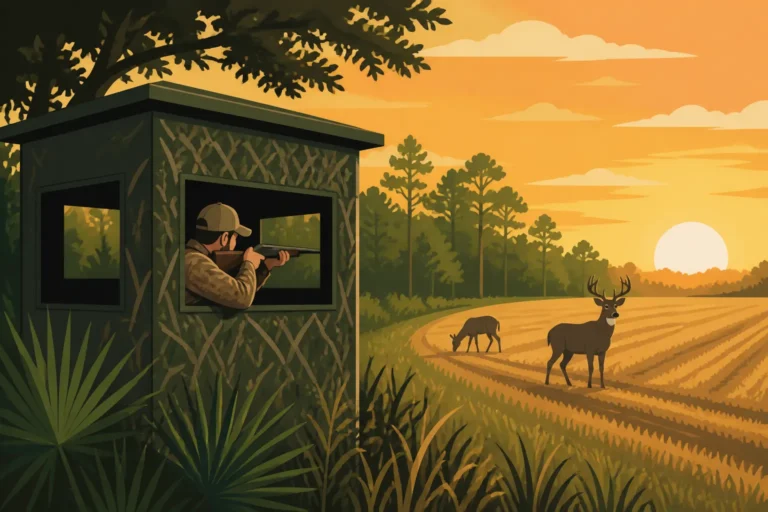
Even in the thickest Lowcountry cover, strategic stand placement can be incredibly effective. Whether you're using a climbing stand, a hang-on, or a ground blind, the principle is the same: find a pinch point, a travel corridor, or a subtle terrain feature that funnels deer movement. This could be a narrow strip of high ground between two swamps, a logging road winding through a thick block of timber, or even the edge of a small green patch planted in a sea of palmettos. When Setting Up on a Lowcountry Field Edge, you might only have a 50-yard shooting lane, perfect for the .30-30.
Consider your shooting lanes from your stand. You'll likely need to do some trimming before the season opens to ensure you have clear lines of sight to key areas where deer might appear. The .30-30, with its forgiving ballistics at closer ranges, means you don't need sprawling open fields. It performs exceptionally well in these tighter, more controlled environments where deer are likely to be moving slowly or pausing. Many hunters find that a simple ground blind, well-brushed in, works wonders in these dense areas, allowing you to stay hidden while giving you a stable rest for your shot.
Participating in Deer Drives
Deer drives are a time-honored tradition in many parts of South Carolina, particularly in the Lowcountry where thick cover makes still-hunting challenging for large tracts. The .30-30 is an excellent choice for both standers and drivers in these situations. For standers, posted on escape routes or funnel points, the compact lever-action is easy to shoulder and aim quickly as deer are pushed past. Shots can be fast-paced and at varying, often close, distances.
For drivers, who are actively pushing through the thickest parts of the woods, the maneuverability of the .30-30 is a huge asset. Carrying a long, heavy rifle through a briar patch or waist-deep swamp water is exhausting and cumbersome. A light, short .30-30 is far less likely to get caught up in the brush, allowing drivers to maintain their pace and focus on moving deer. Just remember, safety is paramount during any drive. Always know where your fellow hunters are, and understand your shooting lanes and backstops. Deer Drives With Three or Four Hunters often rely on disciplined placement and a quick, reliable rifle like the .30-30.
Here's a quick look at common .30-30 bullet types and their characteristics for Lowcountry hunting:
| Bullet Type | Characteristics | Best Use in Lowcountry |
|---|---|---|
| Flat-Nose Soft Point | Traditional, wide meplat for reliable expansion, good energy transfer. | General purpose, close to medium range, deep timber still-hunting. |
| Round-Nose Soft Point | Similar to flat-nose, slightly more aerodynamic than flat-nose, consistent expansion. | Versatile, good for diverse Lowcountry cover, stand hunting. |
| Polymer-Tipped (e.g., LEVERevolution) | Pointed polymer tip improves aerodynamics, safe in tubular magazines. | Slightly extended range capability, good for field edges or longer clear-cuts. |
| Jacketed Hollow Point | Designed for rapid, sometimes aggressive, expansion. | Very close range, where maximum energy dump is desired. |
In sum, the .30-30 Winchester isn't just a nostalgic relic; it's a highly capable and practical firearm for deer hunting in the dense, close-quarters environment of the South Carolina Lowcountry. Its inherent design, paired with the right ammunition and tactics, makes it a formidable choice for any hunter navigating our challenging woods.
Disclaimer
This article is for general informational purposes only and does not constitute professional advice. Laws, prices and regulations vary by location and change over time. Consult a qualified professional for guidance on your specific situation.