Rifle Calibers for South Carolina Bear
Choosing the right rifle caliber for black bear hunting in South Carolina can feel like a daunting task, especially when you consider the vastly different terrains and hunting styles across our state. Whether you're heading to the rugged Upstate mountains or navigating the dense, swampy lowlands of the coast, the effectiveness of your rifle setup hinges on making an informed decision. This guide aims to cut through the confusion and help you select a caliber that provides both ethical stopping power and confidence in your hunting situation, ensuring you're prepared for whatever challenge a South Carolina bear hunt might present.
Understanding South Carolina's Bear Hunting Landscape and Regulations
Before we even get into specific calibers, it's absolutely crucial to understand the unique environments where South Carolina's black bears live and how that shapes your hunting approach. Our state offers two distinct bear hunting zones, each with its own set of characteristics that directly influence what kind of rifle makes the most sense.
The Unique Challenges of Upstate Mountain Bears
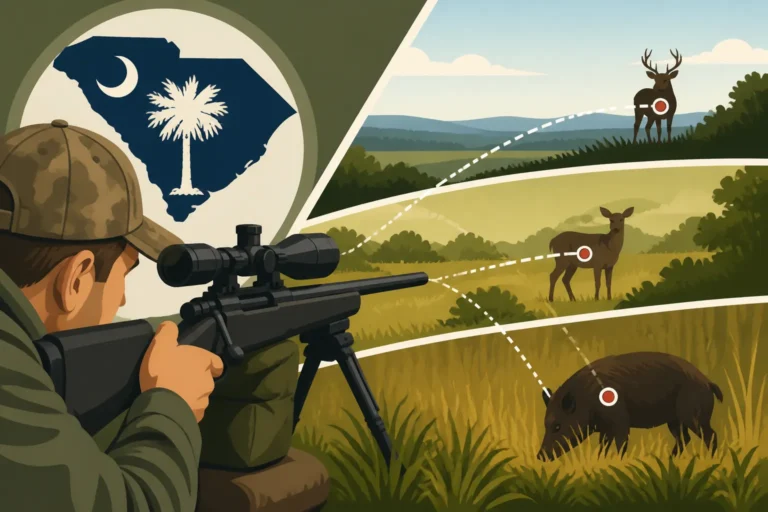
If you're heading to the mountains of Game Zone 1, particularly in areas like Oconee, Pickens, and Greenville counties, you're looking at a completely different ballgame than hunting deer in the flatlands. Here, bears are often found in steep, heavily timbered terrain, sometimes moving through thick rhododendron thickets or across rocky outcroppings. While you might encounter a bear at spitting distance in dense cover, there's also the very real possibility of a longer shot across a valley or down a powerline cut.
This varied terrain means you need a caliber that can handle both scenarios. A flatter-shooting round is a definite advantage if a bear steps out at 150-200 yards across a ravine. However, you also need enough punch to anchor a bear quickly if it's at 50 yards and heading for a thicket. The sheer size and toughness of a mature black bear, especially one that's been fattening up on acorns in the fall, demands a cartridge that delivers substantial energy and penetration. Many hunters in this area swear by calibers that can push a heavier, well-constructed bullet to ensure maximum energy transfer. If you're planning a still-hunt in this challenging environment, check out Hunting Zone 1 Still-Gun Bear Season for more specific details on the season structure and how that might influence your gear.
Coastal Plain Bear Hunting Considerations
Now, shift your mental image from the mountains to the lowcountry swamps and vast timberlands of Game Zone 4. Think Francis Marion National Forest, Bear Island WMA, or other coastal plain locations. Here, visibility is often measured in yards, not hundreds of yards. You're typically dealing with incredibly dense cover – thick palmetto patches, deep briar tangles, and soggy bottomlands. Bears here might be pursued with dogs, leading to very close-range, fast-paced encounters, or they might be ambushed from a stand over a natural food source or a planted pine clearcut edge.
In these conditions, the need for a super-flat shooting caliber diminishes significantly. Instead, you prioritize raw stopping power and the ability of your bullet to punch through dense muscle and bone, even after potentially clipping a small branch or two. A heavier, slower bullet with high sectional density often performs exceptionally well in these close-quarters scenarios. Recoil might be a bigger factor if you're taking quick follow-up shots in tight cover. Understanding the nuances of this region, particularly when bears are driven, is key to success. For a deeper dive into hunting methods and regulations in this unique environment, take a look at Hunting Zone 4 Coastal Bears.
Legal Requirements and Practical Range
South Carolina doesn't impose extremely restrictive minimum caliber requirements for bear hunting, unlike some other states that might mandate a .270 or .30-06 minimum for larger game. Generally, any centerfire rifle cartridge legal for deer hunting will also be legal for bear. However, "legal" doesn't always equate to "ethical" or "effective." While a .243 Winchester might be legal, most experienced bear hunters would strongly advise against it due to the bear's tough hide, dense bone structure, and incredible will to live. You want a caliber that can deliver a quick, humane kill, minimizing the chance of a long, difficult, or even dangerous tracking job through thick cover.
For the most part, we're talking about cartridges that reliably launch bullets weighing 150 grains or more, designed for medium to large game. The practical range you can expect to engage a bear is also a major factor. In the lowcountry, 75-100 yards is a common shot. In the mountains, it might stretch to 200 or even 250 yards. Your chosen caliber needs to perform reliably at these distances, retaining enough energy and maintaining accuracy. Don't forget that understanding general firearm rules is always important, and you can find more information on that in articles like South Carolina Legal Firearms for Deer Hunting.
Classic and Proven Calibers for South Carolina Black Bears
When it comes to bear hunting, there are certain calibers that have stood the test of time, proving their worth across various terrains and conditions. These aren't flashy new rounds, but workhorse cartridges that deliver consistent performance.
The Versatile .30-06 Springfield
Ah, the good ol' .30-06 Springfield. If there's one cartridge that almost every hunter in South Carolina has either owned or knows someone who swears by, it's this one. And for good reason! The .30-06 is perhaps the quintessential all-around big game cartridge, and it's an absolutely fantastic choice for South Carolina black bears, whether you're in the mountains or the swamps.
What makes it so good? Versatility. The .30-06 can handle a wide range of bullet weights, typically from 150 grains up to 220 grains. For bear, you'll want to lean towards the heavier end of that spectrum, say 180-grain or 200-grain bullets, especially those with robust, controlled-expansion designs. These heavier bullets retain energy well, punch deep, and have a high sectional density, meaning they're less likely to deflect if they hit brush or shoulder bone. Imagine you're still-hunting in the Sumter National Forest, carefully picking your way through thick pines. A bear emerges from a thicket at 80 yards, moving steadily. A well-placed 180-grain bullet from a .30-06 will penetrate deep, disrupting vital organs and anchoring that bear quickly, even if it's angling through the timber. Ammunition is widely available, and most hunters can shoot a .30-06 accurately without being overly punished by recoil.
The Hard-Hitting .300 Winchester Magnum
For those who crave more power, especially in the more open areas of the Upstate where longer shots might present themselves, the .300 Winchester Magnum steps up to the plate. This is a formidable cartridge, capable of launching heavy bullets at impressive velocities, translating into significant energy at extended ranges.
The .300 Win Mag excels when you need that extra punch for a large bear or if you anticipate shots pushing beyond 200 yards across a logging road or clear-cut. Its flatter trajectory compared to the .30-06 makes it easier to range and shoot accurately at longer distances without as much holdover. However, this power comes with a trade-off: recoil. The .300 Win Mag definitely kicks more, and consistent accuracy with it requires more practice and a rifle that fits you well. For South Carolina bear, a 180-grain or 200-grain bullet from a .300 Win Mag is an absolute hammer, providing ample penetration and hydrostatic shock. It’s particularly effective if you’re trying to prevent a wounded bear from disappearing into a thicket, as its raw power often results in a quicker incapacitation. While it might be overkill for close-range swamp hunting, if you're chasing the biggest bears in the mountains and want maximum authority, it's a top contender.
The Dependable .270 Winchester
The .270 Winchester is another classic that often gets overlooked for bear in favor of its larger .30-caliber brethren, but it shouldn't be dismissed. Known for its flat trajectory and mild recoil, the .270 is a fantastic choice for deer across the country, and with the right bullet, it can be very effective on black bear, especially in situations where shot placement is precise.
The .270 typically shoots 130-grain to 150-grain bullets at high velocities, making it a dream for those longer shots you might encounter while glassing a clear-cut edge or a powerline in the Upstate. Its flatter trajectory minimizes guesswork, which is a big confidence booster. While it might not have the raw "thump" of a .30-06 or a .300 Win Mag, a premium 150-grain bullet, designed for deep penetration and controlled expansion, can absolutely put a bear down ethically. The key here is excellent shot placement. If you're hunting in an area where bears are primarily harvested over bait, or from a stand where you know your shot distance is controlled and precise, the .270 offers a very comfortable and accurate shooting experience. Imagine you're perched on an Upstate ridge, using your binoculars to scan a distant feeding area. A bear steps out at 175 yards. With a .270, you can confidently make that shot, knowing its flat trajectory will put the bullet where it needs to go.
Modern and Specialized Options for Bear Hunters
Beyond the traditional stalwarts, the hunting world has seen an influx of new cartridges and a resurgence of older, specialized options. Some of these can be excellent choices for South Carolina bear, provided you understand their strengths and limitations.
The 6.5 Creedmoor Debate
The 6.5 Creedmoor has taken the hunting world by storm in recent years, primarily for its incredible accuracy, mild recoil, and effectiveness on deer-sized game. But for black bears? That's where the debate often sparks. Is it truly enough? The honest answer is: it can be, but with caveats.
The 6.5 Creedmoor typically excels with 130-grain to 143-grain bullets. For bear, you absolutely, unequivocally need to use a premium, heavy-for-caliber, controlled-expansion bullet. Forget about standard cup-and-core deer bullets; you need something designed to hold together and penetrate deep through tough hide, muscle, and bone. With such a bullet and impeccable shot placement, a 6.5 Creedmoor can indeed be lethal on South Carolina black bears, especially in the 150-yard range or less. Its low recoil allows for precise shot placement, which is paramount. However, it lacks the energy and bullet weight of larger calibers, meaning your margin for error is smaller. If you're a skilled marksman who places shots perfectly and prefers a lighter-recoiling rifle, it could work. It's often favored in scenarios where precision is key, like targeting a specific vital area rather than relying on brute force. For those who hunt the Upstate's varied terrain, the 6.5 Creedmoor's inherent accuracy, as discussed in 6.5 Creedmoor for Upstate Ridges, can be a significant advantage. Just remember: bullet choice is king here.
Leveraging .45-70 Government for Close Quarters
Now we're talking about a real classic, a thumper from the past that's found renewed popularity, especially among hunters who appreciate its raw power at close range. The .45-70 Government, often fired from a lever-action rifle, is a fantastic choice for the dense cover of South Carolina's coastal bear country.
This cartridge launches heavy, large-diameter bullets (typically 300 grains to 405 grains) at moderate velocities. What it lacks in flat trajectory (its trajectory is often described as "rainbow-like" past 150 yards), it more than makes up for in knockdown power. When a heavy .45-70 bullet hits a bear, it delivers a tremendous amount of energy, creating a wide wound channel and often dropping the animal on the spot. This is especially advantageous in thick swamps where a bear might be moving quickly, or during a dog drive where shots are often under 50 yards and require immediate incapacitation. The heavy bullet is less likely to be deflected by small brush, and its sheer mass helps it punch through heavy bone. While not a long-range caliber by any stretch, for close-range work in the lowcountry, the .45-70 is incredibly effective and gives you a huge confidence boost. It's also a popular choice for those looking for a powerful rifle option in Primitive Weapons Deer Hunting in South Carolina and similar seasons, though technically it's a cartridge, not a muzzleloader.
Handgun Options and Their Limitations
While most bear hunters will opt for a rifle, handgun hunting for black bear is an option for some, particularly those who relish a significant challenge or hunt specific seasons where handguns are preferred. However, this is not for the faint of heart and comes with significant limitations.
Legally, South Carolina does allow handgun hunting for bear, provided the handgun meets general legal requirements for big game. Common calibers used for bear with a handgun would include powerful revolvers like the .44 Magnum, .454 Casull, or even the .500 S&W Magnum. The primary limitation is, of course, effective range and accuracy. Even with powerful handgun cartridges, the effective range for an ethical kill on a bear is usually limited to 50 yards, often much closer. Shot placement becomes even more critical, and you absolutely need to be proficient with your chosen handgun. This means extensive practice at the range, under various conditions, to ensure you can deliver a precise shot under pressure. The dense cover of South Carolina's bear habitats can make a handgun a viable option for extremely close encounters, but it significantly reduces your margin of error. If you're considering this highly specialized approach, it's wise to thoroughly review Handgun Hunting Rules in South Carolina to ensure you're fully compliant and prepared for the unique demands of this method.
Essential Considerations Beyond Caliber
Choosing the right caliber is a huge step, but it's only one piece of the puzzle. There are other equally vital factors that will determine your success and safety when bear hunting in South Carolina.
Bullet Construction Is King
You've heard it before, but for black bear, it bears repeating: bullet construction matters more than almost anything else. You could be shooting the most powerful magnum known to man, but if you're using a cheap, frangible, thin-jacketed bullet designed for varmints or thin-skinned deer, you're asking for trouble. Black bears are stout animals. They have thick hide, dense muscle, and heavy bones, particularly around the shoulders and skull.
When selecting ammunition, look for bullets designed for deep penetration and controlled expansion. This means bullets that are bonded (where the lead core is chemically bonded to the copper jacket), monolithic (solid copper or alloy), or partition-style (with an internal partition separating the front and rear core). Brands like Nosler Partition, Barnes TSX/TTSX, Hornady Interbond, Swift A-Frame, and Federal Trophy Bonded Tip are excellent examples. These bullets are engineered to hold together at high velocities, retain their weight, create a consistent wound channel, and penetrate far enough to reach vital organs even after encountering bone. A bullet that fragments or mushrooms too quickly will dump all its energy superficially, failing to reach the vitals, leading to a wounded animal and a difficult, dangerous tracking job. Never skimp on ammunition when hunting bear.
Shot Placement and Practice
No matter what caliber you choose, from a 6.5 Creedmoor to a .45-70, it is absolutely meaningless without precise shot placement. A perfectly placed shot from a "marginal" caliber is always better than a poorly placed shot from a magnum. Black bears, like all game, have specific vital areas – the lungs and heart – that will lead to a quick and humane kill.
Spend ample time at the shooting range, practicing from various positions you might encounter in the field: offhand, kneeling, sitting, and from a rest. Know your rifle, know your ammunition, and know your effective range. Use targets that accurately represent a bear's anatomy to visualize shot placement. Practice quickly shouldering your rifle and acquiring the target, as bear encounters can often be sudden. Tools like GoHunt can help you plan your shots by understanding terrain and potential shot angles in your hunting area. Remember, the goal is a quick, ethical harvest every single time. For a refresher on where to aim, check out Shot Placement on a South Carolina Black Bear – it's crucial for any big game.
Optics and Accessories
While not directly related to caliber, your choice of optics and other accessories plays a critical role in putting that bullet where it needs to go. A quality rifle scope is indispensable for bear hunting in South Carolina. In the lowcountry, you might be hunting in dense, shaded areas where light conditions are often dim, even in the middle of the day. A scope with good light-gathering capabilities (larger objective lens, quality glass) and a clear, uncluttered reticle will make a huge difference. In the mountains, variable power scopes are key to quickly adapting from close-range thickets to longer shots across open cuts.
A reliable rangefinder is also a must-have, especially in the Upstate where distances can be deceptive due to undulating terrain. Knowing the exact yardage to your target eliminates guesswork and allows you to make precise adjustments. Don't forget other essentials like a sturdy sling for carrying your rifle through rough terrain, and robust rain gear, as South Carolina weather can change on a dime. Investing in quality binoculars, much like those discussed for deer hunting in Binocular Choice for South Carolina Whitetails, will also greatly aid in spotting bears before they spot you, allowing for better shot opportunities and preparation.
| Caliber | Pros | Cons | Ideal South Carolina Scenario |
|---|---|---|---|
| .30-06 Springfield | Versatile, great energy, wide ammo choice | Moderate recoil, not the flattest shooting | All-around choice, good for both Upstate and Coastal |
| .300 Winchester Magnum | High energy, flat trajectory, excellent for larger bears | Significant recoil, expensive ammo | Upstate mountains, longer shots, open country |
| .270 Winchester | Flat trajectory, mild recoil, accurate | Less raw power than .30-06, requires premium bullets | Upstate ridges, accurate shot placement, open clear-cuts |
| 6.5 Creedmoor | Low recoil, highly accurate, ethical with premium bullets | Less energy, small margin of error, bullet choice crucial | Precision hunting, experienced marksmen, controlled distances |
| .45-70 Government | Massive knockdown power, heavy bullet, brush-busting | Rainbow trajectory, limited range, heavy recoil with hot loads | Coastal swamps, dense cover, dog drives, close range |
| .44 Magnum (Handgun) | Portable, ultimate challenge, close-range power | Very limited range, extreme proficiency required, difficult | Specialized close-quarters, self-defense during bear drives |
This article is for general informational purposes only and does not constitute professional advice. Laws, prices and regulations vary by location and change over time. Consult a qualified professional for guidance on your specific situation.