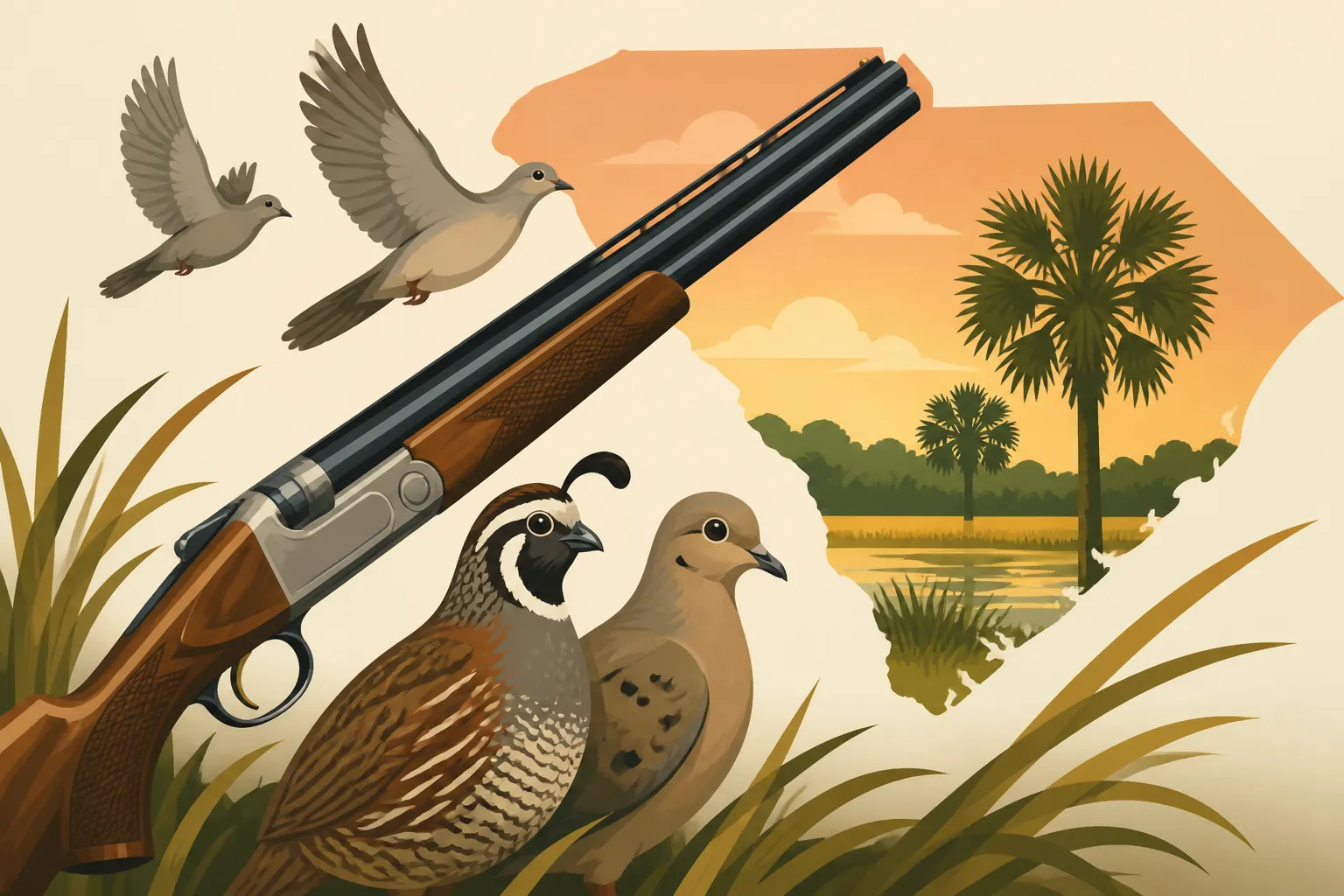
Shotguns for South Carolina Dove and Quail
Stepping into the dove field or flushing a covey of quail in South Carolina is an exhilarating experience, but it quickly reveals the critical importance of having the right shotgun in hand. Many hunters, especially newer ones, find themselves overwhelmed by the sheer variety of shotguns, gauges, and features, struggling to pinpoint what truly works best for the fast-flying action of doves or the explosive flushes of quail in our unique Southern landscapes. This guide is here to cut through the confusion, helping you understand the nuances of shotgun selection and setup so you can confidently hit the field prepared for success.
Understanding South Carolina's Dove and Quail Hunting Landscape
Hunting doves and quail in South Carolina might fall under the "small game" umbrella, but the actual experience, and therefore your gear requirements, can be worlds apart. We're talking about two distinct hunting styles, each demanding different considerations from your shotgun setup. Understanding these differences is the first step toward making an informed choice.
The Thrill of Dove Fields and Their Demands
Picture this: the sun is setting, casting long shadows across a freshly cut cornfield, and doves are zipping in from every direction like feathered rockets. Dove hunting is often a social affair, a high-volume shooting game that demands a shotgun you can swing quickly, shoot repeatedly, and that won't punish you too much over the course of an afternoon. You're typically shooting at birds flying at various angles and speeds, often at distances that range from fairly close to the outer limits of your effective range.
The sheer volume of shooting means that recoil becomes a real factor. A heavy-recoiling gun might feel fine for a few shots, but after a couple of boxes of shells, your shoulder will start protesting. Reliability is also key; you don't want to miss crucial flight times fumbling with a jam or a malfunction. Hunters often post up near food sources like sunflower, corn, or millet fields, and the birds come in waves, providing plenty of action. You can often get away with a more open choke due to the close-to-medium range and the desire for a broad pattern to catch those erratic flyers. Knowing the local Mourning Doves in South Carolina population patterns can give you a real edge here.
The Subtlety of Quail Coverts and Their Challenges
Now, shift that mental image entirely. Quail hunting in South Carolina is a much more intimate, demanding pursuit, often done on foot with a good bird dog. You're typically navigating through thickets, pine forests, or low-lying brush, waiting for that moment when the dog locks up on point and a covey erupts from underfoot. This is all about quick reflexes, immediate target acquisition, and often, extremely close-range shots before the birds vanish into the thick cover.
Unlike dove hunting, where you might have a second or two to track a bird, quail often present a "now or never" shot. The birds explode, and you need to get on them, swing, and shoot almost instinctively. Recoil is less of a factor because the shot volume is generally much lower, even if you're lucky enough to find multiple coveys. What's paramount is a shotgun that is light, easy to carry for miles, and incredibly fast-handling. A shorter barrel that doesn't snag on briars and branches is a huge plus. The focus here is on a shotgun that becomes an extension of yourself, capable of making those lightning-fast reactions count. Understanding Bobwhite Quail in South Carolina habitat preferences helps to envision the challenging cover.
Weather and Terrain Considerations
South Carolina weather can be a real character, especially during the early dove season. Think August and September: sweltering heat, oppressive humidity, and sudden thunderstorms. Your shotgun needs to be able to handle these conditions without fuss. Metal parts are prone to rust if not properly cared for, and wooden stocks can swell or warp. Synthetics and corrosion-resistant finishes become very appealing in this climate.
The terrain varies too. Dove fields might be open and flat, but a lowcountry quail hunt could take you through wet bottomlands, pine thickets, or fields choked with broom straw. A heavy shotgun becomes a burden quickly when you're trudging through muck or tangled undergrowth. Similarly, a long barrel can get hung up on limbs and vines, costing you precious seconds when a covey busts. Consideration for these environmental factors isn't just about comfort; it's about reliable performance when it counts. Checking the South Carolina Small Game Season Rules always helps to align your plans with the specific conditions and dates.
Shotgun Action Types: Matching Your Style to the Game
When you walk into a gun store, you'll immediately notice the different ways shotguns operate. Each action type has its own set of advantages and disadvantages, making some better suited for specific hunting scenarios than others. Understanding these mechanics is crucial to finding a shotgun that truly complements your hunting style and the game you're after in South Carolina.
Semi-Automatics: Speed and Reduced Recoil
Semi-automatic shotguns are incredibly popular, and for good reason. After each shot, the gun automatically cycles a new shell into the chamber, allowing for rapid follow-up shots without any manual manipulation of the action. This speed is a huge advantage in a dove field where multiple birds might pass by quickly, or if you need to double-tap a bird that's further out. Many semi-autos also utilize gas-operation systems, which bleed off some of the propellant gases to cycle the action. A side benefit of this design is that it significantly reduces felt recoil, making them much more comfortable for high-volume shooting sessions like a full afternoon of dove hunting. You might use one of these for Working a Dove Field on Opening Day.
However, semi-autos typically come with a few trade-offs. They tend to be heavier than other action types due to their internal mechanisms, which can be a drawback if you're doing a lot of walking in the uplands for quail. The complexity of the action can also make them slightly more finicky to clean, especially after a dusty or rainy day in the field, and they may require specific ammunition loads to cycle reliably. They are fantastic for dove hunting, providing quick second and third shots, but for a fast-paced quail hunt where carrying comfort is paramount, their weight might be a detriment.
Over-and-Unders: Balance and Tradition
The over-and-under (O/U) shotgun is a classic for a reason, especially among wingshooters who appreciate its elegant lines and superb balance. With two barrels stacked vertically, it offers the distinct advantage of allowing you to have two different choke constrictions ready at a moment's notice. For example, you could have an Improved Cylinder in the bottom barrel for closer shots and a Modified in the top barrel for those longer follow-up shots on doves, or a Skeet and an Improved Cylinder for quail. The break-action design means there are no moving parts to cycle, contributing to their renowned reliability.
O/Us typically have excellent pointability and swing characteristics, making them a joy to shoot for many. They are also easy to open and check for safety, and to load and unload in a blind or while moving through cover. The downside? They are generally more expensive than pumps or many semi-automatics, especially high-quality models. Recoil can also be more pronounced than with a gas-operated semi-auto, as there's no gas system to absorb some of the kick. While you only get two shots, for the precise nature of quail hunting or when targeting specific flight patterns in doves, their balance and dual-choke option are often invaluable. A good 20 Gauge Doubles for Plantation Walks is a classic example.
Side-by-Sides: Classic Aesthetics and Pointability
The side-by-side (SxS) shotgun is arguably the most traditional and aesthetically pleasing of all action types, steeped in the history of upland hunting. Like the O/U, it's a break-action design with two barrels, but these are arranged horizontally. This gives the SxS a distinct silhouette and, for many, an incredibly natural point-and-shoot feel. The wide plane created by the two barrels can act as a natural sighting aid, guiding your eye to the target.
SxS shotguns are often lighter and shorter than O/Us with comparable barrel lengths, making them exceptionally nimble and quick to shoulder, which is a huge benefit when a covey of quail explodes unexpectedly. Their slim profile also means they're less likely to snag on brush, a real concern in South Carolina's dense quail cover. However, like O/Us, they are limited to two shots and can have significant felt recoil, particularly if they are lightweight guns chambered in 12-gauge. Quality SxS shotguns can also be quite expensive. For the traditionalist, or anyone prioritizing quick handling and a classic feel for those close-range quail flushes, a side-by-side offers an unmatched experience.
Pumps: Reliability and Affordability
The pump-action shotgun is a workhorse, known for its rugged reliability and affordability. It's a manual action, meaning you have to physically slide the forend back and forth to eject the spent shell and load a new one. This manual operation is both its greatest strength and its only real drawback. A pump gun will cycle almost any ammunition reliably, from light target loads to heavy magnum waterfowl loads, because it doesn't rely on gas pressure or delicate mechanisms. This makes them incredibly versatile.
For new hunters, or those on a budget, a pump gun is an excellent entry point into wingshooting. They are simple to operate, easy to clean, and incredibly durable, shrugging off bumps and scrapes in the field that might damage other types of shotguns. While the manual cycling is slower than a semi-auto, a practiced hunter can still deliver follow-up shots surprisingly quickly. Recoil can be stout, similar to an O/U or SxS, as there's no gas system to mitigate it. For dove hunting, the ability to hold several shells can be an advantage, but for quail, their robust construction and sometimes heavier weight might make them less ideal than a lighter O/U or SxS. However, a shorter-barreled pump can be very effective in dense cover, especially if you're looking for an affordable, tough option.
Gauge and Shell Selection for Optimal Performance
Once you've settled on a shotgun action, the next big decision revolves around the gauge and the specific ammunition you'll be feeding it. This isn't just about power; it's about balancing recoil, effective range, and pattern density to match the specific demands of dove and quail hunting in South Carolina.
The Versatile 12-Gauge
The 12-gauge is, without a doubt, the most popular shotgun gauge in America, and for good reason. It offers the widest array of ammunition choices, from light target loads to heavy magnum waterfowl and turkey loads, making it incredibly versatile. For dove hunting, a 12-gauge can throw a substantial pattern of shot, which can be advantageous for hitting fast, erratic birds. With lighter target loads (7/8 oz or 1 oz of shot), the recoil is manageable for high-volume shooting, especially in a gas-operated semi-automatic.
However, the 12-gauge does have its downsides, particularly for quail. The guns themselves tend to be heavier, and even with lighter loads, the recoil can still be more pronounced than smaller gauges. For a long day of walking through thick cover, a heavy 12-gauge can become a real burden. While it provides plenty of stopping power for doves, sometimes it can feel like overkill for the smaller quail, potentially damaging meat if you're not careful with your shot placement or using too heavy of a load. For most South Carolina dove hunters, the 12-gauge is a fantastic, reliable choice, but for the quail purist, other options might offer more finesse.
The Nimble 20-Gauge
If there's a sweet spot for South Carolina upland hunting, many would argue it's the 20-gauge. This gauge strikes an excellent balance between manageable recoil, sufficient power, and lighter gun weight. A 20-gauge shotgun is typically much lighter and more nimble than its 12-gauge counterpart, making it a dream to carry all day while chasing quail through thickets or still-hunting small game. The reduced recoil is also a significant benefit, allowing for faster, more comfortable follow-up shots.
Don't let the smaller size fool you; a 20-gauge loaded with appropriate shells is perfectly capable of cleanly harvesting doves and quail. With modern ammunition, it delivers impressive patterns and energy downrange. For dove hunting, it’s a great choice if you prioritize lighter weight and less recoil, though you might feel a slight reduction in effective range compared to a 12-gauge, depending on your load. For quail, however, it shines. The lighter gun and more modest recoil translate to faster swings and better control, which are critical for those sudden, close-range flushes. The ease of carrying a 20-gauge shotgun through dense cover makes it a strong contender for anyone serious about upland birds.
The Classic 28-Gauge and .410
Moving into even smaller gauges, we find the 28-gauge and the .410 bore. These are often considered specialist gauges, favored by experienced shooters who appreciate their unique characteristics and the challenge they present. The 28-gauge, in particular, has a reputation for delivering incredibly uniform and effective patterns despite its small payload. It's wonderfully light to carry, has very little recoil, and in the hands of a skilled shooter, is absolutely deadly on doves and quail.
However, the smaller shot charge of the 28-gauge means your shot placement needs to be more precise, and its effective range is somewhat limited compared to a 12 or 20. Ammunition can also be more expensive and less widely available. The .410 bore is the smallest practical shotgun caliber for hunting and is often seen as a training tool or a true expert's gun. Its extremely light recoil and gun weight are its primary advantages, but its very small shot charge (often 1/2 oz or 11/16 oz) demands exceptional shooting skill to ensure clean kills. For the vast majority of South Carolina hunters, especially those starting out, the 12 or 20-gauge will be a more forgiving and versatile choice. But for the challenge and grace, the 28-gauge and .410 certainly have their ardent fans, especially for quail.
Shot Size and Load for Doves and Quail
Choosing the right shot size and load is just as important as selecting the gauge. You want enough pellets to create a dense pattern for consistent hits, but not so large that you have too few pellets, leading to gaps in your pattern. For both doves and quail, smaller shot sizes are generally preferred.
For doves, who are notoriously tough little birds with surprising speed, #7.5 or #8 lead shot is typically the go-to. These sizes offer a good balance of pellet count and energy. Lighter target loads (e.g., 1 oz in a 12-gauge or 7/8 oz in a 20-gauge) are excellent for dove hunting because they keep recoil down, allowing you to shoot more comfortably for longer periods. You don't need heavy magnum loads for doves; consistency and volume of fire are more important.
Quail, being smaller and flushed at closer ranges, can be effectively harvested with #7.5, #8, or even #9 shot. Many upland hunters prefer #8 or #9 shot for quail to maximize the pellet count for a dense pattern at close ranges. Lighter, faster loads are typically chosen to ensure quick, clean kills without excessive recoil or over-penetration. For example, a 7/8 oz or 1 oz load of #8 shot in a 20-gauge is a fantastic choice. Always consult the specific regulations, as some areas or game species might have restrictions on Shot Size for Quail and Dove, but for general dove and quail hunting on private land in South Carolina, these are solid starting points. Don't forget that non-toxic shot might be required on certain public lands or for specific species, so always double-check. GoHunt users often share their preferred loads for specific hunting areas, which can be a valuable resource.
| Gauge | Common Shot Sizes for Doves | Common Shot Sizes for Quail | Typical Shell Length | Notes on Use |
|---|---|---|---|---|
| 12-Gauge | #7.5, #8 | #7.5, #8, #9 | 2 3/4" | Most versatile, higher pellet count for doves, heavier guns for quail. |
| 20-Gauge | #7.5, #8 | #7.5, #8, #9 | 2 3/4" | Excellent balance, lighter gun for quail, still effective on doves. |
| 28-Gauge | #7.5, #8, #9 | #8, #9 | 2 3/4" | Light recoil, excellent patterns, requires more precise shooting. |
| .410 Bore | #7.5, #8, #9 | #8, #9 | 2 1/2", 3" | Very light, expert's gun, minimal pellet count, very challenging. |
Choke Tubes: Fine-Tuning Your Shot Pattern
Think of choke tubes as the nozzle on a garden hose. Just as you can adjust the nozzle to create a wide spray or a narrow jet, choke tubes constrict the barrel of your shotgun to control how tightly your shot pattern holds together as it travels downrange. This is a crucial element for success in the field, allowing you to tailor your gun's performance to the specific game and hunting conditions.
The Importance of Patterning Your Shotgun
Before you ever head to the field, you absolutely must pattern your shotgun with the specific ammunition you intend to use. This isn't just a suggestion; it's a non-negotiable step. Patterning involves shooting at large paper targets (usually 30 or 40 yards away) to see how evenly and densely your chosen load and choke combination distributes its pellets. You might be surprised at the difference a brand of shell or a particular choke makes. Some guns simply "like" certain loads better than others, producing a more uniform pattern without "holes" that a bird could fly through.
Without patterning, you're essentially guessing. A choke that performs beautifully in one gun might be mediocre in another. The goal is to find a combination that gives you a consistent, dense pattern across the kill zone at your typical shooting distances. This knowledge empowers you to make ethical shots, knowing your gun is performing optimally, and helps you understand your effective range. It's an investment of time and a few shells that pays dividends in the field.
Choke Selection for Doves
Dove hunting typically involves shooting at birds that are moving fast and often at varying ranges, from close-in flushes to longer crossing shots. For this reason, a more open choke is often preferred, especially on opening day when birds might be less wary and coming in closer. An Improved Cylinder (IC) or Modified (Mod) choke is a common choice for doves.
- Improved Cylinder (IC): This choke provides a relatively wide pattern, which is forgiving for those fast, erratic birds and closer shots. It's an excellent choice for the first shot in a semi-automatic or pump, or as your primary choke in an over-and-under when doves are working well within 30 yards.
- Modified (Mod): Slightly tighter than IC, the Modified choke offers a good balance between pattern spread and density, extending your effective range slightly. It's often favored for the second shot in an O/U or as a general-purpose choke for dove fields where birds might be flying a bit higher or at longer distances, say out to 35-40 yards.
- Light Modified (LM): Some hunters like a choke that sits between IC and Mod, offering a bit more reach than IC without being as tight as a full Modified. This can be a great compromise for varying dove presentations.
For hunters using an O/U or side-by-side, having an IC in the first barrel and a Modified in the second provides excellent versatility for the typical ranges encountered in a dove field.
Choke Selection for Quail
Quail hunting, with its close-quarters flushes and split-second shooting opportunities in dense cover, demands an even more open pattern than doves. The goal is to get as many pellets on target as quickly as possible, typically at ranges under 25-30 yards. A tight choke will often result in "quail dust" (pellets missing entirely) or a blown-up bird due to too many pellets in a small area.
- Skeet (SK) or Cylinder (Cyl): These are the most open chokes available and are ideal for quail. They provide a very wide pattern that maximizes your chances of hitting a bird that's just burst from cover. The downside of these chokes is their very limited effective range; they lose pattern density quickly past 25 yards.
- Improved Cylinder (IC): While on the tighter side for pure quail shooting, some hunters might opt for an IC if they expect slightly longer shots or are using smaller shot sizes like #9. However, for most close-range quail encounters, a Skeet or Cylinder is more forgiving.
For a double-barreled gun used for quail, a common setup is Skeet in the first barrel and Improved Cylinder in the second, giving you a slightly tighter option if a bird breaks clean and flies a bit further. The fast action of quail hunting means you need to get the shot off quickly, and a wide pattern is your friend. This is where Choke Choice for Fast Covey Flushes really comes into play.
Interchangeable Chokes vs. Fixed Chokes
Most modern shotguns come with interchangeable choke tubes, which screw into the end of the barrel. This system offers incredible versatility, allowing you to easily swap out chokes to match the game, conditions, or even just your personal preference. It's an absolute game-changer, especially for hunters who pursue multiple species or hunt in varied environments. You can go from a wide-open Skeet choke for quail to a tight Full choke for distant geese in a matter of minutes.
Fixed choke shotguns, on the other hand, have the choke constriction permanently machined into the barrel. These are more common on older firearms or some traditional models like classic side-by-sides. While they offer simplicity and potentially a more consistent pattern from that specific constriction, they lack the flexibility of interchangeable tubes. If you primarily hunt one species in a specific way, a fixed choke might be fine, but for the diverse hunting opportunities in South Carolina, the ability to adapt with interchangeable chokes is a significant advantage. Tools like those found on GoHunt can sometimes help you identify choke tube compatibility for different shotgun models.
Ergonomics and Fit: Why Your Shotgun Should Feel Right
You can have the most expensive, technologically advanced shotgun on the market, but if it doesn't fit you properly, you'll struggle to shoot it effectively. A well-fitting shotgun feels like an extension of your body; it points naturally, swings smoothly, and comes up to your shoulder consistently. This is especially true in wingshooting, where split-second decisions and fluid movements are paramount.
Stock Dimensions: Length of Pull, Drop, and Cast
The stock of your shotgun is where most of the critical fit dimensions are found. These measurements dictate how the gun shoulders, how your eye aligns with the barrel, and ultimately, how consistently you hit your target.
- Length of Pull (LOP): This is the distance from the trigger to the center of the buttpad. If the LOP is too long, the gun will feel cumbersome to shoulder, especially when wearing heavy clothing, and you might snag it on your armpit. Too short, and your head will be too far forward, leading to uncomfortable recoil and poor sight alignment. For dove and quail hunting in South Carolina's warm weather, a slightly shorter LOP might be comfortable for quick mounting, but it should still allow you to shoulder the gun smoothly and quickly.
- Drop at Comb and Heel: This refers to how much the stock drops from the line of the barrel. The "drop at comb" is particularly important, as it determines how high or low your cheek rests on the stock, which directly impacts your eye's alignment with the rib and front bead. If the comb is too high, you'll be looking over the barrel; too low, and you'll be looking under it. For wingshooting, a consistent cheek weld is vital for repeatable accuracy.
- Cast: This is the horizontal deviation of the stock from the center line of the barrel. A right-handed shooter typically needs a slight "cast-off" (stock bent slightly to the right) to align their dominant eye with the barrel, while a left-handed shooter needs "cast-on." Most factory shotguns have a neutral or slight cast-off, but for some individuals, a custom cast is essential for proper alignment.
Achieving a good fit might involve using shims that come with many modern semi-automatics, or even having a gunsmith modify a wooden stock. A shotgun that truly fits you will mount consistently to your shoulder, and your eye will be perfectly aligned with the rib every single time, without you having to consciously adjust your head.
Weight and Balance for Upland and Field Hunting
The overall weight and balance of your shotgun play a huge role in its handling characteristics. For dove hunting, where you might be sitting in a chair or on a bucket, a slightly heavier gun isn't always a disadvantage, especially if it's a gas-operated semi-auto that mitigates recoil. The extra weight can also help stabilize your swing on those longer crossing shots.
However, for quail hunting, where you're often walking miles through thick cover, a lighter gun is almost universally preferred. A light shotgun reduces fatigue, allowing you to stay focused and alert throughout the day. More importantly, the balance of the gun affects how quickly and smoothly you can swing it. A shotgun that's too front-heavy will feel sluggish, while one that's too butt-heavy might feel whippy and hard to control. An ideal upland shotgun has a balance point near the hinge pin (for break actions) or just forward of the receiver, allowing for a fluid swing and rapid changes in direction, which is exactly what you need when a covey bursts from dense South Carolina cover.
Recoil Management and Its Impact on Shooting
Recoil is the rearward force generated when a shotgun is fired. While it's an inherent part of shooting, excessive or poorly managed recoil can lead to flinching, poor shooting habits, and discomfort, especially during high-volume sessions like dove hunting.
- Gauge and Load: As discussed, smaller gauges and lighter loads inherently produce less recoil. A 20-gauge with light field loads will always be more pleasant to shoot than a 12-gauge with heavy magnum loads.
- Shotgun Action: Gas-operated semi-automatics are kings of recoil reduction. The gas system itself acts as a buffer, spreading the recoil impulse over a longer period and reducing its peak force. Inertia-driven semi-autos, pumps, O/Us, and SxSs will typically have more felt recoil because there's no gas system to absorb energy.
- Gun Weight: A heavier gun absorbs more recoil than a lighter one of the same gauge and load. This is a trade-off: a heavy gun is more comfortable to shoot repeatedly, but harder to carry.
- Recoil Pads: Modern recoil pads are incredibly effective at absorbing and dissipating recoil energy. Upgrading a factory pad to a premium aftermarket pad can make a dramatic difference in shooting comfort, especially for dove hunting. Some pads, like those offered by Limbsaver or Pachmayr, can make a 12-gauge feel like a 20-gauge to your shoulder.
For South Carolina dove hunters, where you might shoot 50-100 shells in an afternoon, recoil management is critical to ensure you stay comfortable and maintain good form throughout the hunt. For quail, where shot volume is lower, it's less of a concern, but still contributes to overall shooting enjoyment. Considering these factors will not only improve your shooting but also make your hunting experiences more enjoyable.
Essential Features and Accessories for South Carolina Hunters
Beyond the core action and gauge, there are several features and accessories that can significantly enhance your shotgun's performance and your overall hunting experience in South Carolina. From the length of the barrel to protective gear, these details contribute to comfort, effectiveness, and longevity in our unique environment.
Barrel Length and Ribs
The length of your shotgun barrel influences its swing characteristics and, to a lesser extent, its sight plane. For many years, longer barrels (28-30 inches) were favored, thought to provide a smoother swing and better ballistics. However, modern powders and chokes mean that barrel length has very little impact on ballistic performance beyond about 20-22 inches.
- Longer Barrels (28-30 inches): These barrels tend to have a smoother, more deliberate swing, which can be an advantage for consistent tracking of doves on long crossing shots. They also typically have a longer sighting plane, which some shooters find aids in accuracy. However, in thick South Carolina quail cover, a long barrel can be cumbersome, snagging on brush and making quick movements difficult.
- Shorter Barrels (24-26 inches): These are often preferred for upland hunting, especially for quail. A shorter barrel is lighter, quicker to swing, and much easier to maneuver through dense woods and thickets. While the swing might feel faster, it's often preferred for the instinctive, snap-shooting nature of quail hunting. For dove hunting, a shorter barrel is still perfectly capable, though some might miss the deliberate swing of a longer tube.
Most modern shotguns come with a ventilated rib along the top of the barrel. This rib serves as a sighting plane, helping you align your eye with the target. It also helps dissipate heat from the barrel during rapid firing (like in a dove field), preventing mirage from distorting your sight picture. A well-designed rib can significantly improve your target acquisition and overall shooting consistency.
Sights and Beads for Fast Target Acquisition
While shotguns are primarily pointed rather than aimed, the front bead sight plays a crucial role in consistent gun mounting and ensuring your pattern is centered on the target. Most shotguns come with a simple brass or white bead at the muzzle. However, many hunters, especially those in low-light conditions or dense cover, prefer fiber optic sights.
- Fiber Optic Sights: These bright, light-gathering sights (often red or green) are highly visible against various backgrounds and in dim light conditions, making them excellent for quick target acquisition. For the fast action of doves or the sudden flush of quail, a highly visible front bead helps ensure your eye is exactly where it needs to be when the gun comes to your shoulder. They are particularly useful when hunting in the early morning or late evening hours, common times for dove flights.
- Mid-Beads: Some shotguns also feature a smaller mid-bead on the rib, about halfway down. This serves as an alignment check; if your front bead is sitting perfectly on top of the mid-bead, you know your head is correctly positioned on the stock.
Ultimately, the best sight is one that you can pick up quickly and consistently. Whatever your preference, make sure it’s robust enough to withstand the rigors of field use without falling off or getting damaged.
Weatherproofing and Durability
South Carolina's climate can be brutal on firearms. Humidity, sudden downpours, and exposure to dirt and grit in the field demand a shotgun that is built to last and can withstand the elements.
- Synthetic Stocks: While traditional wood stocks are beautiful, synthetic stocks offer superior weather resistance and durability. They won't swell, warp, or crack due to moisture, and they are generally more resistant to scratches and dings. Many modern hunting shotguns come with synthetic stocks in various camouflage patterns or neutral colors, making them excellent choices for our environment.
- Corrosion-Resistant Finishes: Look for shotguns with advanced finishes on metal parts, such as Cerakote, nitride, or hard chrome plating. These finishes offer enhanced protection against rust and corrosion, which are major concerns in humid South Carolina. Even stainless steel components can be beneficial.
- Internal Coatings: Some manufacturers apply corrosion-resistant coatings to internal parts as well, further protecting the heart of your firearm. This might not be immediately visible, but it's a huge benefit for long-term reliability in wet conditions.
Investing in a shotgun with good weatherproofing and durability will save you headaches in the long run, ensuring your firearm performs reliably season after season, without constant worry about rust or damage from the elements.
Slings and Carrying Systems
Whether you're hiking miles for quail or walking across a large dove field, carrying your shotgun comfortably is essential. A good sling can make a world of difference.
- Comfortable Padded Sling: Look for a sling with ample padding that distributes the weight of your shotgun evenly across your shoulder. Neoprene or memory foam slings are often very comfortable. Wide straps also prevent the sling from digging into your shoulder.
- Non-Slip Material: A sling that constantly slides off your shoulder is more of a nuisance than a help. Choose one with a non-slip backing, often rubberized or textured, to keep your gun securely in place as you walk.
- Quick-Adjust Features: The ability to quickly adjust the length of your sling can be very useful. You might want it shorter when navigating thick brush to keep the gun tight against your body, and longer for more relaxed carrying in open fields.
- Mounting Options: Ensure your shotgun has sling swivel studs (or that you can easily add them) to attach the sling securely.
For upland hunters who carry their guns for hours, a good sling is indispensable. It frees up your hands for dog handling, opening gates, or simply resting your arms. For dove hunters who might only walk short distances to their blind, it's less critical but still a nice convenience. A well-chosen sling, along with an Upland Vests With Water Capacity, contributes to a more enjoyable and less fatiguing day in the field.
Responsible Hunting Practices and Gear Maintenance
Beyond choosing the right equipment, being a responsible hunter means prioritizing safety, maintaining your gear, and respecting the regulations that govern our cherished outdoor pursuits. These are not just rules, but principles that ensure the long-term health of our wildlife populations and the safety of everyone afield.
Safety First: Gun Handling and Range Awareness
No matter how experienced you are, safety must always be your absolute top priority. This is especially true in the dynamic environments of dove and quail hunting, where quick decisions are made, and multiple hunters might be in close proximity.
- Always Treat Every Firearm as if it Were Loaded: This fundamental rule prevents countless accidents. Even if you're certain a gun is unloaded, handle it with the same caution as if it were fully charged.
- Never Point a Firearm at Anything You Are Not Willing to Destroy: This rule dictates safe muzzle control. Always be aware of where your muzzle is pointing, especially when swinging on fast-moving birds. Never allow your muzzle to cross another hunter's path.
- Keep Your Finger Off the Trigger Until Your Sights Are On The Target And You Are Ready to Shoot: This prevents accidental discharges. Your finger should rest alongside the trigger guard until the moment you decide to fire.
- Be Sure of Your Target and What Is Beyond It: In a dove field, especially with multiple hunters, this means knowing where the shooting lanes are and being absolutely certain that what you're shooting at is a legal game bird and that there's nothing behind it that could be struck by falling shot. For quail, be mindful of dogs and other hunters, especially when a covey flushes.
- Wear Eye and Ear Protection: This is non-negotiable for shotgun shooting, particularly in dove fields where shooting volume is high. Eye protection guards against stray pellets, ejected casings, and environmental debris, while ear protection prevents hearing damage.
- Communicate Clearly: In a group hunt, communicate with your fellow hunters about bird direction, safe shooting zones, and any movements you plan to make.
Safety isn't just about avoiding accidents; it's about fostering a culture of respect and awareness in the field. GoHunt often provides resources and articles on hunter safety, which are excellent for refreshing your knowledge.
Cleaning and Care in Humid Climates
South Carolina's notorious humidity can be a shotgun's worst enemy, especially for those beautiful blued steel and wooden stocks. Neglecting proper cleaning and care can quickly lead to rust, pitting, and damage that compromises your gun's function and value.
- Routine Cleaning After Every Hunt: Even if you didn't fire a single shot, moisture and dirt can get into your gun. Wipe down all external surfaces, paying special attention to areas where moisture can collect. Run a bore snake or cleaning rod through the barrel to remove any residue or condensation.
- Deep Cleaning as Needed: After a particularly wet or dusty hunt, or periodically throughout the season, perform a more thorough cleaning. Disassemble the gun as per the manufacturer's instructions, clean all internal parts, and lubricate lightly.
- Rust Prevention: Use a good quality gun oil or rust preventative spray on all metal surfaces. For blued guns, a thin coat of oil is essential. For synthetic-stocked guns with modern finishes, a wipe-down is often sufficient, but never neglect the internal mechanisms. Store your shotgun in a humidity-controlled environment or a gun safe with a dehumidifier. Avoid storing guns in soft cases for extended periods in humid conditions, as these can trap moisture and promote rust.
- Choke Tube Care: Choke tubes can seize in the barrel if not regularly removed, cleaned, and greased. Always apply a thin layer of anti-seize compound to the threads of your choke tubes before reinserting them.
- Wood Stock Maintenance: If you have a wooden stock, periodic application of a good quality stock wax or oil can help protect it from moisture and keep it looking good.
Diligence in cleaning and care in our humid environment will ensure your shotgun remains a reliable and beautiful companion for many seasons to come.
Understanding South Carolina Regulations
Hunting in South Carolina comes with a clear set of rules and regulations designed to manage wildlife populations and ensure fair chase. It is your responsibility as a hunter to know and abide by these laws. Ignorance is no excuse, and violations can lead to fines, loss of hunting privileges, and confiscation of equipment.
- License and Permits: Always ensure you have the correct and current hunting licenses, tags, and permits for the species you are pursuing. This includes a valid hunting license, a big game permit (if applicable, though not for dove/quail), and a migratory bird permit for doves. The South Carolina Migratory Bird Stamp Cost and HIP certification are crucial for migratory bird hunters.
- Season Dates and Bag Limits: Know the specific opening and closing dates for dove and quail seasons in your particular game zone. Be aware of daily bag limits and possession limits. These can vary, so always consult the most current SCDNR regulations.
- Weapon Restrictions: Understand any restrictions on gauge, shot size, or other equipment. For example, some public lands may require non-toxic shot, even for upland birds, or have specific rules about South Carolina Legal Firearms for Deer Hunting which might impact where you carry certain guns.
- Blaze Orange Requirements: While often associated with big game, always know if South Carolina Blaze Orange Requirements apply to your specific hunting scenario or location. It's often required on Wildlife Management Areas (WMAs) regardless of game species during certain seasons.
- Public vs. Private Land Rules: Rules can differ significantly between private land and public hunting areas like WMAs or National Forests. Always check specific regulations for the area you plan to hunt. Using mapping tools, possibly even those from resources like GoHunt, can help clarify land boundaries and regulations specific to those tracts.
Stay informed by regularly checking the South Carolina Department of Natural Resources (SCDNR) website or obtaining a current copy of the hunting regulations digest. Adhering to these rules not only keeps you out of trouble but also contributes to the conservation efforts that keep South Carolina a fantastic place to hunt.
Disclaimer
This article is for general informational purposes only and does not constitute professional advice. Laws, prices and regulations vary by location and change over time. Consult a qualified professional for guidance on your specific situation.