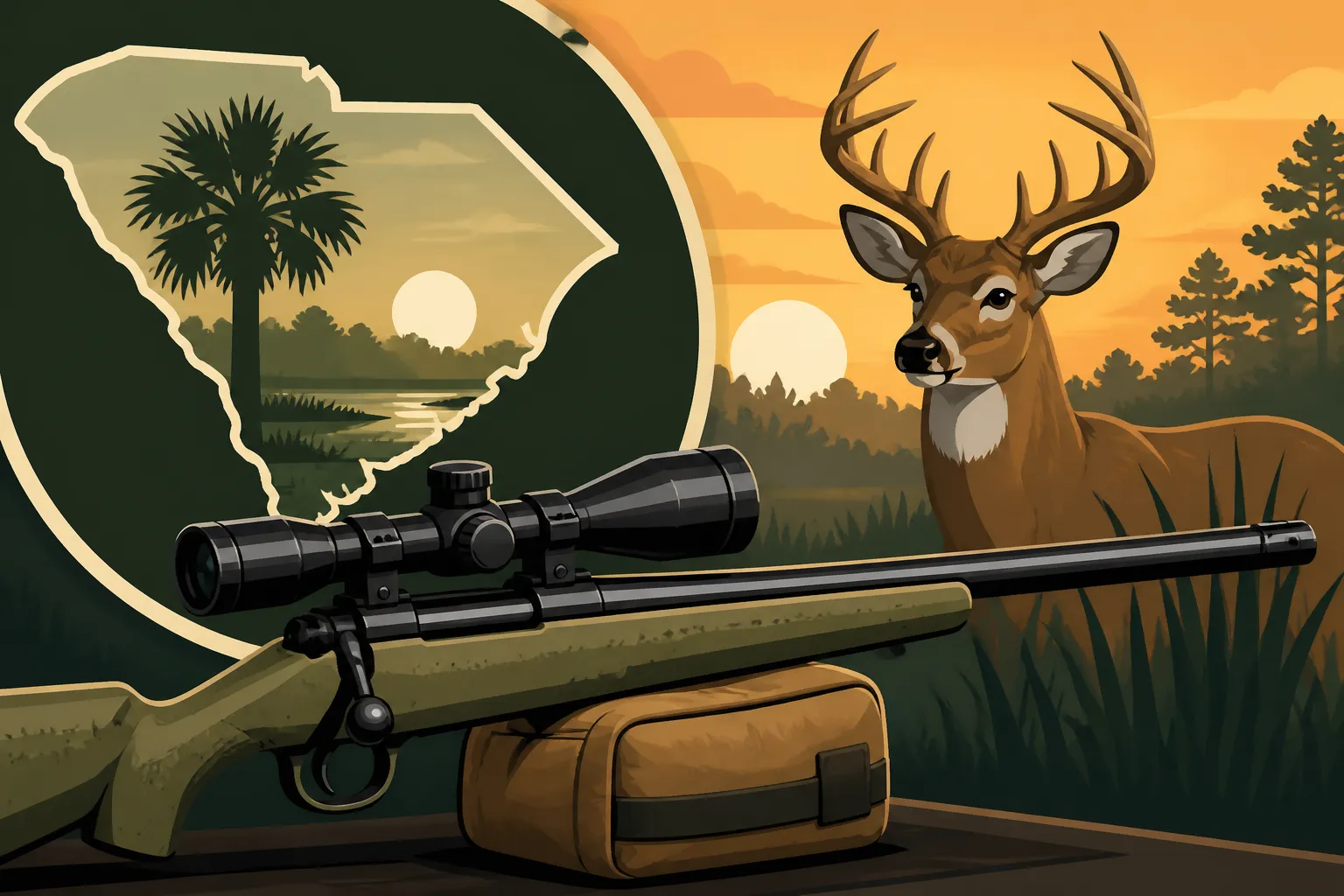
Rifle Setups for South Carolina Deer Hunting
Many hunters in South Carolina find themselves scratching their heads when it comes to picking the "perfect" rifle setup, often feeling overwhelmed by the sheer variety of options and the unique demands of our state's incredibly diverse hunting grounds. From the thick, tangled swamps of the Lowcountry to the rocky, open ridges of the Upstate, one-size-fits-all rarely works, leading to frustrating shots and less-than-ideal experiences. This comprehensive guide aims to demystify the process, helping you navigate the world of rifle calibers, actions, and optics so you can confidently choose a setup that's truly optimized for your South Carolina deer hunting adventures.
Understanding South Carolina's Diverse Deer Hunting Landscape
South Carolina isn't just one type of deer hunting. Our state boasts an incredible variety of habitats, each presenting its own set of challenges and opportunities for rifle hunters. What works beautifully in a vast agricultural field near Santee might be a hindrance in the dense pine thickets of Francis Marion National Forest. Understanding these differences is the first crucial step in building your ideal rifle setup.
The Lowcountry Swamps and Thick Pines
Down here in the coastal plain, especially areas like the ACE Basin or the Wambaw Swamp, the terrain is often flat, wet, and incredibly thick. You're talking about dense palmetto stands, tangled briars, and cypress knees everywhere you look. Visibility is often limited to 50 yards, sometimes even less. Deer often explode from cover at close range, giving you only a split second for a shot. The challenges here are obvious: you need a rifle that's quick to shoulder, handles well in tight quarters, and can put a deer down reliably with a relatively short-range shot. Accuracy at 200 yards is far less critical than reliable performance at 50. Hunting a Funnel Between Two Swamps often means you're tucked in close to heavy cover.
Imagine you're still-hunting slowly through a pine plantation with rows so thick you can barely see ten yards ahead. Suddenly, a mature Lowcountry buck busts out 30 yards to your left, quartering away through the brush. You need to snap the rifle up, acquire the target, and make a clean shot before he vanishes again. A long, heavy magnum rifle with high magnification probably isn't your friend in this scenario. You want something nimble, with a clear sight picture that's forgiving of quick target acquisition. The sound of your rifle clanking against a cypress knee or a low-hanging limb will send deer scattering long before you ever get a shot.
Upstate Mountains and Rolling Foothills
Contrast that with the Upstate, particularly the Andrew Pickens Ranger District of Sumter National Forest. Here, you're dealing with elevation changes, more open hardwoods, and longer potential sightlines, especially when hunting ridges or clear-cuts. While you might still encounter thick pockets, the general terrain allows for shots that could stretch out to 150-200 yards, or occasionally even further if you're overlooking a valley or a large powerline cut. The weather can also be a bit more unpredictable, with colder temperatures and sometimes even a dusting of snow in the higher elevations. Reading a Ridge for Upstate Deer means considering longer shot opportunities.
Consider a crisp November morning in the mountains. You've hiked in, set up on a high point overlooking a saddle, and are patiently watching a logging road. A nice six-point buck steps out at 175 yards, browsing casually. This isn't a snap shot. You have time to brace, settle your crosshairs, and make a precise shot. Here, a rifle capable of consistent accuracy at those medium ranges, perhaps with a bit more reach, becomes a distinct advantage. The rifle's weight also becomes a factor if you're doing a lot of hiking up and down those hills. You don't want to be lugging a benchrest rifle all day long.
Midlands Farmland and Mixed Forests
The Midlands offers a blend of both worlds, and sometimes unique challenges. You'll find expansive agricultural fields – corn, soybeans, cotton – bordered by mature hardwoods, pine forests, and creek bottoms. Deer here often transition between bedding in thick cover and feeding in fields. This means you might be looking at shots across an open field at last light, possibly 200-250 yards, but also needing to make a 75-yard shot through the timber along a creek. Hunting a Green Field Planted for Deer can mean long shots, while Hunting a Funnel Between Two Swamps will mean short ones.
Imagine you've gained permission on a farm near Orangeburg. You're tucked into a brush blind at the edge of a standing cornfield. Deer are filtering out into the field at dusk, some at 100 yards, others maybe 225. Your rifle needs to be versatile enough to handle both the close-in timber shots and the longer stretches across the open. The ability to quickly adjust your scope's magnification, or simply trust a versatile fixed power, becomes important. This mixed bag demands a rifle that's a true all-rounder, capable of consistent performance across a variety of typical hunting scenarios.
Key Considerations for Rifle Caliber Selection
Choosing the right caliber for deer hunting in South Carolina is a decision that weighs heavily on every hunter. It's not just about what's legal, but what provides confidence, ethical performance, and a comfortable shooting experience. There are so many options out there that it can feel like a labyrinth, but breaking it down into a few core considerations can simplify things immensely.
Ethical Killing Power and Deer Size
At the heart of caliber selection is the commitment to an ethical, humane harvest. This means choosing a cartridge that delivers sufficient energy and bullet construction to reliably dispatch a deer with a well-placed shot. South Carolina whitetails, while not typically enormous, are still robust animals that deserve our respect and a swift end. We're generally talking about deer weighing anywhere from 100 to 200 pounds, with some Lowcountry bucks pushing heavier. A bullet needs to penetrate vital organs and create enough tissue damage to cause rapid incapacitation.
The general consensus among seasoned hunters is that a centerfire rifle cartridge delivering at least 1,000 foot-pounds of energy at the point of impact is a good baseline for whitetail deer. More importantly, the bullet itself needs to be designed for deer-sized game, meaning it expands reliably without fragmenting too quickly or failing to penetrate deeply enough. You want a bullet that can punch through bone if necessary and reach the vitals. While tiny, high-velocity rounds can kill deer, they leave a very small margin for error, and we owe it to the animal to maximize our chances of a clean kill. Don't cheap out on bullet construction; a premium bullet in a modest caliber often outperforms a cheap bullet in a magnum.
Recoil Tolerance and Shooter Comfort
This is a huge one, and often overlooked. A rifle that's too powerful for a hunter to shoot comfortably and accurately is less effective than a milder recoiling rifle that the hunter can consistently place shots with. Flinching in anticipation of recoil is a real phenomenon that plagues many shooters, leading to poor shot placement, which negates any theoretical advantage of a more powerful cartridge. It's far better to hit what you're aiming at with a .270 than to miss or wound with a .300 Win Mag because you're scared of the kick.
Think about how often you'll practice with your chosen setup. If a heavy-recoiling rifle leaves your shoulder bruised and your wallet empty after a few boxes of ammo, you're less likely to put in the necessary range time to become proficient. A rifle you enjoy shooting, one that doesn't make you dread pulling the trigger, will be a rifle you practice with more often. More practice equals better accuracy, and better accuracy is the single most important factor in ethical hunting. Many modern calibers offer excellent ballistic performance with manageable recoil, making them fantastic choices for the average South Carolina hunter. Even something like a 6.5 Creedmoor provides more than enough punch without punishing your shoulder.
Ammunition Availability and Cost
In a perfect world, we'd all have access to unlimited, affordable ammunition for whatever niche caliber we chose. The reality, especially in recent years, is that commonality matters. When you choose a widely available caliber, you're far more likely to find ammunition on the shelves of your local sporting goods store or even a rural gas station on the way to your hunting lease. This isn't just about convenience; it's about being able to replace spent rounds, try different bullet types, and have confidence that you won't be scrambling for ammo just before opening day.
Moreover, the cost of ammunition can add up, especially if you're dedicated to regular practice. While some premium hunting rounds can be pricey across the board, common calibers generally offer a wider range of options, including more affordable target practice loads. This allows you to practice more economically, saving your specialized hunting ammunition for when it truly counts. Planning for a successful season also involves budgeting for practice, and a caliber that is both available and affordable for practice will mean you're more prepared when that big buck finally steps out.
Popular Rifle Calibers for South Carolina Deer
South Carolina's diverse deer hunting scenarios mean that a variety of calibers can be effective, each with its own strengths. From the old standbys to modern favorites, understanding what makes each cartridge shine can help you dial in your personal preference.
The Versatile .270 and .308
These two calibers are arguably the workhorses of deer hunting across North America, and for very good reason. They are incredibly versatile, offering an excellent balance of power, range, and manageable recoil that suits a vast majority of South Carolina's hunting situations.
The .270 Winchester is a flat-shooting cartridge known for its ability to reach out and touch deer at longer ranges while still delivering ample energy. It's a great choice if you anticipate shots across open fields in the Midlands or longer stretches on Upstate ridges. With a 130 to 150-grain bullet, it's more than capable of cleanly harvesting any South Carolina whitetail. Recoil is moderate, making it comfortable for most shooters, and ammunition is widely available. If you're looking for a single rifle that can handle anything from a 50-yard jump shot in pine thickets to a 200-yard field edge shot, the .270 is a strong contender. It's a true "set it and forget it" caliber that inspires confidence.
The .308 Winchester might be even more versatile, if such a thing is possible. It's a compact, efficient cartridge that is incredibly accurate and known for its terminal performance on deer. While it doesn't shoot quite as flat as the .270, its trajectory is still more than adequate for typical South Carolina ranges. The .308 shines with a wider range of bullet weights, from 150 to 180 grains, giving hunters more flexibility. Its shorter case length allows for shorter action rifles, which can be lighter and handier in thick cover. Recoil is similar to the .270, making it very comfortable to shoot, and ammunition is ubiquitous. If you spend a lot of time still-hunting through diverse terrain, where a quick, precise shot is paramount, the .308 is a superb choice. It's a favorite for good reason and a strong option for Rifle Setups for South Carolina Deer Hunting.
Close-Quarters Classics: .30-30 and .45-70
When you talk about hunting in the deep woods, the thick stuff where shots are almost always under 100 yards, these two calibers immediately come to mind. They are classics for a reason, built for quick, decisive action in dense cover.
The .30-30 Winchester is the quintessential lever-action deer cartridge. It might not be the flattest shooter, but its moderate velocity and typically heavy, blunt-nosed bullets perform exceptionally well at close range. In the tangled briars and cypress swamps of the Lowcountry, where a deer might appear and disappear in seconds, the .30-30's quick handling, light recoil, and proven stopping power within 100 yards are invaluable. The iconic lever-action rifles chambered in .30-30 are incredibly fast for follow-up shots and point naturally. Many generations of South Carolina hunters have filled their freezers with this cartridge, and it remains a fantastic choice for areas where sightlines are severely limited. For something like Hunting Lowcountry Swamp Deer, a .30-30 in a lever gun is tough to beat.
The .45-70 Government is a powerful big-bore cartridge that, while perhaps overkill for average South Carolina whitetails, excels in brush-busting performance and delivering immense energy at close range. It's often chosen by hunters who want maximum impact within 100-125 yards, especially when dealing with very thick cover or the potential for feral hogs as well. The heavy, large-diameter bullets shed energy quickly, so it's not a long-range round, but within its effective envelope, it's devastating. Recoil can be stout depending on the load, but for those who can handle it, the .45-70 offers incredible stopping power. It’s a very specialized choice, but one that has a passionate following for close-range, heavy cover hunting, particularly when you want to ensure whatever you hit stays put.
Modern Mid-Range Performers: 6.5 Creedmoor and 7mm-08
These two cartridges represent a more modern approach to deer hunting, emphasizing efficiency, accuracy, and reduced recoil without sacrificing terminal performance. They've gained immense popularity and are excellent options for South Carolina's varied terrain.
The 6.5 Creedmoor has taken the hunting world by storm, and for good reason. It's exceptionally accurate, shoots very flat, and offers surprisingly little recoil for its ballistic capabilities. It excels at delivering high ballistic coefficient bullets, which resist wind drift and retain energy well downrange. While some argue it's "too small" for deer, a well-constructed 120-140 grain bullet from a 6.5 Creedmoor provides more than enough energy and penetration for South Carolina whitetails out to typical hunting distances and beyond. It's an excellent choice for open areas in the Midlands, longer shots on Upstate ridges, or anywhere precise shot placement is valued. Hunters who appreciate precision and a comfortable shooting experience will love the 6.5 Creedmoor. When considering Rifle Setups for South Carolina Deer Hunting, the 6.5 Creedmoor is a strong modern contender.
The 7mm-08 Remington is a fantastic, often underrated, cartridge that offers ballistic performance very similar to the .270 Winchester but in a shorter, more efficient package. It uses .284 caliber bullets, which have excellent sectional density and can be quite aerodynamic. Like the 6.5 Creedmoor, it offers mild recoil, superb accuracy, and plenty of power for whitetails. It can handle a wider range of bullet weights than the 6.5, typically from 120 to 160 grains, giving it a bit more versatility for different game sizes or applications. It’s another excellent all-rounder, performing admirably in thick timber as well as across open fields. For hunters looking for a very efficient, accurate, and comfortable-shooting cartridge that truly delivers, the 7mm-08 is an outstanding option.
Larger Calibers for Special Situations: .30-06 and .300 Win Mag
While often not strictly necessary for South Carolina whitetails, these larger calibers certainly have their place, especially for hunters who also pursue larger game out of state, or simply prefer more power.
The .30-06 Springfield is another all-time classic, often considered the benchmark for North American hunting cartridges. It’s incredibly versatile, capable of handling bullet weights from 150 to 220 grains, making it suitable for anything from deer to elk and bear. For South Carolina whitetails, it offers abundant power and can reach out to longer distances than most hunters will ever need. Recoil is more substantial than a .270 or .308 but still manageable for most experienced shooters. If you only want one rifle for all your hunting needs, both in-state and out, the .30-06 is a very strong contender. Its broad power makes it a good option if you’re also targeting hogs, where a bit more punch can be appreciated.
The .300 Winchester Magnum is where you step into serious magnum territory. This cartridge delivers impressive velocity and energy, making it excellent for very long-range hunting or for significantly larger game like moose or elk. For South Carolina deer, it is undeniably overkill for most situations, but some hunters simply prefer the added authority. It’s important to note that with this power comes significant recoil, which can be challenging for some shooters to manage accurately. If you plan to only hunt deer in South Carolina, the .300 Win Mag is probably more than you need, and the recoil can hinder consistent accuracy. However, if you are a confident shooter and use the same rifle for cross-country elk hunts, it will certainly get the job done on a South Carolina whitetail. Always ensure your shot placement is precise regardless of caliber; power is no substitute for accuracy.
Rifle Action Types and Their Suitability
Beyond caliber, the type of action a rifle employs significantly impacts its feel, operation, and suitability for different hunting styles. Each action type has its own set of advantages and characteristics that make it excel in certain situations.
Bolt-Action Rifles: Accuracy and Reliability
Bolt-action rifles are, hands down, the most popular choice for deer hunters globally, and for very good reason. They are renowned for their exceptional accuracy, rugged reliability, and mechanical simplicity. The solid lock-up of the bolt provides a stable platform for consistent shot placement, which is paramount for ethical hunting. For hunters who prioritize precision above all else, especially when Hunting a Green Field Planted for Deer or needing to make a precise shot at a greater distance, a bolt-action is often the go-to.
Modern bolt-actions come in countless configurations, from lightweight mountain rifles to heavy-barreled precision models. They typically offer a smoother, more deliberate firing cycle, allowing the shooter to maintain focus after the shot for observation or follow-up. While not as fast for multiple shots as a semi-auto or lever-action, a skilled hunter can cycle a bolt quickly and smoothly for subsequent shots if needed. Their inherent accuracy potential makes them easy to zero and shoot consistently, which builds confidence in the field. Many bolt-actions also come with detachable magazines or hinged floorplates, making loading and unloading safe and convenient. Whether you’re climbing an Upstate ridge or sitting in a blind overlooking a Lowcountry field, a reliable bolt-action rifle will serve you well.
Lever-Action Rifles: Fast Handling in Tight Spaces
The lever-action rifle is iconic, deeply intertwined with American hunting heritage, and still incredibly relevant for certain South Carolina hunting scenarios. These rifles are distinguished by their rapid, smooth cycling via a lever integrated into the trigger guard, allowing for quick follow-up shots without having to break your cheek weld. This characteristic makes them incredibly fast-handling, especially in the thick, brushy environments where deer can appear and disappear in a blink.
Think about still-hunting in dense swamp thickets or maneuvering through tight timber in the mountains. A lever-action rifle, often shorter and lighter than many bolt-actions, comes to the shoulder quickly and naturally. It’s less prone to snagging on branches and allows for swift target acquisition in close quarters. The traditional tube magazines of many lever-actions limit them to blunt-nosed or round-nosed bullets (to prevent primer detonation in the tube), which perfectly suits their role as close-range brush guns. However, modern designs like the Marlin 336 or some Henry Repeating Arms models, especially those chambered in .30-30 or .45-70, can be surprisingly accurate for their intended range. For hunters who value quick, instinctive shooting in tight cover, and who appreciate a classic, handsome firearm, a lever-action rifle is an excellent, time-tested choice. Hunting Lowcountry Swamp Deer often means a lever gun is perfectly suited.
Semi-Automatic Rifles: Rapid Fire for Hog Control (and Deer)
Semi-automatic rifles, particularly those based on the AR platform, have seen a significant increase in popularity among hunters, including those pursuing deer in South Carolina. Their primary advantage lies in their ability to fire multiple shots rapidly with each pull of the trigger, without requiring manual cycling of the action. While most deer hunting situations only require one well-placed shot, the capacity for quick follow-ups can be appealing for some, especially when dealing with multiple targets or running game (where legal and ethical to engage).
For South Carolina, where feral hogs are a pervasive problem and can be hunted year-round with liberal regulations, semi-automatic rifles chambered in calibers like .223/5.56, .300 Blackout, or .308 Winchester are incredibly effective. Their quick-firing capability can be a real asset when a sounder of hogs bursts from cover. When it comes to deer, the same platforms offer familiar ergonomics and, when chambered in appropriate calibers, provide more than enough power for whitetails. However, hunters must be mindful of magazine capacity laws (which vary) and the perception of using "military-style" firearms for deer hunting. Ethical considerations dictate that rapid fire should never replace careful, well-aimed shots. If you are comfortable with the platform and it fits your hunting style, especially if you combine deer hunting with serious hog control efforts, a semi-automatic rifle can be a powerful and effective tool. Just remember, responsible hunting means precision over volume.
Single-Shot Rifles: Simplicity and Challenge
Single-shot rifles represent the pinnacle of simplicity and often appeal to hunters who relish the challenge of making that first shot count. With no magazine to worry about, these rifles typically feature a very clean, robust action that can be incredibly accurate. Many primitive weapons seasons, like those in South Carolina, allow for specific types of single-shot firearms, including muzzleloaders and often modern single-shot break-action rifles.
For the hunter who wants to truly focus on the fundamentals – stalking, shot placement, and self-discipline – a single-shot rifle offers a unique and rewarding experience. They are often lighter and more compact than their repeating counterparts, making them easy to carry on long treks through the woods. While the lack of follow-up shots means you absolutely must make your first one count, it also encourages a level of patience and precision that can make you a better hunter overall. Many manufacturers like CVA, Traditions, and Thompson/Center offer excellent single-shot options that are both accurate and affordable. If you're looking to embrace the challenge and pure hunting experience, or want a dedicated primitive season rifle, a single-shot can be a remarkably effective and satisfying choice for South Carolina Primitive Weapons Tactics.
Optics: Pairing the Right Scope with Your Rifle
The rifle is only half the equation; the optic you mount on top is just as critical, if not more so, for accurate shot placement. Choosing the right scope for South Carolina's varied conditions involves considering magnification, low-light performance, and reticle design.
Magnification Ranges for South Carolina Terrain
The ideal magnification for your rifle scope largely depends on the typical ranges you expect to encounter. South Carolina's diverse terrain means that a single fixed magnification might not be optimal for everyone, leading many hunters to choose variable power scopes.
For the dense Lowcountry swamps and thick pine plantations, where shots are almost always under 75 yards, a low-magnification scope is king. Something in the 1-4x, 1.5-5x, or 2-7x range is perfect. At the lowest setting, these scopes offer a wide field of view, making it easy to pick up a fast-moving deer in heavy cover. A 1x or 2x setting is almost like a red dot, allowing for quick target acquisition. You rarely need more than 4x or 5x for a shot at 75 yards, and higher magnification would only narrow your field of view and make it harder to find your target quickly.
As you move into the Midlands or Upstate, where shots can stretch to 150-250 yards across fields or down logging roads, a slightly higher top-end magnification becomes more useful. A 3-9×40 or 3-10×40 scope is often considered the classic "all-around" deer hunting magnification. At 3x, you still have a decent field of view for closer shots, but you can dial it up to 9x or 10x for more precise aiming on those longer shots. This range is incredibly versatile and handles most South Carolina hunting scenarios beautifully.
For hunters primarily focused on long-range shooting in truly open areas (which are less common in South Carolina but do exist), or those who simply prefer more precision, scopes with a higher top end (e.g., 4-12x or 4.5-14x) might be considered. However, remember that higher magnification often comes with a narrower field of view, increased weight, and sometimes a higher price tag. Always balance the need for magnification with practical field use.
Low-Light Performance and Objective Lens Size
South Carolina deer, like deer everywhere, are most active during dawn and dusk – those magical, often dim, moments when legal shooting light begins and ends. Having a scope that performs well in low light conditions can be the difference between making an ethical shot and having to pass.
The objective lens, the front lens of the scope, plays a significant role here. A larger objective lens (e.g., 40mm, 44mm, or 50mm) gathers more light, which translates to a brighter image in dim conditions. However, a larger objective also means a larger, heavier scope that sits higher on the rifle. For typical South Carolina deer hunting, a 40mm or 44mm objective is usually a fantastic balance of light-gathering capability and reasonable size/weight. Unless you're primarily shooting in extremely low light or at very long distances, a 50mm or larger objective might be overkill and add unnecessary bulk.
Equally important is the quality of the glass and the coatings applied to the lenses. High-quality, multi-coated lenses from reputable manufacturers will transmit more light and provide a clearer, crisper image, even with a smaller objective, than cheap glass with poor coatings. It's often better to invest in a scope with excellent glass and a 40mm objective than a cheap scope with a 50mm objective. In those fleeting minutes of twilight, clarity and brightness can make all the difference, helping you identify your target clearly and ensure there are no obstructions in the shot path. Consider reputable brands like Vortex, Leupold, or even GoHunt's recommended optics partners for solid performance.
Reticle Choices and Their Advantages
The reticle is the aiming point inside your scope, and there's a surprising variety beyond the classic crosshairs. The right reticle can enhance your accuracy and speed, especially in specific hunting situations.
The most common and still highly effective is the Duplex reticle (or its variations, like the standard Leupold Duplex or Weaver Dual-X). It features thicker lines that taper to fine crosshairs in the center. The thicker outer portions guide your eye quickly to the center, while the fine crosshairs allow for precise aiming. This is an excellent all-around choice for deer hunting in South Carolina, performing well in both open and thick cover. The bold posts can even be used as a quick aiming point in extremely low light when the finer crosshairs might fade.
For hunters who anticipate longer shots or want to account for bullet drop without manually adjusting their turrets, BDC (Bullet Drop Compensating) reticles are popular. These reticles have multiple aiming points below the main crosshair, calibrated for specific distances (e.g., 200, 300, 400 yards). While convenient, they require knowing your bullet's trajectory and typically need to be "zeroed" for a specific load at a specific distance (often 100 or 200 yards). They can be very effective for open field hunting, but in thick woods, the extra clutter in the reticle can sometimes be distracting.
Illuminated reticles are fantastic for hunting in very low light or against dark backgrounds (like a deer's dark hide in deep timber). A small, illuminated red or green dot in the center of the crosshairs provides a clear, bright aiming point without obscuring the target. This is especially useful in those critical minutes at dawn and dusk. Many illuminated reticles offer adjustable brightness settings, so you can fine-tune them to the ambient light without creating a distracting glare. For South Carolina hunters who often find themselves in challenging low-light conditions, an illuminated reticle is a worthwhile upgrade. Always remember to turn it off after the hunt to preserve battery life!
Essential Accessories and Setup Tips
Getting your rifle and scope dialed in is crucial, but a few key accessories and setup practices can significantly enhance your hunting experience in South Carolina, making you more comfortable, accurate, and prepared.
Slings and Carrying Solutions
A good sling isn't just a convenience; it's a necessity for hunting in South Carolina, especially on public land where you might be walking considerable distances to get to your spot. A comfortable, well-adjusted sling frees up your hands for climbing, carrying other gear, or navigating challenging terrain.
Look for a sling that's wide and padded, especially if your rifle is on the heavier side. Neoprene slings offer a bit of stretch and grip, which can be nice for keeping the rifle secure on your shoulder. You want a sling that allows the rifle to ride comfortably and securely, without constantly slipping off your shoulder. Adjustable length is also key; you should be able to cinch it up for walking through thick brush and loosen it quickly for a shot. Some slings even feature thumb loops or quick-detach swivels for rapid deployment. Don't underestimate the fatigue a poorly slung rifle can cause over a long day of still-hunting the Sumter Forest Ridges. Investing in a quality sling from brands like Vero Vellini, Butler Creek, or Outdoor Connection will pay dividends in comfort and readiness.
Bipods and Shooting Sticks
While many shots in South Carolina might be taken off-hand or braced against a tree, having a stable shooting platform can dramatically improve your accuracy, particularly for longer shots or when a precise shot is needed.
Shooting sticks are incredibly versatile for South Carolina hunting. Whether you're standing in a field edge, kneeling in a pine thicket, or sitting on a folding stool, shooting sticks offer an instant, stable rest. They are lightweight, portable, and can be adjusted for various heights and terrains. Bipod-style or tripod-style sticks are available, with tripods generally offering the most stability. For hunting in the Midlands, where you might be Hunting a Standing Cornfield in Farm Country and need to shoot over the stalks, or if you're overlooking a powerline cut in the Upstate, shooting sticks can be a game-changer. They help mitigate natural body sway and fatigue, allowing you to hold steadier for longer, which is vital for making ethical shots.
Bipods that attach directly to your rifle's forend are excellent for prone shooting or when shooting from a fixed blind or treestand setup where you have a flat surface. They offer rock-solid stability. However, they can be cumbersome for walking through thick brush, and they don't always provide enough height for shots over tall grass or uneven terrain when standing. If your hunting involves primarily sitting in a shooting house or laying prone in an open field, a bipod can be very effective. Many hunters opt for detachable bipods (like those from Harris or Magpul) that can be quickly removed when not needed. For Hunting a Green Field Planted for Deer, where you might be shooting from a ground blind, a bipod can be an invaluable asset.
Cleaning and Maintenance for Humid Climates
South Carolina's humidity is no joke. It's a constant battle against rust, mildew, and general wear and tear on your hunting gear. Proper cleaning and maintenance are essential to ensure your rifle functions flawlessly when that moment of truth arrives.
After every hunt, especially if it was wet or damp, wipe down your rifle with a lightly oiled cloth. Pay close attention to metal surfaces, and don't forget the inside of the barrel. Use a good quality gun oil or rust preventative. Even if you're not shooting, humidity can cause issues, so regular cleaning is key. For optics, gently wipe lenses with a microfiber cloth designed for optics, and use a lens pen or cleaning solution only when necessary. Avoid harsh chemicals or paper towels that can scratch coatings. Keeping your scope caps on when not actively hunting will protect the lenses from dust, dirt, and moisture. Consider storing your rifle in a dehumidified gun safe or a moisture-absorbing gun sock. Brands like Hornady and Remington offer excellent cleaning kits and rust preventative products. This diligent care will extend the life of your rifle and ensure its reliability year after year, even in our famously damp Southern climate. A well-maintained rifle is a safe and effective rifle.
Hunting Methods and How They Influence Gear Choices
The way you choose to hunt for deer in South Carolina should have a significant impact on your rifle setup. What’s perfect for a sedentary stand hunt might be a nightmare for a high-mobility still-hunt.
Still-Hunting and Stalking
Still-hunting involves moving slowly and deliberately through the woods, stopping frequently to look and listen, essentially hunting the deer on their own terms. Stalking is a more focused, often quieter approach to close the distance on an animal you've already spotted. Both methods demand a high degree of mobility, quiet operation, and quick readiness from your rifle setup.
For these active hunting styles, lightweight and compact rifles are highly advantageous. Every pound makes a difference when you’re covering miles of varied terrain, especially in the Upstate mountains or the thick tangles of a Lowcountry swamp. A shorter barrel (e.g., 20-22 inches) is less likely to snag on branches and is quicker to bring to bear for a snap shot. Consider rifles with synthetic stocks, which are lighter and impervious to moisture, unlike traditional wood stocks that can swell or warp. A quality sling, as mentioned earlier, is absolutely essential. Your scope should be of moderate magnification (e.g., 2-7x or 3-9x), offering a wide field of view on the low end for quick target acquisition. For hunters engaging in Still-Hunting Sumter Forest Ridges or easing through a pine thicket, a nimble rifle in a versatile caliber like .308 Win, 7mm-08, or even a .30-30 lever-action can be incredibly effective. Every movement needs to be deliberate and quiet, and a bulky, heavy rifle can make that challenging.
Stand Hunting (Treestands and Ground Blinds)
Stand hunting, whether from a treestand or a ground blind, is a more static approach. You pick a strategic location overlooking a food source, bedding area, or travel corridor, and wait for deer to come to you. This method allows for a different set of rifle characteristics to be prioritized.
For treestand hunting, stability is key. You'll be shooting from an elevated, often confined position. A rifle that's not overly long or cumbersome is appreciated, but weight becomes less of a factor once you’re in the stand. A good bipod or shooting rest can be very helpful if your stand setup allows for it. Accuracy at moderate ranges is paramount, so a reliable bolt-action in a caliber like .270 or 6.5 Creedmoor with a 3-9x or 4-12x scope is ideal. Treestand Setups in Francis Marion National Forest demand quiet setup and reliable performance. Consider rifles that have external safety mechanisms that are easy to operate quietly.
When hunting from a ground blind, you often have the luxury of more space and a stable rest (like a blind window sill or shooting sticks). Here, you can afford a slightly heavier, longer rifle if it enhances accuracy, especially if you anticipate longer shots across a field. A scope with a wider magnification range might be beneficial, allowing you to scan broader areas at lower power and then zoom in for a precise shot. Brushing In a Blind on a Field Edge for a rifle hunt offers excellent concealment. Remember that you might be sitting for hours, so a setup that minimizes movement for a shot is beneficial. Both treestand and ground blind hunting emphasize precise, deliberate shot placement, making accuracy the paramount concern.
Deer Drives and Group Hunting
Deer drives, while less common on public land, are a popular hunting method on many private land tracts in South Carolina, especially in the Lowcountry. This involves a group of "drivers" moving through thick cover to push deer towards "standers" positioned along escape routes. This method demands very specific rifle characteristics, particularly for the standers.
For standers on a deer drive, quick target acquisition and the ability to make fast, decisive shots are crucial. Deer will often be moving quickly, sometimes at a dead run. A rifle that is quick to shoulder, points instinctively, and allows for rapid follow-up shots (where legal and safe) is highly desirable. Lever-action rifles in .30-30 or even semi-automatic rifles in .308 are popular choices for their handling characteristics. Low-power scopes (1-4x or 1.5-5x) or even red dot sights are excellent for fast-moving targets at close to moderate ranges, providing a wide field of view. Safety is paramount on a drive; always know your shooting lanes and what lies beyond your target.
A deer drive, particularly a Deer Drives With Three or Four Hunters, means you need to be constantly aware of your surroundings and your fellow hunters. The rifle setup here is less about precision at extreme distances and more about reliable, quick performance within closer ranges. Some hunters also prefer heavier calibers in these scenarios, believing they are more likely to anchor a running deer. However, ethical considerations remain paramount; only take shots you are confident in, regardless of the speed of the game or the caliber of your rifle.
Legal Requirements and Safety
Before you ever head into the South Carolina woods with your rifle, it’s absolutely critical to understand the legal requirements and, even more importantly, to practice safe firearm handling at all times. Ignorance of the law is no excuse, and complacency with safety can have tragic consequences.
South Carolina's Legal Firearm Regulations
South Carolina has specific regulations regarding legal firearms for deer hunting, and it’s your responsibility to know and follow them. While our laws are generally quite hunter-friendly compared to some other states, there are still important details.
For deer, you must use a centerfire rifle. Rimfire rifles (like a .22LR) are not legal for deer. There aren't specific minimum caliber requirements for centerfire rifles for deer hunting, which means many popular calibers are perfectly fine. However, common sense and ethical hunting dictate choosing a cartridge sufficient for the job, as discussed earlier. South Carolina Legal Firearms for Deer Hunting covers the specifics, but generally, anything from a .243 Winchester up to a .300 Win Mag is fair game. Handguns are also permitted, provided they are centerfire and meet ethical power standards. Semi-automatic rifles are legal for deer hunting on private land, but hunters must be aware of any WMA-specific rules that might restrict their use or magazine capacity on public lands. Always check the current South Carolina Department of Natural Resources (SCDNR) regulations booklet or their Go Outdoors SC app before each season, as rules can occasionally change. Being informed ensures you're hunting legally and ethically.
Blaze Orange Requirements
Visibility is a non-negotiable aspect of hunting safety, especially when rifle hunting. South Carolina mandates that hunters wear a certain amount of blaze orange (or blaze pink) clothing during certain hunting seasons to be easily seen by other hunters. This requirement is in place to prevent accidental shootings, particularly during deer season when many hunters are in the woods.
Generally, during deer hunts with firearms on private land, you must wear an outer garment above the waist with at least 500 square inches of solid visible blaze orange or camouflage that includes at least 500 square inches of blaze orange. This includes hats, which must also be solid blaze orange. On public lands (Wildlife Management Areas), the requirements can sometimes be even more stringent, often demanding more continuous coverage of blaze orange. The specific rules for South Carolina Blaze Orange Requirements are clearly laid out by SCDNR. It's crucial to understand these rules and adhere to them without exception. This isn't just about avoiding a ticket; it's about coming home safe and ensuring the safety of everyone else in the woods. Even if you're hunting alone, it's a good practice to wear blaze orange as other hunters might be nearby, or someone might be hiking, cycling, or working in the area.
Safe Handling and Storage
This is the bedrock of responsible firearm ownership and hunting. No matter what rifle setup you choose, its safe handling and storage are paramount. The four fundamental rules of firearm safety should be memorized and practiced without fail:
- Treat every firearm as if it were loaded. This mindset prevents accidental discharges.
- Always point the muzzle in a safe direction. A "safe direction" is one where an unintended discharge would cause no injury or damage.
- Keep your finger off the trigger until your sights are on the target and you're ready to shoot. This prevents negligent discharges due to surprise or startling.
- Be sure of your target and what is beyond it. Never shoot at sounds or movement. Positively identify your game, and ensure your bullet won't harm anything or anyone downrange.
Beyond these rules, always ensure your rifle is unloaded when transporting it, especially in a vehicle. Use a lock or secure storage when the rifle is not in direct use, preventing unauthorized access by children or others. When hunting, clear your chamber before crossing obstacles, climbing into a stand, or walking back to your vehicle. Double-check your setup, use your safety, and communicate clearly with any hunting partners. Never assume anything about the status of a firearm. These practices, ingrained through repetition, are the best defense against accidents and ensure that your hunting experience is not only successful but also safe.
Disclaimer
This article is for general informational purposes only and does not constitute professional advice. Laws, prices and regulations vary by location and change over time. Consult a qualified professional for guidance on your specific situation.