Two-Way Radios on a Deer Drive
There's nothing quite like the adrenaline rush of a deer drive, especially when you're pushing thick South Carolina cover, but that excitement can quickly turn to frustration or even danger if your team isn't on the same page. Whether you're navigating dense Lowcountry swamps or the rolling ridges of the Upstate, trying to yell directions or coordinate movements across a large area is a recipe for chaos. This guide is all about cutting through that confusion, showing you how two-way radios can transform your deer drives into safer, more efficient, and ultimately, more successful operations, allowing you to focus on the hunt, not the hollering.
The Indispensable Role of Two-Way Radios in South Carolina Deer Drives
Deer drives are a classic hunting tactic, especially in areas with thick cover where deer like to bed down. In South Carolina, with our vast expanses of pine plantations, dense bottomland hardwoods, and cypress swamps, these drives can be incredibly effective. However, the very terrain that makes these drives productive also creates significant communication challenges. Without a reliable way to talk to your fellow hunters, you're essentially relying on guesswork and hand signals, which can be dangerous and inefficient.
Why Communication is Key in Thick South Carolina Cover
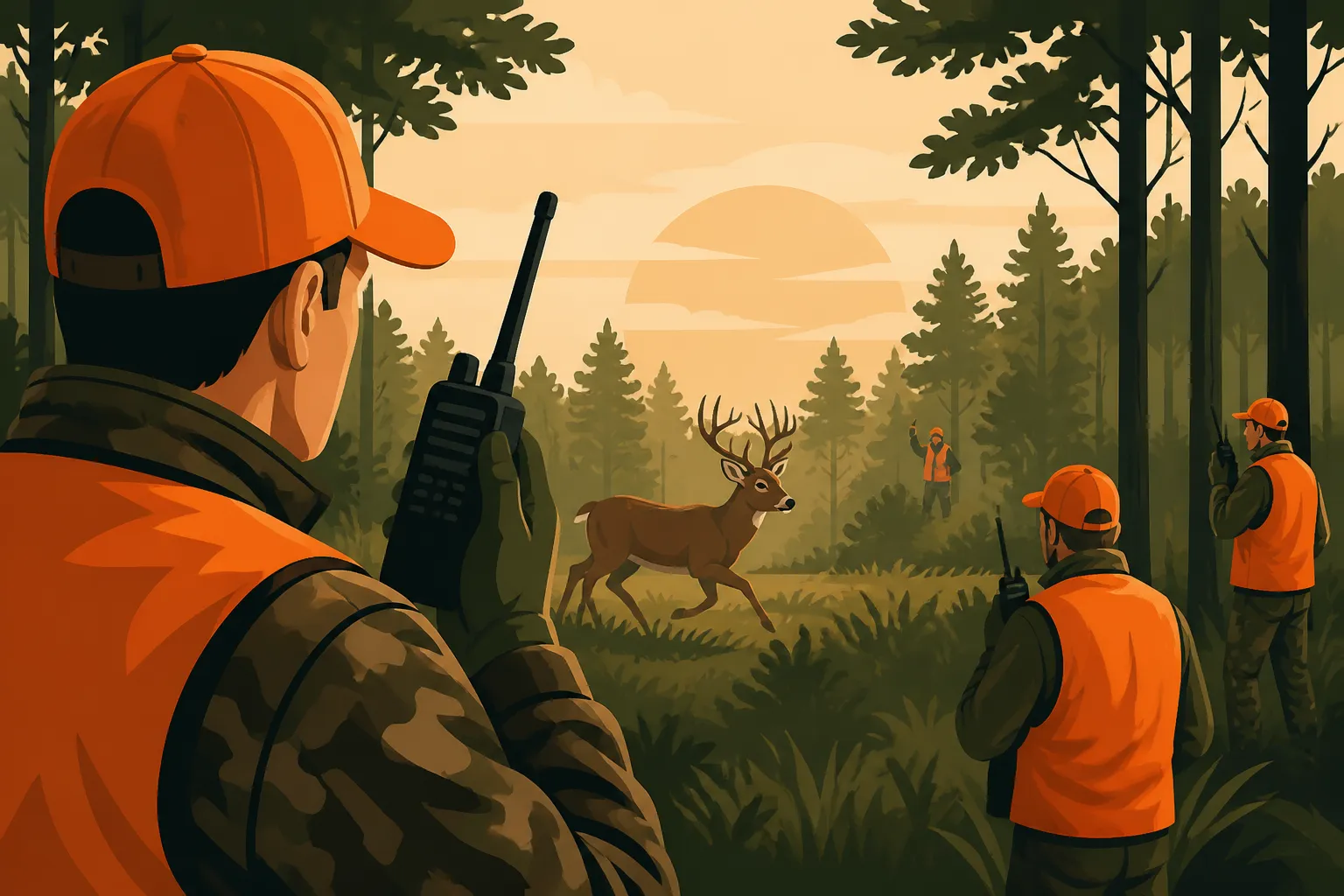
Imagine you're the designated "driver," pushing through a block of dense palmetto thickets or a young pine clear-cut. Your visibility might be just a few yards, and the sounds of your movement, combined with the rustling of leaves and the calls of other wildlife, make it almost impossible to hear or be heard by anyone more than a stone's throw away. Meanwhile, your "standers" are posted along escape routes, waiting for a deer to break cover. If a stander spots a buck heading toward an unblocked escape, or if a driver veers off course, critical information needs to be shared instantly. That's where two-way radios become absolutely essential. They bridge those auditory gaps, allowing real-time coordination regardless of the vegetation or distance.
Consider a common scenario: you're pushing a small block, and suddenly a stander on the far side radios, "Buck, buck, moving fast to the east, just cleared the old logging road!" Instantly, every other stander knows exactly where to focus their attention, and the drivers can adjust their pace or direction to subtly nudge the deer towards the most advantageous funnel. Without that immediate radio call, that buck might have slipped through unnoticed or presented a risky shot opportunity for someone unaware of its exact trajectory. Our diverse South Carolina landscape, from the marshy edges of the ACE Basin to the steep slopes of the Sumter National Forest, demands this kind of precise communication. It's not just about efficiency; it's about making sure everyone knows what's happening at all times. You can even plan your movements more effectively using tools like GoHunt to identify natural funnels and pinch points, ensuring your radio calls are targeted and effective when you're out in the field.
Enhancing Safety and Accountability on the Drive
Beyond efficiency, safety is paramount on any deer drive. A group of hunters moving through heavy cover, some with firearms, requires an unwavering commitment to safety protocols. Radios are your most powerful tool in this regard. Before the drive even begins, you can establish clear boundaries and assign positions, ensuring no hunter accidentally moves into another's line of fire. During the drive, continuous communication means everyone knows where their teammates are, significantly reducing the risk of accidental discharge or misidentification.
Think about a driver, deep in a Lowcountry swamp, who suddenly feels a sharp sting and realizes they've stepped on a yellow jacket nest or, worse, been bitten by a snake. Without a radio, they might be isolated and in serious trouble. With a radio, a quick "Man down, location is by the triple-trunk oak, need assistance!" can alert the entire group, allowing immediate response and potentially life-saving aid. Radios also enforce accountability. Drivers can confirm they've reached their designated checkpoints, and standers can report any changes in their position or observations. This constant flow of information helps prevent reckless actions and fosters a safer environment for everyone involved, especially when operating in challenging areas like those discussed in Deer Drives With Three or Four Hunters. When you’re pushing a specific section, knowing that your fellow hunters can communicate instantly allows for better coordination and prevents any hunter from getting into an unsafe position.
Choosing the Right Two-Way Radio for Your South Carolina Hunt
When you're looking for two-way radios for your hunting crew, you'll quickly discover there's a range of options, each with its own benefits and limitations. The choice often boils down to a balance of range, power, clarity, and cost. Understanding the core types available will help you make an informed decision that suits your specific hunting style and local regulations.
Understanding FRS vs. GMRS Radios for Hunting
The two most common types of consumer-grade two-way radios you'll encounter are Family Radio Service (FRS) and General Mobile Radio Service (GMRS). The primary difference lies in their power output and legal requirements. FRS radios are low-power devices, typically limited to 0.5 to 2 watts, and operate on shared frequencies. They are license-free and generally offer a shorter effective range, usually a mile or two in ideal conditions, but significantly less in thick woods or hilly terrain, which describes much of South Carolina. They're great for smaller groups or shorter drives where everyone stays relatively close.
GMRS radios, on the other hand, can transmit at much higher power levels, up to 50 watts for mobile units, though handhelds are usually capped around 5 watts. This increased power translates directly to greater range and penetration through obstacles like dense trees and varied topography, making them far more effective for covering larger areas like those found in Posting a Drive Around a Lowcountry Swamp. The trade-off is that GMRS radios require a license from the FCC, which covers an entire family for a period of time and doesn't require a test. While there's a small fee, the enhanced communication capabilities and reliability often make it a worthwhile investment for serious hunting clubs or larger groups doing extensive deer drives. When your hunt depends on communicating across a wide, heavily treed landscape, the extra range and clarity of a GMRS radio often outweigh the licensing step.
| Feature | FRS (Family Radio Service) | GMRS (General Mobile Radio Service) |
|---|---|---|
| Power Output | 0.5 – 2 Watts | Up to 50 Watts (handhelds ~5W) |
| Range | Shorter (1-2 miles typical) | Longer (2-5+ miles typical) |
| License | No license required | FCC license required |
| Channels | Shared, limited | More channels, often dedicated |
| Cost | Generally lower | Potentially higher (for features) |
| Antenna | Fixed | Often detachable/upgradable |
Essential Features for a Reliable Hunting Radio
Once you've decided between FRS and GMRS, you'll want to look at specific features that make a radio truly useful in the field. Durability is at the top of the list. Hunting is tough on gear, so look for radios with rugged casings that can withstand drops, bumps, and the occasional branch strike. Water resistance is also crucial in South Carolina, where sudden downpours are common, and you might find yourself in wet environments like a flooded timber bottom. A radio that can handle rain or even a quick dip in a puddle will save you a lot of heartache.
Battery life is another critical factor. A radio that dies halfway through the morning drive is useless. Look for models with long-lasting rechargeable batteries or the option to use standard AA/AAA batteries as a backup. Hands-free operation, often through a voice-activated (VOX) headset, is a game-changer, especially for drivers who need both hands free to navigate thick brush or carry a firearm safely. Privacy codes (DCS or CTCSS) are also important; they help filter out chatter from other radio users on the same frequency, ensuring your group has clear communication without interference, particularly on crowded public lands. Features like NOAA weather alerts can also be invaluable, giving you real-time updates on sudden storm fronts or severe weather warnings, which can dramatically impact your hunting plans, especially when you’re out for a full day. High-quality radios often pair well with detailed planning apps like GoHunt, where you can mark your stand locations and drive paths, ensuring everyone is in the right spot and can communicate effectively.
Best Practices for Using Radios Effectively on Your Deer Drive
Having good radios is one thing; using them effectively is another. To truly leverage the power of two-way communication on a deer drive, you need to establish clear protocols and practice good radio etiquette. This ensures everyone understands their role, messages are clear, and the channel remains open for critical information, not idle chatter.
Pre-Drive Planning and Channel Allocation
The success of any deer drive, and your radio communication, starts long before you step foot in the woods. Begin by carefully planning your drive route, identifying where drivers will push and where standers will be positioned. Using aerial maps or a scouting app like GoHunt to visually lay out the plan can be incredibly helpful. Once the physical logistics are sorted, assign clear roles: who are the drivers, who are the standers, and who is the lead communicator, the one person responsible for making overall decisions and directing the group?
Next, allocate your radio channels and privacy codes. Choose a channel that's likely to be clear, and if you have multiple channels available, assign a primary and a backup. Explain to everyone how to use the privacy codes to minimize interference from other hunting parties, a common issue in areas with Hunting Pressure on South Carolina Public Land. Conduct a radio check before leaving the truck. Ensure everyone's radio is working, they are on the correct channel, and they can hear and be heard clearly. Review communication protocols: what specific terms will be used ("buck left," "doe crossing," "driver X at checkpoint A")? This pre-drive briefing is crucial for a smooth and safe operation, ensuring everyone is literally and figuratively on the same wavelength. Don't forget to practice using the radios in a low-pressure setting, so everyone is comfortable when the real action starts.
Clear Communication and Etiquette During the Drive
Once the drive begins, disciplined communication is paramount. The goal is to convey vital information concisely and clearly, keeping the channel free for urgent updates. Encourage hunters to use call signs ("Driver One," "Stander Three") rather than just names, especially if you have multiple Johns or Bobs in the group. When spotting a deer, the message should be brief but informative: "Buck, moving north, crossing the powerline cut." Or, "Doe, holding in the thicket, near Stander Two." Avoid unnecessary chatter, jokes, or long descriptions that can tie up the channel and potentially mask a more critical message.
Always confirm messages. If you receive an instruction or a deer sighting, a simple "Copy that" or "Heard you, Driver Three" lets the sender know their message was received. Teach everyone to use the push-to-talk button correctly – press it firmly, wait a half-second before speaking to ensure the beginning of your message isn't cut off, and then release it completely. This prevents accidental open mics that can drain batteries and jam the channel. Remember, the radio is a tool for coordination and safety, not conversation. Clear, concise communication can be the difference between a successful harvest and a missed opportunity, especially when Tracking a Deer Through South Carolina Pine Straw or trying to pinpoint its last known direction.
Troubleshooting Common Radio Issues in the Field
Even the best radios can encounter issues in the field, and knowing how to troubleshoot them quickly can prevent a major headache. The most common problem is simply running out of battery. Always start with a full charge, and consider carrying spare battery packs or extra standard batteries if your model supports them. If a radio goes dead, try swapping batteries before assuming it's broken. Signal interference is another frequent complaint. This can be caused by other radio users, electrical lines, or even natural topographical features like hills or dense swamp trees. If you experience interference, try switching to a different channel or privacy code.
Range limitations are inherent to two-way radios, especially FRS models, and are greatly affected by terrain. In South Carolina, dense woods, ridges, and deep creek bottoms can significantly shorten your effective range. If a message isn't getting through, try moving to higher ground or a more open area. Sometimes, simply rotating your body can improve signal reception. Wet conditions can also wreak havoc on electronics, so if your radio isn't water-resistant, keep it in a protective bag or under your rain gear. A damaged antenna can severely impair a radio's performance, so inspect them regularly. Carrying a small, basic repair kit with electrical tape can sometimes temporarily fix a loose antenna or a frayed wire. The more prepared you are for these common issues, the less likely they are to disrupt your well-planned deer drive.
Integrating Radios with Modern Hunting Tools and Safety
Hunting, like many outdoor pursuits, has benefited immensely from technological advancements. While traditional skills remain paramount, integrating modern tools can significantly enhance your experience and effectiveness. Two-way radios are no exception; they work hand-in-hand with other technologies and are a crucial component of a comprehensive safety plan.
Combining Radios with GPS and Mapping Apps
In today's hunting world, GPS devices and smartphone mapping apps are practically standard gear. While these tools excel at navigation and pinpointing locations, they don't offer real-time, instantaneous communication with your team. This is where two-way radios shine as the perfect complement. Imagine a scenario where a driver is deep in the woods and spots a fresh track leading off the planned route. They can quickly consult their GPS or a mapping app like the one available via Scouting With the Go Outdoors SC App to get their precise coordinates, then radio those coordinates to the lead communicator. This allows the group to make immediate, informed adjustments to the drive plan without anyone getting lost or losing track of the deer.
Similarly, if a stander shoots a deer that runs into thick cover, they can mark the last known location on their app. Then, using the radio, they can guide the tracking party directly to that spot, providing verbal cues like, "I'm looking at the downed pine, just twenty yards past my pin." Even better, using advanced planning tools like GoHunt to pre-mark waypoints, property lines, and stand locations on a map before the hunt can give everyone a shared visual understanding of the area. During the hunt, radios then facilitate the dynamic, real-time communication needed to act on that mapped information, whether it's Recovering a Deer From a Lowcountry Swamp or simply confirming positions. These technologies aren't replacements for each other; they're synergistic, making you a more organized and effective hunting team.
Legalities and Responsible Use on South Carolina Public Lands
When you're utilizing two-way radios, especially on public land, it's important to be aware of the legalities and practice responsible use. As mentioned, GMRS radios require an FCC license. While it's generally an easy process to obtain, it's a legal requirement that serious hunters should adhere to. FRS radios are license-free, but their limited power means shorter ranges and less reliability in challenging South Carolina terrain. Regardless of the type, always be mindful of other hunters. Public lands are shared resources, and loud, incessant radio chatter can disrupt the experience for others.
Practice good radio etiquette not just within your group, but also out of respect for those around you. Keep your volume down, use privacy codes to minimize external interference, and avoid using channels that might be actively used by other hunting groups or public safety officials. There's nothing more frustrating than having your deer drive ruined by another group's constant chatter, or vice-versa. Understanding Hunting Pressure on South Carolina Public Land means recognizing that good behavior extends to how you use all your gear, including radios. Responsible use ensures that two-way radios remain a valuable tool for all hunters, enhancing safety and coordination without creating unnecessary conflicts or disrupting the tranquility of the outdoor experience for anyone else.
Disclaimer
This article is for general informational purposes only and does not constitute professional advice. Laws, prices and regulations vary by location and change over time. Consult a qualified professional for guidance on your specific situation.