Finding Sign in Big Sumter Forest Timber
Hunting big timber, especially in the vastness of Sumter National Forest, can often feel like searching for a needle in a haystack. The sheer scale makes it tough to locate concentrated deer activity, leading to frustrating hunts where you walk miles without seeing solid sign. This comprehensive guide will break down exactly how to read the landscape and interpret the subtle clues deer leave behind, transforming your approach to finding and hunting deer in South Carolina's expansive timber country.
Understanding Sumter's Timber Environment
Sumter National Forest covers immense tracts of land across the South Carolina Upstate, presenting unique challenges and opportunities for deer hunters. Unlike smaller, managed private properties with manicured food plots, the deer here rely on natural food sources and vast cover. Success hinges on understanding this ecosystem and how deer navigate it.
The Lay of the Land: Identifying Key Terrain Features
When you're facing thousands of acres of timber, the first step is to break it down into manageable sections by identifying crucial terrain features. Deer are creatures of habit and efficiency, naturally gravitating towards features that offer cover, food, and safe travel.
Sumter National Forest, especially in the Andrew Pickens and Enoree districts, is characterized by rolling hills, steep ridges, and numerous creek bottoms. Ridges are natural travel corridors, particularly those that connect different elevations or funnel into saddles. A saddle, a dip between two high points on a ridge, is a classic deer funnel because it's the path of least resistance. Learning to identify and walk these ridges is paramount. Creek bottoms, conversely, offer dense cover, water, and often different vegetation types. Deer frequently use them for bedding, especially during warmer weather, and as secluded travel routes between feeding and bedding areas. Don't overlook the benches – flat sections on a hillside that aren't quite a ridge top or a bottom. These often serve as transition zones where deer will browse or even bed for short periods. Think of a deer moving from a bedding area on a steep slope to a feeding area in a bottom; a bench might be their pit stop.
Forest Ecology and Food Sources
The diet of a whitetail in Sumter's timber shifts with the seasons, and understanding these changes is vital for finding sign. In late summer and early fall, deer are often keying in on soft mast, like wild grapes and persimmons, if you're lucky enough to find them. As autumn progresses, the focus shifts dramatically to hard mast, primarily acorns. Oak ridges are absolute magnets during this time. White oaks, which drop their acorns earlier and are less bitter, are usually hit first, followed by the various red oak species. When you're Scouting South Carolina Public Land Before Season, identify the dominant oak species and areas with heavy mast production.
However, it's not all about acorns. Deer also browse on a variety of forbs and woody plants. Look for areas where younger growth is prevalent, perhaps in recent clear-cuts or areas that have undergone prescribed burns. These areas stimulate new growth, providing succulent forage that deer find highly palatable. Don't forget the edges – the interface between different timber types, or between timber and a small opening, often creates a diverse buffet for deer, and these are often excellent places to find concentrated sign. Knowing what deer are likely to be eating in a specific month will tell you where to concentrate your search for fresh droppings, chewed browse, and active trails.
Decoding Deer Sign: What to Look For
Once you're in the right type of habitat within Sumter's expansive timber, it's time to put on your detective hat. Deer leave a multitude of clues, and learning to interpret them will tell you not just that a deer was there, but when it was there, where it was going, and sometimes even why.
Tracks and Trails: How to Interpret Movement Patterns
Tracks are arguably the most fundamental sign, but they require careful reading. Fresh tracks with crisp edges, especially if you see any moisture or debris kicked up, indicate recent passage. Older tracks will have rounded, weathered edges. Pay attention to track size – larger tracks often indicate a mature buck, though this isn't foolproof. The direction of travel is also crucial. Are the tracks leading into a thicket (potential bedding area) or out towards a feeding ground?
Trails, on the other hand, show habitual movement. In big timber, these won't always be super highways like you might see on private land. Look for subtle depressions in the leaves or pine straw, broken twigs, or disturbed ground. Major trails will connect bedding areas to feeding areas, or lead to water sources. Intersecting trails often form funnels, especially in bottlenecks created by terrain. If you find a well-worn trail, follow it a distance to understand its purpose. Does it parallel a creek? Traverse a ridge? Lead to a cluster of oaks? A solid trail means consistent deer movement, and consistency is gold for hunters. It's often a key component when considering Still-Hunting Sumter Forest Ridges, as these animals will often stick to predictable paths.
Rubs and Scrapes: Understanding Communication and Territorial Markers
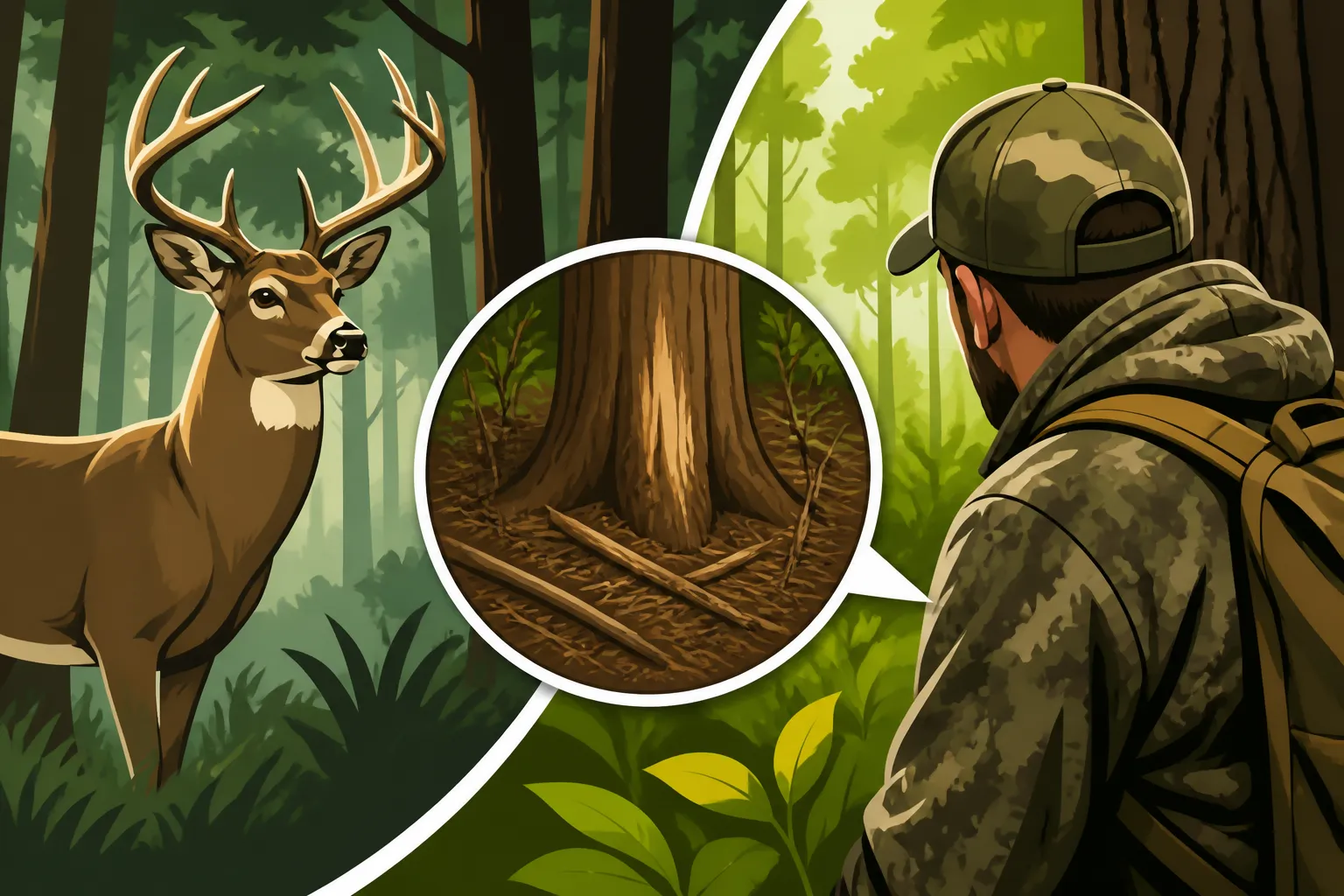
Rubs and scrapes are the deer's billboard and social media, especially during the rut. A rub is where a buck has rubbed his antlers on a small tree or sapling, removing the bark. The height and diameter of the rubbed tree can give you an idea of the buck's size, though smaller bucks rub larger trees too. Fresh rubs will have light-colored, exposed wood, sometimes with sap still oozing. Older rubs will be dark and weathered. A line of rubs, often called a rub line, indicates a buck's travel route, particularly during the pre-rut and rut phases. These are crucial indicators of a buck's core area and movement patterns.
Scrapes are pawed-out patches of bare earth, typically under an overhanging limb. Bucks paw the ground, urinate in the scrape, and rub the overhanging branch (the "licking branch") with their preorbital glands. Scrapes are communication hubs, attracting does and other bucks. Active scrapes will appear moist, often with fresh tracks in them, and the licking branch will show fresh signs of rubbing. While community scrapes can be found in open areas, primary scrapes, those used repeatedly by a dominant buck, are often found along travel corridors or near bedding areas in slightly more secluded spots. Finding a fresh scrape or a well-used rub line is a strong signal that a mature buck is actively working that area, which is vital intel when Hunting the Rut in the Upstate Zone.
Beds and Browsing: Pinpointing Bedding Areas and Feeding Preferences
Finding a deer bed is like finding a deer's bedroom. It's a depression in the leaves or pine straw, often shielded by thick cover. In Sumter's timber, beds might be on the leeward side of a ridge (sheltered from the wind), on a small knob, or tucked deep within a thicket. Fresh beds will still have the impression of a deer's body, and if it's been used recently, it might feel warmer than the surrounding ground. Look for clusters of beds, which indicate a family group of does and fawns, or a solitary, larger bed, which often suggests a buck. Bedding areas are high-value locations, as deer spend a significant portion of their day resting and observing their surroundings.
Browsing sign is where deer have eaten vegetation. Look for clipped twigs or leaves with ragged edges, as deer lack upper incisors and tear their food. The height of the browse can indicate the size of the deer. Pay attention to what they're browsing on – this tells you their current food preference in that specific area. Heavy browsing in an area with good cover signals a preferred feeding location or a staging area just outside a bedding thicket. If you're seeing a lot of browsing on specific plants, those are your current hot spots. Combine this with scat (droppings), which, when fresh and soft, confirms recent activity and what the deer have been eating.
Strategic Scouting in Expansive Forests
Scouting in Sumter National Forest requires a different mindset than on a small woodlot. You can't cover every acre, so efficiency and strategy are key to finding concentrations of deer sign.
Grid-Searching and Funnel Identification
When faced with vast timber, a systematic approach is essential. Instead of wandering aimlessly, try a modified grid-search. Choose a specific block of timber, perhaps a 100-200 acre section bordered by roads, creeks, or distinct terrain features. Then, walk parallel lines through that block, roughly 50-75 yards apart, eyes constantly scanning for sign. This ensures you cover the area thoroughly. As you find signs, mark them on a map or your GPS.
Focus on identifying natural funnels within these grids. Funnels are bottlenecks in the landscape that naturally concentrate deer movement. This could be a narrow strip of woods between two clearings, a saddle on a ridge, a point of land extending into a swamp, or a dense thicket bordered by more open timber. Any feature that restricts deer travel to a narrower path is a funnel. These are high-percentage areas to find consistent sign and are prime locations for a stand. You might be surprised at the subtle funnels you uncover once you start looking for them systematically. This strategy works whether you're Hanging a Stand on a Sumter Forest Ridge or setting up near a thick bottom.
Using Technology for Remote Scouting
In today's hunting world, technology is an invaluable tool for breaking down large tracts of public land. Before you ever set foot in Sumter, use online mapping resources. Platforms like GoHunt, for example, offer detailed satellite imagery, topo maps, and public land overlays that can help you identify potential funnels, ridges, creek drainages, and areas with different timber types. You can use these tools to virtually scout, pinpointing promising areas to investigate on foot.
Mark potential bedding areas (dense, dark timber), travel corridors (ridges, creek edges), and feeding areas (oak flats, clear-cut edges) before you even leave home. This significantly reduces wasted time and energy in the woods. While Using Go Outdoors SC Without Cell Service is possible with downloaded maps, GoHunt or other similar apps can help you understand the terrain beforehand and ensure you don't miss obvious features. Trail cameras, while requiring physical placement, also serve as a technological scouting aid. Place them on active trails, rub lines, or scrapes to gather intelligence on deer movement patterns, timing, and buck quality without constant human presence. Just be sure to adhere to Trail Camera Rules on South Carolina Public Land.
Timing Your Search for Optimal Results
Deer sign isn't static; it changes with the seasons, weather, and hunting pressure. Knowing when to look for certain types of sign can significantly boost your scouting efficiency.
Pre-Season Intelligence Gathering
The off-season and early archery season are prime times for gathering intelligence without the pressure of a hunt. In late summer, before the leaves fully drop, scouting for travel corridors and water sources is key. As early fall arrives, shift your focus to hard mast. Look for acorns on the ground, and identify the most productive oak trees. Early rubs might start to appear in late August and September, signaling bucks are shedding velvet and beginning to mark territory. This pre-season intel is crucial for understanding the foundational movements of deer before they get pressured.
During these warmer months, pay close attention to thermal currents. On an Upstate ridge, understanding Wind and Thermals on an Upstate Ridge can tell you where a deer will be bedded and how they will approach feeding areas. Mornings often see thermals rising, pulling scent uphill, while evenings see thermals falling, pulling scent downhill. Deer use these air currents to their advantage, and knowing this helps predict their movement and your optimal stand placement. This early scouting allows you to build a comprehensive picture of deer activity before opening day, helping you avoid Opening Weekend Crowds on the Coastal Zones (though Sumter is Upstate, the principle of avoiding crowds holds true).
In-Season Adjustments and Fresh Sign
Once hunting season opens, deer behavior can shift rapidly due to pressure, changing food sources, and the rut. This means your scouting can't stop. Continually look for fresh sign. Are the rubs you found pre-season still active? Are new scrapes appearing? Have deer shifted from one oak flat to another because the first one is now picked clean?
Fresh sign is your best indicator of current deer presence. If you're walking in, try to do so quietly, paying attention to what deer have been doing in the last 12-24 hours. A newly pawed scrape or a fresh set of tracks in damp earth can tell you exactly where to focus your efforts for the next sit. During the peak of the rut, sign like aggressive rubs and active scrapes become paramount, indicating a buck is actively seeking does. After a rain, go out and look for fresh tracks – the rain washes away old sign, making fresh movement stand out dramatically. Staying nimble and continually "scouting while hunting" is the hallmark of a successful hunter in Sumter's big timber. Don't be afraid to leave an area if the fresh sign isn't there; deer are constantly adapting, and so should you.
Table: Interpreting Deer Sign in Sumter National Forest
| Type of Sign | What to Look For | What it Indicates | Best Time to Find | Relevance in Big Timber |
|---|---|---|---|---|
| Tracks | Crisp edges, depth, direction of travel | Recent movement, size of deer, travel direction | Any time, especially after rain/snow | Essential for identifying travel corridors, fresh activity. |
| Trails | Worn paths, broken twigs, disturbed leaves | Habitual movement between key areas | Year-round | Identifies primary routes, especially through thick cover. |
| Rubs | Scraped bark on saplings, fresh vs. weathered | Buck presence, territorial marking, travel routes | Pre-rut through rut (late Aug-Nov) | Indicates buck's core area and consistent movement. |
| Scrapes | Pawed earth under licking branch, fresh urine, tracks | Communication hub, buck activity, doe presence | Peak rut (late Sept-Dec) | High-value spots for mature buck encounters. |
| Beds | Oval depressions in cover, sheltered spots | Bedding locations, daytime sanctuary | Year-round, often near thickets/ridges | Pinpoints where deer rest, especially during daylight. |
| Browsing | Clipped or torn twigs/leaves, specific plant species | Current food preferences, feeding areas | Year-round, especially when natural mast is scarce | Identifies active feeding grounds. |
| Droppings (Scat) | Size, freshness, contents | Recent activity, diet, general health | Any time, freshness is key | Confirms deer presence and what they are eating. |
Disclaimer
Hunting is an inherently dangerous activity. Always prioritize safety, follow all local and state regulations, and obtain proper licenses and permits before venturing into the field. The information provided in this guide is for educational purposes only and should not replace professional instruction or local wildlife agency guidelines. Happy hunting, and stay safe out there!