Field Dressing Knives Worth Carrying
Hunting in South Carolina is a truly unique experience, from the thick Lowcountry swamps to the rolling Upstate hills. But when you finally drop that buck, boar, or gobbler, the real work begins, and nothing can spoil an otherwise perfect hunt faster than struggling with a dull, poorly designed, or just plain wrong knife when it's time to field dress. This guide will walk you through the nuances of choosing and caring for a field dressing knife that can stand up to the rigors of a South Carolina hunt, ensuring your hard-earned game is processed efficiently and cleanly, no matter the conditions.
The Unsung Hero: Why Your Field Dressing Knife is Crucial in South Carolina
Let's be real, South Carolina's hunting seasons often mean dealing with heat and humidity, sometimes right from opening day in August. When you've got a downed animal, time is absolutely of the essence. You need to get that carcass cooled down quickly to preserve the meat, and that means efficient field dressing. A knife isn't just a tool; it's a critical piece of gear that directly impacts the quality of your harvest and, frankly, your enjoyment of the entire experience.
Imagine you've just put a beautiful Lowcountry buck on the ground. The air is thick, probably pushing 80 degrees, and the mosquitoes are already making their presence known. You know you need to open that body cavity, remove the entrails, and get some air circulating. If your knife is dull, slips in your hand, or isn't designed for the task, you're going to fight it every step of the way. You'll spend more time, risk nicks and cuts, and potentially compromise the meat quality. This isn't just about convenience; it's about respect for the animal and ensuring you bring home the best possible table fare. Field Dressing a Deer in Warm Weather is a prime example of where a good knife shines.
A reliable field dressing knife allows for precision cuts, reduces the chance of piercing organs you don't intend to, and simply makes the entire process faster and cleaner. This speed is invaluable in a climate where warm temperatures can rapidly accelerate bacterial growth. It's the difference between a quick, satisfying job and a frustrating, messy ordeal that leaves you questioning your gear choices.
Decoding Your Options: Types of Field Dressing Knives for Palmetto State Hunters
When you walk into a sporting goods store or browse online, the sheer variety of field dressing knives can be overwhelming. But understanding the basic types and what they're best suited for can help you narrow down the perfect blade for your South Carolina hunting adventures. Most hunters gravitate toward a few core designs, each with its own advantages.
Fixed Blade Knives: The Dependable Workhorse
For many seasoned hunters, a fixed blade knife is the gold standard for field dressing. There's something inherently trustworthy about a solid piece of steel that extends from tip to handle. This construction means there are no moving parts to fail, no hinges to gum up with blood and fat, and generally, a stronger, more robust tool.
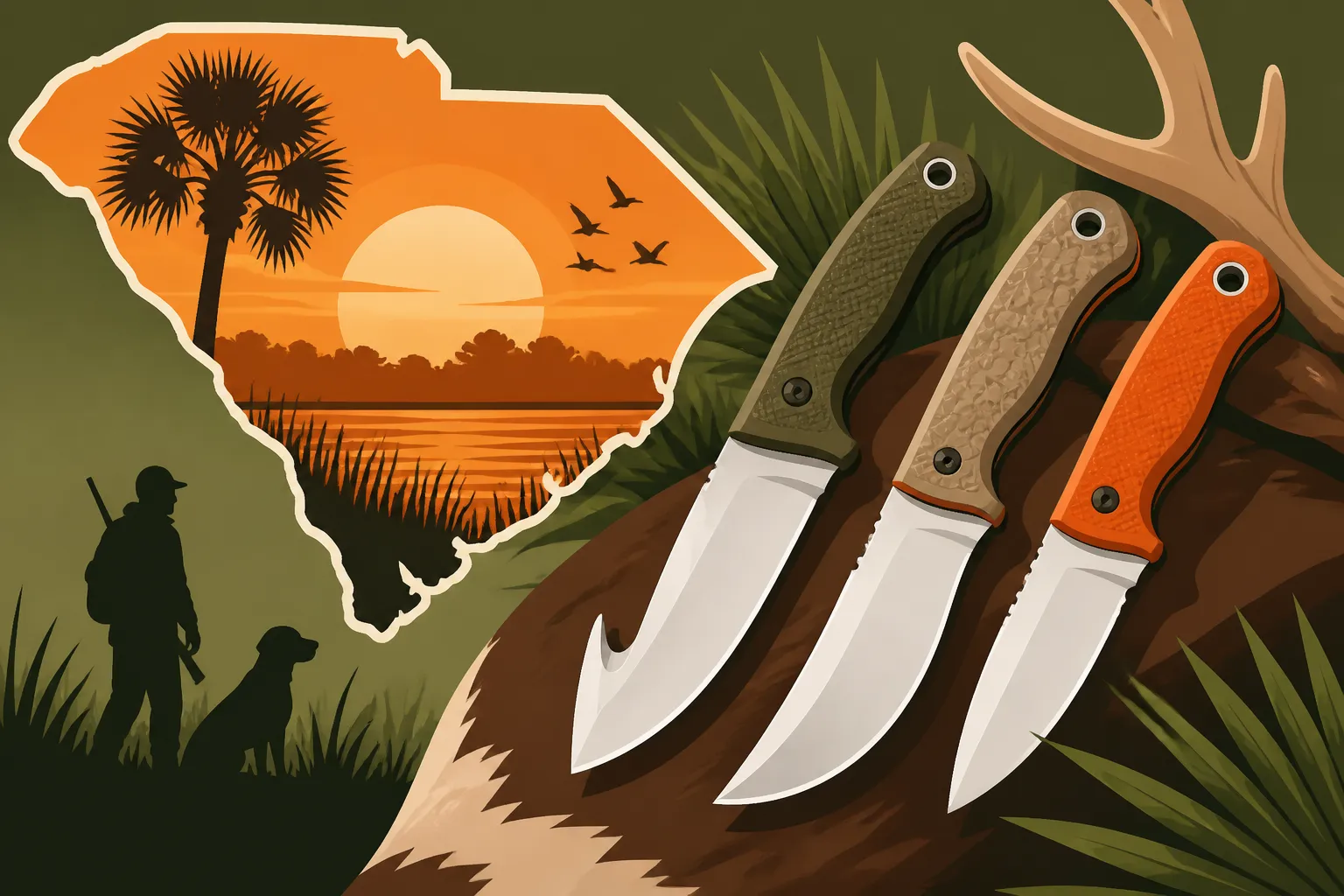
Fixed blades come in various shapes and sizes. A common favorite is the drop point, which has a gently curving spine that drops to meet the tip, offering a strong point for piercing while providing plenty of belly for skinning. Clip point blades, with their concave curve on the spine, offer a finer point for delicate work but can be more prone to breaking if twisted. Then you have the gut hook, often integrated into the spine of a drop point or clip point. This feature is designed to unzip the hide without piercing the viscera, which can be a real game-changer, especially for new hunters or when you're working quickly in low light. For those long walks back to the truck on public land, a dependable fixed blade ensures you're ready for the task. You might even use it for tasks back at camp when Butchering a Deer at Camp.
The primary advantages of a fixed blade are its strength, ease of cleaning, and reliability. They tend to be easier to clean thoroughly because there are no crevices for blood and tissue to collect. The main downside? They require a sheath, which adds bulk and another item to secure on your belt or pack. However, many quality sheaths are designed to be comfortable and secure for all-day wear.
Folding Knives: Compact Convenience
Folding knives offer undeniable convenience and portability. They tuck neatly into a pocket, pack, or small pouch, making them less obtrusive than a fixed blade. Modern folding knives are incredibly robust, with advanced locking mechanisms that make them nearly as strong and safe as many fixed blades.
When choosing a folding knife for field dressing, look for a strong lockback, liner lock, or frame lock mechanism. These are designed to prevent accidental closure, which is critical when you're applying pressure and making cuts around an animal. Blade shapes often mirror fixed blades, with drop points and clip points being popular. Some folding knives even incorporate gut hooks. The key benefit here is minimal bulk and easy carry, which can be appreciated when you're Hunting Small Woodlots Near Suburban Columbia and trying to keep a low profile.
The challenge with folding knives for field dressing is cleaning. Blood, hair, and tissue can get trapped in the pivot and handle scales, making thorough sanitization more difficult. This is especially important in warm, humid South Carolina conditions, where bacteria thrive. If you opt for a folder, make sure it has an open-back design or can be easily disassembled for cleaning. Regular maintenance is paramount.
Specialized Blades: Beyond the Basic
Beyond the general-purpose fixed and folding knives, there are a few specialized options that some hunters swear by:
- Caping Knives: These are small, precise blades, often with a fine tip and a lot of belly, designed for intricate cuts when you're skinning around eyes, ears, and mouth for taxidermy. While not essential for basic field dressing, if you plan to get a shoulder mount, a caping knife makes the job infinitely easier.
- Boning Knives: Typically thin, flexible blades, boning knives are fantastic for separating meat from bone once the animal is back at camp. While you can field dress with a boning knife, its flexibility isn't ideal for the initial robust cuts needed to open a carcass.
- Replaceable Blade Knives: A newer category, these knives feature a handle that accepts disposable, razor-sharp blades. The advantage is a consistently razor-sharp edge without needing to sharpen in the field. They are incredibly effective for skinning and even the initial cuts. The main considerations are carrying extra blades and the environmental impact of disposal. Many hunters using GoHunt resources find reviews on these for specific hunting scenarios.
Choosing the right type often comes down to personal preference and the specific hunting situation. Many experienced hunters carry a combination—perhaps a fixed blade for the heavy work and a smaller folding or caping knife for finer cuts.
| Knife Type | Primary Use | Pros | Cons | Best For |
|---|---|---|---|---|
| Fixed Blade | All-around field dressing, robust cuts | Strong, reliable, easy to clean, durable | Requires sheath, can be bulky | General hunting, heavy use, adverse conditions |
| Folding Knife | Field dressing, lighter cuts, utility | Compact, portable, discreet carry | Harder to clean thoroughly, potential for hinge failure (rare) | Everyday carry, quick tasks, hunters preferring minimal gear |
| Gut Hook | Opening body cavity without puncturing guts | Fast, clean opening; reduced risk of contamination | Single-purpose; can snag on thick hide or clothing | Efficient gutting, especially on larger game like deer and hogs |
| Caping Knife | Fine skinning around head/antlers | Precise cuts for taxidermy, intricate work | Too small for general field dressing, specialized | Hunters planning shoulder mounts or European skull mounts |
| Replaceable Blade | Skinning, precise cuts with sharp edge | Always razor-sharp, lightweight blades | Blades can be fragile, need to carry spares, disposable | Hunters who prioritize sharpness and don't want to sharpen in the field |
Choosing Your Edge: Essential Features for a South Carolina Hunting Knife
Beyond the type of knife, several key features dictate its effectiveness and longevity, especially when facing South Carolina's distinct environmental challenges. Think about what a knife goes through here: heat, humidity, blood, grit, maybe even a dip in a swamp if you're Recovering a Deer From a Lowcountry Swamp. Your knife needs to be built for it.
Blade Material: Stainless Steel is Your Friend
The steel used for the blade is perhaps the most critical component. For South Carolina hunting, stainless steel is almost universally preferred. Why? Because it resists rust and corrosion, which are major concerns in our humid environment. While carbon steel blades can hold a sharper edge and are easier to sharpen, they rust rapidly if not meticulously cleaned and oiled after every use. Dealing with a rusty blade when you're miles into the Francis Marion National Forest Hunting is the last thing you want.
Look for high-quality stainless steels like S30V, S35VN, VG-10, or 440C. These offer a good balance of edge retention (how long it stays sharp), toughness (resistance to chipping and breaking), and corrosion resistance. They might take a bit more effort to sharpen, but they'll hold an edge through a full field dressing and resist the elements. For those looking at options, researching different steel types on a platform like GoHunt can provide detailed comparisons.
Blade Profile and Edge Geometry: The Right Shape for the Job
While we touched on drop points and clip points, consider the grind of the blade. A full flat grind or saber grind is generally excellent for field dressing, offering a good balance of strength and slicing ability. The edge itself should be relatively thin for efficient cutting, but not so thin that it becomes fragile.
Pay attention to the length of the blade too. For deer and hogs, a blade between 3.5 and 5 inches is often ideal. Too short, and you struggle with leverage; too long, and it becomes unwieldy and potentially dangerous for fine work inside the body cavity. A blade with some belly (curve) near the tip is invaluable for skinning, while a sturdy, slightly upswept tip can aid in opening the hide.
Handle Design and Material: Grip and Ergonomics
A field dressing knife must feel secure in your hand, even when wet or bloody. Slipping can lead to serious injury. Look for handles made from materials that offer excellent grip, such as:
- G-10: A fiberglass laminate, G-10 is incredibly durable, lightweight, and offers excellent traction, even when wet.
- Micarta: Another laminate material, Micarta provides a slightly softer, warmer feel than G-10 but with similar durability and grip.
- Rubberized Overmolds: Many knives feature handles with a rubberized grip, which provides superb traction and comfort, reducing hand fatigue during extended use.
- Textured Synthetics: Materials like Zytel or FRN with aggressive texturing also offer good grip and are often more affordable.
Avoid highly polished or smooth handles, even if they look pretty. Functionality trumps aesthetics when you're elbow-deep in an animal. The handle should also be ergonomically shaped to fit your hand comfortably, with a finger guard or choil to prevent your hand from sliding onto the blade.
Sheath or Carry System: Safe and Secure
For fixed blades, the sheath is an extension of the knife itself. It needs to be secure, durable, and allow for easy, one-handed draw and re-sheathing.
- Kydex or Molded Polymer: These are excellent choices. They hold the knife securely with an audible click, resist moisture, and are easy to clean.
- Leather: Traditional and beautiful, but leather can absorb blood and moisture, making it harder to clean and more prone to rot or mold in humid conditions. If you choose leather, ensure it's well-treated and meticulously cleaned.
- Nylon/Cordura: Often found on budget knives, these can be acceptable but ensure the retention strap is robust and doesn't get in the way.
The carry method matters too. A belt loop, Molle compatibility, or even a neck carry option for smaller blades allows you to keep your knife accessible. You don't want to be fumbling around in your pack when you need your knife right away.
Beyond the Cut: Maintaining Your Field Dressing Knife for Longevity
Having a great knife is only half the battle; maintaining its edge and cleanliness is crucial, especially in South Carolina's environment. Neglecting your knife can quickly turn a premium tool into a frustrating burden.
Sharpening: Keep That Edge Razor Sharp
A sharp knife is a safe knife. It cuts cleanly with less force, reducing the chance of slips and injuries. Never try to field dress with a dull blade. It makes the job harder, messier, and significantly increases your risk of cutting yourself.
Invest in a quality sharpening system. This could be a set of sharpening stones (water stones or diamond stones), a guided sharpening system like a Work Sharp, or ceramic rods. Learn how to use it correctly and practice regularly. A few passes on a ceramic rod or strop before and after each hunt can maintain a razor edge. If you're out for an extended hunt, a small portable sharpener can be a lifesaver. This is especially true for prolonged hunts, say, when you're out for South Carolina's Long Archery Season.
Cleaning and Disinfection: Preventing Contamination
This is non-negotiable, particularly in warm weather. After every use, even if it's just a quick cut, your knife needs to be thoroughly cleaned.
- Rinse Immediately: Get as much blood and tissue off the blade as possible right away. Warm water works best.
- Scrub with Soap: Use dish soap and a scrub brush to meticulously clean the blade, handle, and sheath. Pay close attention to any crevices on folding knives.
- Disinfect: After cleaning, many hunters use an alcohol wipe or a diluted bleach solution (check manufacturer recommendations first) to disinfect the blade. This is especially important for food safety.
- Dry Thoroughly: This is critical for stainless steel and absolutely paramount for carbon steel. Pat the knife completely dry with a towel, and then let it air dry for a bit longer before storing. Any lingering moisture, even on stainless steel, can lead to rust spots, especially in our humidity.
Storage: Protecting Your Investment
Once clean and dry, store your knife properly.
- Ventilation: Don't store a knife in a damp, enclosed space. If using a leather sheath, consider storing the knife outside the sheath to prevent moisture buildup within the leather.
- Light Oil (Optional): Even with stainless steel, a very light coating of food-grade mineral oil on the blade can offer an extra layer of protection against corrosion during extended storage.
- Accessibility: Keep your field dressing knife separate from your utility knives to ensure it's always dedicated to the task and ready when you need it. Perhaps in your Packs for a Sumter Forest Day Hunt ready to go.
By following these maintenance steps, your field dressing knife will be a reliable companion for many South Carolina hunting seasons to come, ready to tackle any animal you put on the ground with precision and efficiency.
Disclaimer
This article is for general informational purposes only and does not constitute professional advice. Laws, prices and regulations vary by location and change over time. Consult a qualified professional for guidance on your specific situation.