Public Hunting Land in South Carolina
Finding places to hunt in South Carolina can feel like an impossible puzzle, especially when it seems like every acre is privately owned or locked behind expensive leases. Many of us arrive in the Palmetto State, or even live here our whole lives, and struggle to identify legitimate, accessible public hunting opportunities. This guide is dedicated to demystifying public hunting lands in South Carolina, helping you navigate the options and unlock incredible experiences without needing a personal invitation.
Understanding South Carolina's Public Land Landscape
South Carolina, with its rich hunting heritage, certainly has its share of private land. It's a reality that can be frustrating for many hunters, new and old, who don't have access to family property or pricey club memberships. But don't let that discourage you! There are substantial public land opportunities, if you know where to look and how to prepare. These areas offer diverse habitats, from the mountain forests of the Upstate to the coastal swamps and pinelands, presenting unique challenges and rewards for various game. It’s not always easy, but the satisfaction of finding success on public ground is truly unmatched.
The Scope of Public Hunting Opportunities
When we talk about public hunting land in South Carolina, we're primarily looking at two major categories: federally managed lands like the National Forests, and state-managed areas known as Wildlife Management Areas (WMAs). Beyond these, there are a few other, more specialized access points like certain National Wildlife Refuges or even some state parks that offer limited hunts. While the overall percentage of public land might feel small compared to some western states, the acreage available here is significant and holds a surprising amount of game. Knowing the distinction between these land types is crucial because the rules and regulations can vary quite a bit, even for the same game species. You might find different seasons, bag limits, or even equipment restrictions depending on whether you're in a National Forest or a specific WMA.
Dispelling Common Misconceptions
One of the biggest misconceptions about hunting public land in South Carolina is that it's "hunted out" or only holds small, pressured game. While it's true that public land often sees more hunting pressure than secluded private tracts, it doesn't mean it's devoid of quality animals. Hunters who are willing to put in the work – scouting diligently, walking farther, and employing smart tactics – consistently find success. The key is often to avoid the obvious access points and popular spots, venturing deeper into areas that many other hunters overlook or simply don't want to tackle. Another common thought is that you need specialized gear, but often, just good boots, a map, and a willingness to explore are your most valuable tools. Remember, every big buck or old gobbler on private land had to start somewhere, and many of them spend time on public boundaries.
National Forests: Francis Marion and Sumter
South Carolina is fortunate to host portions of two magnificent National Forests: the Francis Marion National Forest in the Lowcountry and the Sumter National Forest, which spans the Upstate and Midlands regions. These vast federal lands offer hundreds of thousands of acres of huntable ground, providing a crucial backbone for public hunting access in the state. They are managed by the U.S. Forest Service, but hunting regulations within them are set by the South Carolina Department of Natural Resources (SCDNR), often with specific WMA rules applying to designated sections within the forests. Understanding the terrain, available game, and unique challenges of each is key to a successful hunt.
Hunting Francis Marion National Forest
The Francis Marion National Forest, located just outside of Charleston in the coastal plain, is a sprawling expanse of pine forests, hardwood bottoms, and vast swamps. This lowland environment presents its own set of challenges, from dense palmetto thickets to omnipresent biting insects and, of course, the potential for very wet conditions. But within these challenges lie incredible opportunities for deer, hogs, and even bears in certain zones. The sheer size of Francis Marion means that if you're willing to venture away from the main roads, you can absolutely find solitude and unpressured pockets of game. Francis Marion National Forest Hunting is a unique experience where patience and local knowledge, or diligent scouting, will pay dividends.
Deer in the Francis Marion tend to be smaller-bodied but numerous, adapting well to the dense cover and abundant browse. Hog populations are also robust, offering year-round hunting opportunities in many areas. For those who enjoy a true wilderness experience, still-hunting through the pine flats or wading into cypress swamps can be incredibly rewarding. Access points are plentiful, with a network of forest roads, but many of the most productive areas require walking in a good distance. Be prepared for varied terrain, from dry pine needles to standing water, and always keep an eye on the weather and tide charts if you're near tidal creeks.
Hunting Sumter National Forest
In stark contrast to the Lowcountry's Francis Marion, the Sumter National Forest stretches across the Upstate and Midlands, offering a more varied landscape of rolling hills, mature hardwood ridges, and swift-flowing rivers. This forest is actually divided into three distinct sections: the Andrew Pickens District in the mountainous Upstate, the Enoree District in the central Piedmont, and the Long Cane District in the western Piedmont. Each district offers slightly different hunting experiences and dominant game species. Sumter National Forest Hunting provides a completely different experience than its coastal counterpart, with elevation changes and rockier terrain.
The Andrew Pickens District is known for its rugged, mountainous terrain and is the primary bear hunting zone in South Carolina. Deer hunting here often involves navigating steep inclines and hunting along prominent ridge lines. The Enoree and Long Cane Districts, on the other hand, feature more rolling topography, mature oaks, and dense thickets, which are excellent for deer and turkey. These areas often have higher deer densities than the mountains, and hunters who understand how to read a ridge for deer movement or identify key acorn-producing areas will find success. While less swampy than Francis Marion, creek crossings and muddy bottoms are still common, so appropriate footwear is a must.
Wildlife Management Areas (WMAs): Diversity and Access
Beyond the vast National Forests, South Carolina boasts an impressive network of Wildlife Management Areas (WMAs). These lands are owned or leased by the state and specifically managed for wildlife and public recreation, including hunting. The WMA system is incredibly diverse, ranging from small, isolated tracts to large contiguous blocks of land, each with its own habitat types, game populations, and unique hunting regulations. South Carolina Wildlife Management Areas are a critical component of the state's public hunting opportunities, providing thousands of acres specifically dedicated to sportsmen and women.
Navigating the WMA System
The sheer variety within the WMA system can be both a blessing and a curse. On one hand, it means there's likely a WMA suited to your preferred hunting style and target species, whether it's deer, turkey, small game, or waterfowl. On the other hand, the regulations can differ significantly from one WMA to another, and even within different units of the same WMA complex. This means that simply having a WMA permit isn't enough; you absolutely must consult the specific regulations for the WMA you plan to hunt before you ever set foot in the woods. These regulations cover everything from season dates and bag limits to allowed hunting methods, vehicle access, and even trail camera usage.
One of the best resources for navigating the WMA system is the SCDNR's annual hunting regulations digest, which provides a comprehensive overview of all WMAs and their specific rules. Additionally, the Go Outdoors SC website and app are invaluable tools. The "Go Outdoors SC Map Tool" on the app allows you to view WMA boundaries, check regulations, and even see current hunting opportunities in real-time. It’s crucial to understand that many WMAs operate under quota hunt systems for popular species like deer and turkey, meaning you might need to apply for a limited draw permit well in advance. Don't just show up; do your homework!
Types of WMAs and Their Offerings
WMAs in South Carolina are incredibly varied, reflecting the diverse ecosystems of the state. You'll find coastal WMAs that are prime for waterfowl, with managed impoundments and tidal marshes, like those found in the ACE Basin. Other WMAs protect large tracts of bottomland hardwoods along major rivers, offering excellent deer and turkey hunting in areas that are often difficult to access. Then there are upland WMAs, characterized by pine plantations, clearcuts, and mixed hardwoods, which provide great habitat for deer, small game, and even bear in some Upstate locations.
For example, areas like Bear Island Wildlife Management Area or Donnelley Wildlife Management Area are renowned for their managed habitats and often require special draw hunts for deer and turkey due to their high quality. Other WMAs, often smaller or more remote, might have general access for hunters with the proper WMA permit. It's a spectrum, and each WMA is a unique puzzle to solve. Scouting is paramount, as understanding the specific layout, terrain, and game sign of your chosen WMA will dramatically increase your chances of success. Never assume that one WMA is just like another; always check the details.
Special Public Access Programs
While National Forests and the general WMA system form the bulk of South Carolina's public hunting lands, there are also some fantastic specialized programs and areas that provide additional opportunities. These can range from National Wildlife Refuges with specific hunt programs to cooperative agreements with timber companies or private landowners. While often more limited in scope or access, these programs can offer some truly exceptional hunting experiences for those willing to do the research and navigate their unique requirements.
National Wildlife Refuges and State Parks
Several National Wildlife Refuges in South Carolina, such as the ACE Basin National Wildlife Refuge or parts of the Santee National Wildlife Refuge, offer public hunting for various species, most notably waterfowl and deer. However, hunting on these federal lands is almost always managed through a strict quota system, requiring hunters to apply for permits, often months in advance, through a lottery draw. The regulations for these refuges are typically even more specific and stringent than general WMA rules, so thorough review of their individual hunt brochures is essential. For instance, Hunting the ACE Basin can be an incredible experience for ducks, but securing a spot requires careful planning and a bit of luck in the draw.
Similarly, some South Carolina State Parks may offer limited hunting opportunities, often through managed draw hunts to control deer populations or for specific conservation goals. These are usually very restricted and highly sought after, again requiring advance application. While these opportunities might not be as widespread as general WMA access, they often provide unique, high-quality experiences in areas that typically see very little hunting pressure. Keep an eye on the SCDNR website and the individual refuge/park websites for application periods and specific hunt details.
Cooperative Public/Private Land Initiatives
In some cases, the SCDNR partners with private landowners or timber companies to open up additional lands for public hunting. These cooperative agreements are invaluable, as they expand the huntable footprint beyond purely government-owned tracts. These lands might be managed as WMAs, or they might fall under specific agreements with their own sets of rules. While the specifics of these programs can change, they represent a fantastic way for hunters to gain access to areas that would otherwise be entirely private.
These initiatives often target specific conservation needs, like managing deer populations or controlling feral hogs, while simultaneously providing public access. Details on such programs are usually found in the annual SCDNR hunting regulations guide or on their website. It pays to check regularly, as new opportunities can sometimes arise, offering a chance to hunt new areas that might not be as widely known or heavily pressured as the more established public lands. Always respect the landowner's rules and boundaries when hunting these cooperative tracts to ensure these valuable partnerships continue.
Navigating Public Land Rules and Regulations
The biggest hurdle for many hunters venturing onto South Carolina's public lands isn't finding game, but understanding and adhering to the complex web of rules and regulations. Each type of public land—National Forest, WMA, National Wildlife Refuge, etc.—can have its own set of guidelines, which can even vary by game zone or specific unit. Failing to understand these rules can not only lead to a ruined hunt but also potential fines and loss of hunting privileges. It’s a reality we all face, and it requires diligence, but it’s entirely manageable once you know where to look.
Essential Permits and Licenses
Before you even think about stepping onto public land, you need the right permits and licenses. At a minimum, any hunter in South Carolina needs a valid state hunting license. For hunting most public lands, you'll also need a Big Game Permit if you're pursuing deer, turkey, or bear, and often a specific WMA permit. These WMA permits are your access pass to most state-managed public lands. South Carolina WMA Permit Requirements are pretty straightforward but absolutely non-negotiable. For migratory birds like ducks or doves, federal stamps and Harvest Information Program (HIP) certification are also required.
It's critical to note that license requirements vary for residents and non-residents, and prices can differ. Always purchase your licenses and permits well in advance of your hunt, and carry physical or digital proof with you at all times. The Go Outdoors SC app is great for this, allowing you to display your licenses right on your phone. Don't assume that because you have a license from another state, it applies here. South Carolina has its own system, and it's your responsibility to be fully compliant.
Understanding Game Zones and Season Dates
South Carolina is divided into four distinct game zones, each with its own deer season dates and, sometimes, bag limits. While WMA rules often supersede or modify these statewide zone rules, understanding the baseline for your game zone is fundamental. For example, coastal zones generally open much earlier for deer than the Upstate zone. How South Carolina's Four Zones Split the Calendar provides a good overview of these broad categories.
Within National Forests and WMAs, these zone dates can be further refined. Some WMAs may have primitive weapons seasons, archery-only periods, or specific dog hunting seasons that differ from surrounding private land. Pay very close attention to these nuances. For instance, you might find that while archery season is open on private land in Zone 3, the local WMA might have an archery-only season that starts a week later or has specific days of the week designated for hunting. Always double-check the specific WMA or National Forest regulations against the general game zone rules.
Specific Public Land Regulations
Beyond licenses and seasons, public lands often have a host of other specific regulations designed to manage pressure, ensure safety, and protect resources. These can include restrictions on:
- Vehicle Access: Many interior forest roads or WMA roads are gated or seasonal. Always check maps and signage.
- Camping: While some national forest areas allow primitive camping, many WMAs have strict rules or outright prohibitions.
- Treestands and Ground Blinds: Treestand Rules on South Carolina Public Land and Ground Blind Rules on South Carolina WMAs dictate how long stands can be left up, whether they need to be marked, and what materials are allowed. Generally, stands must be removed at the end of the season.
- Trail Cameras: Trail Camera Rules on South Carolina Public Land are becoming more common, with some areas prohibiting them or requiring them to be clearly marked.
- Dog Hunting: While dog hunting for deer is traditional in some parts of South Carolina, it's often restricted or entirely prohibited on many WMAs and within certain National Forest areas.
- Blaze Orange/Pink: Required during certain firearm seasons, even for archery hunters when gun season overlaps. How Much Blaze Orange South Carolina Requires is a key piece of information for hunter safety.
These are just a few examples, and the list can be extensive. The golden rule is: when in doubt, assume it's prohibited or consult the official regulations. A quick call to the local SCDNR office or Forest Service ranger district can clarify any uncertainties.
Planning Your Public Land Hunt
Hunting public land in South Carolina demands a different level of preparation than hunting private, managed acreage. You can't just show up and expect a deer to walk by a feeder. Success on public land is often a direct result of meticulous planning, thorough scouting, and a willingness to adapt. It’s about being proactive, not reactive, and embracing the challenge that public ground presents.
Essential Scouting Strategies
Scouting is your most powerful tool on public land. It's how you learn the lay of the land, identify game movement patterns, and find those overlooked pockets where animals feel safe. Don't limit your scouting to just a week or two before the season. Off-season scouting, especially in late winter or early spring when foliage is down, can reveal bedding areas, travel corridors, and old food sources that are hidden during the greener months. This is also a great time to avoid hunting pressure. Scouting South Carolina Public Land Before Season is highly recommended for building your knowledge base.
When scouting, look for key features:
- Food Sources: Acorn flats, persimmon trees, honeysuckle thickets, and agricultural field edges (if bordering public land). These change throughout the season, so knowing what's available when you plan to hunt is crucial.
- Water Sources: Creek bottoms, swamps, and small seeps. Deer need water, especially in warmer early seasons.
- Bedding Areas: Dense thickets, pine regeneration areas, and remote swamp islands where deer feel secure. Look for heavy tracks and droppings.
- Travel Corridors/Funnels: Ridgelines, creek crossings, edges of clearcuts, or narrow strips of timber between open areas. These are natural pinch points where deer are likely to travel.
- Pressure Points: Identify common access points, well-worn trails, and areas with obvious hunter sign. Then, plan to go beyond these areas. Most hunters won't walk more than a mile or two from a vehicle; those willing to go farther often find better opportunities.
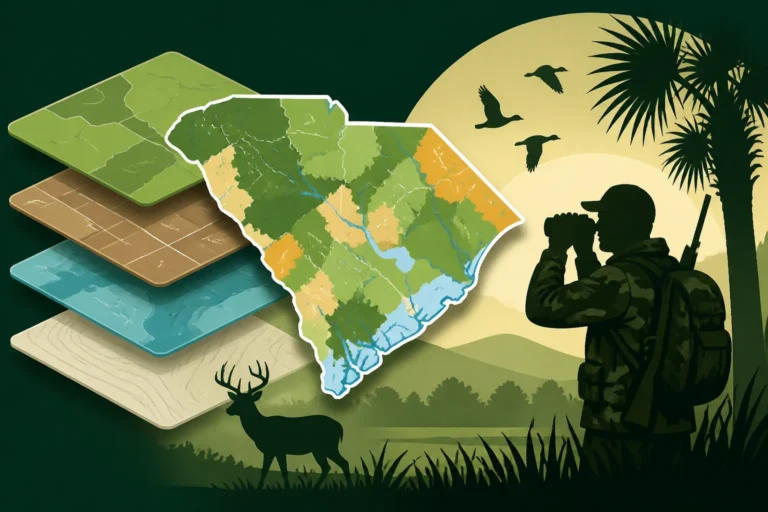
Using mapping tools like onX Hunt or GoHunt during scouting is a game-changer. These apps allow you to mark waypoints, measure distances, identify property boundaries (crucial for public/private interfaces), and analyze topography and aerial imagery from your phone. onX Layers for South Carolina Land Status is particularly useful for instantly knowing where you stand.
Gear Considerations for Public Land
The gear you choose for public land hunting should prioritize durability, mobility, and practicality. You'll likely be doing more walking, encountering rougher terrain, and possibly spending more time exposed to the elements than on a manicured private property.
- Navigation: A reliable GPS unit or a smartphone with a robust mapping app (like onX Hunt or GoHunt) is non-negotiable. Don't rely solely on cell service, as many public land areas have spotty coverage. Downloading offline maps is essential.
- Footwear: Snake boots or waterproof hiking boots are critical, especially in the low country swamps or rocky upstate terrain. You'll be covering ground, so comfort is paramount.
- Clothing: Layering is key for South Carolina's unpredictable weather. Early season hunts can be sweltering, while late season can bring cold snaps. Don't forget bug repellent, especially for early archery season in the coastal areas.
- Treestand/Ground Blind: If using, ensure it's lightweight for packing in and out. Familiarize yourself with Treestand Rules on South Carolina Public Land and Ground Blind Rules on South Carolina WMAs to ensure compliance.
- Water/Food: Always carry more water than you think you'll need, especially on warmer days or longer hikes. Snacks for sustained energy are also important.
- Game Retrieval: A good deer cart or game carrier can be invaluable for extracting an animal from deep public land, especially if you're hunting alone. Planning your extraction route is part of the overall hunt plan.
Adapting to Hunting Pressure
One of the realities of public land is hunting pressure. While you can find solitude, especially deeper in, you'll likely encounter other hunters. Instead of letting this deter you, learn to adapt your tactics.
- Hunt Mid-Week: If possible, avoid opening weekends and holiday periods when pressure is highest. Mid-week hunts often provide a more peaceful and productive experience.
- Go Deeper: As mentioned, most hunters don't venture far. A willingness to walk an extra mile or two can put you in areas with significantly less pressure.
- Hunt Smarter, Not Harder: Instead of just walking aimlessly, use your scouting to identify routes that avoid common trails or funnels that other hunters might be using.
- Use Pressure to Your Advantage: Sometimes, other hunters can inadvertently push game towards you. Set up on escape routes or travel corridors that deer might use to avoid pressure.
- Be Patient: Public land animals are often warier. You might need to sit longer, move slower, and be more scent-conscious.
Utilizing Mapping Tools for Public Land Success
In today's hunting world, mapping applications have become indispensable, especially for public land hunters. Gone are the days of relying solely on paper maps, though carrying one as a backup is always a good idea. Modern apps like onX Hunt and GoHunt provide a wealth of information at your fingertips, helping you navigate complex landscapes, understand property boundaries, and plan your hunt with unparalleled precision.
The Power of onX Hunt
onX Hunt is widely considered a gold standard for outdoor mapping, and for good reason. Its detailed satellite imagery, topographic maps, and crucial land ownership layers make it an invaluable tool for South Carolina public land hunters. With onX Hunt, you can instantly see the boundaries between public and private land, a critical feature when hunting along WMA or National Forest edges. This helps prevent accidental trespassing and ensures you're always on legal ground. onX Layers for South Carolina Land Status is more than just a convenience; it's a necessity for ethical hunting.
Beyond boundaries, onX Hunt allows you to:
- Mark Waypoints: Drop pins for stand locations, game sign, water sources, bedding areas, or even your vehicle's parking spot. This makes navigating in and out much easier, especially in dense cover or low light.
- Measure Distances: Precisely measure how far your stand is from a potential bedding area or how long that hike in will be.
- Analyze Topography: Understand elevation changes, ridges, and saddles, which are key for predicting deer movement and understanding wind thermals, particularly in the Sumter National Forest.
- Offline Maps: Crucially, you can download maps for specific areas, ensuring you have full functionality even when cell service is nonexistent, which is common in many remote public land tracts.
- Track Your Movement: See your exact path, helping you learn the terrain better and find your way back to camp or your vehicle.
Leveraging Go Outdoors SC
While onX Hunt is fantastic for general navigation and land intel, the Go Outdoors SC app, developed by the South Carolina Department of Natural Resources (SCDNR), is specifically tailored for South Carolina hunters. It integrates directly with state regulations and licensing, making it an essential companion for anyone hunting public land here. The Using the Go Outdoors SC App Map Tool feature is especially helpful.
With the Go Outdoors SC app, you can:
- Purchase and Display Licenses: Keep all your South Carolina hunting and fishing licenses, permits, and tags digitally on your phone, eliminating the need for physical copies (though having backups is always wise).
- Access Regulations: Instantly pull up the latest hunting and fishing regulations, including specific rules for individual WMAs and game zones. This means you have the most current information right in your pocket.
- View WMA Boundaries: The app's map tool clearly shows WMA boundaries, helping you confirm you're on designated public hunting land.
- Game Check Reporting: After a successful hunt, you can use the app to report your harvest, which is a mandatory requirement for deer and turkey in South Carolina. This streamlines the process and ensures compliance.
Using both onX Hunt and Go Outdoors SC in tandem provides the most comprehensive digital toolkit for public land hunting in South Carolina. onX for detailed topographical and boundary analysis, and Go Outdoors SC for regulatory compliance and harvest reporting.
Ethical Considerations and Respecting Shared Resources
Hunting public land isn't just about finding game; it's also about being a responsible steward of shared resources and demonstrating respect for the land, wildlife, and fellow hunters. Public lands are for everyone, and our actions as hunters directly impact the future of these precious areas and the perception of hunting as a whole. Embracing ethical conduct is paramount to ensuring these opportunities remain available for generations to come.
Leave No Trace Principles
The "Leave No Trace" philosophy is particularly vital on public land. This means packing out everything you pack in, and often more. Don't leave trash, spent shell casings, or discarded items in the woods. This includes treestands, ground blinds, and trail cameras that are left illegally or beyond season dates. Trail Camera Rules on South Carolina Public Land and Treestand Rules on South Carolina Public Land are in place for a reason – to prevent clutter and ensure fair access.
Beyond trash, consider your impact on the environment. Stick to established trails or roads where permitted, and avoid creating new ones that can lead to erosion. Be mindful of sensitive habitats, especially wetlands or areas with endangered species. The goal is to leave the area as, or better than, you found it, preserving its wild character for others. This not only shows respect for nature but also helps maintain a positive image of hunters.
Respect for Fellow Hunters and Other Users
Public lands are multi-use areas. You'll likely encounter hikers, birdwatchers, mountain bikers, and other outdoor enthusiasts. Always be courteous and respectful, regardless of whether they agree with hunting. A friendly wave and a mindful distance go a long way. This includes ensuring your hunting activities don't infringe upon others' enjoyment or safety.
When it comes to other hunters, common courtesy dictates leaving ample space, not crowding someone's spot, and being mindful of sound and light, especially during early morning or late evening hours. If you arrive at an area and see another hunter's vehicle, consider moving to a different spot to avoid unnecessary pressure or conflict. Communicate clearly and politely if you do encounter someone. The goal is coexistence, not confrontation. Safety is also paramount; always know your target and what's beyond it, and adhere strictly to blaze orange requirements during applicable seasons.
The Role of Conservation
Every hunter has a role to play in conservation, especially on public lands. By purchasing licenses and permits, you directly contribute to wildlife management and habitat improvement efforts undertaken by the SCDNR and the U.S. Forest Service. These funds help maintain the very lands you hunt, creating a virtuous cycle. But conservation goes beyond financial contributions. It also means adhering to bag limits, reporting harvests accurately (using tools like the Go Outdoors SC app), and refraining from unethical practices like baiting where prohibited.
Consider volunteering for habitat work days or participating in wildlife surveys. Understanding the biology and management goals for the game you pursue, and for the public lands you hunt, makes you a more effective and responsible conservationist. Public lands are a privilege, not a right, and our collective actions determine their future accessibility and quality for all.
Disclaimer
This article is for general informational purposes only and does not constitute professional advice. Laws, prices and regulations vary by location and change over time. Consult a qualified professional for guidance on your specific situation.