Glassing a Powerline Cut at Last Light
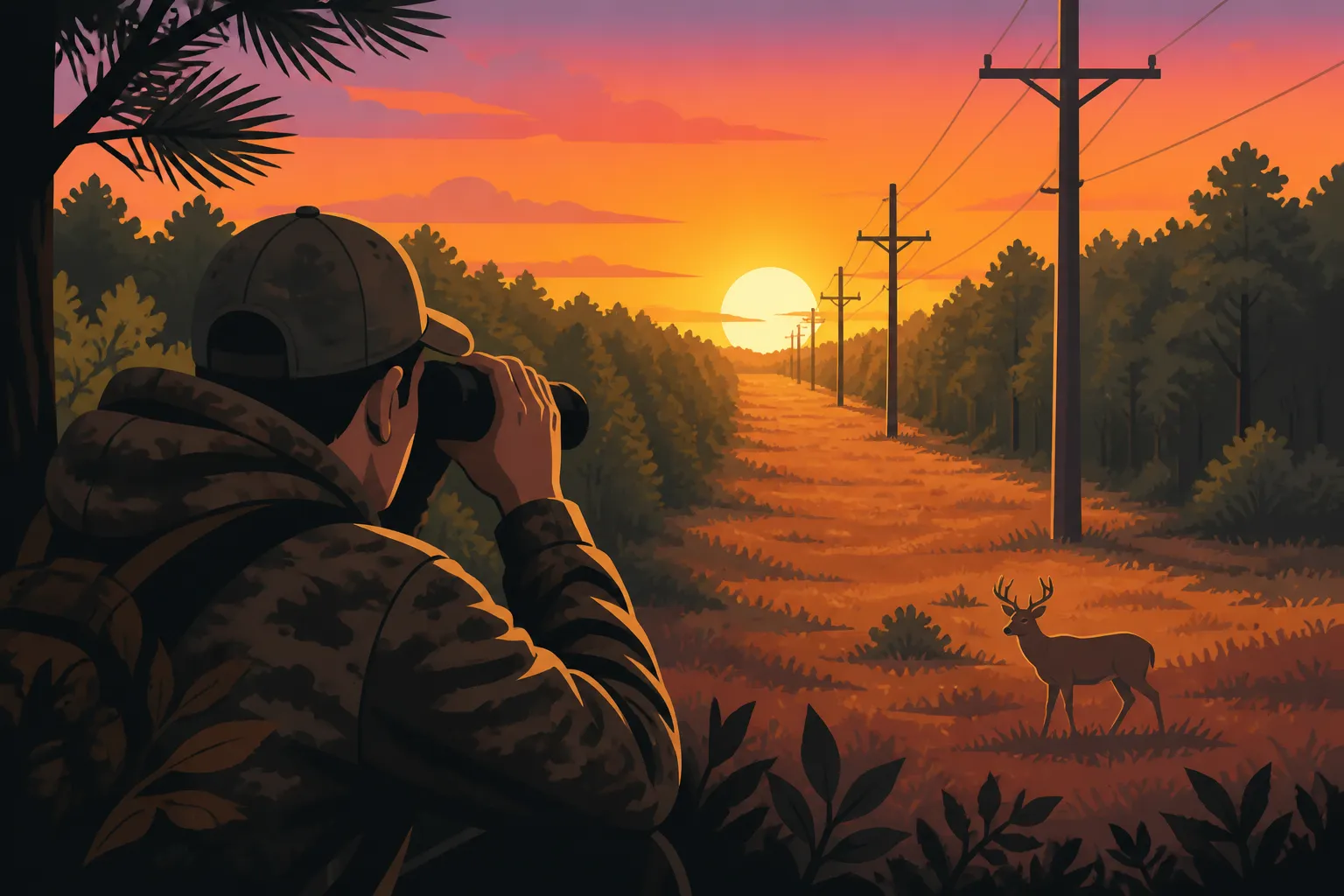
You've sat patiently through the afternoon, the woods quiet save for the chirping of crickets, and that familiar frustration begins to set in. No matter how much scouting you've done, deer can seem to vanish into thin air, only to magically appear at the most inconvenient times. But as the sun dips below the South Carolina horizon, casting long shadows across open spaces, a unique opportunity arises in those often-overlooked powerline cuts. This guide is dedicated to helping you master the art of glassing these critical areas at last light, transforming those fleeting moments into successful hunting strategies.
Understanding Powerline Cuts as Deer Habitat
Powerline cuts, for all their man-made appearance, are incredibly dynamic habitats for white-tailed deer in South Carolina. They aren't just barren strips; they're often ecological magnets, drawing in wildlife for a variety of reasons. Many hunters overlook these areas, assuming they're too open or too disturbed, but a closer look reveals a different story.
Why Powerlines Attract Deer
The primary draw of a powerline cut for deer often comes down to food and cover. Unlike the dense, mature timber on either side, the ground within a powerline right-of-way is regularly maintained, either through mowing, herbicide application, or selective clearing. This disturbance promotes the growth of early successional plants – think tender forbs, young briars, and various browse species that deer absolutely love to munch on. These areas essentially become linear food plots, rich with palatable vegetation that is constantly regenerating. Deer, being opportunists, will frequent these areas to feed, especially when natural mast crops might be scarce or the surrounding timber lacks undergrowth.
Beyond just food, powerline cuts also offer excellent bedding cover, particularly in areas where thick, thorny bushes and dense saplings are allowed to grow up to a certain height. A buck, in particular, might choose to bed just inside the treeline adjacent to the cut, giving him a clear view of the open area while remaining concealed. This creates a fantastic "edge effect" where two distinct habitats — the open cut and the dense woods — meet. This edge is a superhighway for deer movement, providing both food access and secure travel corridors. It's not uncommon to see deer emerge from the dense woods into the powerline to feed, or use the slight depressions and humps within the cut as safe travel lanes to move between different feeding or bedding areas.
Reading the Landscape: Beyond the Obvious
Successfully glassing a powerline cut isn't just about staring into an open field; it's about understanding the nuances of the terrain and how deer utilize them. Many hunters make the mistake of simply scanning the most obvious, wide-open sections. However, the biggest bucks, ever cautious, often stick to the more subtle features. Look for slight dips or swales where a deer can drop down and become nearly invisible, or consider the natural contours of the land. Is there a small ridge or a knoll that breaks up the line of sight? These are prime areas where a deer might feel secure enough to browse before stepping fully into the open.
Pay close attention to where different types of vegetation meet. A transition from short grasses to taller brush, or where a drain crosses the powerline, can be a magnet for deer. They'll often follow these natural lines, using them as cover while moving. Before you even head out, a solid Scouting With the Go Outdoors SC App session, combined with Reading Aerial Photos for Upstate Deer, can reveal key features like subtle bends, small pockets of dense cover, or even old logging roads that intersect the powerline. These are all potential deer magnets. Remember, deer are creatures of habit, and understanding how they use these features can give you a significant advantage.
Essential Glassing Techniques for Low Light
Glassing at last light presents its own unique set of challenges, primarily due to diminishing visibility. You’re not just looking for a deer; you’re looking for movement or a part of a deer that stands out against a fading background. This requires not only the right equipment but also a methodical and patient approach.
Choosing the Right Optics
When it comes to glassing powerline cuts at last light, your binoculars are your most crucial tool. Not all binoculars are created equal for low-light conditions. You'll want to prioritize models with larger objective lenses (the second number in specs like 10×42 or 8×56). A 50mm or 56mm objective lens will gather significantly more light than a 42mm lens, giving you precious extra minutes of usable viewing time. Magnification is also a consideration; while 10x is popular, an 8x magnification often provides a wider field of view and a brighter image in true low light, making it easier to pick up subtle movements. Look for quality glass and coatings that maximize light transmission.
The "exit pupil" is another specification worth noting; it's the size of the light beam that exits the eyepiece and enters your eye. In low light, your pupils dilate, and a larger exit pupil (calculated by dividing the objective lens by the magnification, e.g., 8×56 = 7mm exit pupil) means more light reaches your eye. When you're looking at optics, especially for low-light performance, comparing specs can be a headache. That's where tools like GoHunt can really help, providing detailed gear reviews and user feedback to inform your choices and understand what works best for Binocular Power for Swamp Edge Hunting or open powerline cuts. Good quality binos might seem like a big investment, but they are absolutely worth it when those crucial moments of last light arrive.
| Binocular Specification | Best for Low Light | Why it Matters |
|---|---|---|
| Objective Lens (mm) | 50mm or 56mm | Gathers more light for a brighter image. |
| Magnification (x) | 8x | Wider field of view, often brighter image than 10x in low light. |
| Exit Pupil (mm) | 7mm (or larger) | More light delivered to your dilated pupil. |
| Glass Quality | ED (Extra-Low Dispersion) or HD (High Definition) | Reduces chromatic aberration, provides sharper image. |
| Coatings | Fully Multi-Coated | Maximizes light transmission through lenses. |
Strategic Positioning and Patience
Your position relative to the powerline cut is paramount. You want an elevated vantage point if possible, allowing you to see over the subtle undulations in the terrain. A small hill, a treestand on the edge of the woods, or even the top of a subtle rise can provide this advantage. Always consider the wind direction – even if you're glassing, you don't want your scent blowing out into the area where deer might be moving. Also, try to position yourself with the setting sun at your back, or at least to your side, to avoid looking directly into glare. This backlighting can sometimes silhouette deer against the sky, making them easier to spot, but direct glare is a vision killer.
Once in position, patience is key. Don't just sweep your binoculars quickly across the entire cut. Instead, divide the area into smaller grids and methodically scan each section. Move your binoculars slowly, pausing to thoroughly examine any suspicious shapes, shadows, or variations in texture. Your goal is to become part of the landscape, like a seasoned hunter Hanging a Stand on a Sumter Forest Ridge would. Deer will often pause just inside the treeline for extended periods, scent-checking and observing before stepping into the open. That's why you need to hold still and glass those edges, especially where the timber meets the open cut, over and over again. It’s amazing what you’ll eventually pick out when you give your eyes time to adjust and methodically scour the area.
Using the Last Light to Your Advantage
As the light fades, your eyes and optics need to work together. Instead of looking for an entire deer, which might be obscured by shadows, focus on individual body parts. The horizontal line of a deer's back, the white patch of its throat, the gleam of an eye, or the dark outline of an antler can be the first clues. Look for anything that seems "out of place." Deer often blend in incredibly well, so you're looking for anomalies. A slight flick of an ear, a shift of weight, or a tail twitch can give them away.
When using your binoculars, try to brace yourself against a tree or use shooting sticks to minimize shake, which becomes more pronounced in low light. This steady platform allows you to resolve finer details. Another trick is to look around an object rather than directly at it. Your peripheral vision is often more sensitive to movement in low light. If you suspect you see something, shift your gaze slightly off it, and then bring your eyes back, sometimes the movement will become clearer. This is prime time for deer to be active, especially if you're Hunting the Rut in the Coastal Zones or the Hunting the Rut in the Upstate Zone, as bucks will be on the move. Don't give up until it's too dark to see anything at all; those last five minutes can be the most productive.
Maximizing Your Evening Hunt Opportunity
Glassing a powerline cut at last light isn't just about spotting deer; it's about translating that intel into a successful hunt, whether it's the same evening or the following morning. The decisions you make immediately after spotting game are critical and can determine success or failure.
Planning Your Approach and Exit
If you've spotted a deer you intend to pursue, your next moves must be meticulously planned to minimize disturbance. This is where pre-scouting pays off immensely. Before you even sit down to glass, you should have identified potential routes to approach a deer if you spot one within range. This means knowing the wind, understanding the topography, and identifying any cover that can aid your stalk. A silent entry and exit are paramount. You don't want to alert other deer in the area, or worse, spook the deer you've just located. This is especially true if you are on public land and other hunters are around. Access points like Logging Roads can be helpful for entry and exit, but be mindful of vehicle traffic and noise.
Think about how you'll get out of the woods after dark if you either harvest a deer or simply decide to call it a night. Have a reliable headlamp, mark your trail, and ensure your exit route is quiet and scent-free. The goal is to leave the area as undisturbed as possible, preserving its potential for future hunts. Sometimes, the best move after spotting a deer is simply to watch it until it's too dark to shoot, gaining valuable information without pressuring the animal.
Follow-Up Strategies for Morning Hunts
Often, glassing at last light provides incredible intel for a morning hunt, even if you don't get a shot in the evening. If you watch a deer enter a specific bedding area or cross into a particular section of the woods, you now have a highly educated guess about where that deer might be at first light. After you've spotted a potential target, using a mapping tool like GoHunt to quickly mark the location and then analyze property boundaries or access points can save you a lot of grief the next morning. You can then plan an ambush site between its bedding area and a suspected feeding area, or along a travel corridor you observed.
If the deer you spotted moved off into dense cover, plan to set up very early the next morning, well before first light. Get into position quietly and wait for dawn, ready for the deer to potentially move back towards the powerline cut to feed or stage before bedding down for the day. This is a classic pattern, especially if you're trying to capitalize on Late-Season Food Sources for South Carolina Whitetails, as deer become more predictable with dwindling food options. This evening scouting provides an invaluable head start, giving you a distinct advantage over simply walking into the woods blind.
Common Mistakes and How to Avoid Them
Even with the best gear and intentions, hunters can fall into common traps when glassing powerline cuts at last light. Recognizing these pitfalls and proactively avoiding them will significantly increase your odds of success.
Rushing the Glassing Process
One of the most frequent mistakes is simply being too impatient. The excitement of last light, combined with the pressure of limited time, can lead hunters to rush their scans. They'll sweep their binoculars too quickly, not allowing their eyes to properly adjust, and miss subtle details. Remember that methodical grid pattern we talked about? Stick to it. It's better to thoroughly scan a smaller section of the powerline cut than to quickly skim a larger area and miss the buck that's standing perfectly still, just blending in with the shadows.
Deer are masters of camouflage, and they often know they are being watched. They might stand motionless for several minutes, waiting for you to move on. If you're constantly rushing, you're playing right into their hands. Take a deep breath, slow down, and meticulously examine every clump of grass, every shadow, and every edge. Even if you don't spot anything immediately, continue to scan the same areas repeatedly; often, a deer will reveal itself with a slight movement only after you've looked through your optics several times.
Ignoring Wind and Thermals
It’s easy to get tunnel vision when you’re focused on glassing, but neglecting the wind and thermals can quickly spoil your hunt. As the day cools down, thermals often begin to drop, carrying your scent downhill and into the low-lying areas where deer frequently travel and feed. Even if you're not actively stalking, your scent can alarm deer before they even step into view. Knowing Wind and Thermals on an Upstate Ridge is crucial, as they can swirl unpredictably in these open areas as the day cools, especially in hilly terrain or near water features.
Always check the wind before you position yourself and continue to monitor it. Consider using a wind checker puff bottle to confirm the air currents, particularly as the sun sets and temperatures drop. If the wind shifts unfavorably, you might need to adjust your position, even if it's less ideal for glassing. A deer that smells you is a deer you won't see through your binoculars.
Underestimating Deer Movement Patterns
Deer movement isn't static; it changes throughout the season and even with daily weather patterns. Underestimating these nuances can lead to frustration. For instance, early in the season, deer might emerge earlier in the evening due to warmer temperatures, whereas later in the season, Hunting Deer After a Cold Front might mean they hold tight until the very last light, driven by both hunger and the urge to conserve energy. Understanding deer movement isn't just about reading tracks; it's about predicting where they'll be. Platforms like GoHunt offer advanced mapping features that can help you overlay historical data or analyze habitat types to refine your predictions based on the time of year and local conditions.
During the rut, bucks might be cruising the edges of powerline cuts throughout the day, looking for does, making them less predictable. Conversely, in the late season, deer become highly patternable around specific food sources. Pay attention to how deer move into and out of the powerline cut. Do they always use a particular trail? Do they skirt the edges, or do they boldly walk down the middle? This information, gathered through repeated glassing sessions, helps you build a mental map of their habits. If you don't get a shot, that evening glassing session just became crucial intel for Hunting the Earliest Coastal Zone Opener or planning a morning ambush in the very same spot.
Disclaimer
Hunting involves inherent risks, including injury and death. Always prioritize safety, adhere to all local, state, and federal hunting regulations, and ensure you have the appropriate licenses and permits. The information provided in this guide is for educational and informational purposes only and should not be considered a substitute for professional training or direct experience. Always be aware of your surroundings and hunt responsibly.