Shot Placement on a South Carolina Black Bear
There are few things more disheartening in the hunting world than making a shot on a big game animal and not finding it, especially when that animal is a tenacious black bear. The dense cover and often challenging terrain of South Carolina’s bear country, particularly in the Upstate mountains or the Lowcountry swamps, means that a wounded bear can be incredibly difficult, if not impossible, to recover. This guide is all about giving you the knowledge and confidence to make that critical, ethical shot on a South Carolina black bear, ensuring a swift, humane harvest.
Understanding Black Bear Anatomy for Ethical Shots
Before you even think about pulling a trigger or releasing an arrow, you absolutely need to understand where a bear’s vitals are located. They're not always exactly where you'd expect compared to deer, and misunderstanding this can lead to a long, frustrating, and potentially dangerous tracking job. Ethical hunting starts with responsible shot placement, every single time.
The Vital Triangle: Heart and Lungs
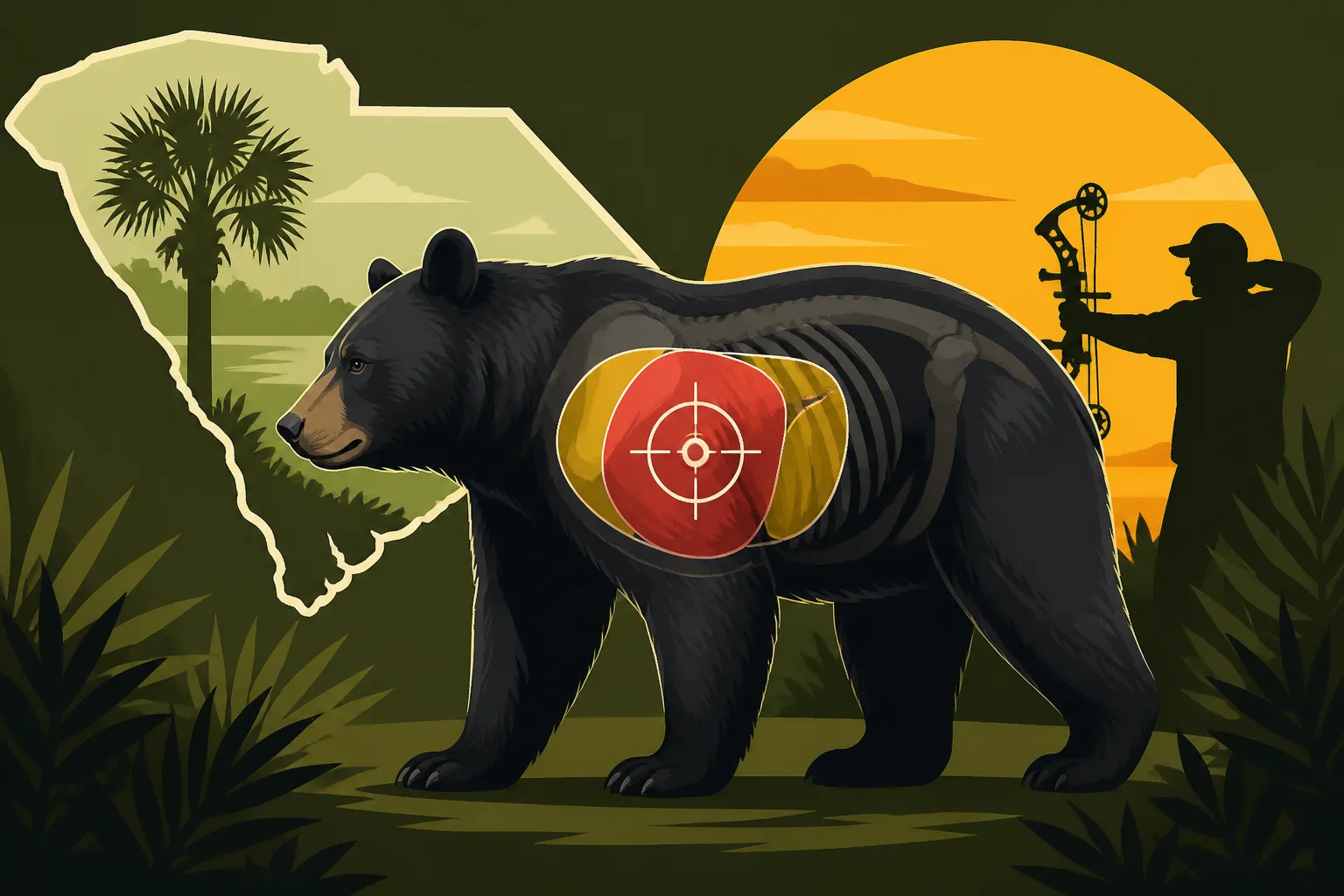
When we talk about ethical shot placement, we're aiming for what hunters often refer to as the "vital triangle" – the area encompassing the heart and lungs. On a black bear, these organs are situated a bit further forward and lower in the chest cavity than on a deer. Imagine a line running up the bear’s front leg, and another line coming across from the bottom third of its body. Where those lines intersect, just behind the shoulder, is your sweet spot.
The lungs are surprisingly large, offering a decent target area, but the heart sits low between the shoulders. A double-lung shot is often ideal, as it typically causes massive hemorrhaging and a quick incapacitation. Aiming for this region means your projectile will pass through both lungs, maximizing damage and reducing the chance of the bear traveling a significant distance. This is your primary target for a humane kill.
It’s crucial to remember that a bear’s fur can be incredibly thick, and their hide is tough. What might look like a perfectly placed shot on a deer could be too far back on a bear. Always lean towards aiming a little more forward than you might instinctively, especially when considering the heart. Think about that front leg crease, roughly a third of the way up from the chest, and place your shot there for maximum effect.
Shoulder Blade Obstacles and Bone Structure
Now, here's where things get tricky. While you want to aim near the shoulder, directly hitting the shoulder blade can significantly reduce penetration, especially if you're using a bow or a lighter caliber rifle. A black bear’s shoulder blades are robust and can effectively shield the vitals if struck squarely. This isn't like hitting a deer's scapula, which might be a concern but often still allows for penetration with modern projectiles. Bears are built like tanks.
The key is to visualize the vitals behind the shoulder blade. If the bear is perfectly broadside, you want to tuck your shot just behind that crease of the leg, avoiding the heaviest bone. For a quartering-away shot, you might aim to enter through the soft tissue behind the rib cage on the opposite side, angling forward to exit through the vitals. Understanding the internal structure, not just the external outline, is paramount.
For rifle hunters, using a well-constructed bullet designed for deep penetration and controlled expansion is vital. Cheap, rapidly expanding bullets might fragment on a bear's shoulder, failing to reach the vitals. Bowhunters need to ensure they have enough draw weight and a stout, sharp broadhead that can punch through hide, muscle, and potentially some bone, to reach those critical organs. Don't underestimate the physical toughness of these animals, whether you’re Hunting South Carolina Black Bear Without Bait in the Upstate or chasing one through a coastal thicket.
Brain and Spine Shots: High Risk, High Reward?
The allure of an instant lights-out kill from a brain or spine shot is undeniable, but for 99% of hunters, these are shots best left to professional culling operations or Hollywood movies. The target areas for the brain and spine are incredibly small, and the consequences of being off by even an inch are catastrophic. A non-lethal hit to the jaw, nose, or lower neck will inflict immense suffering and create an unrecoverable, wounded animal – the absolute antithesis of ethical hunting.
A brain shot requires hitting a very specific, small area between the eye and ear, or directly between the eyes, which on a bear often presents a small, indistinct target depending on the angle of its head. The spine, while running the length of the back, is rarely fully exposed, and even a direct hit might paralyze rather than immediately kill, leading to a lingering death. These are extremely low-percentage shots in a high-stakes scenario.
Unless you have literally thousands of hours of practice shooting at tiny, moving targets under immense pressure, and a deep understanding of bear cranial and spinal anatomy, do not attempt a brain or spine shot. Focus on the larger, more forgiving vital triangle in the chest. Your goal is a humane kill, and consistency in hitting a larger target is far more reliable than attempting a miracle shot.
Shot Angles and Common Hunting Scenarios
Bears, like any wild animal, rarely stand perfectly still and broadside for your convenience. Understanding how different angles affect vital placement is crucial for making an ethical decision in the moment. Remember, if you don't have a high-percentage shot at the vitals, don't take it. Patience is a hunter's best friend.
Broadside Shots: The Ideal Scenario
A broadside shot presents the largest and most accessible target for the heart and lungs. When a bear is standing with its side perfectly perpendicular to you, you're looking for that sweet spot just behind the front leg, roughly one-third to halfway up the body from the bottom line of the chest. Envision the opposite leg, and aim to have your projectile exit just in front of it. This ensures a full pass-through of both lungs and potentially the heart.
The challenge with broadside bears, especially if you're Hunting the South Carolina Rut by Zone for deer and happen upon a bear, is that they can look deceptively large. Their thick fur and dense musculature can obscure the exact location of the vitals. Use visual landmarks: the crease of the front leg, the center line of the body. Don't rush; take a moment to confirm the angle and settle your aiming point. If you’re hunting in areas like the Francis Marion National Forest, where bears are present, a broadside opportunity can be fleeting.
A well-placed broadside shot, particularly with appropriate calibers for Rifle Calibers for South Carolina Bear or a stout bow setup, will often result in the bear running a short distance and piling up. Pay attention to how the bear reacts – a solid kick, a hump in the back, or a quick run often indicates a good hit. Take note of the exact spot the bear was standing and the direction it ran, which will be vital for tracking later.
Quartering Away: A Calculated Risk
A quartering-away shot occurs when the bear is angled slightly away from you, exposing more of its flank and potentially offering a clearer path to the vitals from the opposite side. This can be a very effective shot if executed correctly, but it demands a precise understanding of the bear's internal anatomy and projectile trajectory. You're essentially aiming to enter behind the rib cage on your side, and have the projectile travel through the vitals on the opposite side.
When a bear is quartering away, your aiming point will shift further back than a broadside shot, towards the rear of the ribs, to account for the angle and ensure the bullet or arrow travels forward into the heart and lungs. If you aim where you would for a broadside shot, your projectile will likely exit without hitting the vitals on the opposite side. This is why tools like GoHunt's mapping features can be so helpful; knowing your stand placement in relation to common bear trails can give you an edge in anticipating shot angles.
This shot requires excellent judgment of angles and a good understanding of your projectile's penetration capabilities. A bullet needs to travel through more tissue and potentially more bone. For bowhunters, this can be a more challenging shot as the arrow might have to contend with additional layers of muscle before reaching the vitals. If there's any doubt about the angle or your ability to make the shot, pass on it. A wounded bear is a real possibility with an improperly angled quartering-away shot.
Quartering To and Head-On: Shots to Avoid
These are almost always bad ideas, and frankly, they’re shots that ethical hunters should never take on a black bear. A quartering-to shot means the bear is angled towards you, presenting mostly the shoulder and chest, but with the vitals largely protected by the dense muscle and bone of the shoulder girdle and the sternum. A head-on shot presents an even smaller, less reliable target, with the heaviest bone structure directly facing you.
On a quartering-to bear, the only truly vital area that might be exposed is a small portion of one lung, and getting a projectile through the heavy shoulder structure to reach it is incredibly difficult and inconsistent. You risk glancing off bone, leading to a superficial wound or a non-lethal but debilitating hit. Similarly, a head-on shot offers only the brain as a reliably lethal target, which, as we discussed, is extremely small and difficult to hit consistently.
The risk of simply wounding a bear with a quartering-to or head-on shot is incredibly high. These animals are powerful, can cover ground quickly, and if wounded, can become dangerous to track. It's simply not worth the risk of unethical behavior or personal danger. Always wait for a broadside or a well-angled quartering-away shot. If the bear won't give you one, let it walk. There will be other opportunities, maybe next time you're out Hunting the Earliest Coastal Zone Opener or further upstate.
Practical Tips for Improving Shot Placement Confidence
Even with a perfect understanding of bear anatomy, making the shot in the field when your heart is pounding can be a challenge. Confidence comes from preparation and realistic practice. Don't wait until opening day to find out if you're ready.
Practice, Practice, Practice: Range Time and Field Drills
There's no substitute for consistent practice. This isn't just about punching paper at the local range; it's about simulating real-world hunting scenarios. If you plan to use a rifle, practice from various positions you might encounter in the woods – kneeling, sitting, even off-hand if necessary. Use realistic bear targets, or at least a target with a bear vitals overlay, so you can visualize that "vital triangle." Don't forget to practice with your actual hunting ammunition, as different loads can have different points of impact.
For bowhunters, this means shooting from your treestand or ground blind, wearing your hunting clothes, and under varying light conditions. Practice drawing your bow smoothly and holding steady. Simulate a bear suddenly appearing by having a friend place a target quickly. Practice controlling your breathing and settling your pin or reticle, even when your adrenaline is spiking. This kind of thoughtful, scenario-based practice builds muscle memory and confidence that pays off when a big bear steps out.
It's also important to practice judging distance. In the dense woods of South Carolina, distances can be deceiving. Regularly using your rangefinder and practicing estimating distances to various objects can make a huge difference. Knowing your effective range with your chosen weapon system is critical, especially when Hunting South Carolina's Year-Round Feral Hogs where quick shots might be more common, but bears require more precision.
Knowing Your Gear and Its Limitations
Your equipment plays a significant role in your ability to place a shot effectively. For rifle hunters, choosing the right caliber is paramount. While a .270 or .30-06 might be excellent deer rounds, a black bear often demands something with a bit more punch for reliable penetration and energy transfer. Many experienced bear hunters lean towards calibers like the .308, .30-06, .300 Win Mag, or even larger, especially when considering Rifle Calibers for South Carolina Bear. More importantly than caliber, however, is bullet construction. You need a premium, controlled-expansion bullet that will penetrate deep and retain its weight.
| Shot Type | Recommended Caliber Range | Ideal Bullet Construction | Key Considerations |
|---|---|---|---|
| Rifle | .270 to .300 Win Mag+ | Bonded, Partitioned, Solid Copper | Deep penetration, controlled expansion, weight retention. |
| Archery | 45-60lb+ Draw Weight | Fixed-blade, 2- or 3-blade | Razor sharp, sturdy construction, good FOC. |
For bowhunters, ensuring you have adequate Bow Draw Weight for South Carolina Whitetails (and scaling up for bears) is crucial. A minimum of 45-50 lbs for bears is generally recommended, but more is always better for penetration. Use heavy arrows with high FOC (front of center) for maximum kinetic energy and momentum, and choose a stout, razor-sharp fixed-blade broadhead. Mechanical broadheads can work, but a fixed-blade often offers more reliable penetration on tough bear hide and bone. Make sure your bow is perfectly tuned and your broadheads fly true.
Regardless of your weapon, understand its limitations. What is your ethical maximum range? This isn't just about what your rifle can do on paper, but what you can consistently do in the field under pressure. For many, that might be 150-200 yards with a rifle, and perhaps 30-40 yards with a bow. Stick within those limits. This is particularly important when you're preparing for seasons in South Carolina's Two Bear Hunting Zones, as the terrain can vary dramatically.
Patience and Shot Selection
Perhaps the most critical "tool" in your arsenal is patience. It's easy to get caught up in the excitement when a bear finally steps out, especially after hours of still-hunting or sitting patiently in a stand. However, rushing a shot is the number one cause of poor placement and wounded animals. Take a deep breath. Slow down your heart rate. Wait for the bear to present the absolute best shot opportunity.
This might mean waiting for the bear to turn from quartering-to to broadside, or waiting for it to clear an obstruction. It might mean waiting for it to take one more step into a clearer shooting lane. A mature black bear is a magnificent animal, and affording it the respect of a clean, ethical kill is paramount. If the shot doesn’t feel right, or you can’t clearly identify the vitals, don’t take it.
Using scouting tools and apps like GoHunt can actually help with patience. By thoroughly scouting an area beforehand, understanding bear movement patterns, and identifying optimal stand locations, you can increase your chances of getting a high-percentage shot in the first place. This groundwork helps minimize rushed decisions in the field because you've already put yourself in a position for success. Remember, South Carolina Bear Tag Requirements mean you only get one opportunity per season for many hunters, so make it count.
Tracking and Recovery After the Shot
Even with a perfect shot, a bear can cover ground quickly. Knowing what to do in the immediate aftermath of the shot is just as important as the shot itself for a successful and safe recovery.
What to Do Immediately After the Shot
Once you've taken the shot, resist the urge to immediately jump out of your stand or blind. Remain still and quiet for at least 15-20 minutes for a rifle shot, and up to 30-45 minutes or even an hour for a bow shot, especially if you didn't hear a crash. Listen intently. Did you hear the tell-tale "thwack" of a solid hit? Did the bear react strongly, kick, or run with an arched back? Did you hear it crash within earshot?
Mark the exact spot where the bear was standing when you shot it, and the last place you saw it. Use a piece of blaze orange ribbon, your hat, or an item from your pack. This is critical for establishing a starting point for your blood trail. Before you even start tracking, mentally replay the shot: where did you aim, what was the bear's reaction, what direction did it go, and how far did it travel before it disappeared? This information will guide your tracking efforts. Knowing Where Upstate Mountain Bears Range means understanding how steep and thick the terrain can get, making precise marking even more important.
Blood Trailing and Interpreting Sign
Once you begin tracking, move slowly and deliberately. Look for blood, hair, disturbed leaves, or broken branches. The type of blood can tell you a lot:
- Bright red, frothy blood: Indicates a lung shot. This is excellent sign.
- Dark red, thick blood: Often indicates a liver or muscle hit. The bear might travel further.
- Sparse, watery blood: Could mean a gut shot or a flesh wound. This is a tough trail.
- Hair: White hair usually means a belly shot, darker hair from the back or sides.
Bears don't always leave a profuse blood trail, even with a good hit, due to their thick fur and sometimes heavy fat layers that can seal wounds. If the blood trail is sparse, expand your search pattern. Look for tracks, overturned leaves, or broken twigs. Grid searching with a few patient friends can be very effective. Be prepared for a challenge, especially in the thick undergrowth or swamps typical of South Carolina. Remember, it might be an opportunity to practice skills you use when Tracking a Deer Through South Carolina Pine Straw.
Dealing with a Wounded Bear
This is where safety becomes paramount. A wounded black bear, especially a large boar, can be incredibly dangerous. If you suspect you're on the trail of a wounded bear and the sign indicates it's still alive or might charge, do not proceed alone. Contact the South Carolina Department of Natural Resources (SCDNR) or an experienced bear tracker. If you’re hunting on WMA land, always be aware of Zone 1 Bear Still-Gun Season Rules and any specific WMA regulations for tracking and recovery.
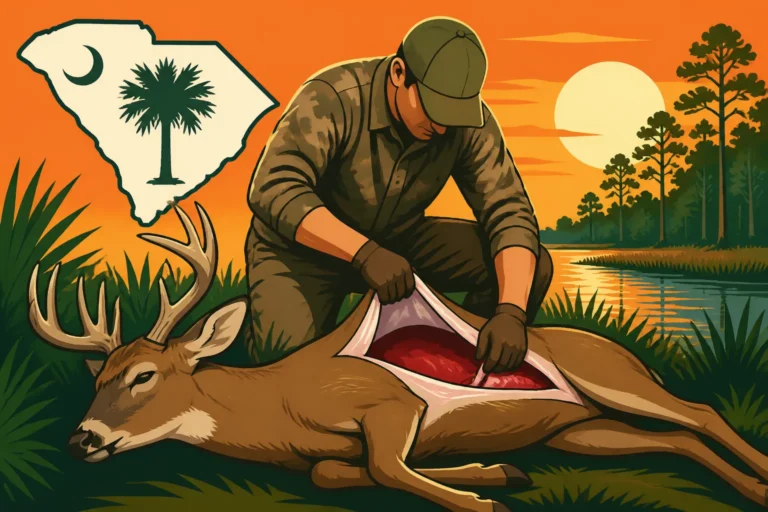
When approaching a downed bear, do so with extreme caution, always from behind, and with your firearm ready. A bear can "play dead" and still be very much alive and capable of charging. Scan the area around the bear for any movement or signs of life before getting too close. The goal is to recover your animal safely and respectfully, and sometimes that means calling in backup rather than risking a dangerous encounter. Always err on the side of caution.
Disclaimer
Hunting involves inherent risks. This guide provides general information on shot placement for South Carolina black bears and is not a substitute for professional hunter education, experienced guidance, or adherence to all local, state, and federal hunting regulations. Always prioritize safety and ethical hunting practices. Conditions and regulations can change, so always consult the latest SCDNR guidelines before heading into the field.