Chesterfield County Public Hunting Ground
It's incredibly frustrating when you're itching to get out into the South Carolina woods, but all you see are "No Trespassing" signs or you're simply unsure where to even begin looking for public land. Many hunters in the Pee Dee region, especially those near the North Carolina border, often feel like they're in a desert when it comes to accessible hunting ground. This guide is here to shed light on the public hunting opportunities in Chesterfield County, South Carolina, helping you cut through the confusion and find productive spots to pursue your passion.
Navigating Public Hunting Opportunities in Chesterfield County
Chesterfield County, nestled in the Sandhills region of South Carolina, offers a unique public hunting experience compared to the coastal swamps or the mountainous Upstate. While it might not boast the same vast expanses of national forest as some other parts of the state, it's home to significant public acreage that provides consistent opportunities for deer, turkey, and small game. Understanding the primary public lands and how they are managed is your first step toward a successful hunt.
Understanding the Sandhills State Forest
When most folks talk about public hunting in Chesterfield County, they're referring to the Sandhills State Forest. This sprawling forest, encompassing over 46,000 acres, is a true gem in the heart of the Sandhills. Unlike the dense bottomland hardwoods or thick pine plantations you might find elsewhere, the Sandhills State Forest is characterized by its longleaf pine savannas, rolling sand ridges, and an understory of scrub oak, wiregrass, and palmetto. It's a remarkably beautiful and ecologically distinct area that offers a challenging yet rewarding hunting experience.
Imagine driving into the forest, and instead of towering oaks and muddy sloughs, you're greeted by endless stands of longleaf pines, their needles creating a soft, rustling carpet underfoot. This habitat is prime for white-tailed deer, wild turkeys, and a variety of small game. Deer here can be elusive, often using the dense scrub oak thickets for bedding cover, making still-hunting or carefully placed stands crucial. Turkeys roam these open woods, often feeding in recently burned areas where fresh greens are sprouting. Don't let the "sand" in Sandhills fool you into thinking it's barren; this ecosystem is vibrant and teeming with wildlife if you know where to look.
Chesterfield County WMA Overlay and Management
It’s important to understand that while it's called Sandhills State Forest, much of the hunting access and rules fall under the South Carolina Department of Natural Resources (SCDNR) Wildlife Management Area (WMA) program. This means that hunters here will be subject to general statewide WMA regulations in addition to any specific rules for the State Forest itself. These regulations are in place to manage game populations, reduce pressure, and ensure safety for all users.
For instance, you might find specific zones within the forest that have different season dates or bag limits than adjacent private lands. Some areas might even be designated for specific types of hunting, like archery-only sections or youth-only hunts during certain times. It’s absolutely critical to consult the most current SCDNR hunting regulations digest for the Sandhills State Forest and the general WMA rules before heading out. I can't stress this enough – showing up on opening morning without understanding the WMA rules can quickly turn a hopeful day into a frustrating one, potentially even leading to a citation. Many WMAs, including sections of State Forests managed as such, require hunters to sign in and out, often through an online portal or at designated kiosks. Always double-check these details to ensure you're in compliance.
Essential Regulations and Access for Chesterfield Public Lands
Navigating the rules and access points for public hunting land can sometimes feel like solving a complex puzzle. But with a little preparation and the right tools, you can ensure your hunt in Chesterfield County is both legal and enjoyable. The Sandhills State Forest, as a public land managed under WMA guidelines, has specific requirements you’ll need to meet.
License and Permit Requirements
First and foremost, every hunter needs a valid South Carolina hunting license. This is your foundational pass to hunt any game in the state, whether on private or public land. However, for hunting deer, turkey, or bear, you'll also need a South Carolina Big Game Permit. This permit is crucial and covers the species that require specific tags or reporting. Beyond that, if you plan to hunt within the Sandhills State Forest, which operates under WMA regulations, you must also possess a South Carolina WMA Permit. This permit grants you access to all designated Wildlife Management Areas across the state, including the portions of the Sandhills State Forest managed as WMA land.
Think of it this way: your basic hunting license is your driver's license, your Big Game Permit is like your endorsement for a specific type of vehicle, and your WMA permit is the special pass you need to drive on certain restricted roads. You can usually purchase all these licenses and permits through the Go Outdoors SC website or at authorized vendors throughout the state. It's always a good idea to buy them well in advance and keep a digital or physical copy readily accessible while hunting. For a deeper dive into what you need, check out South Carolina Hunting Licenses and What They Cost.
Specific Rules for Sandhills State Forest / WMA
Hunting on public land comes with a unique set of rules designed to ensure safety, fair chase, and sustainable wildlife management. On Sandhills State Forest, like most WMAs, you'll encounter specific regulations that might differ from private land. For instance, blaze orange requirements are critical during gun seasons for deer. Typically, you'll need to wear at least 500 square inches of solid outer blaze orange above the waist, visible from all sides. There are also specific rules about tree stands and ground blinds; generally, stands must be temporary and cannot damage trees (no screws, nails, or permanent fixtures). They also usually need to be removed at the end of the season. Treestand Rules on South Carolina Public Land
Vehicle access is another key point. While there are main roads throughout the forest, many smaller roads or fire breaks may be gated or designated for foot traffic only. Always observe signs and gates. Attempting to drive past a closed gate can result in fines and damage to the forest floor. You also need to be aware of the rules regarding Sunday hunting; while private lands have seen expanded Sunday hunting opportunities, public lands, including WMAs, generally have stricter limitations. To learn more about this, see South Carolina Sunday Hunting on Public Land. Before you even leave the house, confirm the specific Sandhills WMA rules in the current year's SCDNR regulations.
Strategies for Hunting Deer and Turkey in Chesterfield County
Hunting in the Sandhills State Forest requires a different mindset and approach than many other areas of South Carolina. The unique ecosystem influences how deer and turkeys behave, and understanding these patterns is key to finding success. You won't be navigating dense swamps or climbing towering mountains, but rather vast pine forests and scrubby ridges.
Deer Hunting Tactics in Sandhills Habitat
The deer in Chesterfield County’s Sandhills are typically smaller-bodied than their Lowcountry counterparts, but they're incredibly resilient and well-adapted to their environment. Their primary cover is the dense thickets of scrub oak, often impenetrable to humans, which line the sandy ridges and low-lying areas. During archery and early gun seasons, these deer will be feeding heavily on acorns from various oak species, as well as native browse like huckleberry and gallberry. Late in the season, if any green fields or food plots are maintained by SCDNR (check WMA specific maps), these can become deer magnets.
Still-hunting can be very effective here, especially on cool, damp mornings when the pine straw is quiet. Move slowly, pause frequently, and glass ahead, focusing on the edges of thickets where deer might be moving to or from bedding areas. Scouting before the season is absolutely paramount. Look for rubs and scrapes along logging roads and powerline cuts, which act as natural travel corridors. Pay close attention to subtle changes in elevation – even a slight ridge can serve as a travel route or a bedding area. Scouting South Carolina Public Land Before Season Using a mapping app like onX Hunt is incredibly helpful here to identify these subtle contours and visualize the dense cover.
Spring Turkey Hunting in the Sandhills
Spring turkey hunting in the Sandhills offers a fantastic experience, with gobblers often roosting in the tall longleaf pines that dominate the landscape. The terrain provides good visibility in many areas, allowing hunters to see and hear birds from a distance. However, it also means the turkeys have good visibility, so remaining unseen is critical. During the early morning, listen intently for gobblers sounding off from their roosts. Once you locate a bird, the challenge becomes getting close enough to set up without spooking it.
Run-and-gun tactics can be effective in this open, rolling terrain. Don't be afraid to move, stopping every few hundred yards to listen for a gobble. When you do get a response, try to get ahead of the bird's likely travel path or set up between him and a known strutting zone. Fan calls or soft clucks and purrs can often entice a curious gobbler to close the distance. Be patient, and don't overcall. Run-and-Gun Turkey Tactics on Public Land Often, a single, well-placed setup against a large pine or a cluster of scrub oaks, combined with minimal, realistic calling, is all it takes. Remember, turkeys in the Sandhills are often very responsive to calls, but they are also incredibly wary.
Additional Game and Tools for Success in Chesterfield County
While deer and turkey are often the main draw, Chesterfield County's public lands offer much more for the dedicated hunter. Plus, having the right tools and knowing how to use them can drastically improve your chances of success, especially on unfamiliar public ground.
Small Game and Feral Hogs
Beyond the pursuit of big game, the Sandhills State Forest is home to healthy populations of small game. Squirrels, both gray and fox squirrels, are abundant, especially in areas with mature hardwoods mixed into the pine stands or along creek bottoms. Rabbit hunting can be productive in thick brushy areas and along field edges, often providing great opportunities after deer season has closed. Squirrel and Small Game Hunting in South Carolina While wild bobwhite quail populations are not what they once were, diligent hunters might still find coveys in areas managed with prescribed burns, which create ideal habitat.
Feral hogs are also present throughout the Sandhills State Forest, and they can be hunted year-round on private land and generally during established hunting seasons on WMAs, often with no bag limit. These intelligent and destructive animals provide an exciting challenge and excellent table fare. Look for their rooting signs in moist areas, along creek banks, and near food sources. Hunting hogs can be an excellent way to extend your time afield and contribute to managing a challenging species. Hunting South Carolina's Year-Round Feral Hogs
Utilizing Technology for Public Land Navigation
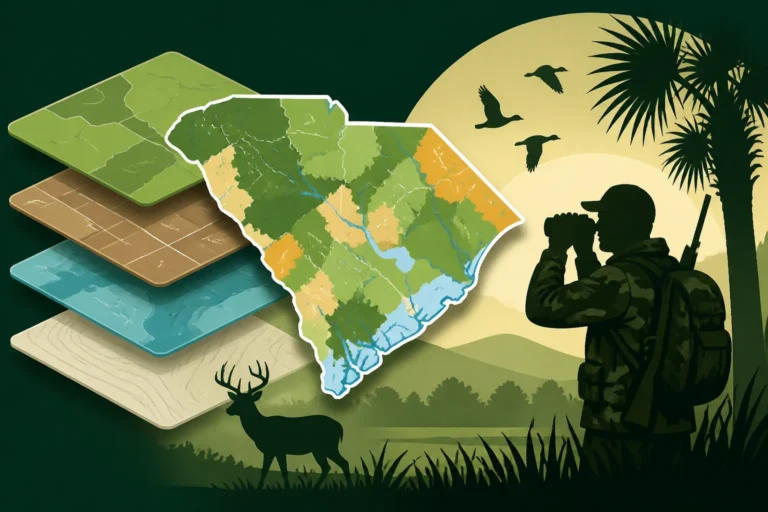
Hunting public land, especially a large, somewhat uniform area like the Sandhills State Forest, benefits immensely from modern technology. A reliable mapping application like onX Hunt or GoHunt is an absolute game-changer. These apps allow you to view public and private land boundaries, identify WMA overlays, mark stand locations, pinpoint potential food sources, and even track your movements. For example, using onX Hunt, you can clearly see the perimeter of the Sandhills State Forest, ensuring you don't inadvertently stray onto private property. You can also layer topographical maps to find those subtle ridges or drainage features that deer often utilize.
Before heading into areas with spotty cell service, make sure to download offline maps for your chosen hunting grounds. This ensures you'll have access to all your crucial information, even when you're deep in the woods. These tools are invaluable for navigating, scouting, and ensuring you're compliant with property lines and WMA regulations. Think of it as a modern-day compass and paper map, but with far more detail and real-time positioning. Don't leave home without it. For general scouting, even the Go Outdoors SC app can provide valuable insights on WMA rules and locations. Scouting With the Go Outdoors SC App
| License/Permit Type | Description | Required for Public Land in Chesterfield? |
|---|---|---|
| SC Resident Hunting License | Basic license for SC residents to hunt all legal game. | Yes |
| SC Nonresident Hunting License | Basic license for non-SC residents to hunt all legal game. | Yes |
| SC Big Game Permit | Essential for deer, turkey, and bear hunting. | Yes |
| SC WMA Permit | Required for hunting on designated Wildlife Management Areas and most State Forests with WMA rules. | Yes |
| Federal Migratory Bird Stamp | Necessary for hunting migratory birds (ducks, geese, etc.). | If hunting waterfowl |
| HIP Certification | Required for hunting migratory birds (doves, ducks, etc.). | If hunting migratory birds |
Disclaimer
This article is for general informational purposes only and does not constitute professional advice. Laws, prices and regulations vary by location and change over time. Consult a qualified professional for guidance on your specific situation.