Timber Cuts and Where Deer Move After
It's incredibly frustrating, isn't it? You spend months, maybe even years, scouting a prime piece of South Carolina timber, only to arrive one morning and find that the forest you knew is gone, replaced by a tangled mess of stumps and slash. Your heart sinks as you wonder where all the deer went, feeling like all your hard work has been undone. But here’s the thing: timber cuts, while jarring initially, aren't necessarily the end of your hunting spot. In fact, they can transform into some of the most productive areas for deer, if you understand how deer adapt and how to adapt your hunting style right along with them. This guide will help you decipher the impact of different timber operations and provide strategies for consistently finding deer in these dynamic landscapes.
The Immediate Impact of Timber Operations on Deer Habitat
When the chainsaws start humming and the heavy machinery rolls in, it’s a seismic event for the local deer herd. They don't have a calendar telling them when the loggers are coming, so the sudden intrusion is a huge shock to their system. Understanding this initial disruption is key to predicting their immediate movements.
Disruption and Displacement
Think about it from a deer's perspective. One day, their world is a quiet, shaded forest, full of familiar trails and bedding spots. The next, it's a cacophony of engines, grinding metal, and falling trees. This intense noise and human presence is enough to send most deer packing, at least temporarily. They'll seek the path of least resistance, which usually means heading for the nearest patch of untouched woods.
This displacement isn't always far-reaching. Deer might only move a few hundred yards into an adjacent thicket, a dense creek bottom, or an unlogged finger of woods that offers immediate security. They're still in the neighborhood, just taking refuge from the chaos. However, if the timber operation is massive and leaves no immediate cover, they might vacate the entire area until things settle down. This initial "ghost town" phase can last a few days or even a couple of weeks, depending on the intensity and duration of the logging.
Loss of Shelter and Security
Mature timber, especially stands with a dense canopy and decent understory, provides crucial thermal cover in winter and shade in summer. More importantly, it offers a profound sense of security for deer. They feel hidden from predators, whether that's a coyote or a hunter. When a significant portion of this timber is removed, it strips away that vital sense of safety.
Clear-cuts, in particular, expose deer to the elements and to any eyes scanning the landscape. This vulnerability means that deer using newly cut areas will be incredibly cautious. They'll often skirt the very edges of these exposed sections, hugging the remaining timberline, or venture into the wide open only under the deepest cover of darkness. The remaining thickets, small patches of untouched woods, or even narrow strips along property lines become hyper-important sanctuaries that deer will cling to until the new growth provides better cover. Don't underestimate the magnetic pull of a small, unlogged gully or a dense patch of yaupon holly near a fresh cut.
Understanding Different Timber Cut Types and Deer Response
Not all timber cuts are created equal, and knowing the difference can drastically alter your hunting strategy. Each type of cut creates a unique habitat dynamic that deer will utilize in different ways, and at different times throughout the regeneration cycle.
Clear-Cuts: From Desolation to Deer Haven
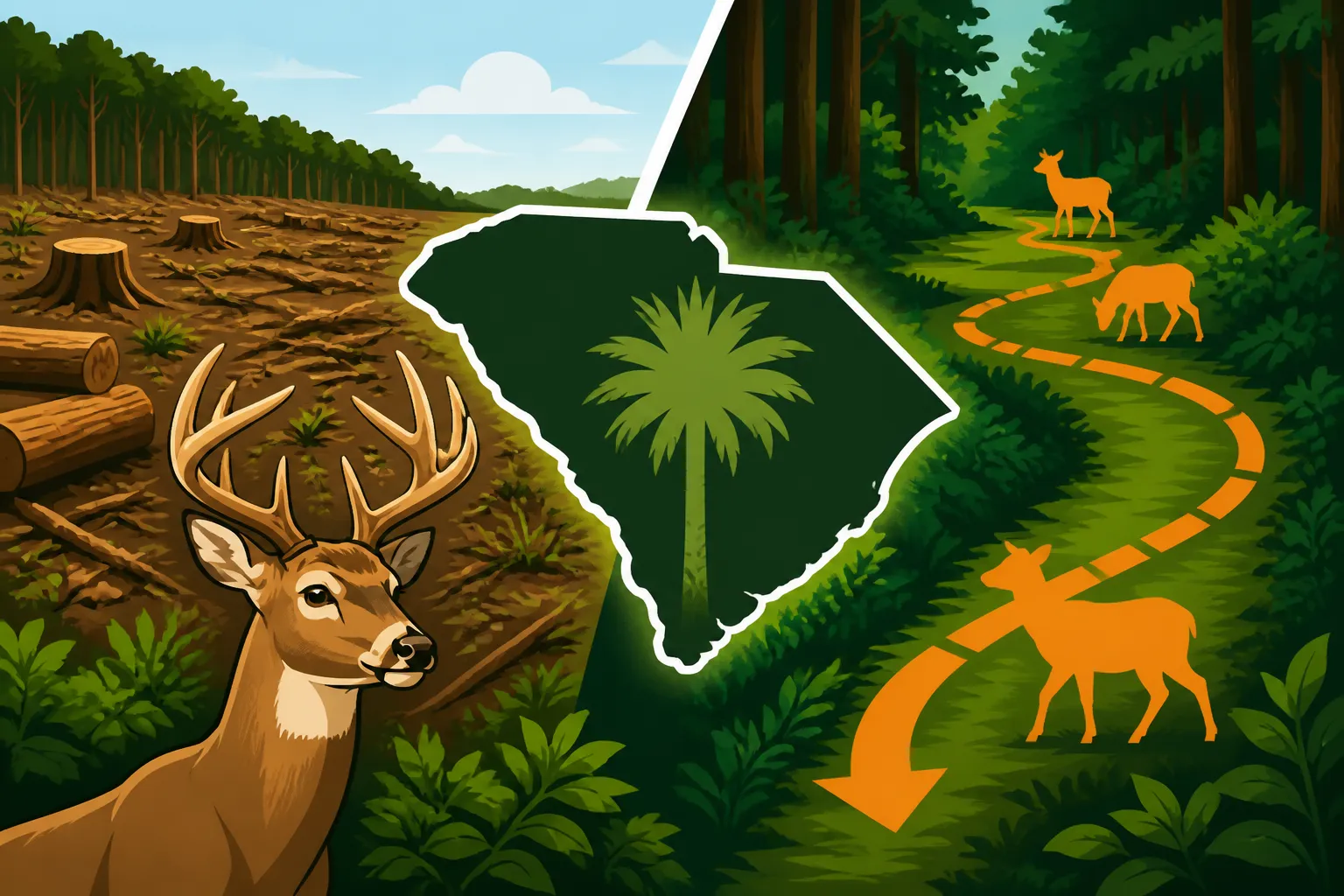
A clear-cut is perhaps the most dramatic change you’ll see. The land is essentially stripped bare of its trees, leaving behind stumps, logging debris (slash), and often churned-up soil. Initially, it looks like a wasteland, and deer will indeed avoid it. They simply cannot survive in a barren landscape. However, this apparent desolation is often a temporary phase before a phenomenal transformation.
In the short term, say the first one to three years after a clear-cut, the sunlight hitting the forest floor unleashes an explosion of new growth. Forbs, grasses, blackberry briars, and various hardwood saplings shoot up with incredible vigor. This isn't just "weeds"; this is a deer buffet. At this stage, deer will venture into the clear-cut, often during low-light hours, to browse on this rich new food source. They'll use the remaining timber edges as staging areas and quick escape routes. You might not see them bedding in the clear-cut yet, but they're certainly visiting. You can often find heavy browse lines along the perimeter of these younger clear-cuts, especially where they meet a mature timber stand or a dense swamp. This is where you want to focus your attention, as deer will often parallel these edges as they enter and exit. For more on these areas, check out Reading a Clear-Cut Regrowth Edge.
Fast-forward to the mid-term, roughly three to seven years out, and that clear-cut has become an impenetrable fortress of thick, dense regeneration. The pine saplings are shoulder-to-head high, interwoven with briars and brush. This stage is a deer heaven for bedding and security cover. Bucks, especially, will often bed deep within these thickets, feeling incredibly safe. Hunting these areas becomes a completely different ballgame; you're often still-hunting slowly, looking for small lanes or relying on deer drives with a few buddies. Movement within these thick cuts might be slower and more deliberate, with deer often creating tunnels through the vegetation. Locating these tunnels or natural openings, and setting up a ground blind or a well-placed stand on a slightly higher knoll overlooking these pockets, can be incredibly effective.
Eventually, in the long term (seven-plus years), the planted pines grow taller, and their canopy begins to close, shading out the understory. The once-abundant browse diminishes, and the clear-cut becomes less attractive as a primary food source or dense bedding area, though it still offers decent security cover. Deer patterns will shift again, often back to the edges or seeking out areas that are being thinned or clear-cut anew.
Thinning and Selection Cuts: Subtle Shifts, Big Opportunities
Not all logging operations involve completely flattening a forest. Sometimes, timber companies perform less invasive cuts that, while still disruptive, can create immediate and lasting benefits for deer.
Thinning involves removing a percentage of trees, typically pines, to reduce competition and promote the growth of the remaining, higher-quality trees. The effect on deer habitat is almost universally positive. By opening up the canopy, more sunlight reaches the forest floor, stimulating the growth of herbaceous plants, forbs, and desirable browse species. This immediately increases the available food for deer within the thinned stand itself. While the initial noise might push deer out for a few days, they often return quickly to take advantage of the new food sources.
Furthermore, thinning creates more open "lanes" and better visibility within the woods. This can make it easier for hunters to spot deer moving through, but it also creates more defined travel corridors that deer will use. Bucks often appreciate the slightly more open understory for navigating quietly, yet still having plenty of visual cover from the remaining trees. Think of it as creating a more navigable, yet still secure, environment. You might find deer still-hunting through a thinned pine stand, browsing as they go, feeling secure in the scattered cover. These thinned areas, particularly in South Carolina's Hunting Longleaf Pine Savanna for Deer regions, can become exceptional places to ambush deer.
Selection cuts are even more targeted, where individual trees or small groups of trees are harvested based on specific criteria. This method is the least disruptive to the overall forest structure. The impact on deer is generally positive, as it mimics natural disturbance more closely. Deer adapt very quickly to selection-cut areas, taking advantage of increased sunlight and new browse that springs up in the small openings. These cuts often lead to a more diverse, multi-aged forest, providing a wider variety of food and cover types for deer over time. They don't typically displace deer for long, and in many cases, deer will simply shift their patterns slightly to take advantage of the new food sources that emerge.
Here’s a quick comparison of these timber operations:
| Cut Type | Immediate Impact on Deer | Short-Term (1-3 yrs) | Mid-Term (3-7 yrs) | Long-Term (7+ yrs) | Hunting Challenge |
|---|---|---|---|---|---|
| Clear-Cut | High disruption, displacement | High food availability (browse) | High bedding/security cover, food | Reduced food/cover, taller pines | Visibility, penetration |
| Thinning | Moderate disruption | Increased food/visibility | Improved food/travel corridors | Good cover, less browse | Patterning travel |
| Selection | Low disruption | Mild increase in food | Diverse habitat, consistent use | Stable habitat, consistent use | Finding specific pockets |
Adapting Your Scouting and Hunting Strategies
So, the timber has been cut, and the landscape has changed. Now what? Your old stand locations might be gone, or they might be completely ineffective. This is where adaptation comes in. Don't be discouraged; embrace the new opportunities.
Re-Scouting with a Fresh Perspective
The first step after a timber cut is to throw out your old map, metaphorically speaking, and start fresh. Your mental map of deer trails and bedding areas is likely outdated. This is where modern tools become absolutely invaluable. Apps like onX Hunt and GoHunt allow you to see the new cuts on aerial imagery, often updated relatively quickly. You can literally watch the landscape change from your couch. Use these tools to identify the new edges, the remaining timber fingers, and any unlogged strips along creek bottoms or property lines that now stand out as prime security cover.
Once you have a general idea from your map, it’s time to hit the ground. Focus your scouting efforts on these transition zones. Look for new pinch points where deer are forced through a narrow strip of cover between a clear-cut and a field, or where a logging road now creates an easy travel lane through dense regrowth. Deer are creatures of habit, and they will establish new patterns surprisingly quickly around these altered features. Pay close attention to the new funnels created by the cut. A deep gully or a small drainage that was once just part of the general timber might now be a crucial travel corridor. This intense re-scouting effort, as detailed in Scouting South Carolina Public Land Before Season, will be the cornerstone of your success.
Don't forget to scrutinize the aerial photos for those subtle changes, as taught in Reading Aerial Photos for Upstate Deer. A slight ridge that was once insignificant might now provide a critical vantage point for deer to survey the new clear-cut before entering. Look for isolated pockets of cover within or adjacent to the cut-over; these are often overlooked by other hunters and can be goldmines for bedding.
Hunting the Edges and Internal Thickets
With the landscape rearranged, your stand placement needs a complete overhaul. The edges of any timber cut are often the most productive places to start, especially in the first few years after the cut. Deer, still wary of the open spaces, will "stage" in the mature timber just inside the cut's perimeter before venturing out to feed. Setting up a stand on one of these interior edges, downwind of a suspected entry point, can be incredibly effective.
As the clear-cut or thinned area grows into a dense thicket, deer will begin to bed inside it. This is particularly true for mature bucks seeking maximum security. Hunting these internal thickets requires a different approach. Still-hunting slowly, often from a ground blind, through these dense areas can be highly effective, but it’s hard work and requires extreme patience. You’ll need to focus on identifying subtle trails or small openings that deer use to navigate. A well-brushed-in ground blind, as discussed in Using a Ground Blind on South Carolina Public Land, placed strategically on a high point within the cut-over, overlooking a natural travel lane, can provide excellent opportunities without spooking deer in the open. For the very edges, especially where a cut meets a field, refer to Setting Up on a Lowcountry Field Edge.
Remember to always prioritize wind direction and thermals, especially when hunting edges or venturing into new clearings. The increased exposure means deer are even more sensitive to human scent and movement. A slight thermal shift can carry your scent right into a bedding area you never knew existed.
Patience and Persistence
The biggest challenge with hunting timber cuts is that deer patterns aren't static. They evolve as the vegetation grows and their sense of security changes. Your initial success might come from ambushing deer on the edges, but a few years later, you might need to shift to still-hunting deep within the cut. This requires immense patience and a willingness to constantly adapt.
Don't get discouraged if your first few hunts in a newly cut area are slow. It takes time for deer to settle into new routines and for you to learn them. Experiment with different times of day – early mornings and late evenings for deer feeding on the edges, and midday for still-hunting bedding areas within the thickest parts of the cut. Don't be afraid to try new entry and exit routes to minimize disturbance. You're trying to figure out a completely new puzzle. By paying attention to details and being persistent, you'll often find that the areas others walk past, thinking they're "ruined," actually hold the biggest bucks. This kind of dedication to finding overlooked spots is key, as explored in Finding Ground Others Walk Past.
Long-Term Habitat Changes and Deer Population Dynamics
While the immediate shock of timber operations can feel destructive, from an ecological and long-term deer management perspective, they are often beneficial. These disruptions are a natural part of forest succession and can lead to healthier, more robust deer populations.
Regenerating Forests as Deer Factories
Consider the life cycle of a forest. A mature, unbroken canopy might be beautiful, but it often shades out the understory, limiting the growth of browse plants that deer rely on. Timber operations, particularly clear-cuts, reset this cycle. By letting sunlight hit the forest floor, they kickstart a massive burst of new plant growth, creating a "deer factory." This regenerating habitat provides an abundant and diverse food source for many years.
These young, thick forests also offer unparalleled security and bedding cover, which is crucial for fawn survival. With dense cover to hide in, fawns are better protected from predators, leading to higher recruitment rates. While mature bucks might initially move out, they will often return to utilize these regenerating areas for both food and bedding once sufficient cover has grown. Many of the highest deer densities in South Carolina are found in areas with a mosaic of different forest ages, including active timber management.
Management Practices and Future Hunting Opportunities
Understanding the landowner’s or land manager's long-term plan for a timber cut can give you a significant advantage. Is it destined to become a pine plantation, replanted uniformly with fast-growing loblolly? Or is it being allowed to regenerate naturally with a mix of hardwoods and pines? These different trajectories will influence how deer use the area in the years to come. Pine plantations will eventually grow tall and thin, reducing food, while natural regeneration might offer more consistent browse over a longer period.
Many timber companies and state agencies (like the SCDNR on Wildlife Management Areas) often integrate wildlife management practices into their timber plans. This can include leaving buffer strips along creeks, creating wildlife openings, or conducting prescribed burns. These efforts, such as those discussed in Habitat Work on South Carolina WMAs, are designed to enhance deer habitat and can create fantastic hunting opportunities. For instance, a firebreak along the edge of a clear-cut might be planted with clover, creating a perfect food plot that deer will frequent. Always look for these intentional wildlife enhancements, as they are specifically designed to concentrate deer. Even if you're hunting private land, knowing what a property owner intends to do with their timber after a cut can inform your future strategies, perhaps leading to conversations about Hunting a Green Field Planted for Deer to maximize the new open ground.
The dynamic nature of timber cuts means that your hunting strategy can never truly be static. But by understanding the phases of forest regeneration and how deer respond, you can turn what initially feels like a loss into a new, exciting challenge and consistently find success in the diverse hunting landscapes of South Carolina.
Disclaimer
This article is for general informational purposes only and does not constitute professional advice. Laws, prices and regulations vary by location and change over time. Consult a qualified professional for guidance on your specific situation.