Where South Carolina Turkeys Are Densest
Finding that sweet spot where wild turkeys seem to be everywhere, vocal, and ready to play ball can feel like discovering a hidden treasure in South Carolina. Many hunters spend countless hours in the woods, hearing nothing, only to wonder if they're even in the right zip code for turkeys. This comprehensive guide is here to shed light on where South Carolina's turkey populations are densest, helping you pinpoint those prime gobbler territories and increase your chances of a successful spring hunt.
The Quest for High-Density Turkey Habitat in South Carolina
Hunting wild turkeys in South Carolina is a truly special experience, but it’s no secret that some areas hold far more birds than others. It can be incredibly frustrating to scout a promising-looking piece of woods, only to find sparse sign or hear nary a gobble. You're out there, putting in the miles, doing everything right, but if the birds simply aren't concentrated in that particular area, your efforts feel like they're falling flat. That's why understanding turkey density and the factors that create it is absolutely crucial for any serious hunter in our state. It's about working smarter, not just harder, to put yourself in a position where the odds are more in your favor.
Why Turkey Density Matters to Hunters
When you're hunting in an area with a high density of wild turkeys, several aspects of the hunt become significantly easier and more productive. First, simply locating birds becomes less of a needle-in-a-haystack endeavor. You're more likely to hear multiple gobblers sounding off from the roost, giving you options and allowing you to choose the most approachable bird. Instead of settling for the one distant gobble you might hear all morning, you might have three or four birds competing for your attention.
Furthermore, a higher density often means more active birds throughout the day. You'll encounter more tracks, droppings, dusting bowls, and feather piles, which are all indicators of consistent turkey activity. This abundance of sign not only boosts your confidence but also provides invaluable information for setting up and calling. You're also more likely to encounter birds strutting in open fields or crossing logging roads, which can be critical for filling your South Carolina Spring Turkey Bag Limit. It just makes the whole experience more engaging and less about endless, quiet wandering.
Factors Influencing South Carolina's Turkey Distribution
Wild turkeys, like all wildlife, thrive where their essential needs are met, and South Carolina's diverse landscape offers a patchwork of suitable habitats. The density of turkeys in any given area is a direct reflection of the quality and availability of these resources. Primary forests with a mix of mature hardwoods, especially oaks that produce acorns, are paramount. These mast crops provide a critical food source, particularly during the leaner winter months. Think about those big Sumter National Forest ridges or deep bottomland hardwoods; these areas are goldmines for foraging birds.
Beyond food, turkeys need suitable roosting sites, typically tall, mature trees near water or on prominent ridge lines, offering safety from predators. They also require open understory for easy movement and foraging, interspersed with dense cover for nesting, brooding, and escape. This mosaic habitat, often found on well-managed private lands or specific public land tracts, supports robust populations. Predators, disease, and hunting pressure also play a significant role, but generally, where habitat is ideal, turkey numbers tend to be higher. Learning about South Carolina Turkey Population Trends can help you understand the broader picture across the state.
Pinpointing South Carolina's Turkey Hotbeds
While turkeys are found in all 46 counties of South Carolina, their distribution is far from uniform. Certain regions and even specific types of terrain within those regions consistently hold higher concentrations of birds. It's not just about guessing; it's about understanding the land and how it caters to a turkey's needs. From the rolling hills of the Upstate to the sprawling flatwoods of the Lowcountry, each area presents unique challenges and opportunities for turkey hunters. Knowing where to focus your efforts can make all the difference, especially when spring fever is in full swing.
The Upstate Mountains and Foothills
The Upstate region, particularly the mountainous areas of Oconee, Pickens, and Greenville counties, as well as the adjoining foothills, is a recognized stronghold for wild turkeys. Here, the rugged terrain provides vast expanses of mature hardwood forests, which are absolutely vital for wild turkeys. These forests offer abundant mast crops like acorns, hickories, and beechnuts, which are essential food sources, especially in the fall and winter, helping birds build up reserves for the demanding spring breeding season. The varied topography also creates numerous natural funnels and drainage systems that turkeys frequent.
While the steep hills can make for a challenging hunt, they also provide natural barriers that can limit human access in some spots, leading to pockets of less pressured birds. Imagine the satisfaction of calling a gobbler off a remote ridge in the Andrew Pickens Ranger District; it's an experience unlike any other in the state. Hunters often find success by listening from high points at first light, then working into the drainages where birds often spend their day foraging. These dense, mature woodlands offer excellent roosting habitat and diverse food sources, making it a reliable area for those willing to put in the legwork.
The Midlands and Sandhills
Moving south and east into the Midlands and Sandhills regions, you'll find another significant concentration of turkeys. This area presents a blend of agricultural fields, extensive pine plantations, and critical river bottomland hardwoods, all of which contribute to excellent turkey habitat. Counties like Fairfield, Kershaw, Newberry, and Chester are often cited as areas with strong turkey numbers due to this diverse landscape. The edges where agriculture meets timber provide incredible food sources, drawing birds out into the open, while the dense woods offer security.
River systems, such as the Broad, Saluda, and Congaree, create fertile bottomland forests that act as superhighways and feeding grounds for turkeys. These areas are rich in insect life and soft mast, which are crucial for poult survival. A lot of private land here is managed for timber and wildlife, which can create ideal conditions. Public land hunters might explore areas adjacent to these river systems, looking for similar habitat features. The mixed-use landscape here provides both the wide-open spaces turkeys love for strutting and the thick cover they need for nesting, leading to robust populations.
The Lowcountry and Coastal Plain
While the Lowcountry and Coastal Plain might seem like a challenging place for turkeys with its vast swamps and dense thickets, certain parts boast incredibly high densities, often rivaling or even exceeding other regions. The key here is the mosaic of habitat types, particularly around large agricultural operations and well-managed private timberlands. Counties such as Colleton, Hampton, Orangeburg, and Clarendon, especially those with significant river systems like the Edisto, Combahee, and Santee, can be phenomenal. The birds here have adapted to the unique environment.
Managed pine plantations, when thinned and burned properly, provide excellent open understory for foraging and bugging, while the vast cypress-tupelo swamps offer isolated, predator-safe roosting sites. The combination of agricultural fields providing reliable food sources (like corn and soybeans) and the dense, often impenetrable, swamp and upland cover for security and nesting creates ideal conditions. While navigating the dense cover and water can be tough, those who learn to read the Lowcountry landscape often find incredible success. Places like parts of the ACE Basin can be exceptional for turkeys, but demand a different approach due to the terrain. Hunters should also consider Hunting Lowcountry Swamp Deer for similar habitat insights.
General Density by Region (Illustrative)
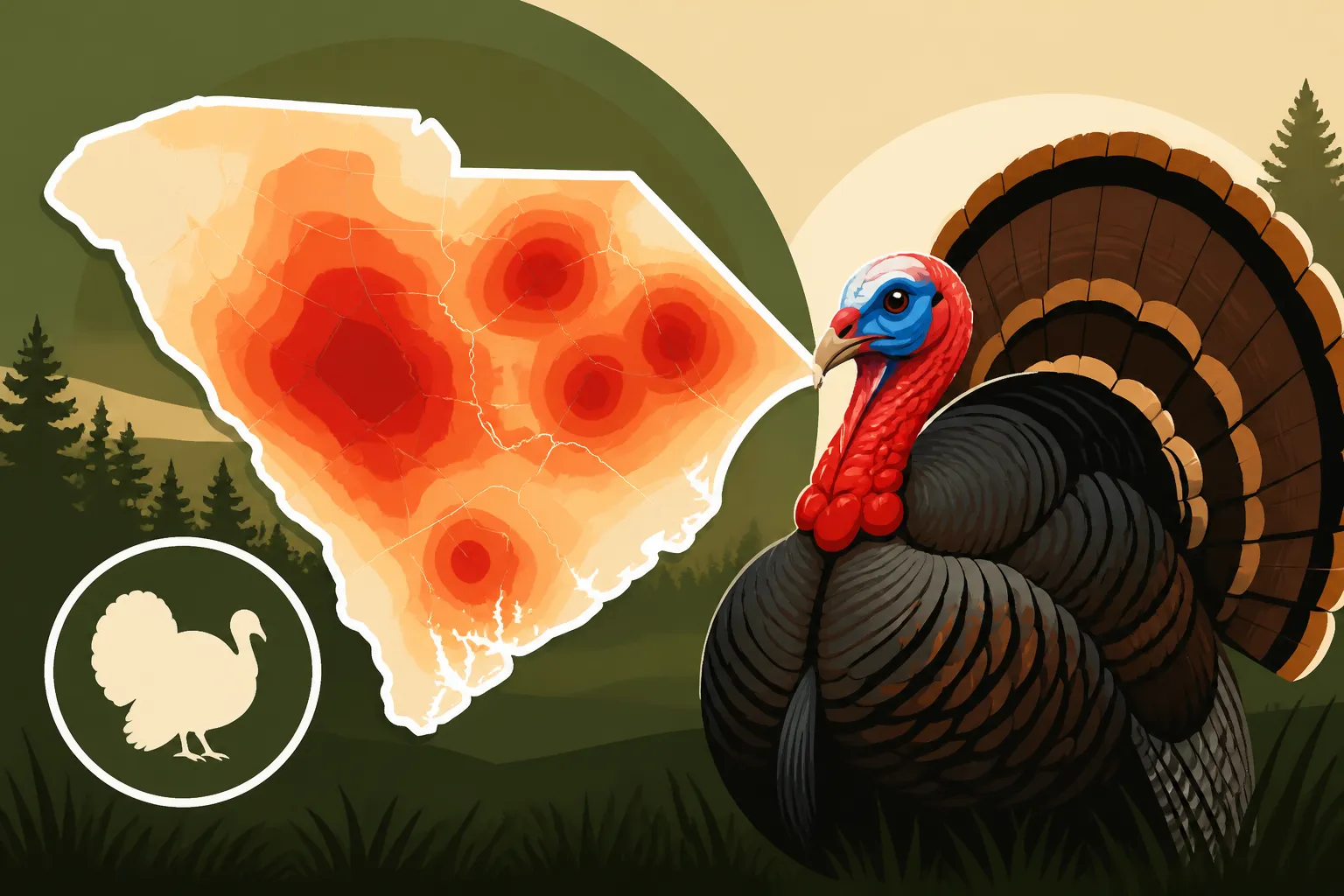
To give you a clearer picture, here's a general, illustrative breakdown of where you might expect to find higher concentrations of turkeys across the state. Remember, this is a simplification, and pockets of high or low density can exist within any region based on local habitat quality and management.
| Region | Dominant Habitat Types | General Turkey Density | Key Counties (Examples) | Challenges |
|---|---|---|---|---|
| Upstate Mountains | Mature Hardwood Forests, Steep Topography, Pine Ridges | High | Oconee, Pickens, Greenville | Rugged terrain, steep climbs |
| Upstate Foothills | Mixed Hardwoods/Pines, Smaller Farms, Rolling Hills | High | Anderson, Spartanburg, Cherokee | Variable public land access |
| Sandhills | Longleaf Pine Forests, Scrub Oak, Sand Ridges | Moderate to High | Chesterfield, Sumter, Aiken | Sparse water in some areas |
| Midlands | River Bottom Hardwoods, Agriculture, Pine Plantations | High | Fairfield, Newberry, Lexington, Kershaw | High private land ownership |
| Upper Coastal Plain | Agriculture, Managed Pine, Cypress-Tupelo Swamps | High | Clarendon, Orangeburg, Bamberg | Dense cover, swamp navigation |
| Lower Coastal Plain | Extensive Swamps, Coastal Forests, Agriculture | Moderate to High | Colleton, Hampton, Georgetown, Charleston | Water, bugs, limited high ground |
Strategies for Locating and Hunting Dense Turkey Populations
Knowing where turkeys should be is one thing, but actually finding them and getting them to commit is another challenge entirely. Even in high-density areas, turkeys can be incredibly elusive and wary. The key is to blend thorough pre-season preparation with adaptive in-the-field tactics, leveraging both technology and traditional woodsmanship. It’s about being observant, persistent, and ready to change your approach based on what the birds are telling you – or not telling you.
Pre-Season Scouting and Digital Tools
Effective turkey hunting, especially in areas with potentially dense populations, starts long before opening day. Pre-season scouting is non-negotiable. Begin by utilizing digital mapping tools like GoHunt, which can be an invaluable asset. You can use aerial imagery to identify potential roosting areas – look for mature, tall trees, especially pines or hardwoods, near water or along prominent ridges. Use topographic maps to find elevation changes, creek bottoms, and saddles that turkeys might use for travel corridors. You can also identify clear-cuts, field edges, and openings within timber that might serve as strutting zones. These mapping layers can help you quickly identify the kind of mixed habitat that typically draws higher numbers of birds.
Furthermore, digital tools allow you to overlay property boundaries, which is crucial for determining public versus private land. If you're hunting public ground, identifying large, contiguous blocks of suitable habitat away from easy access points can lead you to less pressured birds. Look for those remote corners of the Francis Marion National Forest Hunting or Sumter National Forest that other hunters might overlook. Once you have a few promising spots identified on your map, plan a trip to walk those areas, ideally before the leaves fully come out, to verify your findings and look for fresh sign.
On-the-Ground Reconnaissance
Once you've done your digital homework, it's time to put boots on the ground. The most effective way to confirm turkey density is to simply go out and look and listen. Early morning reconnaissance, ideally before the season opens, is golden. Get into your identified areas well before first light and just listen. Use locator calls – an owl hoot, crow call, or coyote howl – to try and provoke a shock gobble from a roosted bird. The more gobblers you hear, the more confident you can be in the area's density. Pay attention to Where South Carolina Gobblers Roost to help predict their morning patterns.
During the day, look for physical evidence of turkeys. Tracks in soft dirt, roads, or creek beds are obvious indicators. Droppings, feather piles, and dusting bowls are also tell-tale signs of active birds. These bowls, often found in dry, sandy spots, indicate where turkeys have been taking dust baths to clean their feathers and rid themselves of parasites. Identifying these signs confirms that birds are consistently using the area. Don't forget to pay attention to food sources, like oak flats or chufa patches, as these will draw birds in. This on-the-ground scouting, combined with your mapping research, gives you a comprehensive picture of turkey activity.
Adapting Your Calling and Setup
Hunting in areas with higher turkey density can be a double-edged sword. While there are more birds, there might also be more hunters, leading to more pressured birds. This means you often need to adapt your calling and setup strategies. If birds are hearing constant aggressive calling from other hunters, a softer, more subtle approach might be more effective. Instead of loud yelps and cutts right off the bat, try soft tree yelps, clucks, and purrs to pique a gobbler's curiosity without immediately signaling that you're a threat or another hunter. Sometimes less is truly more.
Your setup is equally crucial. In dense areas, you might need to be more mobile, employing Run-and-Gun Turkey Tactics on Public Land if birds are spread out or moving quickly. However, if you've pinpointed a key strutting zone or travel corridor, setting up a blind or sitting against a large tree and remaining patient can pay off. Consider using a ground blind on a field edge, or carefully Setting Up Against a Big Oak near a known roost or feeding area. If you find yourself in an area where gobblers are particularly "henned up," meaning they are with a group of real hens, realistic decoy spreads combined with subtle calling can sometimes convince the gobbler to break away. Remember, every hunt and every gobbler is different, so be prepared to adjust your strategy.
Navigating Challenges in High-Density Turkey Zones
While the allure of hunting in a turkey-rich area is undeniable, these locations often come with their own set of challenges. High bird numbers can attract high hunter numbers, leading to increased pressure and more cautious birds. It’s important to acknowledge these realities and adjust your expectations and strategies accordingly. A successful hunt isn't just about finding birds; it's about navigating the dynamics of the hunting environment itself, especially when sharing the woods with others.
Understanding Hunting Pressure and Its Effects
One of the most significant challenges in high-density turkey areas, especially on public lands, is hunting pressure. More birds often means more hunters, and that can make gobblers incredibly wary. Birds that have been called to, spooked, or even shot at by multiple hunters quickly become "educated." They might gobble less on the roost, come in silently, or "hang up" just out of range, refusing to close the distance. This can be incredibly frustrating when you know there are birds nearby but can't get them to commit.
To counter this, consider hunting during weekdays when pressure is typically lower, or venturing further into remote areas that are harder to access. Sometimes, even just walking an extra half-mile from a popular access point can put you in front of less-pressured birds. Observing how other hunters operate can also provide clues. If everyone is aggressive calling, try being subtle. If everyone is setting up on field edges, try deep timber. The key is to do something different that the birds haven't encountered multiple times already. You might find some useful insights by looking at Opening Weekend Tactics by Game Zone to understand how pressure varies.
Access and Ethical Considerations
In areas of high turkey density, access can sometimes be a hurdle. While South Carolina offers fantastic public lands, much of the prime turkey habitat, particularly in the Midlands and Lowcountry, is on private property. Gaining permission to hunt these private tracts can unlock incredible opportunities. This often involves building relationships with landowners or joining a hunting club. On public lands, even with good access, it's crucial to be mindful of other hunters. Nothing sours a hunt faster than bumping into another hunter or, worse, walking in on someone else's setup.
Ethical hunting practices are paramount, especially in high-density areas where encounters with other hunters are more likely. Always know your target and what's beyond it. Avoid "sky-busting" birds that are too far out, or trying to intercept another hunter's setup. Giving other hunters space, especially at first light, ensures a safer and more enjoyable experience for everyone. Using a tool like GoHunt can help you understand public land boundaries and even identify potential areas of concentrated hunting pressure, allowing you to plan your approach to avoid conflicts. It's about respecting the land, the wildlife, and your fellow sportsmen.
Disclaimer
This article is for general informational purposes only and does not constitute professional advice. Laws, prices and regulations vary by location and change over time. Consult a qualified professional for guidance on your specific situation.