Bow Sights for Swamp Timber Shots
Hunting in South Carolina's dense swamps and flooded timber presents a unique set of challenges, especially when you're relying on a bow. The low light, thick cover, and often fleeting shot opportunities can make target acquisition incredibly difficult if you're not equipped with the right gear. This guide is dedicated to helping you navigate the world of bow sights, ensuring you can make accurate, ethical shots when that swamp buck finally steps out of the shadows.
Understanding the Challenges of Swamp Timber Shots
Let's be real, hunting in South Carolina's lowcountry swamps isn't like sitting in a midwestern food plot. The environment itself is part of the challenge, and your gear needs to be up to the task. When you're tucked away in those flooded bottomlands or dense maritime forests, every piece of equipment matters, and your bow sight is no exception.
Low Light Conditions and Dense Canopy
One of the biggest hurdles you'll face in the swamp is the perpetual lack of bright, direct sunlight. The canopy in places like the Francis Marion National Forest can be so incredibly thick that even at midday, it feels like dusk. Add to that the dark, tannin-stained water and the shadows cast by cypress and tupelo trees, and you're often hunting in conditions where visibility is severely limited.
Imagine this scenario: you're sitting patiently, maybe even in a ground blind you've painstakingly brushed in on a field edge, watching a funnel between two swamps. The deer are moving, but the sun is already dipping, or maybe it's just an overcast day, and the light is barely filtering through the leaves. A buck steps out at 25 yards, but his dark hide blends perfectly with the shadows. If your sight pins aren't bright enough to pick up quickly against that dim background, you might miss your window. Humidity is another sneaky culprit, sometimes causing optics to fog ever so slightly, further obscuring your view. This isn't a problem for distant shots on wide-open plains; it's a critical factor when you're trying to thread an arrow through thick cover at close range.
Close Quarters and Quick Shot Opportunities
South Carolina's swamps and timber tracts aren't typically known for wide-open shooting lanes. More often than not, you're hunting in tight quarters where shots are measured in mere yards, not dozens. Deer might appear suddenly, move through a small opening, and be gone in a flash. This means you need a bow sight that allows for incredibly quick target acquisition without overthinking.
Think about hunting Lowcountry Swamp Deer – you're often dealing with tangled undergrowth, cypress knees, and water. A deer might pop up for a second in a small window, or you might get a quick look as it navigates a narrow game trail. If your sight is overly complicated with too many pins or requires constant adjustments, those precious seconds could cost you an opportunity. Speed and simplicity become paramount. You're not trying to range a deer at 80 yards; you're trying to put a pin on a vital zone at 15 or 20 yards, often with branches, vines, and palmettos threatening to deflect your arrow. This environment demands a robust yet straightforward sight that won't let you down.
Key Features to Look for in a Swamp Timber Bow Sight
Given the unique challenges of hunting South Carolina's swamps, selecting the right bow sight isn't just about personal preference; it's about optimizing for the conditions you'll actually encounter. There are specific features that will give you a distinct advantage when every photon of light and every fraction of a second counts.
Bright, Visible Pins and Fiber Optics
This is perhaps the most critical feature for swamp hunting. In those perpetually dim conditions, you absolutely need pins that glow like tiny beacons. Look for sights with ample fiber optic length, as longer fibers gather more ambient light and transfer it to the pin, making it brighter. Some sights feature specific technologies or larger diameter fibers designed to maximize light collection.
Consider different pin colors. While some hunters have a personal favorite, a bright green or yellow is often highly visible in low light and contrasts well against the dark greens and browns of the swamp. Red can also work, but sometimes gets lost if you're targeting an animal with reddish-brown fur against fall foliage. Many modern sights also come with rheostat-controlled illumination for their pins. This means you can adjust the brightness of the pin with a small light that can be turned up or down. While this sounds great, remember that it requires batteries. You don't want to be deep in a WMA, maybe Hunting a Funnel Between Two Swamps, and realize your battery is dead just as a shooter buck steps out. If you go this route, always carry spare batteries and check them regularly. The "GoHunt" app might even have forums or reviews where hunters discuss battery life in specific illuminated models.
Simple, Uncluttered Pin Configurations
When you're dealing with quick, close-range shots in thick cover, less is often more. A sight packed with five, seven, or even nine pins can become a confusing mess in low light or when adrenaline is pumping. For most swamp timber scenarios, your shots are likely to be within 30-40 yards. Having pins for 20, 30, and maybe 40 yards is usually more than sufficient.
A three-pin sight, set at, say, 20, 30, and 40 yards, allows for rapid target acquisition within those common distances without having to think too hard about which pin to use. If a deer is at 25 yards, you can split the difference between your 20 and 30 pin, or simply hold your 20-yard pin a little low. This kind of simplicity is invaluable when a deer suddenly appears from behind a thicket. Single-pin adjustable sights, while offering ultimate precision and zero clutter, require you to range the animal and then dial your pin to that exact distance. This can be too slow for the fast-paced, reactionary shots often presented in swamp environments. While excellent for open country or known distances, it might add an unnecessary layer of complexity when you need to shoot fast.
Durable and Weather-Resistant Construction
Let's face it, South Carolina swamps are brutal on gear. You're dealing with constant humidity, sudden downpours, mud, muck, and the occasional branch snag. Your bow sight needs to be able to take a beating and keep performing. Cheaper sights with flimsy components or exposed fiber optics are a recipe for disaster.
Look for sights constructed from robust materials like machined aluminum, known for its strength and corrosion resistance. Ensure that the fiber optics are well-protected within a durable housing, minimizing the risk of them being snapped or damaged. Consider sights that boast sealed components to prevent moisture intrusion, which can lead to fogging or internal damage. A sight with a well-designed hood or shroud can also offer added protection from rain and glare, improving pin visibility. When you're making your way through the thick stuff, perhaps even after a long session wading in your Waders for South Carolina Tidal Marsh Hunting, you don't want to worry about your sight falling apart. A sturdy, reliable sight is an investment that pays off in dependability.
Types of Bow Sights Best Suited for Swamp Timber
When it comes to bow sights, there isn't a one-size-fits-all solution, especially not for the specific demands of South Carolina's swamp timber. Different types offer distinct advantages and disadvantages that you'll need to weigh against your hunting style and the particular areas you frequent.
Multi-Pin Sights for Fixed Distances
Multi-pin sights are the most common choice for many bowhunters, and for good reason. They offer several fixed pins, typically 3 or 5, pre-set to specific yardages like 20, 30, and 40 yards. The beauty of these sights in a swamp setting is their speed. Once you've established your pin gaps, you can quickly identify the correct pin for a given distance without any further adjustment.
Imagine you're hunting in a prime area after Reading a Tidal Creek for Deer Movement, expecting deer to cross at a specific choke point. You might have your 20-yard pin ready for a close encounter. If the deer stops unexpectedly at 30 yards, you simply drop to your next pin. This eliminates the need for fumbling with adjustments, which can be critical when a fleeting opportunity arises. The main drawback, as discussed, is potential pin clutter, especially in low light. If you opt for a 5-pin sight, make sure the pins are well-spaced and distinctly colored, so you don't accidentally pick the wrong one under pressure. Many hunters find that a 3-pin setup (20, 30, 40 yards) provides the best balance of speed and clarity for typical South Carolina timber hunting.
Single-Pin Adjustable Sights
Single-pin sights, also known as slider sights, offer a different approach. They feature only one illuminated pin, which you can adjust up or down to precisely match the distance to your target. The obvious advantage here is an incredibly clean and uncluttered sight picture. There's only one pin to focus on, reducing visual noise and potential confusion.
However, the major trade-off for swamp timber hunting is speed. To use a single-pin sight effectively, you must range your target, then dial the sight to that exact yardage before you shoot. In a scenario where a deer bolts through a tight opening, or appears suddenly, taking the time to range and adjust might mean the difference between a shot and an empty tag. While some hunters are incredibly proficient and fast with these, they demand more practice and a calmer hunting scenario. They might be a good choice if you're primarily hunting from a treestand where you have pre-ranged landmarks and more time for setup, for example, on a property where you've hung a stand Hanging a Stand on a Sumter Forest Ridge. If you're spot-and-stalk hunting or expecting quick, reactionary shots, a multi-pin might serve you better. You can research various models and their adjustment mechanisms on sites like GoHunt to see which might offer the quickest, most intuitive dialing.
Hybrid Sights (Slider with Multiple Pins)
Hybrid sights attempt to offer the best of both worlds, combining the fixed-pin concept with an adjustable slider. Typically, these sights will have a few fixed pins (e.g., 20, 30, 40 yards) and then a floating "slider" pin below them that can be adjusted for longer distances. This setup is particularly appealing for hunters who anticipate mostly close shots but still want the option for a precise long-range shot if the rare opportunity presents itself.
For example, you might rely on your fixed 20- and 30-yard pins for most shots in dense cover. But if you're set up overlooking a small clear-cut or a powerline and a deer steps out at 60 yards, you can quickly slide your bottom pin to that exact distance without having a whole rack of pins cluttering your sight picture for shorter shots. This offers a great balance, providing the quick acquisition needed for close swamp shots while retaining the flexibility for those longer, more open shots that might occur on the periphery of the timber. As with all sights, practice is key to becoming proficient with its features. Understanding how quickly you can transition from fixed pins to slider adjustments will dictate its effectiveness in a fast-paced swamp hunting scenario.
Practical Considerations and Setup Tips
Getting the right bow sight is only half the battle. Proper setup, regular practice, and understanding how your sight performs in real-world conditions are just as important. For hunting South Carolina's diverse environments, from the dense coastal swamps to the rolling Upstate terrain, attention to these details can make a significant difference.
Practice, Practice, Practice
This cannot be stressed enough, especially when hunting in challenging environments like South Carolina's swamps. It's not enough to just shoot broadheads at a target on a flat range in perfect daylight. You need to simulate the conditions you'll actually encounter.
Set up targets in dim light, perhaps at dawn or dusk, or even in a shaded area that mimics the thick canopy. Practice shooting from awkward positions – kneeling, sitting on a bucket, twisting slightly in a mock treestand – because a real-life shot rarely presents itself perfectly. Work on quick draws and snap shots at close ranges (10-30 yards). Get comfortable acquiring your pin rapidly and making the shot before the deer vanishes. If you're running a multi-pin sight, know your pin gaps cold. If it's a single-pin, practice ranging and dialing quickly. The more muscle memory you build, the less you'll have to think in the moment of truth. This kind of focused practice will build your confidence and ensure you're ready when that swamp buck offers a shot.
Choosing Pin Colors and Sizes
While personal preference plays a role, certain pin colors tend to stand out better in low light and against natural backgrounds. Many hunters find bright green or yellow pins to be exceptionally visible. These colors tend to contrast well with the greens of vegetation and the browns of deer hide. Some sights offer a variety of pin colors, allowing you to customize your setup. For instance, you might use a green pin for 20 yards, a yellow for 30, and a red for 40, creating a visual hierarchy that makes it easier to select the correct pin under pressure.
Pin size is another factor. Larger diameter pins (e.g., .029) are easier to see in low light, which can be a huge advantage in the swamp. However, they can also cover up more of the target at longer distances. Since swamp shots are typically close, a slightly larger pin size might be a good trade-off for enhanced visibility. Smaller pins (e.g., .019 or .010) offer more precision but can be harder to pick up quickly when the light is fading. Experiment with different sizes and colors during your practice sessions to see what works best for your eyes and the conditions you expect to encounter.
Mount Position and Bubble Levels
Properly mounting your bow sight is crucial for consistent accuracy. Ensure it's securely fastened to your bow, and double-check all screws regularly, especially after hiking through rough terrain or experiencing bumps. A loose sight can throw off your accuracy dramatically. Consider your eye relief and how far forward or back you want the sight to be. This can affect your sight picture and how quickly you acquire your target.
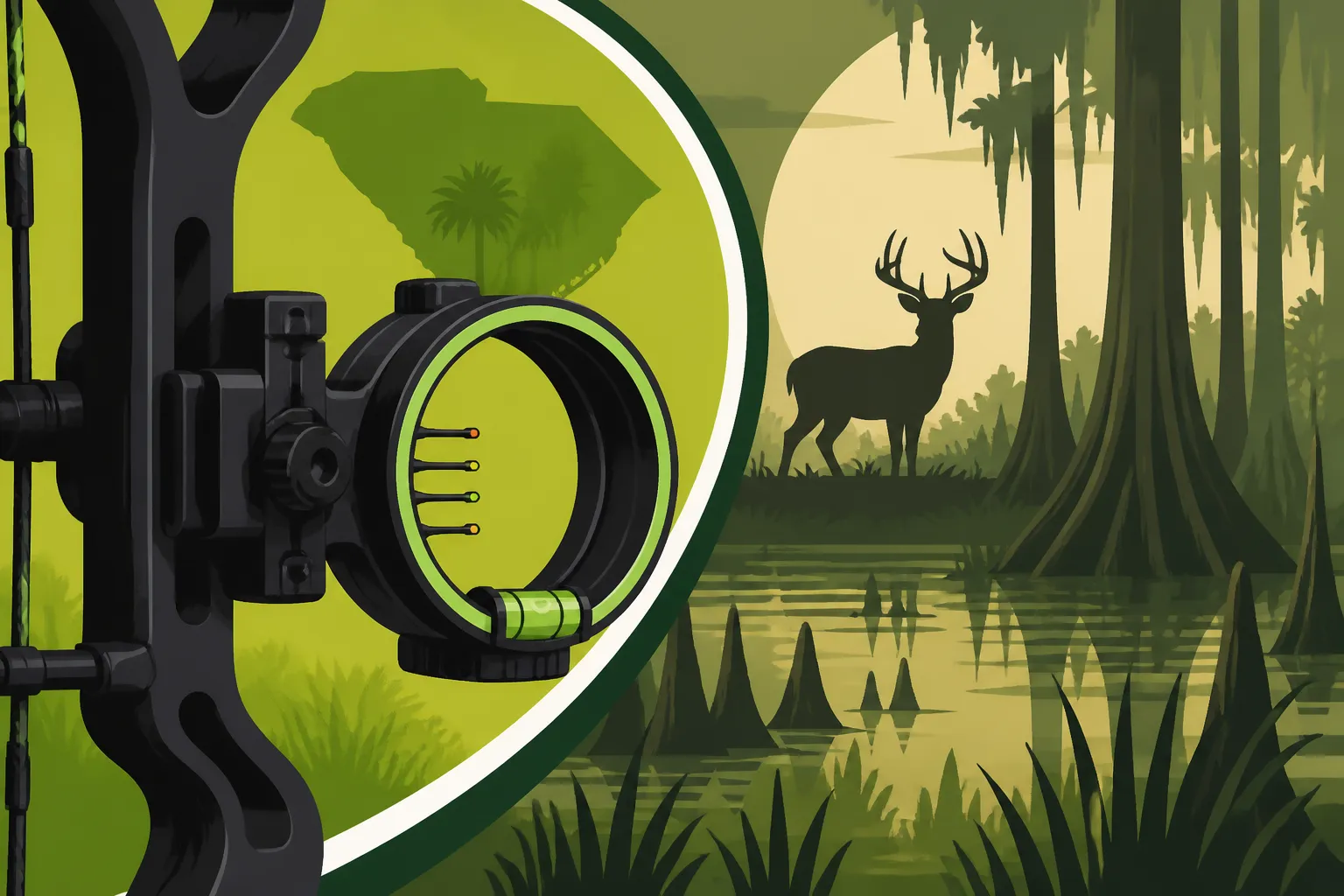
Many quality bow sights include a bubble level, and for good reason. Canting your bow (tilting it left or right) can cause your arrow to hit left or right of your intended aim point, especially at longer distances. In the excitement of a shot, or when positioned awkwardly in a treestand or ground blind, it's easy to cant the bow without realizing it. A clearly visible bubble level, positioned so you can see it in your peripheral vision without diverting focus from your target, is invaluable. Make sure your bow is perfectly level when you draw back and aim. This small detail ensures that all the effort you put into Bow Draw Weight for South Carolina Whitetails and choosing the right Broadheads for Swamp Timber Shots isn't wasted by a simple cant. Many accessories, which you might find listed on a site like GoHunt, are available to help ensure your sight is perfectly level to your bow.
Here's a quick comparison of common bow sight features for swamp timber hunting:
| Sight Type | Pin Configuration | Low Light Visibility | Speed of Acquisition | Clutter Level | Durability (depends on model) | Ideal Use Case |
|---|---|---|---|---|---|---|
| Multi-Pin (3-5) | Fixed pins (e.g., 20, 30, 40) | Good to Excellent | Fast | Moderate | High | Quick, close-range shots in dense cover |
| Single-Pin Slider | One adjustable pin | Excellent | Slower (needs adjustment) | Minimal | High | Known distances, static positions (e.g., treestand) |
| Hybrid (Fixed + Slider) | Fixed pins plus one adjustable slider | Excellent | Fast for fixed, Slower for slider | Moderate | High | Mixed terrain, balancing quick close shots with potential longer ones |
Ultimately, your choice will come down to personal preference, but always remember the environment you're hunting in. The swamps and timber of South Carolina demand durability, reliability, and excellent low-light performance from your bow sight.
Disclaimer
This article is for general informational purposes only and does not constitute professional advice. Laws, prices and regulations vary by location and change over time. Consult a qualified professional for guidance on your specific situation.