Is a .243 Enough for South Carolina Whitetails?
It's a question many South Carolina deer hunters wrestle with: is my trusty .243 caliber rifle truly enough to take down a whitetail cleanly and ethically in our diverse terrain? With deer sizes varying wildly from the Lowcountry to the Upstate, and hunting conditions ranging from wide-open fields to dense swamps, it’s understandable to want to be absolutely confident in your setup. This guide aims to clear up that uncertainty and help you understand how to maximize your success with a .243 for South Carolina whitetails.
Understanding the .243 Caliber for Whitetail Deer
The .243 Winchester has earned a solid reputation over the years, often being recommended as a great all-around cartridge, particularly for varmints and medium-sized game like deer. But "enough" can be subjective, right? Let's dive into what makes this caliber tick and how it applies to our South Carolina deer.
Ballistics and Bullet Selection
At its heart, the .243 is a necked-down .308 Winchester cartridge, firing a smaller diameter bullet at a very high velocity. This combination results in a flat trajectory and relatively mild recoil, which are huge advantages. Most deer hunters using a .243 will opt for bullets in the 80 to 100-grain range.
When we talk about ballistics for deer, we're really talking about two things: energy and expansion. You want a bullet that carries enough energy to penetrate deeply into the vital organs, and then expands reliably to create significant tissue damage. For the .243, popular bullet choices often include heavier, well-constructed options like 95-grain Nosler Ballistic Tips, 100-grain Core-Lokt, or Hornady InterLock bullets. These bullets are designed to retain weight and penetrate while still expanding, which is crucial for ethical harvest.
A well-constructed bullet from a .243, placed precisely, delivers a tremendous amount of kinetic energy and creates a hydrostatic shockwave that disrupts vital organs. It’s not about sheer bullet weight, but about how that smaller, faster bullet performs on impact. You're looking for that pass-through shot that creates an exit wound, making blood trailing much easier. Rifle Setups for South Carolina Deer Hunting often involve choosing a bullet that matches your expected hunting conditions.
South Carolina Deer Characteristics
South Carolina's whitetail deer population is robust, but the deer themselves can vary quite a bit depending on the region. In the coastal plains and Lowcountry areas, deer tend to be smaller-bodied, often weighing in the 100-150 pound range live weight. Head north into the Upstate, particularly in the foothills of the Blue Ridge, and you might encounter deer closer to 180-200 pounds, sometimes even heavier.
This regional difference in deer size plays a role in the "is it enough?" question. For the generally smaller-bodied deer found in much of our state, a .243 is undeniably capable. However, even with a larger Upstate buck, the efficacy of the .243 still comes down to one absolute truth: shot placement. The vitals on a 120-pound doe are not drastically different from those on a 180-pound buck in terms of size and location. The challenge comes with thicker bone structure or heavier muscle mass if you make a less-than-ideal shot. South Carolina Deer Density by South Carolina Zone can give you an idea of what to expect in different parts of the state.
Pros and Cons of Using a .243 in South Carolina
Like any tool in the hunter's arsenal, the .243 comes with its own set of advantages and potential drawbacks. Understanding these can help you decide if it's the right choice for your specific hunting style and local conditions.
Advantages for the Hunter
One of the most appealing aspects of the .243 Winchester is its incredibly mild recoil. For new hunters, youth hunters, or anyone who is recoil-sensitive, this is a game-changer. Less recoil means less flinching, which translates directly to better accuracy and more confidence behind the trigger. When you're not anticipating a harsh kick, you can focus entirely on your sight picture and breath control, leading to more precise shots.
Beyond comfort, the .243 is also known for its inherent accuracy. Many rifles chambered in .243 are tack drivers, capable of grouping shots very tightly. This precision, combined with a flat trajectory, makes it an excellent choice for hunting over longer distances, such as across agricultural fields in the Midlands or down long logging roads in the Francis Marion National Forest, provided the bullet selection is appropriate for the range. The ammunition is also generally affordable and widely available, which encourages more practice – and practice is paramount for any hunter.
Potential Limitations
While the .243 is a fantastic cartridge, it does have some limitations you need to be aware of, especially when hunting in South Carolina's sometimes challenging environments. The primary concern often revolves around the margin for error. With a larger caliber, a slightly off-center shot might still impact enough vital tissue for a quick kill. With the .243, that margin is much, much smaller. A hit that's an inch or two off the mark can turn a quick recovery into a long, difficult, or even lost animal.
Another consideration is energy retention at longer ranges or when encountering obstacles. While the .243 is flat-shooting, its smaller, lighter bullets lose energy faster than heavier projectiles from larger calibers. This means that beyond 200-250 yards, the bullet's ability to transfer sufficient energy for a quick, ethical kill diminishes more rapidly. For most South Carolina hunting, where shots are often under 100-150 yards in dense timber, this isn't a huge issue, but it's something to consider for those open field scenarios.
Furthermore, in thick swamp cover or dense pine plantations, a smaller, lighter bullet can be more prone to deflection if it hits a twig or heavy brush before reaching the target. While no bullet is truly "brush-proof," heavier, slower projectiles tend to be less affected. Finally, with less robust bullet expansion on a marginal hit, the blood trail might be less pronounced, making tracking a challenge in our often-thick undergrowth. This is where Tracking a Deer Through South Carolina Pine Straw can become a true test of skill and patience.
| Caliber | Typical Bullet Weight Range (Grains) | Typical Recoil (Foot-Pounds) | Effective Deer Range (Yards) | Notes for SC Hunting |
|---|---|---|---|---|
| .243 Win | 80-100 | 8-12 | 200-250 | Low recoil, high accuracy, demands precise shots. |
| .270 Win | 130-150 | 15-20 | 300+ | Versatile, good for open areas and larger deer. |
| .308 Win | 150-180 | 16-22 | 250-300 | Excellent all-rounder, solid performance in various cover. |
| .30-06 Spr | 150-180 | 20-25 | 300+ | Powerful, classic choice, more recoil. |
Note: Recoil values are approximate and can vary with rifle weight, stock design, and specific ammunition loads. Effective range is for ethical deer hunting with proper bullet placement.
Maximizing Success with a .243 Whitetail Rifle
If you choose to hunt South Carolina deer with a .243, you absolutely can do so effectively and ethically. The key is to understand its capabilities and limitations and adjust your approach accordingly. It's about being a smarter, more disciplined hunter.
The Absolute Criticality of Shot Placement
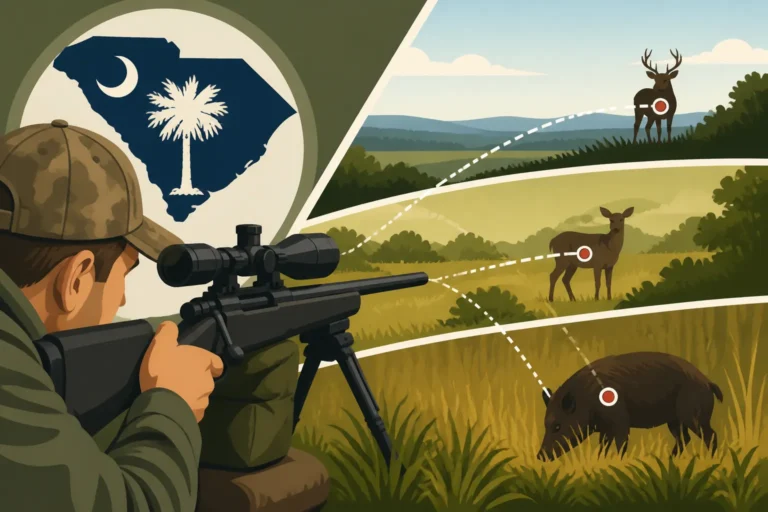
I cannot stress this enough: with a .243, shot placement isn't just important, it's everything. You must aim for the vital organs – specifically, the heart and lungs, often referred to as the "boiler room." This broadside shot offers the largest target zone of vital organs and allows the bullet to do its job by disrupting these critical systems. Avoid marginal shots, such as those through heavy shoulder bone or extreme quartering angles. The .243 simply doesn't have the brute force to consistently break heavy bone or penetrate several feet of muscle and gut to reach vitals.
Practice aiming for a pie-plate sized target, but think about placing your bullet in the center of a teacup within that pie plate. When you're in the stand, wait for that perfect broadside or slightly quartering away shot, where you can visualize the bullet path directly through the lungs and heart. If you don't have that shot, pass. It's far better to let a deer walk than to take a questionable shot and risk wounding an animal. This discipline is what truly defines an ethical hunter.
Ammunition Choice and Practice
Choosing the right ammunition for your .243 is crucial. As mentioned earlier, focus on well-constructed bullets designed for deer-sized game, typically in the 95 to 100-grain weight. These bullets are engineered to hold together better upon impact, ensuring deeper penetration and more reliable expansion. Experiment with different brands and bullet types to see which one performs best in your rifle. Every rifle has a preferred diet, and finding it will significantly improve your accuracy.
Once you’ve found that perfect load, practice, practice, practice! Don't just shoot from a bench at 100 yards. Practice from different positions you might encounter while hunting: off-hand, kneeling, sitting, or even leaning against a tree. Use a rangefinder to verify distances to various targets. Services like GoHunt can be invaluable here, allowing you to scout your hunting area beforehand, identify potential shooting lanes, and mark exact distances to landmarks from your stand. This mental and physical preparation means when that moment of truth arrives, you're not guessing. Zeroing at 100 Yards for Field Edge Hunting is a great starting point, but extend that practice to cover your maximum ethical range.
Terrain and Hunting Styles
South Carolina's diverse terrain means you need to adapt your hunting style, especially when using a .243.
- Open Fields and Clear-Cuts: In areas with open sight lines, like agricultural fields in the Midlands or large clear-cuts in timber country, the .243's flat trajectory shines. This is where your practice at longer ranges pays off. Before heading out, I'll often use GoHunt to study aerial maps, identifying potential shooting lanes and confirming distances from my planned stand locations. You'll want to ensure you have a stable rest, such as shooting sticks or a bipod, for these longer shots.
- Thick Swamps and Dense Cover: Hunting the Lowcountry swamps or thick pine plantations means shots are typically close-range, often within 50-75 yards. In these environments, bullet deflection can be a concern. Focus on finding natural openings, logging roads, or small clearings where you can guarantee a clean shot without intervening brush. Still-hunting slowly and deliberately, focusing on seeing the entire deer before raising your rifle, is crucial. Hunting a Funnel Between Two Swamps is a great example of where careful shot selection matters.
- Upstate Hardwoods and Ridges: The rolling hills and mature hardwoods of the Upstate present their own challenges. Shots can range from close-quarters to 150+ yards across valleys or ridges. Again, using a tool like GoHunt to understand elevation changes and potential shot angles will help you prepare. The .243 performs admirably here, given its accuracy, but always prioritize a clear shooting lane.
Ethical Considerations and Confidence in Your Setup
Ultimately, hunting with a .243, or any caliber, boils down to respect for the animal and your own capabilities. Ethical hunting means doing everything in your power to ensure a quick, clean kill.
Knowing Your Limits and Your Rifle's Limits
Be honest with yourself about your effective shooting range. For some, that might be 150 yards with a .243; for others, it might be 200. Never take a shot beyond what you know you can consistently hit in the vitals under hunting pressure. Understanding the terminal ballistics of your chosen bullet at various ranges is also important. What performs perfectly at 100 yards might not have the same energy or expansion characteristics at 250.
It's also about knowing your rifle. Is it consistently accurate with the ammunition you're using? Does it hold zero after a long walk through the woods or a bumpy truck ride? Regular checks at the range are vital. Our South Carolina Hunter Education Requirements emphasize safety and ethical hunting, and knowing your limits is a huge part of that.
Field Dressing and Tracking
With any deer, but especially with one taken with a .243, immediate and thorough tracking is essential. Even with a perfect shot, deer can run a surprising distance. Take a moment after the shot to collect yourself, listen for the deer's crash, and then give it 15-30 minutes (or longer if the shot felt less than ideal, or if it's a gut shot) before beginning your search.
Look for signs of a hit: hair, blood, bone fragments. If you find blood, note its color and consistency, as this can give clues about the hit. A good blood trail is your best friend. In South Carolina's warm climate, Field Dressing a Deer in Warm Weather is also a crucial skill to master to preserve your meat quality, regardless of the caliber used. The sooner you can get to your deer and start the process, the better.
So, is a .243 enough for South Carolina whitetails? Absolutely, yes – if you use a well-constructed bullet, place your shot precisely, and understand your personal and rifle's limitations. It’s a highly capable cartridge in the right hands, offering a pleasant shooting experience that encourages practice and, ultimately, makes you a more effective and ethical hunter.
Disclaimer
This article is for general informational purposes only and does not constitute professional advice. Laws, prices and regulations vary by location and change over time. Consult a qualified professional for guidance on your specific situation.