Zeroing at 100 Yards for Field Edge Hunting
There's nothing quite like the anticipation of a deer stepping out onto a field edge in South Carolina. One moment, you're scanning thick timber, the next, a prime buck is silhouetted against the fading light of a longleaf pine savanna or a freshly cut soybean field. But this scenario often brings a common hunter's dilemma: what's your shot distance going to be? It might be a chip shot at 50 yards, or a more stretching 150-yard poke. The frustration comes when your zero isn't optimized for these varying, but often intermediate, distances. This guide will walk you through why a 100-yard zero is your absolute best friend for field edge hunting in South Carolina and how to achieve it with confidence.
Why 100 Yards is Your Go-To for South Carolina Field Edges
Hunting field edges in South Carolina is a distinct challenge and joy, different from the deep woods or mountainous terrain. Deer are drawn to these transitional areas for food and cover, but their movements can be unpredictable, demanding a rifle setup that offers versatility without complex calculations in the heat of the moment.
Understanding Typical Shot Distances on Field Edges
When you set up on a South Carolina field edge, whether it's overlooking a lush clover plot, a standing cornfield, or a recently harvested soybean field, your shot opportunities usually fall into a certain range. Unlike western open-country hunting where 300-yard shots are common, here in the Lowcountry or even parts of the Midlands, truly long shots are rare. The dense timber that often borders these fields limits visibility beyond a couple hundred yards.
Think about it: a deer might nose out of the woods right at the corner of your blind at 30 yards. Or it could be cautiously working its way down the opposite edge, just inside the timber, putting it at 150 yards. Sometimes, a deer might even cross the middle of a larger field, pushing the 200-yard mark. What's crucial is that most of these shots are not point-blank, nor are they extreme long-range. They're in that sweet spot where a simple, reliable zero becomes invaluable. Having a solid understanding of Rifle Ranges Realistic in Lowcountry Woods is key to preparing yourself for these varied scenarios. These fields, while open, are often not so vast that you're regularly stretching out to 300+ yards, making the 100-yard zero a practical choice that covers the majority of your bases with minimal fuss.
The Ballistics of a 100-Yard Zero
A 100-yard zero is often considered the gold standard for many deer hunters, and for good reason, especially in diverse environments like South Carolina's field edges. What does it mean? It means your bullet will impact exactly where your crosshairs are aimed at 100 yards. But how does that translate to other distances, particularly those shorter and slightly longer shots you'll encounter?
Let's talk about minute of angle (MOA) and trajectory. Most common deer calibers, like a .308, .270, or even a .243 (which is often plenty for Choosing a Rifle Caliber for South Carolina Deer), will shoot slightly high at intermediate distances (like 50 or 75 yards) when zeroed at 100. This is because the bullet starts rising out of the barrel and reaches its peak trajectory somewhere between your muzzle and your 100-yard zero point. For example, a .308 zeroed at 100 yards might be 1.5 inches high at 50 yards. That's a negligible difference on a deer's vitals. As the bullet travels past 100 yards, it begins to drop. At 150 yards, it might be an inch or two low, and at 200 yards, perhaps 4-6 inches low, depending on your caliber and bullet weight.
The beauty of the 100-yard zero is that it creates a very forgiving "point-blank range" for the distances most frequently encountered on South Carolina field edges. This is the range within which you can hold dead-on the vitals without worrying about significant bullet drop or rise, knowing your shot will still be lethal. With a 100-yard zero, you can typically hold dead-on a deer's kill zone out to about 175-200 yards with most common calibers, as the bullet's rise and fall within that range are minor enough to still ensure a good hit. You can use online ballistic calculators or even a reputable app like GoHunt to visualize these trajectories for your specific setup. Understanding how your chosen Rifle Setups for South Carolina Deer Hunting performs with a 100-yard zero is paramount.
Here's a quick look at typical bullet drop/rise (approximate, for illustration) for a couple of popular calibers with a 100-yard zero:
| Distance (Yards) | .308 Win (150gr) – inches | .270 Win (130gr) – inches | .243 Win (100gr) – inches |
|---|---|---|---|
| 25 | +0.5 | +0.6 | +0.4 |
| 50 | +1.2 | +1.4 | +1.0 |
| 75 | +0.8 | +0.9 | +0.7 |
| 100 | 0 (Zero) | 0 (Zero) | 0 (Zero) |
| 125 | -0.6 | -0.5 | -0.4 |
| 150 | -1.8 | -1.5 | -1.3 |
| 175 | -3.5 | -2.9 | -2.5 |
| 200 | -5.8 | -4.8 | -4.2 |
Note: These are approximations. Always confirm with your specific rifle, ammunition, and a ballistic calculator.
Step-by-Step Guide to Zeroing at 100 Yards
Zeroing your rifle isn't just about getting on paper; it's about building confidence in your equipment and your ability to make an ethical shot when it counts. Taking the time to do it right will pay dividends in the field.
Setting Up for Success at the Range
Before you even touch a sandbag or pull a trigger, a good setup is crucial. You're aiming for consistency, and that starts with eliminating as many variables as possible from your shooting position. First, find a comfortable, stable shooting bench. A wobbly bench or an uncomfortable position will only lead to frustration and inaccurate groups.
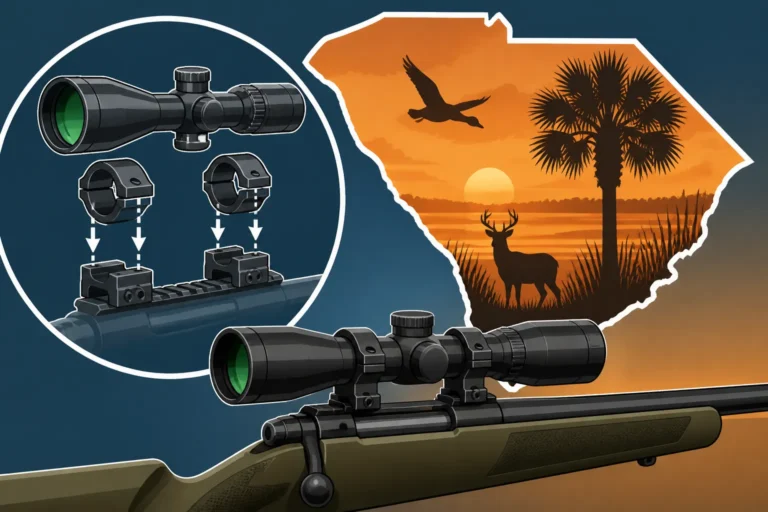
Next, invest in or borrow a solid shooting rest. This could be a sturdy bipod combined with a rear bag, or a dedicated front and rear sandbag setup. The goal is to minimize human error and allow the rifle to recoil consistently. When you're trying to fine-tune your scope adjustments, you want to be sure that any variation in bullet impact is due to the rifle or ammo, not you. Also, make sure your scope rings are properly torqued and your scope is mounted securely. A loose scope will never hold a consistent zero, no matter how much you adjust it.
Perhaps most importantly, use the ammunition you intend to hunt with. This isn't the time to practice with cheap plinking rounds if your hunting ammo is a premium, bonded bullet. Different bullet weights, types, and manufacturers can (and usually will) have different points of impact. You want your zero to reflect the actual performance of your hunting load. It's smart to pick up your Ammunition Availability Before Opening Day well in advance. Consider bringing multiple boxes of the same lot number, as even different lots can sometimes show slight variations.
Finally, ensure your range is safe and you understand all the rules. Always wear eye and ear protection, and never point your muzzle at anything you don't intend to destroy. A calm, controlled environment is best for precise zeroing.
The Zeroing Process: From Paper to Perfection
Alright, you're set up, you've got your hunting ammo, and you're ready to get on paper. Let's walk through the actual zeroing.
-
Boresighting (Optional, but Highly Recommended): If your scope is brand new or has been removed, boresighting will save you a lot of time and ammunition. This can be done with a laser boresighter inserted into the muzzle or by looking through the barrel (only on bolt-action rifles with the bolt removed). The idea is to get your scope's crosshairs roughly aligned with the bore of the rifle. This ensures your first shots will at least hit the paper at closer distances.
-
Getting on Paper at 25 Yards: Many seasoned hunters start at a closer distance, like 25 yards, to ensure they're on the target before moving back to 100. Set up a target at 25 yards. Fire a group of three shots, aiming dead center. If your shots are wildly off, adjust your scope to bring them closer to the bullseye. At 25 yards, a 1-inch adjustment on your scope (assuming 1/4 MOA clicks at 100 yards) will move your impact point 1/4 inch. So, if you're 2 inches low and 1 inch left, you'd come up 8 clicks (2 inches / 0.25 inches per click) and right 4 clicks (1 inch / 0.25 inches per click). Make sure to understand your scope's click values before you start turning dials; a 1/4 MOA click at 100 yards is typical, but some scopes are 1/2 MOA or even 1/8 MOA.
-
Moving to 100 Yards and Fine-Tuning: Once you're consistently hitting the bullseye or very close to it at 25 yards, move your target back to 100 yards. Now, the real work begins.
- Shoot a Group: Fire a three-shot group, aiming dead center. Take your time, focus on fundamentals: breathing, trigger control, and follow-through. Let the barrel cool between groups if you're shooting rapidly, especially with lighter profile barrels, as heat can affect accuracy.
- Analyze the Group: Look at where your three shots landed relative to your aiming point. You want a tight group, ideally within an inch or so for a good hunting rifle and ammo. This tells you the rifle is consistent.
- Make Adjustments: Measure the distance from the center of your group to the bullseye, both horizontally and vertically. Let's say your group is 2 inches low and 1 inch left. If your scope has 1/4 MOA clicks at 100 yards, then each click moves your impact 1/4 inch. To move 2 inches up, you'd need 8 clicks (2 / 0.25). To move 1 inch right, you'd need 4 clicks (1 / 0.25). Adjust your scope accordingly.
- Confirm: After making adjustments, fire another three-shot group. Did your point of impact shift closer to the bullseye? Repeat this process until your groups are consistently hitting the center of the bullseye at 100 yards. Don't be afraid to take your time and use plenty of ammunition to confirm your zero. It's an investment in a clean harvest. When using quality optics, understanding Rifle Scope Magnification for South Carolina Deer can further refine your precision at the range.
Practical Considerations for Field Edge Hunting with a 100-Yard Zero
A perfectly zeroed rifle at the range is fantastic, but the real test comes in the field. South Carolina's hunting conditions can throw curveballs, from variable winds to tricky shooting positions.
Holdovers and Holdunders: Knowing Your Bullet Drop
While a 100-yard zero is forgiving, it doesn't mean you can completely forget about bullet trajectory. For those slightly closer or longer shots on a field edge, a basic understanding of holdovers and holdunders is crucial.
-
Holdunder for Close Shots (Under 50 yards): As discussed, with a 100-yard zero, your bullet will typically hit slightly high at 25-75 yards. For a deer, this usually isn't enough to cause a miss, but if you're aiming for a precise heart shot at 30 yards, knowing your bullet might impact an inch or so high can help you compensate by holding just a tiny bit low on the vitals. The goal is to always hit that vital zone, so tiny adjustments in aim, rather than scope adjustments, are usually all you need.
-
Holdover for Longer Shots (125-200 yards): This is where you might need to consciously adjust your aim. If you're looking at a deer at 175 yards across a vast agriculture field, and your specific cartridge drops 3-4 inches at that distance, you'll want to hold a corresponding amount high on the deer's shoulder or chest. This is where practice, and especially using a rangefinder, becomes invaluable. A good quality rangefinder can confirm the exact distance, removing all guesswork. You can then use a ballistic app (again, GoHunt or similar tools are excellent) to quickly confirm your holdover. Familiarity with Rangefinders in Thick Coastal Plain Cover can significantly improve your accuracy in dynamic field edge scenarios. Don't try to dial your scope for these intermediate distances unless you've had extensive practice and know your turrets and rifle inside and out; a simple holdover is far more practical and faster in hunting situations.
Wind and Environmental Factors
South Carolina's weather can be notoriously humid, and even on calm-looking days, a subtle breeze can play tricks on your bullet. Wind is a factor you absolutely cannot ignore, even on "short" field edge shots. A 10-mph crosswind, while it might only move your bullet an inch or two at 100 yards with a fast-flying deer cartridge, can be enough to push a shot just outside the vitals if you're not paying attention.
When hunting a field edge, always assess the wind direction and speed. Watch the movement of grass, leaves on nearby trees, or even use a wind checker. If the wind is coming from your left, pushing right, you'll need to hold slightly left. If it's coming from your right, hold slightly right. For instance, if you're setup in a ground blind Using a Ground Blind on South Carolina Public Land overlooking a bean field and a steady breeze is blowing from left to right, a slight hold into the wind will help keep your bullet on target. The amount of hold depends on the distance and wind speed, but for most field edge shots up to 200 yards, it's usually a small adjustment. Learning to gauge Wind and Thermals on an Upstate Ridge also applies to subtle breezes around field edges.
Humidity, while not directly affecting bullet trajectory like wind, can sometimes affect visibility, especially at dawn or dusk, and can also make your equipment feel damp, potentially leading to fogging optics if your scope isn't high quality. Always keep your lenses clean and dry.
The Importance of Practice Beyond the Range
Having a perfectly zeroed rifle is only half the battle. The other half is being able to apply that precision in real hunting scenarios. This means practicing in ways that mimic the field.
-
Simulate Shooting Positions: How often do you shoot off a perfectly stable bench at the deer camp? Probably never. Practice shooting from kneeling, sitting, and even offhand positions. If you hunt from a treestand, find a safe way to practice shooting from an elevated position (e.g., from a shooting platform) or even practice quickly getting into a stable shooting rest while standing. If you hunt public lands, like Treestand Setups in Francis Marion National Forest, knowing how to get steady quickly is critical. This builds muscle memory and helps you achieve stability when the moment of truth arrives.
-
Quick Target Acquisition: Deer rarely stand still for long. Practice quickly raising your rifle, finding your target, and settling your crosshairs. This doesn't mean rushing, but developing efficiency. A good drill is to pick a target, then quickly acquire it and dry fire (or safely fire at the range) as if a deer just stepped out. This helps with the mental and physical speed needed in the field.
-
Environmental Practice: If possible, try to practice in similar conditions to what you expect afield. This might mean shooting on colder days, or even in light rain (with proper gun care afterward). The more you expose yourself to varying conditions, the less they will surprise you during hunting season. Remember, your South Carolina Legal Firearms for Deer Hunting are tools that require mastery. Consistent, varied practice is the only way to truly build confidence in your 100-yard zero and your own abilities when that trophy buck steps out onto the field edge.
A field edge in South Carolina is a dynamic environment, offering diverse shot opportunities. By carefully zeroing your rifle at 100 yards and understanding its ballistic performance at varying distances, you equip yourself with a versatile and reliable tool. Couple that with consistent practice under simulated field conditions, and you'll be ready for whatever challenge the South Carolina woods and fields throw your way.
Disclaimer
This article is for general informational purposes only and does not constitute professional advice. Laws, prices and regulations vary by location and change over time. Consult a qualified professional for guidance on your specific situation.