Rangefinders Under 100 Yards
Hunting in South Carolina often means navigating thick, dense cover, whether you're stalking swamp edges in the Lowcountry or perched in an oak on an Upstate ridge. Many hunters mistakenly believe that a rangefinder is only for those long-range, wide-open western hunts, dismissing its importance for our typically close-quarters shots. However, misjudging even a 30 or 40-yard shot can be the difference between a clean harvest and a frustrating tracking job, especially with archery equipment or primitive firearms. This guide is all about showing you how a simple, effective rangefinder, costing less than a hundred bucks, can dramatically improve your accuracy and confidence in the South Carolina woods, even when your target is well within spitting distance.
Why Close-Range Precision Is Crucial in South Carolina
It's a common thought, isn't it? "Ah, that deer is only 30 yards, I don't need a rangefinder." We've all been there, mentally estimating distances, convinced our eyes are calibrated like a precision instrument. But in the real world, especially with the fluctuating light and the dense vegetation we face across South Carolina, our perception can be wildly off. And when you're talking about putting an arrow or a slug exactly where it needs to go, even small errors in distance can have big consequences.
The Deceiving "Close Enough" Trap
When a buck steps out into a small opening, heart pounding, the last thing you want to be doing is guessing. Our eyes tend to flatten distances, especially when looking through a scope or peep sight at an animal. What looks like 25 yards can easily be 35, or even 40. For a rifle hunter, this might mean a slightly higher or lower impact, but with a bow or muzzleloader, that 10-15 yard difference can mean the difference between a double-lung shot and a gut shot, or worse, a clean miss. Think about the arc of an arrow; its flight path isn't flat. If you're sighted in for 20 yards and shoot at 35, your arrow will drop significantly. The same goes for many shotgun slugs or muzzleloader projectiles. That "close enough" mentality can lead to ethical issues and wasted opportunities. Having the exact distance, confirmed by a rangefinder, removes that doubt and allows you to focus on form and execution.
Navigating South Carolina's Dense and Varied Cover
From the impenetrable palmetto thickets of the coast to the steep, timbered creek bottoms of the Upstate, South Carolina's hunting terrain is rarely wide open. You're often looking through narrow shooting lanes, across patches of pines, or over a section of standing water. These environments make visual range estimation incredibly difficult. A deer might appear closer or farther depending on the background, the light, and the amount of brush between you and it. Practical Range in South Carolina Swamp Timber can be vastly different than what you might imagine, and those distances need to be precise.
Even subtle changes in elevation, like those found on the rolling hills of the Midlands or the slight rises in coastal plain timber, can impact your shot, especially for archery. An inexpensive rangefinder can provide angle compensation, giving you the "true horizontal distance" even on slight inclines or declines from your treestand. This feature, once reserved for high-end units, is now often found in entry-level models and is incredibly valuable in our diverse hunting landscapes.
Essential Features for Affordable, Short-Range Rangefinders
When you're looking for a rangefinder that won't break the bank but still performs reliably for those critical under-100-yard shots, you're not sacrificing much. The market has come a long way, and many budget-friendly options offer excellent performance. You just need to know what features genuinely matter for our kind of hunting.
Accuracy and Readability: More Than Just Numbers
The primary job of any rangefinder is to give you an accurate distance, and for under 100 yards, most modern units are incredibly precise, often within +/- 1 yard. What's more important for an affordable unit is that it consistently delivers that accuracy and that the display is clear and easy to read. You don't need ballistic calculators or fancy reticles built into a sub-$100 model. You need a bright, simple display that gives you the number quickly.
Look for models with a clear LCD display, ideally with some form of backlight or illumination for low-light conditions – think those crucial first and last 30 minutes of legal hunting light. A cluttered display with too much information can actually slow you down when you need to make a fast shot. Simplicity is key. A simple crosshair or square to aim with, and a large, easily visible distance readout, is all you truly need. Remember, the goal is to get a quick, accurate read, not to compute complex ballistics.
Durability and Weather Resistance: Built for the Palmetto State
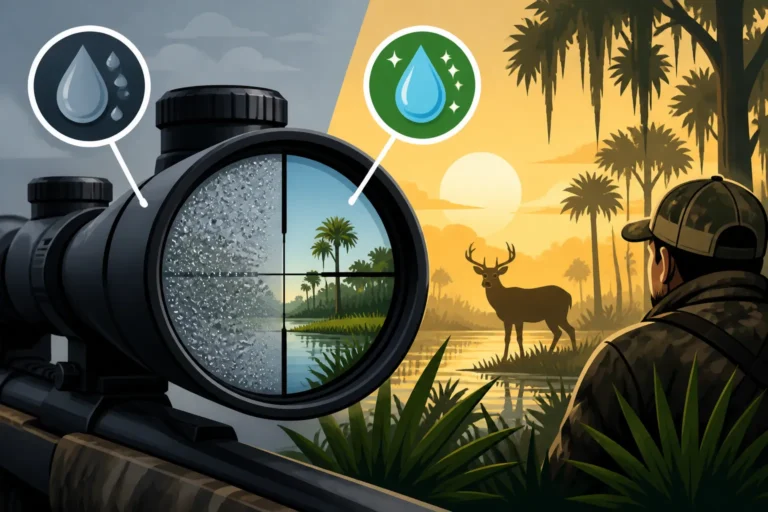
South Carolina weather is rarely mild for long. We've got humidity that can cling to everything, sudden downpours, and plenty of opportunities for gear to get knocked around. A rangefinder needs to be tough enough to handle these conditions. Look for models that are advertised as water-resistant or, even better, waterproof. This means they can take a splash, a light rain, or maybe even a brief dunk without conking out. Fogging can be an issue with cheaper optics, so models purged with nitrogen or argon will help prevent internal condensation.
The casing itself should feel solid, not flimsy. Rubberized armor is a huge plus, as it provides a better grip when your hands are cold or wet and offers some shock absorption if you accidentally drop it from your treestand or when Still-Hunting Sumter Forest Ridges. Accidents happen, and a rangefinder that can take a beating and keep working is invaluable. You want a tool, not a delicate piece of electronics you constantly worry about.
Simplicity and Speed: Crucial in the Moment of Truth
When that wary buck steps into your shooting lane, you don't have time to fumble with complicated menus or multiple buttons. The best budget rangefinders for South Carolina hunting are those that operate with one or two simple presses: one to power on, one to range. Look for models with "scan mode" – this allows you to hold down the range button and pan across multiple objects, getting continuous distance updates. This is incredibly useful for ranging multiple trees, bushes, or even a moving animal.
Speed is also a factor. A good, affordable rangefinder should give you a reading almost instantaneously. If it takes several seconds to process a distance, that precious window of opportunity might close. Test it in the store, if possible, or read reviews that specifically mention ranging speed. You're looking for something you can pull out of your pack, hit a button, get a number, and be ready to make a shot in a matter of seconds.
Field Applications in South Carolina's Diverse Terrain
Putting a rangefinder to use in the field is where its true value shines. It's not just about getting a number; it's about building confidence, making better decisions, and ultimately, being a more effective hunter in the varied landscapes of South Carolina. Whether you're in a stand overlooking a vast field or tucked into a thicket, knowing your distances is a game-changer.
Ranging in Dense Timber and Swamps
Hunting the Lowcountry's bottomland swamps or the dense pine forests of the Francis Marion National Forest means dealing with limited visibility. You might only have a 20 or 30-yard shooting lane, but how do you know if that lane extends far enough? Or if the tree beyond it is 40 or 60 yards? This is where pre-ranging comes into play.
From your treestand, use your rangefinder to mark distances to key landmarks: that stump at 30 yards, the fork in the path at 45, the edge of the thicket at 60. You can even use small pieces of reflective tape on trees at specific distances to give you quick visual cues. When a deer steps into view, you already have a good idea of the range by associating it with a marked spot. This becomes second nature with practice. This kind of preparation is essential for bowhunters, where Bow Sights for Swamp Timber Shots need to be dialed in perfectly for those precise ranges. Knowing your distances to multiple points around your stand, even small openings, can dramatically reduce panic when a deer suddenly appears. It’s also invaluable when considering potential shot opportunities through a Hunting a Funnel Between Two Swamps.
Hunting Field Edges and Food Plots
Open areas like agricultural fields, clear-cuts, or planted food plots present a different challenge. Here, distances can seem much shorter than they are, especially in the fading light of dusk or the dim glow of dawn. That deer feeding contentedly at the far end of a soybean field could be 150 yards away, but it looks like 75. While a sub-$100 rangefinder might top out at 100-150 yards for animals, it's perfect for confirming those closer, critical shots.
If you're Hunting a Green Field Planted for Deer, for example, you can range the corners, the edges of thick cover, and any dominant trees within your effective range before a deer even steps out. This way, when that big buck walks into the opening, you've already got your yardage markers established. This works equally well if you're set up on the edge of a standing cornfield or a longleaf pine savanna. It takes the guesswork out and allows you to confirm the shot is within your comfort zone and equipment's capabilities, whether it's 40 yards or 80.
Public Land Challenges and Mobility
Hunting South Carolina's public lands, like the extensive Sumter National Forest or various Wildlife Management Areas, often means being mobile. You might be still-hunting, doing a small deer drive, or just moving to a different stand location. In these scenarios, a compact, lightweight rangefinder that quickly gives you accurate distances on the fly is a huge asset.
When you're sneaking through the woods, stopping to glass, and trying to decipher Reading South Carolina Mud for Fresh Deer Movement, you might suddenly spot a deer. If it's standing in a small opening or along a distant ridge line, a quick range can determine if it's a shootable distance. It helps you understand the terrain better too. Perhaps you're moving through an area you've identified on your GoHunt app as a pinch point, and you can confirm the tightest part is only 35 yards across. This information helps you visualize the shot and plan your approach more effectively.
Maximizing Your Affordable Rangefinder's Potential
Having a rangefinder is one thing, but truly integrating it into your hunting routine is another. It's not just a tool to pull out when a deer appears; it's a scouting aid, a confidence builder, and a crucial piece of safety equipment. Getting the most out of your sub-$100 rangefinder means using it often, knowing its limits, and taking care of it.
Pre-Season Scouting and Pre-Ranging
One of the most valuable ways to use your rangefinder is during your pre-season scouting trips. This is when you're walking potential stand locations, identifying pinch points, and mapping out travel corridors. When I'm out scouting a new block of public land or checking a familiar private tract, I'll often have a mapping app open on my phone, something like GoHunt, to mark waypoints and identify potential stand locations. But those maps only give you overhead distances. That's where a compact rangefinder comes in.
Walk to your chosen treestand location, then range every prominent tree, bush, or ground feature within a 70-yard radius. Note these distances in a small notebook or even on your phone's notepad. If you're using a ground blind, range the entire field or opening from your seated position. Identify potential shooting lanes and confirm their maximum effective distance. This practice builds familiarity with the area and primes your brain to recognize distances more accurately when the pressure is on. It also helps you visualize where deer might need to be for a shot, allowing you to fine-tune your setup. For instance, understanding a Reading a Tidal Creek for Deer Movement can tell you where a deer might cross, and your rangefinder helps you pinpoint that exact crossing distance.
Battery Life and Maintenance: Keep It Ready
It's a simple point, but often overlooked: check your batteries! Most affordable rangefinders use common CR2 or CR123A batteries, or sometimes even standard AAA batteries. Always carry a spare, especially during extended hunts or when camping. A dead battery on opening morning is incredibly frustrating and easily avoidable.
Beyond batteries, basic care will extend the life of your unit. Keep the lenses clean; a soft microfiber cloth is your best friend. Dust, pollen, and fingerprints can degrade image clarity and affect performance. Protect your rangefinder from excessive moisture and impact. Many come with a small carrying case or lanyard. Use them! Attaching it to a Binocular Harnesses Worth Wearing or around your neck means it's always accessible and less likely to be dropped. After a rainy hunt, let it air dry completely before putting it away. Having a reliable, affordable rangefinder in your kit just adds another layer of confidence to your hunt. You've done your scouting, maybe marked some key spots on your GoHunt app, and now you can confirm those critical shot distances in real-time.
Here's a quick comparison of what to prioritize in a budget rangefinder for South Carolina hunting:
| Feature | High-End Rangefinder (Often >$300) | Affordable Rangefinder (<$100) | Priority for SC Hunting (<100 yards) |
|---|---|---|---|
| Max Range | 1,000+ yards (animals) / 2,000+ yards (reflective) | 300-600 yards (animals) / 800-1,000 yards (reflective) | Medium-High: Focus on reliable close ranges (under 100) |
| Accuracy | +/- 0.5 yard | +/- 1 yard | High: +/- 1 yard is perfectly adequate |
| Display | OLED, multiple reticles, advanced ballistics | LCD, simple crosshair/indicator, clear digits | High: Clear, simple, easy-to-read, illuminated is a bonus |
| Angle Comp. | Yes, often with complex algorithms | Often Yes (true horizontal distance) | High: Crucial for treestand and varied terrain |
| Scan Mode | Yes | Yes, a common feature | High: Great for moving targets or multiple objects |
| Weatherproofing | Fully waterproof, fogproof, robust armor | Water-resistant, some fogproofing, rubberized | High: Needs to handle humidity and rain |
| Speed | Instantaneous (sub-0.2 seconds) | Fast (sub-1 second) | High: Quick readings are essential |
| Battery Life | Excellent, often proprietary | Good, typically CR2/CR123A/AAA | Medium: Carry spares; easy to find |
Having a solid understanding of your effective range, whether you're using a bow, crossbow, or rifle, is paramount to ethical and successful hunting. Knowing your exact shot distances, especially on public land where deer movement can be unpredictable, allows you to make quick, confident decisions. It's another layer of preparedness, much like having your South Carolina Deer Season Structure Explained dialed in, or using digital tools like GoHunt to navigate the woods and locate property boundaries. Don't let the thought of an expensive gadget deter you; an inexpensive rangefinder can provide the precision you need right here in the Lowcountry and Upstate, making you a more effective hunter for those crucial under-100-yard opportunities.
Disclaimer
This article is for general informational purposes only and does not constitute professional advice. Laws, prices and regulations vary by location and change over time. Consult a qualified professional for guidance on your specific situation.