Working River Cane Thickets for Deer
Many South Carolina hunters cast a wary eye on river cane thickets, seeing them as nothing more than an impenetrable, thorny mess to be avoided. It’s easy to feel intimidated by these dense stands of Arundinaria gigantea, but for the deer, these are often hidden sanctuaries—places of safety, cover, and even sustenance. If you learn how to understand and approach them, these challenging environments can transform into some of the most productive hunting grounds in the state. This guide will help you decipher the secrets of river cane and effectively hunt the whitetails that call them home.
Understanding the Allure of River Cane Thickets for Deer
River cane isn't just a random plant; it's a specific type of native bamboo that creates unique habitat features. Knowing what it is and why deer are drawn to it is the first step in successful hunting.
What is River Cane and Where Does It Grow?
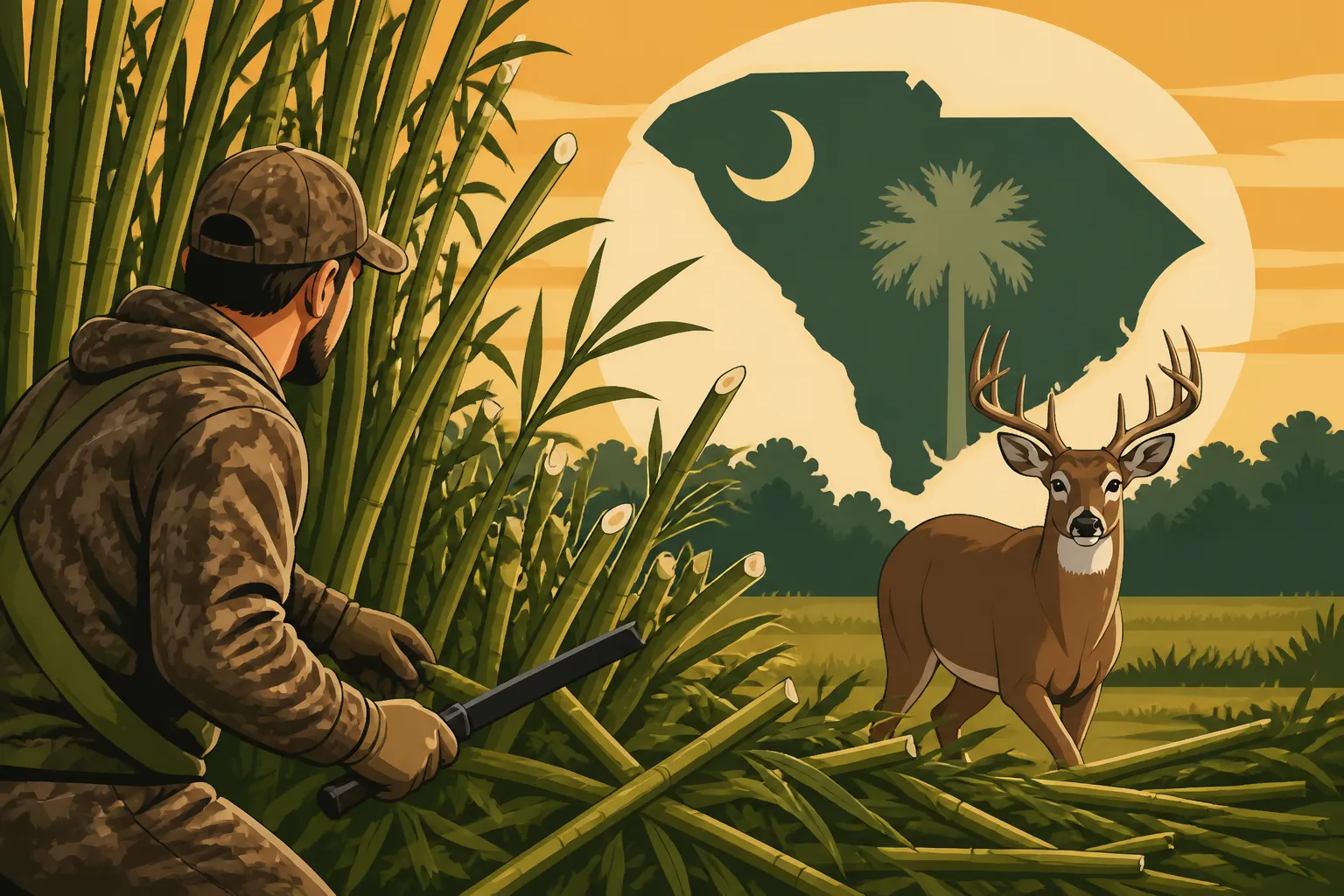
River cane, or Arundinaria gigantea, is a native bamboo species that grows incredibly dense, often forming near-impenetrable thickets. Unlike some other bamboos, it’s not always a sign of disturbed ground; it’s a natural part of many South Carolina ecosystems. You'll primarily find river cane thriving in moist, fertile soils, typically along river bottoms, creek drainages, and in the edges of swamps. Think of the rich bottomlands of the Pee Dee River region, the dense coastal plain swamps, or even smaller creeks winding through private timberland in the Lowcountry.
These thickets can be astonishingly dense, with stalks growing so tightly together that light barely penetrates, creating a shadowy, cool understory even on the brightest days. Walking through them often requires pushing and crawling, and you’ll quickly find yourself disoriented without a reliable navigation tool. This inherent denseness is precisely what makes them so valuable to deer.
Why Deer Seek Out Cane Thickets
Deer are masters of survival, and river cane thickets offer a multitude of advantages that appeal directly to their instincts for safety and sustenance.
First and foremost, river cane provides unparalleled thermal cover. In the scorching South Carolina summers and during sudden cold snaps, these thickets offer refuge. The dense canopy shades deer from the oppressive sun, while the mass of intertwined stalks insulates them from chilling winds. This makes them ideal bedding areas, where deer can rest comfortably and conserve energy regardless of the weather.
Secondly, and perhaps most importantly for hunters, cane thickets are sanctuaries from pressure. When hunting season opens, especially on public lands like those within Francis Marion National Forest or Sumter National Forest, deer quickly learn where the human activity is. The dense, difficult-to-navigate cane becomes their safe haven, a place where few hunters dare to tread deeply. They know they can often escape the majority of hunters simply by retreating into the almost impenetrable tangles of cane. This makes these areas prime spots for mature bucks looking to avoid detection.
Finally, river cane can be a food source. While not a primary browse, deer will eat the tender new shoots as they emerge. More critically, the dense cover of cane thickets often protects other browse species within its interior, or creates shaded, moist edges where other preferred forage plants can thrive. Deer will browse these protected areas and the fringes of the cane, making them not just bedding, but also feeding locations, albeit ones requiring strategic access.
Scouting the Impenetrable: Unlocking River Cane Secrets
The thought of scouting a dense cane thicket might make you want to throw in the towel before you even start. But with the right approach and tools, you can unravel the mysteries of these areas.
Aerial Reconnaissance and Topo Maps
Before you ever set foot near a cane thicket, put in some time with your digital mapping tools. Applications like GoHunt are invaluable for this type of scouting. Begin by scanning aerial photos, looking for those tell-tale long, dense green strips that often follow river and creek drainages. Identify the boundaries of the cane and note how it interfaces with other habitat types—open timber, hardwoods, pine plantations, or agricultural fields.
Pay close attention to "soft edges" or fingers of cane that extend into less dense areas. These can be prime entry and exit points for deer. Look for topographical features like subtle elevation changes, small ridges, or dry creek beds that might offer easier travel routes for deer within or around the thicket. These natural corridors are gold. Even a slight rise in elevation can mean dry ground within a swampy cane bottom, providing a preferred travel route or bedding area. Use the topo map overlay to identify pinch points where the cane narrows, forcing deer into predictable patterns. Remember, deer are creatures of efficiency; they'll take the path of least resistance whenever possible.
Ground-Level Investigation: Finding Trails and Rubs
Once you’ve identified potential hot spots from your armchair scouting, it's time for boots on the ground. However, resist the urge to bust straight into the thickest part of the cane. Your goal is to be a detective, not a bull in a china shop. Start by investigating the edges of the cane thicket. This is where you’ll find the most evidence of deer activity without alarming them.
Look for defined trails leading into and out of the cane. These trails, especially those that look well-used, indicate regular deer movement. Pay attention to how these trails intersect with other cover, water sources, or food plots. You might find a major travel corridor running parallel to a creek, leading directly into a thick patch of cane. Search for fresh rubs and scrapes on trees along these edges. A line of rubs leading into the cane from a feeding area is a huge indicator that a buck is using that specific access point.
Carefully probe a few yards into the cane where you find heavy sign. You're not trying to push deep; you're just looking for confirmation of heavy use. Sometimes, you'll find a small, relatively open pocket or a slightly less dense section just inside the main thicket, which might reveal bedding areas or more subtle travel lanes. Always be mindful of the wind direction during your ground scouting, especially if you’re doing it during hunting season, as you could easily spook deer. When scouting, I always imagine I'm Hunting Pressure on South Carolina Public Land and try to move as silently as possible.
Reading Mud and Other Sign
In the often-wet environments where river cane thrives, mud becomes your ally in scouting. Fresh deer tracks in the mud are an undeniable sign of recent activity. Look for track size to differentiate between does, fawns, and mature bucks. Pay particular attention to tracks entering or exiting the thicket, and try to discern their direction of travel. Are they coming from a distant feeding area and heading into the cane to bed? Or are they leaving the security of the cane to seek out a food source?
Beyond tracks, look for droppings. Fresh droppings can tell you about recent diet and time of day. If you find a cluster of fresh droppings within a small opening or along a faint trail deep inside the cane, it could indicate a bedding area. Chewed cane shoots or other browse sign can also confirm that deer are not just hiding, but also feeding in and around the thicket. Combining these observations with your aerial map work on GoHunt will help you piece together the puzzle of deer movement in these challenging areas.
Strategic Hunting Methods for River Cane
Hunting river cane requires a different mindset and approach than open timber. It's about patience, precision, and understanding how deer utilize this dense cover.
Still-Hunting the Edges and Interior
Still-hunting is perhaps the most effective method for tackling river cane, but it demands extreme patience and stealth. Instead of charging in, imagine yourself as a ghost drifting through the woods. Move agonizingly slowly, taking one or two steps, then pausing for several minutes to scan, listen, and observe. This is especially crucial when you're "Hunting a Funnel Between Two Swamps" or other tight corridors.
Focus on the edges first. Deer often stage just inside the thickest cover before stepping out into more open areas to feed or travel. By working the edges slowly with the wind in your favor, you might catch a deer moving along the fringe or just inside the cover.
If you decide to penetrate the interior, do so only if you've identified a known travel route or a slightly more open area from your scouting. Break the thicket down into small, manageable sections. Don't try to cover too much ground. Every step should be deliberate, checking for noise from breaking twigs or rustling leaves. Use your binoculars constantly to pick apart the dense vegetation, looking for horizontal lines of a deer's back or the flick of an ear. When the vegetation is this dense, a deer can be incredibly close without you knowing it. This method is particularly effective for deer that are already pressured, as they're likely tucked away deep within the sanctuary.
Stand Placement: Capitalizing on Travel Corridors
Placing a stand in a river cane thicket can be tricky, but if done correctly, it can be incredibly rewarding. The biggest challenge is finding a suitable tree within or on the immediate edge of such dense growth. Your aerial scouting on GoHunt and ground-level investigation will be crucial here. Look for those natural pinch points, transition zones between cane and other habitat, or creek crossings that funnel deer movement.
A stand on the downwind side of a major travel trail leading into or out of the cane can be deadly. Deer often use the prevailing wind to scent check open areas before exiting the safety of the thicket. If you can set up to catch them before they expose themselves, you're in a prime position. Don't overlook the potential of a ground blind if suitable trees are scarce or if you need to be deeply hidden. Brushing In a Blind on a Field Edge adjacent to a cane thicket can offer excellent concealment and a good shooting lane.
Consider a stand where you can overlook a "break" in the cane, perhaps where a logging road cuts through, or a small clearing exists. These spots offer a brief window of visibility and a clear shooting lane. Remember to account for the sun's position throughout the day, ensuring it doesn't silhouette you or create glare in your optics. For early season hunts, a Warm-Weather Sitting Strategy in South Carolina is essential, focusing on shady spots and hydration.
The Role of Wind and Thermals
In any hunting scenario, wind is critical, but in the dense, often swampy environments of river cane, understanding thermals becomes equally important. Wind dictates scent, and in thick cover where visibility is limited, deer rely heavily on their nose. Always hunt with the wind in your favor, ensuring your scent is blowing away from where you expect deer to approach or bed.
Thermals, which are rising and falling air currents, are particularly strong in bottomland areas and can override surface winds, especially in the early morning and late evening. As the sun rises, thermals typically rise, carrying your scent upwards. In the evening, as the air cools, thermals fall, carrying your scent downwards into the drainage. When hunting along a creek or river bottom bordered by cane, this can mean your scent is carried directly into a bedding area even if the surface wind seems favorable.
Always be mindful of this interplay. A still-hunt upstream in the morning might be effective as rising thermals carry your scent away, while still-hunting downstream in the evening might be better. Constantly check a wind checker or even a milkweed puff to monitor air currents. Neglecting wind and thermals in a river cane thicket is a sure way to alert every deer in the vicinity to your presence.
Overcoming the Challenges and Staying Safe
Hunting river cane is not for the faint of heart. It presents unique challenges that can be overcome with preparation and the right gear.
Gear for Penetrating Thickets
Your choice of gear is paramount when venturing into river cane. First, prioritize protection. South Carolina's lowlands are home to various snakes, including venomous species, so high-quality snake boots are an absolute must. These will protect your lower legs from snake bites and the constant abrasion of sharp cane stalks.
Durable hunting clothing is also essential. Ripstop fabrics that can withstand thorns and snags will save you from torn pants and scratched skin. Lightweight, breathable layers are vital for the often-humid South Carolina climate, allowing you to move without overheating. A good daypack is also key, especially for a Sumter Forest Day Hunt, carrying water, snacks, and extra layers.
For navigation, your phone with a robust mapping app like GoHunt is a lifesaver. Ensure you have downloaded offline maps because cell service can be spotty deep in these areas. A portable charger is also a good idea. Consider a small, sharp fixed-blade knife or a folding saw. These can be invaluable for clearing a small shooting lane around your stand or for processing a deer if needed. Always carry a compass as a backup to your digital tools.
Retrieving Deer from Dense Cover
This is arguably the biggest challenge of hunting river cane. A deer shot in dense cane can be incredibly difficult to locate and retrieve, even if the shot was good. Your first priority, once the shot is taken, is to mark the exact location of the shot and the deer's last known direction of travel. Use brightly colored flagging tape to mark your path or drop a pin on your GoHunt app every few feet.
Wait longer than you normally would, especially if you suspect a marginal hit. Give the deer plenty of time to expire. When you begin tracking, move slowly and methodically. Look for blood, broken cane, and disturbed leaves. If the blood trail becomes sparse, expand your search in concentric circles from the last confirmed sign. If you can, bring a buddy. Two sets of eyes are always better than one, and having an extra person makes dragging a deer out of a thicket significantly easier. Having a plan for Tracking a Deer Through South Carolina Pine Straw or dense undergrowth before you even head into the woods can save a lot of heartache.
Managing Hunting Pressure
River cane thickets, particularly on public lands, are natural pressure valves. Many hunters will skirt the edges, and few will commit to pushing deep inside. This makes these areas de facto sanctuaries where mature deer can find respite. Your goal isn't necessarily to blow through them every day, but to hunt them strategically to capitalize on this sanctuary effect.
Try to time your hunts when other hunting pressure is high, such as opening weekend or during the peak of the rut. This is when deer are most likely to be seeking the security of the cane. Don't over-hunt a single thicket. If you find success, give that area a break to allow deer to settle back in. If you're constantly pushing deep into a cane thicket, you'll turn it from a sanctuary into a high-pressure zone, and the deer will simply move elsewhere. Instead, focus on Finding Ground Others Walk Past on the edges of these zones.
Consider hunting the access points rather than trying to penetrate the deepest part of the cane. Often, bucks will filter out of the thickest cover during low-light hours to check scrapes, feed, or cruise for does along the fringes. Setting up on these staging areas can allow you to intercept a deer without ever having to step foot into the truly impenetrable stuff, thus preserving the thicket as a safe haven that continues to draw deer. Remember, deer are creatures of habit, and even in the densest cover, they'll have preferred entry and exit routes.
Disclaimer
Please note: Hunting regulations and laws can change. Always consult the latest South Carolina Department of Natural Resources (SCDNR) regulations before heading afield. This guide is for informational purposes only and does not supersede official regulations.