Choke Choice for Fast Covey Flushes
There’s nothing quite like the heart-stopping explosion of a covey of bobwhite quail taking flight, scattering in every direction as you try to pick a bird. It’s a moment of pure adrenaline, but it’s also incredibly challenging, and many of us have experienced the frustration of swinging too fast, too slow, or simply watching our shot string blow right past a blurring target. Choosing the right choke for these fast-flushing situations here in South Carolina isn't just about what's supposed to work; it's about understanding how your shotgun performs in the heat of the moment and giving yourself the best possible chance for a clean, ethical harvest. This guide will walk you through making that critical choke decision for those unpredictable covey flushes.
Understanding Chokes and the Dynamics of Upland Hunting
Let's be real, shotguns can feel a bit like magic sometimes, especially when you think about how a handful of lead pellets can bring down a fast-flying bird. But there’s a lot of science, and a bit of art, that goes into making that happen. The choke in your shotgun barrel is a huge part of that equation, especially when we’re talking about the lightning-fast action of a quail covey.
The Basic Role of a Shotgun Choke
At its core, a choke is simply a constriction at the muzzle end of your shotgun barrel. This constriction is designed to control how tightly or openly your shot pellets spread out after they leave the barrel. Imagine it like putting your thumb over the end of a garden hose; a tighter thumb makes the water spray farther and more narrowly, while a looser thumb allows a wider, shorter spray. Shotgun chokes work in much the same way.
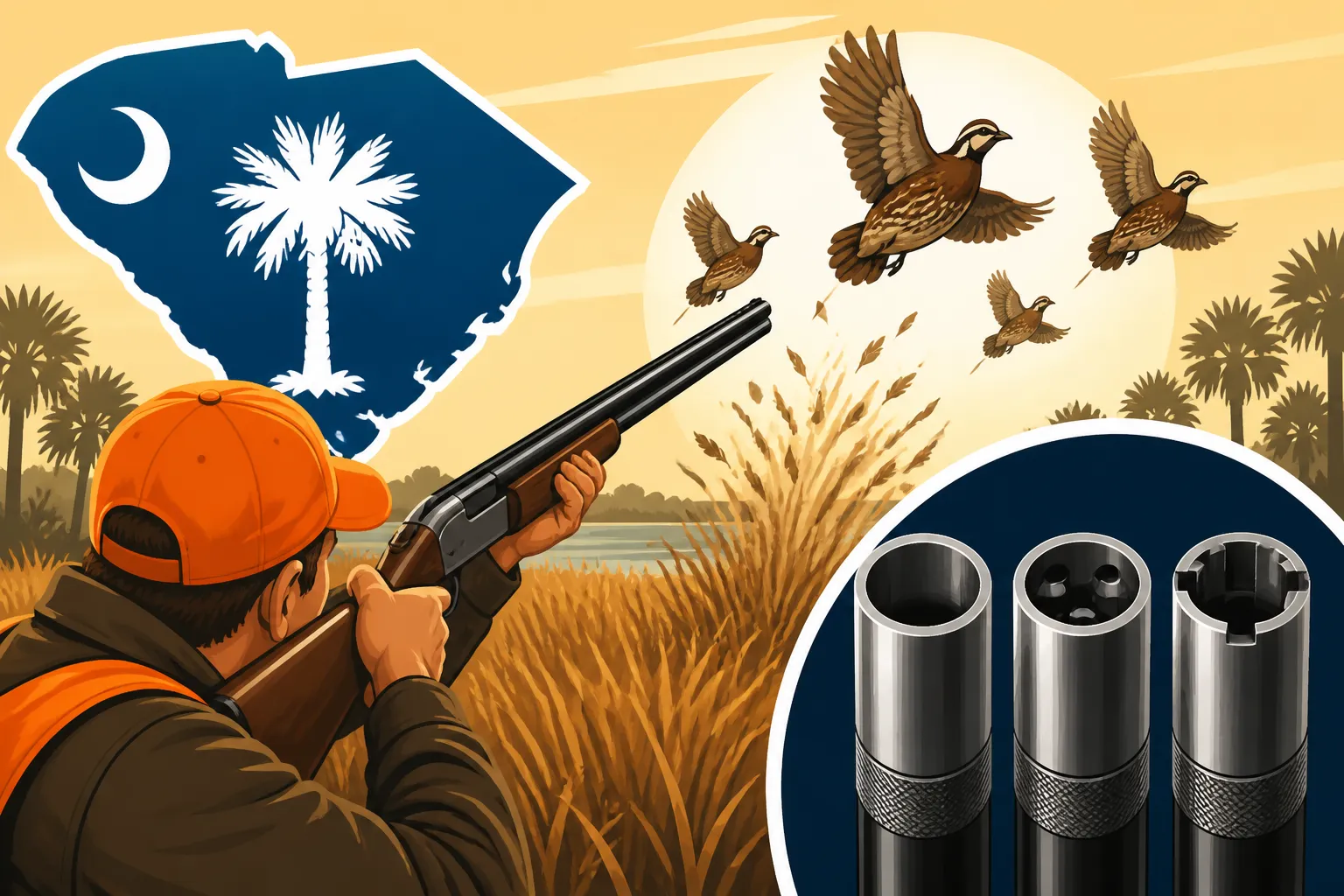
The common choke designations range from very open to very tight: Cylinder (Cyl), Skeet (SKT), Improved Cylinder (IC), Light Modified (LM), Modified (Mod), Improved Modified (IM), and Full (F). A Cylinder choke provides the widest, quickest spread, while a Full choke keeps the pellets in a much tighter group for longer distances. For quail, especially those erupting from dense cover, a wide, forgiving pattern is usually your best friend. A tight choke like a Full might keep your pattern together at 40 yards, but at 15-20 yards, that pattern is still so compact that it's easy to completely miss a bird or, worse, blow it to smithereens if you hit it dead center. We’re looking for a sweet spot that gives us enough spread to connect without sacrificing too much density for a clean kill.
Why Covey Flushes Are Unique
There are few hunting experiences as exhilarating or chaotic as a covey of bobwhite quail flushing around your feet, especially when you've got a good bird dog working. One moment, the world is still, and the next, there's an explosion of wings, chirps, and a dozen or more birds erupting in every direction. It’s not like a single pheasant getting up ahead of you or ducks decoying over a marsh. Here, you’re dealing with multiple targets, often at very close range, making split-second decisions about which bird to pick and how to swing.
The challenge isn't just the sheer number of birds, but their unpredictable flight paths and incredible speed. They don't fly in a straight line; they jink, dive, and climb, often weaving through cover. This means your window of opportunity to get on target and make a shot is incredibly narrow. A choke that provides a wide, forgiving pattern becomes crucial because it increases your chances of putting enough pellets on a fast-moving, close-range bird, even if your lead or swing isn't absolutely perfect. If you're using a tight choke, you're essentially trying to hit a moving, dinner-plate-sized target with a golf ball – very tough. You need that pattern to be more like a Frisbee. Being prepared for these dynamic situations is key, and understanding the ground you're on, perhaps by using mapping tools from GoHunt to visualize cover, can give you a mental edge before the flush.
Ideal Choke Choices for South Carolina Quail
When that covey erupts from underfoot, you need a pattern that’s open enough to tag a bird quickly but dense enough to ensure a clean kill. Over the years, upland hunters have found a few dependable choke choices that consistently deliver in these high-intensity, close-range scenarios.
The Go-To: Improved Cylinder
For most South Carolina quail hunting, the Improved Cylinder (IC) choke is often the gold standard, and for good reason. It strikes a fantastic balance between pattern spread and density at the typical distances you’ll encounter during a covey flush. Think about it: most quail are shot between 15 and 25 yards, right after they’ve exploded from cover and are still gaining speed. At these ranges, an IC choke delivers a pattern that’s wide enough to be forgiving if your aim is slightly off, yet still dense enough to ensure multiple pellet strikes for a quick, ethical kill.
An IC choke typically throws about 45-50% of your pellets into a 30-inch circle at 40 yards. While 40 yards isn’t your primary quail distance, that percentage gives you a good idea of its relative openness compared to, say, a Modified choke, which throws around 55-60%. In the moment of a flush, when birds are going in all directions and you're trying to pick one out of the chaos, having that wider pattern from an IC choke means you have a larger effective killing zone. It gives you a little grace when a bird jinks unexpectedly or you're slightly behind the swing. Many experienced bird hunters wouldn't dream of heading into the piney woods or across a cut field without an IC in their primary barrel. Before heading out, you might even use mapping resources from GoHunt to identify potential quail territories based on How Managed Pine Could Restore South Carolina Quail, which can influence your confidence in close-range flushes.
When to Consider Cylinder or Skeet
While Improved Cylinder is a fantastic all-around choice, there are specific situations where an even more open choke, like Cylinder (Cyl) or Skeet (SKT), might be beneficial. These super-open chokes are perfect for exceptionally tight cover, such as dense briar thickets or overgrown fencerows, where the birds are going to flush practically at your feet and disappear into the vegetation almost instantly. In these scenarios, your shots will likely be under 15 yards, sometimes as close as 10 yards.
At these very close distances, even an IC choke might still produce a pattern that’s too tight, leading to either missed birds because the pattern is still too small to connect, or to over-patterned birds that are essentially shredded by the tightly grouped shot. A Cylinder or Skeet choke, designed for the absolute closest ranges, opens up your pattern much faster, giving you a wider spread at those ultra-close distances. The trade-off, of course, is a significant reduction in effective range. If you manage to get a follow-up shot on a bird that has flown out to 30 yards, your pattern might be too sparse for a clean kill with these open chokes. However, if your hunting grounds consistently put you nose-to-beak with flushing coveys, an open choke can save a lot of frustration and result in more birds in the bag.
Double Barrel Wisdom: Mixing Chokes
For hunters who carry a double-barrel shotgun – whether a classic side-by-side or a versatile over-and-under – you have a distinct advantage: the ability to select two different chokes for different situations within the same hunt. This is a tactic that many seasoned upland hunters swear by, offering a dynamic approach to the varied shots a quail hunt can present.
The typical setup involves placing a more open choke in the first barrel (which fires first, usually the bottom barrel on an O/U or the right barrel on an SxS) and a slightly tighter choke in the second. For South Carolina quail, this often means an Improved Cylinder or Skeet choke in the first barrel, ready for that immediate, close-range covey explosion. This open pattern is designed to maximize your chances on the initial, chaotic flush, when birds are closest and most unpredictable. If you manage to connect, great. If not, or if a second bird presents a slightly longer shot, you then have your second barrel, often choked Light Modified or Modified. This tighter choke provides a denser pattern with a bit more reach, perfect for a follow-up shot on a bird that might be 25-35 yards out and still flying strong. This strategy essentially gives you two different tools for two different ranges, allowing you to adapt to the fast-changing conditions of a quail hunt without having to swap chokes in the field. It's a pragmatic approach that acknowledges the reality of Upland Guns for Quail Plantation Walks where shots can vary widely in distance.
| Choke Type | Typical Pattern at 20 Yards (Approx. Diameter) | Ideal Scenario | Key Benefit |
|---|---|---|---|
| Cylinder / Skeet | 30-35 inches | Very dense cover, extremely close flushes (under 15 yards) | Maximum pattern spread for high probability hits at very close range |
| Improved Cylinder | 25-30 inches | General quail hunting, typical covey flushes (15-25 yards) | Balanced spread and density; forgiving for quick, close shots |
| Light Modified | 20-25 inches | Follow-up shots on fleeing birds, slightly more open cover | Slightly more reach than IC, good for second shots from a double barrel |
| Modified | 15-20 inches | Very open cover, longer follow-up shots (25-35 yards) | Increased pellet density and effective range, but less forgiving at close range |
Factors Influencing Your Choke Decision on the Ground
Choosing a choke isn’t just about the birds themselves; it’s also heavily influenced by the environment you’re hunting in and even your personal shooting style. South Carolina offers a diverse range of landscapes, and each can present unique challenges and opportunities for quail hunting. Being aware of these elements can help you fine-tune your setup.
Habitat and Cover Density
South Carolina’s quail habitat varies significantly, from the dense, regenerating clear-cuts to the more open, managed pine savannas. The type of cover you’re hunting in directly impacts how close birds will hold, how quickly they’ll get up, and how far they might fly before dipping into another thicket.
In areas with very thick, impenetrable cover – think dense briar patches, grown-up logging roads, or thick broom sedge fields – birds are likely to hold tighter. When they do flush, they’ll be practically at your feet, and they’ll vanish into the surrounding vegetation almost immediately. For these situations, a more open choke like Cylinder or Skeet is often ideal, as it gives you the widest possible pattern for those incredibly close, reactive shots. On the flip side, if you're hunting more open ground, such as understory-thinned longleaf pine stands or large, open agricultural fields with scattered cover, birds might flush a bit farther out. In these scenarios, an Improved Cylinder or even a Light Modified choke might offer that extra bit of pattern density and reach needed to connect with a bird that gets up at 25 or even 30 yards. Understanding the nuances of South Carolina Longleaf Pine and Quail Habitat is crucial for anticipating these flushing distances.
Shot Size and Shell Selection
The choke is one part of the pattern equation; your shot size and the specific shell you’re using are the other. These two elements work in tandem to create the effective killing pattern. For quail, most hunters opt for smaller shot sizes, typically 7.5 or 8. These smaller pellets mean you get a higher pellet count per shell, which increases your chances of hitting a fast-moving bird with multiple pellets.
However, smaller shot also loses energy more quickly and tends to spread out a bit faster than larger shot. This is where your choke choice becomes critical. If you’re using very fine shot (like 9s) with a very open choke (Cylinder), you might end up with a pattern that’s too sparse at even moderate distances, leading to wounded birds. Conversely, if you use a tighter choke (Modified) with larger shot (7.5) at close range, your pattern might be too dense, resulting in ruined meat. The key is to find a balance. Many hunters find that 7.5 shot combined with an Improved Cylinder choke offers an excellent balance of pellet count, pattern density, and killing power for typical quail ranges. Experimenting with different loads and chokes is really the only way to find what works best with your specific shotgun, and using a rangefinder to judge target distances on GoHunt maps can help you visualize these distances more effectively.
Personal Shooting Style and Confidence
Let’s face it, we all shoot a little differently. Some hunters are incredibly quick to shoulder their shotgun and swing, almost instinctively connecting with a bird as it rises. Others might take a fraction of a second longer to acquire their target, preferring a more deliberate swing. Your personal shooting style and, perhaps most importantly, your confidence in your setup, play a huge role in choke selection.
If you’re someone who tends to shoot fast and instinctively, often connecting with birds within 15-20 yards, a more open choke like Improved Cylinder or even Skeet might be perfectly suited for you. That wider pattern will be forgiving for those lightning-quick reactions. However, if you find yourself often taking slightly longer shots, or if you prefer a bit more leeway in your swing, you might find more success with an Improved Cylinder or even a Light Modified choke, especially if you shoot a single-barrel gun. Ultimately, confidence is paramount. If you feel like your gun is patterned perfectly for the situation, you’re more likely to make a good shot. Spending time at the range patterning your shotgun with various chokes and loads (which we'll cover next) is the only way to truly understand what works for you. It’s a bit like picking the right pack for a day out; whether it's a Choosing a Daypack for a Coastal Hunt or for a deep woods trek, comfort and confidence in your gear makes all the difference.
Patterning Your Shotgun: The Essential Step
All the theory in the world about chokes won't mean a thing if you don't know how your specific shotgun, choke, and ammunition combination actually performs. This is where patterning comes in – it's the non-negotiable step for any serious bird hunter.
Why Patterning Matters
Think of your shotgun as a unique individual. No two shotguns, even of the same make and model, will shoot exactly alike. The internal bore dimensions, the slight variations in choke manufacturing, and even how your particular ammunition is loaded can all influence how your pellets distribute downrange. Relying solely on the choke designation stamped on your barrel is like buying a pair of shoes without trying them on – they might fit, or they might pinch your toes.
Patterning reveals the truth: where your gun actually shoots relative to your point of aim, how dense the pellet pattern is, and its effective spread at various distances. You might assume your Improved Cylinder choke throws a perfect 25-inch pattern at 20 yards, but your patterning session might show it's actually throwing a 30-inch pattern, or that it's consistently shooting a few inches high or low. This information is gold. It allows you to make an informed decision about which choke to use, gives you confidence in your setup, and ultimately helps you make cleaner, more ethical kills in the field. Without patterning, you're guessing, and when those quail burst out, you want certainty, not guesswork. This applies whether you're chasing bobwhites or even South Carolina Squirrel and Rabbit Season Rules.
The Patterning Process
Patterning your shotgun isn't complicated, but it does require a bit of time and methodical effort. Here’s a simple step-by-step guide to get it right:
- Gather Your Gear: You'll need your shotgun, the various chokes you want to test, the specific ammunition you intend to hunt with (same brand, same shot size, same load data), a large piece of paper or cardboard (at least 3×3 feet is good), a marker, and a measuring tape.
- Set Up Your Target: Place your paper target at a realistic hunting distance. For quail, start at 20 yards, then move to 15 and 25 yards. Draw a clear aiming point (a small circle or crosshair) in the center of each target.
- Shoot Methodically:
- Screw in your first choke (e.g., Improved Cylinder).
- Load your chosen ammunition.
- From your chosen distance (e.g., 20 yards), take a steady, aimed shot at the center of your target. Treat it like a rifle shot – aim carefully at the bullseye, not a moving bird. This tells you where the center of your pattern is relative to your point of aim.
- Repeat this process at least 3-5 times for each choke and load combination, using a fresh target for each shot. This averages out any minor inconsistencies in your shooting or the ammunition.
- Analyze Your Patterns:
- Point of Impact: First, look at where the center of your pellet pattern is relative to your aiming point. Is it consistently high, low, left, or right? If so, you might need to adjust your gun's fit or aim accordingly.
- Pattern Density: Draw a 30-inch circle around the densest part of your pattern (not necessarily your aiming point). Count the pellet holes within this circle. You want enough pellets to consistently hit the vital zone of a quail (roughly a 4-inch circle) with 3-5 pellets for a clean kill. A good rule of thumb is at least 80-100 pellets in the 30-inch circle for smaller shot sizes like 7.5 or 8 at your maximum effective range.
- Pattern Distribution: Is the pattern evenly distributed, or are there "holes" where a bird could potentially slip through without receiving enough pellets? Look for a consistent spread.
- Compare and Choose: After patterning all your desired choke and load combinations at various distances, you’ll have a clear picture of their performance. You might find that your Improved Cylinder with one brand of shell performs better than another, or that a Skeet choke is surprisingly effective at 20 yards with a particular load. This empirical data is invaluable for making your final choke decision for fast covey flushes. It’s the ultimate way to ensure your Shotguns for South Carolina Dove and Quail are truly ready for the field.
Disclaimer
This article is for general informational purposes only and does not constitute professional advice. Laws, prices and regulations vary by location and change over time. Consult a qualified professional for guidance on your specific situation.