Arrow Weight for Short Shots
We've all been there: tucked into a cozy treestand in a thick patch of South Carolina pines, maybe on a warm August afternoon or a crisp October morning, when a deer suddenly materializes just twenty yards away. It's an adrenaline-fueled moment, and you know you've got a prime opportunity. But in these close-quarters situations, are you truly optimized for success? This guide is going to dig deep into arrow weight for those crucial short shots, helping you understand how to maximize your setup for clean, ethical kills when deer are practically under your stand.
Understanding Arrow Weight and Its Impact
When you're thinking about bowhunting, especially in the tight, often unforgiving cover we have here in South Carolina, the weight of your arrow isn't just a number on a package. It's a critical component that dictates everything from your arrow's trajectory to its penetration power. For those "short shots"—the ones that happen fast and close—understanding this relationship is paramount.
Kinetic Energy vs. Momentum for Short Shots
Let's talk physics for a moment, but I promise we won't get too academic. When an arrow leaves your bow, it possesses both kinetic energy (KE) and momentum.
- Kinetic Energy is largely about speed. A faster arrow generally has more KE. It's the "shock and awe" factor, if you will.
- Momentum is more about mass and how well that mass resists stopping. A heavier arrow, even if slower, carries more momentum. Think of it like a bowling ball versus a baseball; the bowling ball, despite its slower speed, will hit with much more sustained force.
For short shots, especially those under, say, 30 yards, speed isn't the absolute king. Why? Because the arrow doesn't have much time to drop, so trajectory concerns are minimal. What is king at these ranges is penetration. You want that arrow to punch through bone, hide, and tissue cleanly. This is where momentum really shines. A heavier arrow, carrying more momentum, will drive deeper into the animal, increasing your chances of a pass-through and a quick, ethical harvest. This becomes particularly important when aiming for Shot Placement on a South Carolina Black Bear or for a deer that might be slightly quartering away.
Factors Affecting "Short Shot" Definition in South Carolina
What exactly constitutes a "short shot" in the context of South Carolina hunting? Well, it's not a universal number. In the dense woods and swamp edges we often hunt, a "short shot" might be anything from 5 yards out to 30 or even 35 yards.
- Dense Cover: Picture hunting in the Francis Marion National Forest or a thick lowland swamp. Your shooting lanes are often tight, limited by pine trees, palmetto bushes, or dense undergrowth. Deer can seemingly appear out of nowhere, offering only a brief window. These tight conditions inherently lead to shorter shot opportunities.
- Quick Opportunities: Often, deer in these environments are on the move, browsing or slipping through cover. You might not have time for extensive rangefinding or intricate calculations. It's often a snap decision, draw, and shoot.
- Deer Movement Patterns: Whether you're hunting a Funnel Between Two Swamps or a busy scrape line, deer are often concentrated in areas where you expect close encounters. Scouting with tools like the GoHunt app can help identify these high-traffic areas, increasing your odds of a short-range opportunity.
So, while "short" might typically mean under 20 yards, in South Carolina's varied terrain, that effective "short shot" range can extend a bit further, making the emphasis on penetration even more vital.
The Role of FOC Front of Center in Arrow Performance
Beyond overall arrow weight, another critical factor for penetration, especially on short shots, is your arrow's Front of Center (FOC). This refers to how much of the arrow's total weight is concentrated in the front half. A higher FOC (typically 12-15% or even more for extreme setups) means the arrow is more "front heavy."
- Increased Stability: A higher FOC helps stabilize the arrow in flight, making it more forgiving of small form errors and wind drift. While wind isn't usually a major factor on very short shots, stability is always a good thing.
- Enhanced Penetration: More importantly for our discussion, a front-heavy arrow drives more efficiently. Think of it like a dart; the weight is forward, allowing it to penetrate better than a perfectly balanced stick. For a close shot where you might encounter a shoulder blade or a rib, that forward weight helps the broadhead punch through with maximum force, conserving momentum for deeper penetration into the vitals. This design can be particularly beneficial when considering Broadheads for Swamp Timber Shots, where hitting unexpected obstacles isn't uncommon.
Ideal Arrow Weight Ranges for South Carolina Conditions
Now that we understand why arrow weight matters, let's talk about what "ideal" looks like for those close encounters in our South Carolina woods. It's not about being the fastest; it's about being the most effective.
Why Heavier Arrows Shine in South Carolina's Thick Cover
South Carolina's hunting environments are rarely open prairie. We deal with dense hardwoods, thick pine plantations, palmetto stands, and river bottom swamps. These aren't places where a deer will often stand silhouetted at 60 yards. More often, you're picking a small lane at 15 or 20 yards, and you need that arrow to get there and do its job without deflection or insufficient penetration.
- Punching Through Brush: Sometimes, despite your best efforts, you might clip a small twig on the way to the target. A heavier arrow, due to its increased momentum, is less likely to be deflected by minor contact, maintaining a truer path and delivering more energy.
- Bone-Crushing Power: Deer aren't always broadside. A slight quartering angle can put the shoulder blade squarely in the path of your broadhead. A heavier arrow significantly increases your chances of breaking through bone, ensuring that your broadhead can continue into the vitals. This is a huge ethical consideration; a deer hit in the shoulder by a light, fast arrow might just be wounded, whereas a heavier arrow could still achieve penetration.
- Maximizing Pass-Throughs: A pass-through shot creates two holes for blood trail, dramatically increasing your recovery odds. In dense South Carolina cover, a strong blood trail is often the difference between finding your deer and losing it. Heavier arrows are far more likely to achieve a pass-through, even on larger deer. Given the typically smaller size of South Carolina deer compared to their northern cousins, a heavy arrow still offers substantial over-penetration for confident results.
For most bowhunters aiming for these benefits, an arrow in the 450-550 grain range (total arrow weight, including broadhead) is an excellent sweet spot. Some dedicated penetration fanatics might go even heavier, but this range offers a fantastic balance for most bows.
Balancing Speed and Kinetic Energy for Close Encounters
While I just championed momentum, speed isn't entirely irrelevant. You still want your arrow to get to the target quickly enough that the deer doesn't "jump the string." This phenomenon occurs when a deer reacts to the sound of the bow string and drops or moves before the arrow arrives.
- The Compromise: The good news is that modern bows are incredibly efficient. Even with a heavier arrow in the 450-550 grain range, most contemporary bows will still launch it at speeds well over 250 feet per second (fps), often closer to 270-290 fps, depending on your Bow Draw Weight for South Carolina Whitetails. This is more than fast enough for any reasonable bowhunting shot, including those close ones, to minimize string jumping.
- Sufficient Kinetic Energy: At these speeds and weights, your kinetic energy will still be substantial, often well into the 70-80 ft-lbs range, which is more than adequate for any deer or even black bear in South Carolina. The point isn't to sacrifice kinetic energy for momentum, but to ensure you have a balanced combination that prioritizes the deep penetration needed for a quick kill, especially when Hunting Lowcountry Swamp Deer where tracking can be tough.
Consideration for Broadhead Type
Your choice of broadhead works hand-in-hand with your arrow weight.
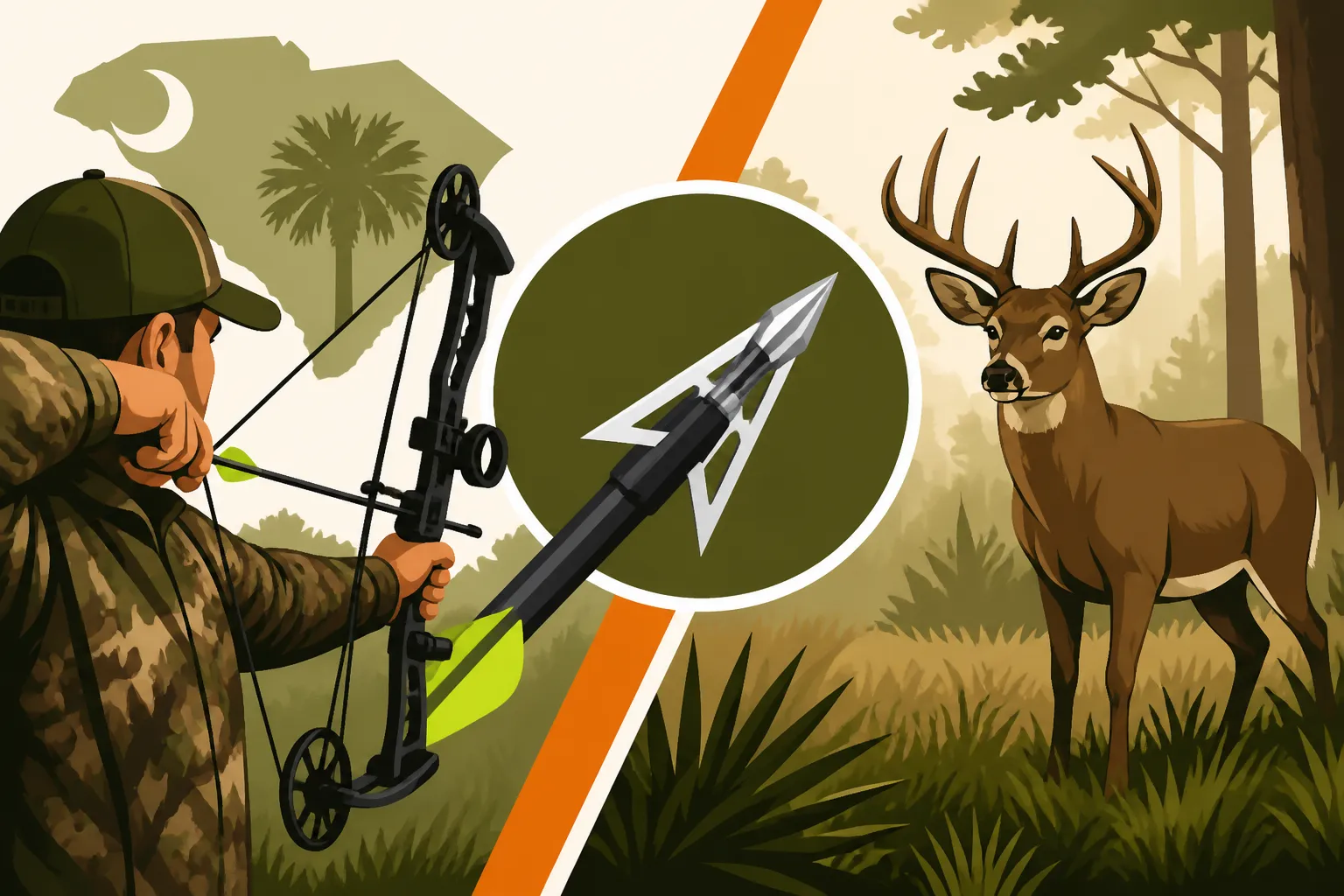
- Fixed-Blade Broadheads: These are generally robust and designed for maximum penetration, often with a smaller cutting diameter. They excel when paired with heavier arrows, as the arrow's momentum drives the sturdy blade through tough hide and bone. If you're using a fixed-blade, a heavier arrow simply compounds its inherent penetration advantages.
- Mechanical Broadheads: Mechanical broadheads deploy on impact, creating a larger cutting diameter. While they can be devastating, they also require more energy to open and continue penetrating. A lighter, faster arrow might open a mechanical broadhead but then lose too much energy, resulting in shallower penetration, especially if bone is hit. This is precisely why pairing a heavier arrow with a mechanical broadhead can be a smart move for short shots in South Carolina. The added momentum helps ensure the broadhead opens, clears the bone, and continues its work deep into the vitals, offering the best of both worlds: a wide cutting diameter and robust penetration.
| Arrow Characteristic | Lighter Arrow (e.g., 350 grains) | Heavier Arrow (e.g., 500 grains) |
|---|---|---|
| Speed (FPS) | Higher | Lower |
| Kinetic Energy | High | Very High |
| Momentum | Moderate | Excellent |
| Trajectory (0-30yds) | Very Flat | Flat (minimal difference at close range) |
| Penetration | Good (can struggle with bone/angles) | Excellent (drives through bone/angles) |
| Wind Drift | More Susceptible | Less Susceptible |
| Noise | Often Quieter (less mass) | Can be slightly louder (more mass to move) |
| Deflection | More Prone | Less Prone |
| Pass-Through Rate | Lower | Higher |
Setting Up Your Bow for Optimal Short-Range Performance
It's not enough to just buy heavy arrows; you need to ensure your entire setup is working in harmony. A well-tuned bow is critical for accuracy, regardless of arrow weight or shot distance.
Tuning Your Bow for a Heavier Arrow
Switching to a significantly heavier arrow, especially if you've been shooting lighter ones, will likely require some re-tuning of your bow.
- Paper Tuning: This is a fundamental step. You shoot an arrow through a piece of paper suspended a few feet in front of you. The tear pattern in the paper tells you if your arrow is leaving the bow perfectly straight (bullet hole) or if it's tearing high, low, left, or right. These tears indicate issues with your arrow rest, nocking point, or cam timing. A heavier arrow can sometimes exaggerate these issues or require slight adjustments to achieve a perfect tear.
- Walk-Back Tuning: After paper tuning, walk-back tuning helps fine-tune your arrow rest. You shoot at a vertical line from increasingly longer distances (e.g., 10, 20, 30 yards). If your rest is perfectly aligned, all your arrows should impact on that vertical line, regardless of distance. If they start walking off to the left or right, a minor adjustment to your arrow rest is needed.
- Broadhead Tuning: This is the ultimate test. You want your broadheads to hit exactly where your field points do. If they don't, it usually means your broadheads are "steering" the arrow, indicating a tuning issue that needs to be resolved. This is particularly crucial for fixed-blade broadheads but applies to mechanicals as well. A properly tuned bow launching a heavy arrow will make broadhead tuning much easier. You want absolute confidence that your arrow will fly true, whether you're taking a shot at a deer after Rattling and Grunting in South Carolina or patiently waiting in a blind.
Practicing Close-Range Shots with Your Chosen Setup
Once your bow is perfectly tuned with your new heavy arrows, the real work begins: practice. And I'm not just talking about shooting at 20 yards from a flat range.
- Realistic Yardages: Practice at 10, 15, 20, 25, and 30 yards. Many hunters neglect the super-close shots, assuming they're easy. But target panic or improper form can be magnified at these distances.
- Hunting Positions: This is huge for South Carolina hunting. Are you hunting from a Treestand Setups in Francis Marion National Forest? Practice shooting from elevated positions. Are you using a Ground Blind Rules on South Carolina WMAs? Practice shooting from a seated position, through mesh, and simulating tight lanes.
- Quick Draws: Practice drawing your bow quickly and quietly, getting to full draw smoothly, and acquiring your target. Many short-shot opportunities are fleeting.
- Obstacle Awareness: Set up targets behind small branches or leaves (safely, of course) to simulate real-world shooting lanes. Learn to pick a spot and focus on it, ignoring the surrounding distractions. Use a rangefinder, like a GoHunt integrated feature, to mark key distances around your stand or blind, making those quick decisions easier.
Customizing Arrow Components for Specific Needs
Beyond the shaft itself, you can fine-tune your arrow setup with various components.
- Heavy Inserts: To achieve a higher FOC and more front-end weight without simply using a heavier shaft, you can install heavy brass or steel inserts (50-100+ grains) in the front of your arrow. This adds weight exactly where it helps penetration and stability most.
- Fletching: While less critical for weight, your fletching choice impacts drag and stability. For shorter shots, a slightly larger fletching (e.g., 3-inch vanes) can provide excellent stabilization for heavier arrows, especially with broadheads, without significantly impacting speed over short distances.
- Nocks: Nocks are mostly standard, but ensuring they fit snugly and consistently on your string is part of overall accuracy. Some illuminated nocks add a small amount of weight to the rear, which slightly decreases FOC, but the benefit of tracking your shot in low light often outweighs this minor effect.
Common Misconceptions and Practical Advice
The world of archery, like any other hunting pursuit, is full of opinions and preferences. But when it comes to maximizing your chances on those critical close shots in South Carolina, there are some hard truths and practical tips worth considering.
Dispelling the "Lighter is Always Faster" Myth
It's a common trap many new (and even some experienced) bowhunters fall into: the idea that a faster arrow is automatically a better arrow. While it's true that a lighter arrow will leave your bow at a higher velocity, that speed comes at a cost, especially in our hunting scenarios.
- The Law of Diminishing Returns: Once you hit a certain speed threshold (e.g., 250-270 fps), additional speed offers very little practical advantage for trajectory out to typical bowhunting distances (under 40 yards). The slight arc difference between 280 fps and 300 fps at 20 yards is negligible.
- Compromised Penetration: The real problem with excessively light arrows is the significant reduction in momentum. At impact, a light arrow rapidly loses energy, leading to shallower penetration. If you hit anything substantial—a rib, a shoulder, or even just dense muscle—that light arrow might not have the oomph to get where it needs to go. For close shots, where you often have less room for error in terms of precise shot placement due to dense cover, you want every ounce of penetration you can get. This is why many experienced hunters for South Carolina's Black Bear Population or larger deer opt for a heavier arrow.
Focus on effective speed – enough to deliver the arrow quickly and quietly – and prioritize the momentum that guarantees deep, bone-crushing penetration.
The "GoHunt" Approach to Gear Selection
When you're trying to figure out the best gear, it can feel overwhelming. Platforms and tools like GoHunt can be incredibly helpful in this process.
- Researching Arrow Components: GoHunt often provides detailed specs and user reviews for various arrow shafts, broadheads, and components. You can compare different grain weights, FOC percentages, and material types to build an arrow that's perfectly suited for your needs. Instead of just guessing, you can make informed decisions based on available data and community feedback.
- Mapping and Scouting for Short Shot Opportunities: Beyond gear, GoHunt mapping features can help you scout potential hunting areas in South Carolina's public lands, like Sumter National Forest Hunting. You can identify pinch points, funnels, bedding areas, and food sources that naturally lead to close-range encounters. By understanding deer movement and habitat, you can strategically place your stand or blind to maximize those short-shot opportunities. A well-placed stand in a thicket can make a huge difference, and knowing where to place it often comes from diligent scouting. This blend of gear knowledge and spatial awareness, aided by modern tools, empowers you to be a more effective hunter.
Real-World Scenarios and Adaptations
Let's consider a few South Carolina-specific scenarios where arrow weight truly matters for short shots:
- Deep Swamp Bottoms: You're sitting on the edge of a cypress swamp, perhaps in the ACE Basin, and a nice buck steps out from the palmettos at 18 yards. The air is humid, the deer is likely moving through thick undergrowth, and you might have a small sapling partially obscuring your shot. A heavy arrow, coupled with a fixed-blade broadhead, will cut through any minor brush deflection and drive deep, even if the deer is slightly angled or you hit a rib head-on.
- Pine Plantations: Imagine still-hunting a young pine plantation in the Midlands. A doe suddenly bursts from the cover at 12 yards, momentarily pauses, and you get a quick shot. The deer is close, but the shot window is tiny and fleeting. You might hit a pine branch on the way in. A heavier arrow gives you the confidence that even with a slight deflection, it will still retain enough energy and momentum to penetrate the vitals for a clean kill. This is paramount for Hunting South Carolina's Year-Round Feral Hogs as well, where vital areas can be smaller and surrounded by tough muscle and bone.
- Field Edges at Dusk: You're overlooking a small clover plot on private land, waiting for deer to step out. A wary old buck appears on the very edge of the woods, just 25 yards away, barely offering a shot through the hanging branches. The light is fading fast. A heavier arrow ensures maximum energy transfer and a higher likelihood of a pass-through, giving you the best chance of a quick recovery before darkness completely sets in. This is why paying attention to Late-Season Food Sources for South Carolina Whitetails is crucial, as deer will often be seen on field edges at prime short-shot distances.
Ultimately, the goal is always a quick, ethical kill. For those close-range encounters we all dream about in the South Carolina woods, prioritizing arrow momentum through appropriate arrow weight is one of the smartest gear decisions you can make. It builds confidence in your shot and increases your chances of punching that tag and putting venison in the freezer.
Disclaimer
This article is for general informational purposes only and does not constitute professional advice. Laws, prices and regulations vary by location and change over time. Consult a qualified professional for guidance on your specific situation.