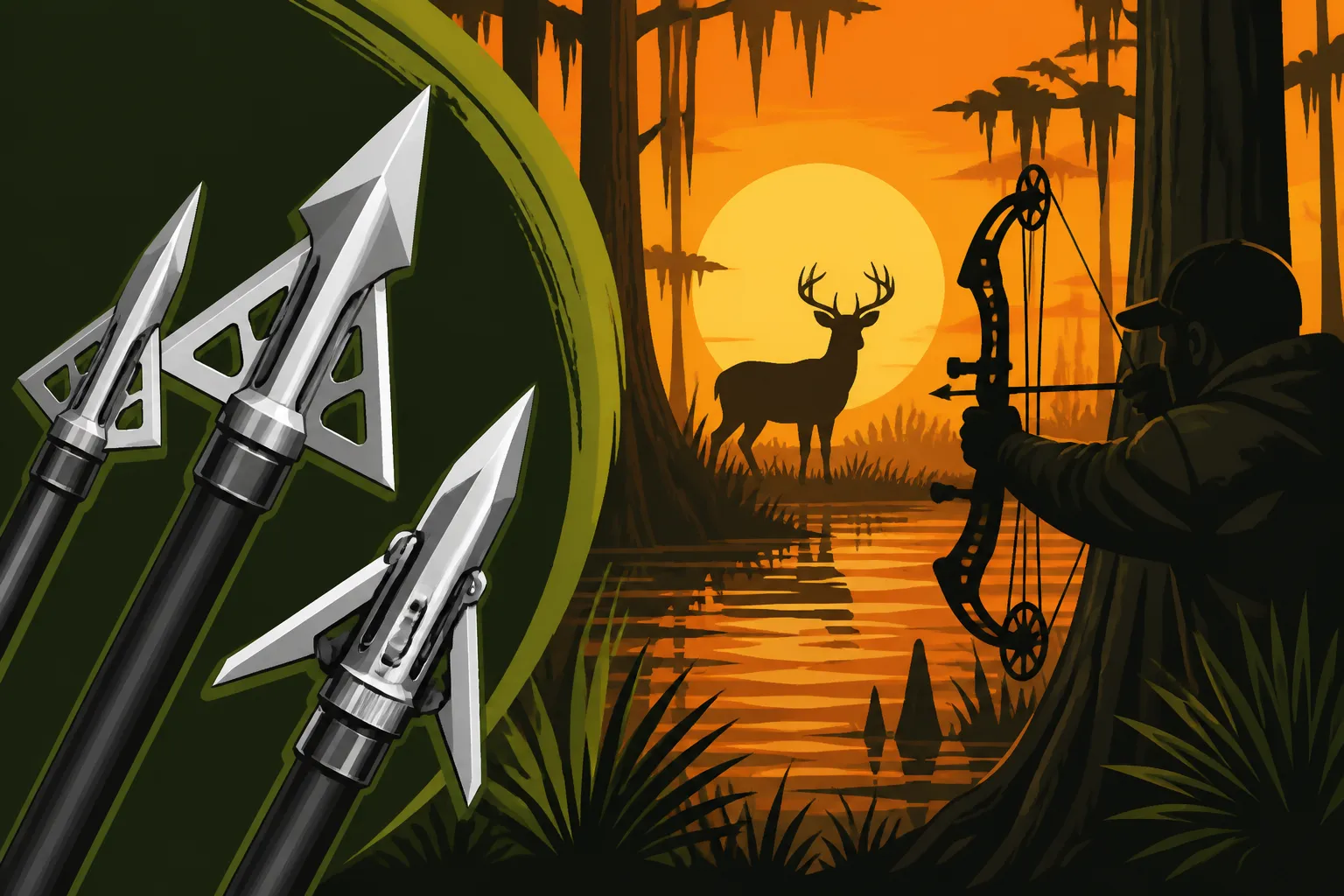
Broadheads for Swamp Timber Shots
Hunting in the dense, often unforgiving swamp timber of South Carolina presents a unique set of challenges, especially for bowhunters. The thick vegetation, tough hides of swamp deer, and the sheer physicality of the environment demand that every piece of your gear is up to the task. This guide dives deep into choosing the perfect broadhead designed to perform when every shot counts in those tight, humid, and often muddy conditions, ensuring you're ready for what the Lowcountry throws your way.
Understanding the Unique Challenges of South Carolina Swamp Timber
South Carolina's swamps and bottomlands aren't your typical open woods. They are unique ecosystems that test both hunter and gear to their limits. The humidity, the dense undergrowth, and the resilience of the local game require a broadhead that can stand up to extreme conditions and deliver consistent, lethal penetration. It’s not just about hitting the target; it’s about what happens after the hit, especially when tracking can be a nightmare in a mucky environment.
Dense Vegetation and Limited Shot Angles
Imagine stalking through a cypress stand, the air thick with moisture, and you finally spot that heavy-antlered buck through a tiny window in the palmettos and briars. Your shot might be close, perhaps twenty yards or less, but the arrow has to navigate a gauntlet of small twigs, leaves, and hanging vines. This isn't wide-open country where you can afford a slight deviation. The broadhead you choose needs to be compact, aerodynamic, and forgiving, minimizing the chance of deflection. A mechanical broadhead with large, deploying blades might be prone to snagging or pre-deploying on brush, leading to a disastrous shot. On the flip side, a fixed-blade broadhead with a wider cutting diameter might also catch, altering your arrow's flight path just enough to turn a lethal hit into a wounding shot or a clean miss. This is where precise tuning and a solid, durable design really come into play. Every hunter knows the frustration of a deflected arrow, and in the swamps, it's an even more common concern.
Tough-Skinned Animals and Bone Impact
South Carolina deer, particularly those that thrive in the tough swamp environments, can be surprisingly robust. They're often thick-bodied, with strong shoulders and dense bone structure built for pushing through heavy cover. When your arrow hits, it needs to penetrate cleanly through hide, muscle, and potentially bone to reach the vitals. A broadhead that fails to penetrate effectively can result in a superficial wound, a lost animal, and a disheartening experience. We're talking about situations where a buck might be quartering away slightly, and you need to drive through a scapula or ribs. This isn't the time for a broadhead that sacrifices structural integrity for a huge cutting diameter. You need one that holds together, maintains its edge, and drives deep. Thinking about your Bow Draw Weight for South Carolina Whitetails is crucial here; a higher draw weight will aid penetration, but the broadhead still needs to do its part.
Humidity, Water, and Broadhead Integrity
The South Carolina swamp isn't just about dense vegetation; it's about wet dense vegetation. Persistent humidity, sudden downpours, and even accidental dips in standing water are all part of the game. Your broadheads need to be able to withstand these elements without rusting, corroding, or having their components seize up. Imagine a mechanical broadhead's pivot points or retention bands getting rusty and failing to deploy, or a fixed blade's ferrule corroding, weakening the head. Blade sharpness can also be compromised by exposure to moisture. You might spend all morning carefully getting into position for Hunting Lowcountry Swamp Deer, and the last thing you want is your meticulously sharpened broadhead dulled by rubbing against wet leaves or condensation forming in your quiver. Quality materials and robust construction are paramount to ensuring your broadhead is as ready at the moment of truth as it was when you screwed it onto your arrow.
Fixed-Blade Broadheads: The Tried and True for Tough Conditions
When it comes to dependability and raw penetrating power, fixed-blade broadheads have been the backbone of bowhunting for generations. Their simplicity is their strength: typically, a solid ferrule with two, three, or four blades permanently attached. There are no moving parts to fail, no deployment mechanisms to worry about, just pure, unadulterated cutting and penetration. For the unforgiving environment of South Carolina's swamp timber, this steadfast reliability can be a huge advantage. They are often the go-to for hunters who prioritize deep penetration, especially when facing potential bone impacts.
Two-Blade vs. Three/Four-Blade Designs
The choice between a two-blade and a multi-blade fixed head often boils down to a trade-off between penetration and cutting surface area. Two-blade broadheads, especially those with a cut-on-contact tip and a low blade angle, are renowned for their incredible penetration. They create a longer, narrower wound channel, often slicing through ribs and even shoulder bone with minimal energy loss. This can be absolutely vital in situations where you might have less-than-ideal shot angles or need every inch of penetration to reach the vitals of a big swamp buck. Many hunters swear by them for hogs too, given their tough shoulder shields.
Three- and four-blade fixed heads, on the other hand, create a wider wound channel, which can lead to a quicker bleed-out and a more visible blood trail—a huge plus when you're Recovering a Deer From a Lowcountry Swamp. While they might not penetrate quite as deeply as a perfectly tuned two-blade, the increased cutting surface can cause more trauma to the internal organs. For shots that don't hit heavy bone, they can be devastating. However, the wider profile of a three or four-blade can also make them slightly more susceptible to wind drift or deflection from minor brush if your arrow isn't perfectly tuned for them. It’s a classic debate, and many veteran hunters will tell you that matching the broadhead to your specific arrow setup and shot distance is key.
Structural Integrity and Resharpening
One of the defining characteristics of a good fixed-blade broadhead is its structural integrity. You need a broadhead that won't bend, break, or shed blades upon impact, especially if it encounters bone. High-quality fixed blades often feature sturdy ferrules made from aircraft-grade aluminum or steel, paired with thick, razor-sharp blades that are securely integrated. This robust construction ensures that the broadhead maintains its form and cutting ability throughout the entire penetration process. A well-constructed fixed blade can often be resharpened after practice or even after harvesting an animal, extending its lifespan and value. This is a significant economic and practical advantage over many mechanicals, which often require new blades after each shot. Being able to quickly touch up an edge with a ceramic stick or diamond file means you're always ready, even if you’re deep in camp on a multi-day hunt.
Flight Characteristics with Heavy Arrows
Fixed-blade broadheads, by their very nature, can be more sensitive to arrow tuning than mechanicals. Their exposed blades can act like small wings, influencing the arrow's flight, especially with a poorly tuned setup. However, when paired with a properly spined arrow and precise tuning, they can fly exceptionally well, often matching field points out to reasonable bowhunting distances. Many swamp hunters prefer a heavier arrow setup, as Arrow Weight for Short Shots in dense cover can significantly enhance penetration. A heavier arrow carries more kinetic energy and momentum, which, when combined with the excellent penetration of a fixed-blade broadhead, creates a formidable combination for thick-skinned animals and navigating minor brush. When you're considering your setup, using resources like GoHunt to dial in your arrow FOC (Front of Center) and overall weight can make a massive difference in how consistently your fixed blades group at the target. Taking the time to broadhead-tune your arrows is paramount for consistent flight and ethical kills with these heads, especially if you're aiming for a tight window in the palmettos.
Mechanical Broadheads: Pros, Cons, and Considerations for Swamp Hunting
Mechanical broadheads, sometimes called expandable broadheads, have surged in popularity due to their field-point-like flight characteristics and large cutting diameters. The idea is that the blades remain tucked away during flight, reducing aerodynamic drag and making them fly more consistently like a field point. Upon impact, the blades deploy, creating a significantly wider wound channel than most fixed blades. This can be incredibly appealing for hunters who prioritize a massive blood trail and rapid internal trauma. However, the complex nature of their design introduces a few more variables, especially in the demanding conditions of South Carolina's swamp timber.
Cutting Diameter Versus Penetration
The biggest draw of mechanical broadheads is their impressive cutting diameter, often ranging from 1.5 to over 2 inches. This wider cut can create devastating wound channels, leading to quicker incapacitation and easier blood trailing. In an ideal scenario, a mechanical broadhead delivers maximum damage to the vitals, making for a swift and ethical harvest. However, this large cutting diameter comes with a trade-off in penetration. The energy required to deploy the blades and then cut a much wider hole means that mechanicals generally penetrate less deeply than fixed blades.
In swamp timber, where you might hit a deer that is quartering slightly or encounter bone, this reduced penetration can be a significant concern. A mechanical broadhead that doesn't fully penetrate to create an exit wound can make blood trailing incredibly difficult, especially in thick, wet undergrowth. Recovering a Deer From a Lowcountry Swamp is already challenging enough without a minimal blood trail. You want two holes, one in and one out, for maximum blood loss and a clear path to your animal. Some mechanicals are designed for maximum penetration, often with a smaller cutting diameter or steeper blade angle, attempting to bridge this gap.
Reliability of Deployment in Timber
The deployment mechanism is the heart of any mechanical broadhead, and its reliability is absolutely critical. Most mechanicals use either an O-ring, a collar, or spring-loaded blades to hold them in place until impact. The concern in thick swamp timber is the potential for premature deployment or failure to deploy. Brushing against a twig, heavy palmetto frond, or even a tight quiver can sometimes cause blades to open prematurely, completely destroying the arrow's flight path. Conversely, a dull blade or a component failure could prevent deployment altogether, turning your high-tech broadhead into a glorified field point on impact.
Quality mechanicals are designed with robust retention systems to prevent this, but the risk is always present in dense cover. When you're making a precision shot through a small opening, any uncertainty in your broadhead's performance is unacceptable. Practicing with your chosen mechanicals, checking O-rings, and inspecting the entire head for any signs of weakness is crucial. It's a level of maintenance and trust that fixed-blade users often don't have to consider to the same degree.
Blade Retention and Durability
Once deployed, the blades of a mechanical broadhead need to remain intact and sharp to effectively cut through tissue and bone. Some mechanicals feature very thin blades or complex pivot points that can be prone to bending or breaking on heavy bone impact. If a blade snaps or gets damaged during penetration, the broadhead's cutting efficiency is severely compromised, further reducing the wound channel and penetration. You also want to consider how securely the blades are held once deployed. Cheaply made mechanicals might have blades that wobble or flex, reducing their cutting effectiveness.
Durability is particularly important when considering the possibility of hitting heavier bone like the shoulder or sternum, which can happen even on well-placed shots if the animal moves at the last second. When processing your harvest, you want to see clean, consistent cuts, not torn tissue from a damaged broadhead. Many hunters opt for mechanicals with robust, thicker blades or a more solid locking mechanism once deployed, even if it means a slightly smaller cutting diameter. The trade-off for guaranteed durability and blade retention is often worth it for the peace of mind it provides in the demanding South Carolina swamps.
| Broadhead Type | Pros for Swamp Timber | Cons for Swamp Timber | Best Use Case |
|---|---|---|---|
| Fixed Blade | – Maximum Penetration | – Can be sensitive to tuning | – Hitting bone / quartering shots |
| – No Moving Parts to Fail | – Smaller wound channel than mechanicals | – Thick-skinned animals like hogs | |
| – Excellent Structural Integrity | – May plane in crosswinds if not tuned | – Dense cover where deflection is a risk | |
| Mechanical | – Field Point-Like Flight | – Reduced Penetration (relative) | – Open lanes, broadside shots |
| – Large Wound Channels | – Risk of Pre-Deployment / Failure | – Good blood trails, faster incapacitation | |
| – Good for Less-Tuned Bows (if blades stay closed) | – Blades can break on heavy bone | – When confidence in flight is paramount | |
| Hybrid | – Combines Fixed & Mechanical | – Often more expensive | – Balancing penetration and cutting diameter |
| – Reliable Fixed Blade Tip | – More complex than pure fixed blade | – Versatile for varied swamp scenarios | |
| – Enhanced Wound Channel | – Potential for mechanical failure | – Hunters wanting both reliability & large cut |
Hybrid Broadheads: Blending Performance and Penetration
Hybrid broadheads represent a fascinating evolution in arrow technology, aiming to offer the best of both worlds: the reliable penetration of a fixed blade with the expanded cutting diameter of a mechanical. These designs typically feature a small, fixed blade section at the tip, often a cut-on-contact style, followed by larger mechanical blades that deploy upon impact. For the diverse and challenging conditions of South Carolina's swamp timber, a hybrid broadhead can be an excellent compromise, providing a reliable wound channel even if the mechanical blades don't fully open or encounter heavy resistance.
Combining Fixed and Mechanical Advantages
The core appeal of a hybrid broadhead lies in its dual nature. The fixed-blade component acts as an initial penetrator, ensuring a cutting entry hole regardless of what follows. This is particularly valuable in situations where a mechanical might struggle to open properly, such as on a glancing blow, or if it encounters very tough hide. That initial cut-on-contact tip acts like a pilot hole, helping to initiate the wound channel and maintain penetration depth. Think of it as your insurance policy for getting through the initial resistance.
Once past the initial impact, the mechanical blades then deploy, creating a significantly larger secondary wound channel. This combines the fixed-blade's penetration focus with the mechanical's rapid bleeding potential. In the Lowcountry swamps, where a blood trail can be quickly obscured by water or thick vegetation, having the benefits of both types of heads can mean the difference between recovering an animal quickly and an agonizing, often fruitless, search. Many hunters feel more confident knowing they have that fixed-blade foundation driving the arrow forward, even as the expandables do their work. It's truly a "belt and suspenders" approach for those critical shots.
Assessing Deployment Mechanisms
Just like with pure mechanical broadheads, the deployment mechanism on hybrid designs is crucial. While the fixed tip guarantees some initial penetration, the effectiveness of the mechanical blades still hinges on reliable deployment. Hybrid broadheads often feature simpler mechanical components compared to some full mechanicals, as they're usually designed to complement the fixed blades rather than carry the entire burden of cutting. Look for designs where the mechanical blades are robust and deploy consistently with minimal energy loss. Some might use a simple lever system, while others rely on a collar or friction.
It's important to test these broadheads in practice, especially if you're hitting dense foam targets that mimic some real-world resistance. You want to ensure those mechanical blades open fully and reliably every time. Checking the integrity of the mechanical components before each hunt, especially after storing them in humid conditions, is a good habit. You wouldn't want to finally get that perfect Treestand Setups in Francis Marion National Forest shot, only to have the mechanical blades fail. GoHunt reviews can also be incredibly helpful here, as other hunters often share their experiences with deployment reliability across various brands and models.
Weight Forward and FOC Considerations
Arrow dynamics, particularly Front of Center (FOC), play an even more nuanced role when using hybrid broadheads. The combination of fixed and mechanical elements can subtly shift the balance of your arrow. A well-designed hybrid broadhead will contribute to a good FOC, which enhances arrow stability and penetration. A higher FOC means a more stable arrow flight, especially crucial when shooting through small gaps in dense cover where a perfectly flying arrow can make all the difference. Arrow Weight for Short Shots is another factor; a slightly heavier arrow with good FOC will maintain its momentum better, driving that hybrid broadhead deeper into the target.
When selecting a hybrid, consider its overall weight and how it integrates with your arrow's spine and total weight. Many hunters find that fine-tuning their arrow setup for a specific hybrid broadhead yields superior accuracy and penetration. This might involve experimenting with different arrow lengths, fletching configurations, or even adding weight inserts to the front of the arrow shaft. The goal is to achieve broadhead-to-field-point accuracy while maximizing the penetration potential of both the fixed and mechanical components, creating a truly lethal and reliable setup for the demanding swamp environment.
Shot Placement and Ethical Harvest in Dense Cover
Even with the perfect broadhead, shot placement remains the single most critical factor in achieving a quick, ethical harvest. In the unforgiving conditions of South Carolina's swamp timber, where visibility can be limited and tracking challenging, precise shot placement is not just good practice—it's paramount. The goal is always a double-lung or heart shot, ensuring rapid incapacitation and a clean kill.
Aiming for the Vitals in Tight Windows
Hunting in dense cover often means taking shots through small openings, where you might only see a portion of the animal. It's incredibly tempting to take a marginal shot, especially after a long wait, but resisting that urge is key. Always aim for the "crease"—the area directly behind the front shoulder, slightly lower than halfway up the body. This zone provides the largest vital target area, encompassing both lungs and often the heart. Even if the deer moves slightly, a shot aimed here has the highest probability of hitting critical organs.
When shooting through small windows, visualize the arrow's path through the animal, not just to it. Consider potential deflection points like small branches or heavy leaves close to your stand. Practice shooting at various angles and through simulated brush at home to understand how your arrow and broadhead react. If you can't confidently place your arrow into that vital window, it's always better to let the animal walk. Remember, an ethical hunter prioritizes a clean kill above all else, and sometimes that means passing on a less-than-ideal opportunity. Your Scent Control Gear for South Carolina Humidity might help you get a closer, better shot, making those tight windows less of a factor.
The Importance of Exit Wounds
For hunting in South Carolina's swamps, securing an exit wound is absolutely crucial. An arrow that passes completely through the animal creates two holes, allowing for a much more significant blood trail. This is vital for tracking, as blood can quickly dissipate in standing water, mud, or be absorbed by thick vegetation. A deer that leaves a good blood trail is far more likely to be recovered than one with only an entry wound, especially when tracking through knee-deep muck and briar patches.
Achieving an exit wound requires excellent penetration from your broadhead and arrow setup. This brings us back to the discussion of fixed blades versus mechanicals: a fixed-blade broadhead with superior penetration will increase your chances of a pass-through. If using a mechanical, ensure it's a robust design known for good penetration. When aiming, try to visualize the arrow exiting the far side of the animal. If the deer is quartering away, aiming slightly forward on the exit side will increase your chances of hitting both lungs and getting a pass-through. This commitment to an exit wound greatly simplifies the already challenging task of Recovering a Deer From a Lowcountry Swamp.
Practicing with Your Hunting Setup
There's no substitute for practice, and this holds especially true for bowhunting in demanding environments. Don't just practice with field points; incorporate your actual broadheads into your shooting regimen. While mechanicals are often advertised to fly like field points, it's still essential to confirm this with your specific arrow and bow setup. Fixed blades require tuning and practice to ensure they fly consistently and accurately. Spend time shooting at various distances you expect to encounter in the swamp, typically 10 to 40 yards, and from elevated positions if you plan on using a treestand.
Practice from the ground, kneeling, or from a mock elevated stand to simulate real hunting scenarios. Focus on consistent form, shot execution, and follow-through. Knowing exactly how your broadheads fly, how they group, and what their limitations are will build confidence—and confidence translates to better shots under pressure. Consider using a quality archery target that can withstand broadhead impacts without damaging your expensive heads. Regularly checking your broadheads for sharpness and integrity after practice shots is also a good habit. You can find excellent advice on platforms like GoHunt that guide you through tuning your bow for broadheads.
Maintenance and Preparation for the Humid Swamp Environment
The South Carolina Lowcountry is notoriously humid and wet. This constant moisture can wreak havoc on hunting gear if not properly maintained. For broadheads, which are precision cutting tools, neglecting maintenance can mean the difference between a clean kill and a lost opportunity. Proactive care ensures your broadheads are razor-sharp, free of corrosion, and ready to perform when the moment of truth arrives.
Rust Prevention and Blade Sharpness
Rust is the enemy of any sharp metal object, and broadheads are no exception. High humidity, exposure to rain, and damp conditions in a quiver can quickly lead to corrosion on broadhead blades and ferrules, especially if they are made from carbon steel. Rust dulls edges, weakens structural integrity, and can even seize up mechanical parts. To combat this, always ensure your broadheads are clean and dry after every hunt, even if they weren't used. A light coat of a rust-preventative oil, such as silicone spray or a specialized gun oil, can create a protective barrier. Make sure to wipe off any excess before hunting to avoid scent contamination.
Blade sharpness is equally critical. A truly sharp broadhead will slice cleanly through hide and tissue, creating a much more effective wound channel than a dull one, which can tear and push tissue aside. Even factory-sharp blades can benefit from a quick touch-up with a fine ceramic or diamond sharpener. For fixed blades, developing a consistent sharpening routine is part of the craft. For mechanicals, always replace blades after practicing or harvesting an animal, as even minor nicks can compromise performance. A sharp broadhead is an ethical broadhead, and it significantly improves your chances of a quick, humane kill and a good blood trail, especially if you're Tracking a Deer Through South Carolina Pine Straw or dense swamp.
Pre-Season Inspection and Tuning
Before the season even begins, conduct a thorough inspection of all your broadheads. Check for any signs of corrosion, bent blades, loose components, or compromised ferrules. If you use mechanicals, pay close attention to the retention system—O-rings, collars, or springs—and ensure they are functioning correctly. Replace any damaged or worn parts. This is also the time to screw each broadhead onto an arrow and spin-test it on a flat surface or arrow spinner. Any wobble indicates a bent insert, a damaged broadhead, or an improperly seated broadhead, all of which will negatively affect flight accuracy.
Once inspected, broadhead tune your bow. This involves shooting your broadhead-tipped arrows alongside field-point-tipped arrows at various distances to ensure they hit the same point of impact. If they don't, adjustments to your bow's rest, nocking point, or even arrow spine might be necessary. This tuning process is absolutely essential for consistent accuracy and ethical hunting. It ensures that when you draw back on that swamp buck, you can trust your arrow to fly true. Using online resources and forums, perhaps even checking out what GoHunt users are saying about broadhead tuning, can provide valuable insights and tips for getting your setup dialed in.
Carrying Spares and Field Repair
Given the unpredictable nature of hunting in South Carolina's dense swamps, being prepared for unexpected gear issues is always a smart move. This means carrying spare broadheads, and potentially a small, compact sharpening tool for fixed blades, in your pack. Imagine finally getting a shot opportunity, only to realize your broadhead was damaged by accidental contact with a branch while climbing into your stand, or by an unlucky bump. Having a couple of fresh, sharp broadheads readily available can save your hunt.
For those who rely on fixed blades, a small, multi-tool-style sharpener or even a piece of ceramic can allow you to touch up an edge in the field. For mechanicals, carrying extra blades or even an entire spare broadhead is the best course of action, as field repair of their intricate components is often impractical. Your pack for a Sumter Forest day hunt or a swamp excursion should always include these small but critical items. Being able to quickly replace a damaged broadhead means you can stay in the stand, ready for the next opportunity, rather than having to call it a day because of a minor gear setback.
Disclaimer
This article is for general informational purposes only and does not constitute professional advice. Laws, prices and regulations vary by location and change over time. Consult a qualified professional for guidance on your specific situation.